
Search
The Rare & Early Newspapers Hobby

Receive the Newsletter

Buy Historic Newspapers

“Telegraph” newspapers prior to 1844?
July 20, 2009 by TimHughes · Leave a Comment
 It is commonly known that the magnetic telegraph was developed in 1844 by Samuel Morse, so perhaps you’ve wondered—like I have—why so many newspapers had the title “Telegraph” dating long before this date? Clarence Brigham in his book “Journals & Journeymen” provides some details.
Between 1792 & 1794 several systems of telegraphic signals were developed in England & France. They were dependent upon cross-bars pivoting into difference positions at the top of high poles.
In 1795 a paper was established at Carlisle, Pennsylvania, titled “The Telegraphe”. The first issue did a history of telegraphic experiments taken from British & French periodicals, & stated it was the first paper in America to use the title. This was true, but less than a month after the Carlisle paper’s beginning the “Fells Point Telegraphe” was established at Baltimore, and shortly thereafter newspapers in Charleston, Greenfield (Mass.), and again in Baltimore changed their titles to include the word “Telegraphe”. In the next five months another 4 newspapers incorporated this word into their titles.
By 1820 forty newspapers in America had employed this word into their mastheads, but the phenomena was almost entirely American. Curiously only 2 papers in London & Paris used the word in 1794 and none after that until later in the 19th century.
A new (old) definition of a “sacrifice hit”…
July 18, 2009 by TimHughes · Leave a Comment
 Since we are in the midst of baseball season, this little comic item from “Life” magazine of June 28, 1894 would seem appropriate.
Darwin’s “other” sons…
July 11, 2009 by TimHughes · Leave a Comment
 The Ogden Junction newspaper from Utah, dated September 6, 1873, includes this small comic tidbit making light of Darwin’s theory of evolution.
Definition of “half drunk” and “whole drunk”…
July 4, 2009 by TimHughes · Leave a Comment
 The Massachusetts Spy newspaper of Worcester, dated July 21, 1830, includes in interesting tidbit on the intoxication levels of four young surgeons in London.
Encouraging newspaper collecting in 1862…
July 2, 2009 by TimHughes · Leave a Comment
An article in the “Charleston Mercury” of June 13, 1862 has a curious item concerning the collecting of early newspapers, and even includes a statement about the value in keeping current (meaning 1862) issues for future posterity:
“NEWSPAPERS—Many people like newspapers but few preserve them; yet the most interesting reading imaginable is a file of old newspapers. It brings up the past age with all its bustle and every day affairs, and marks its genius and its spirit more than the most labored description of the historian. Who can take up a paper half a century old without the thought that almost every name there printed is now upon a tombstone at the head of an epitaph? The newspaper of the present day will be especially interesting years hence, as containing the current record of events fraught with tremendous import to the cause of freedom in all the civilized world. We therefore would urge upon all the propriety of preserving their papers. they will be a source of pleasure and interest to them hereafter.”
Hobby trivia: most used newspaper titles…
June 29, 2009 by TimHughes · 1 Comment
 By far the most common of early titles were “Gazette” and then “Advertiser“. Between 1704 and 1820 “Gazette” was used either by itself or as part of a newspaper title 488 times. This was closely followed by “Advertiser” with 440 times, showing the deference which publishers paid to their advertisers who made up the greater part of a newspaper’s profit.
These two titles were followed by “Herald” with 115 times, “Journal” 114, “Intelligencer” 104, “Register” 86, “Republican” 77, “Chronicle” 75, “Patriot” 57, “Centinel” or “Sentinel” 56, and “Courier” 45.
Titles frequently used, but in lesser number, were “Eagle“, “Mercury“, “Messenger“, “Monitor“, “Museum“, “Observer“, “Post“, “Recorder“, “Repository“, “Star” and “Times“.
It is curious that “Times” was rarely used before 1820, and there is no mention whatever of “Tribune” or “Transcript“, all somewhat common within newspaper titles today.
(The above is excerpted from the book “Journals and Journeymen” by Clarence Brigham)
Charles Dickens on newspapers…
June 15, 2009 by TimHughes · 3 Comments
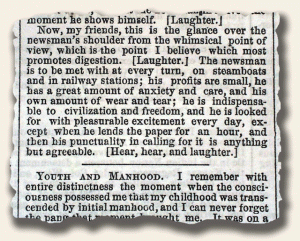 The Boston Evening Transcript of July 21, 1862, has a front page article “Charles Dickens on Newspapers”, a speech he delivered in London at the Newsvenders’ Benevolent Institution. The lengthy speech takes two-thirds of a column and is filled with witty comments, and ends with: “…The newsman is to be meet with at every turn, on steamboats and in railway stations; his profits are small…he is indispensable to civilzation and freedom, and he is looked for with peasurable excitement every day…”.
Census with a bit of flair…
May 23, 2009 by TimHughes · Leave a Comment
“The Alaska Times” newspaper from Seattle, W.T. (Washington Territory), May 14, 1871, contains a very colorful front page article with a simple heading: “Alaska” which reports a census for Sitka. Enjoy reading how the inhabitants were categorized.

Twelve issues, twelves different cities…
April 23, 2009 by TimHughes · Leave a Comment
Occasionally one finds a single title which had two or maybe three cities of publication, particularly some of the Old West titles which moved from place to place during their early years. Even the venerable Gazette of the United States moved from New York to Philadelphia when the seat of government moved, in order to be close to the political action it was reporting.
 The Trans-Continental had a different take on printing in different cities. It’s creation was a stroke of historical genius in the mind of its editor, W. R. Steele, when on May 24, 1870 over 130 passengers boarded a beautiful eight car Pullman train built under special orders of George M. Pullman specifically for this trip, the first chartered excursion by rail from the Atlantic to the Pacific. On board was carried small printing press which was used to publish 12 issues of the “Trans-Continental” newspaper, each at a different point along the round-trip journey. By what is read in these twelve issues it was a glorious affair enjoyed by all, amid the splendor of the finest mode of living ever constructed on wheels.
For their enjoyment, the passengers were lavished with the finest food, surrounded by a setting which few of the finest mansions constructed could rival. Sights of the new West as well as extraneous news & anecdotes of the day were recorded in the pages of this newspaper, witnessed by the passengers continually in awe of the splendor of the prairies, magnificence of the Rockies and the warmth & hospitality of the people they met along the way.
The Trans-Continental lasted but 42 days and twelve issues–six printed on the westward journey & six printed on the return to the east coast. What is unique is that each issue not only carries a different date but a different city of publication.
Unfortunately for the collector exceedingly few genuine issues of the Trans-Continental remain. Having a complete set in our private collection we had each issue professionally reproduced and bound into a SINGLE BOOKLET so any collector can read from one of the more intriguing & unusual newspapers of the 19th century.
You may never own an original but you can take some vicarious enjoyment in the trip by reading what those 130 passengers enjoyed nearly 140 years ago by clicking on the “single booklet” link above. After all, isn’t this what brought is all to the hobby in the first place?
Don’t tell the Chamber of Commerce…
April 4, 2009 by TimHughes · Leave a Comment
 A brief piece in the “Niles’ National Register” newspaper of Baltimore, January 14, 1843, obviously came from a disgruntled visitor to the West:
“Capt. Kendall, in describing Santa Fe, says it is a little mud-built city, that stands between civilization and the jumping off place.”
If you’ve visited Sante Fe, New Mexico recently, you can certainly attest to the significant improvements which have been made since 1843.