

Search
The Rare & Early Newspapers Hobby

Receive the Newsletter

Buy Historic Newspapers

The Civil War in newspapers…
April 29, 2013 by TimHughes · 1 Comment
Could there be a period in American history which fascinates and intrigues more than the Civil War? As we celebrate the 150th anniversary of the battle between the North and the South, collecting interest in genuine newspapers which reported the news as it was happening, remains strong among the relatively small number of rare newspaper collectors. Any visit to a Civil War collector’s show will give evidence to the high prices of genuine memorabilia, from guns to uniforms to every bit and scrap of war-related material a collector might desire. But newspapers remain a very welcomed low-priced option, perhaps largely because they have yet to be discovered by majority of Civil War collectors.
But that has always been the case with this hobby, regardless of the time period. Rare newspaper have always remained relatively unknown in the world of historical collectables—a reality which continues to amaze—but its consequence has provided one of the benefits of those who enjoy the hobby: low prices. Across the entire spectrum of collectables, be they coins, stamps, furniture, books, autographs, toys—you name it–items of comparable age to newspapers are much higher than newspapers.
And what a world is available to the Civil War collector who discovers rare newspapers. You name the battle or political event that happened from 1861 to 1865 and it will be found in a newspaper of the day. And this hobby allows a collection to showcase not just the events of the war but the lead-up to the conflict between the states, as the issue of slavery and the troubling relationship between the Northern and Southern states making news for more than a decade before the outbreak of war.
From the Battle of Fort Sumter to the assassination of Abraham Lincoln, a collector can create a notable collection of newspapers as large or small as their budget will allow. Some might focus on the top ten most significant battles of the Civil War (see previous post) and include newspapers with accounts of Fort Sumter, First and Second Bull Run (Manassas), Hampton Roads (the Monitor vs. the Merrimac), Shiloh (Pittsburg Landing), capture of New Orleans, Antietam, Gettysburg, Vicksburg, Chickamauga, fall of Atlanta, Savannah and Richmond as well as the surrender of General Lee to U.S. Grant. Wikipedia offers an excellent and very inclusive list of all the battles of the Civil War which can be used as a checklist for the collector seeking the most notable events of the war.
Typically daily newspapers have war reports on the front page with additional news on inside pages as well, and a select few included graphics. The “New York Times”, “New York Tribune” “New York Herald” and the “Philadelphia Inquirer” are—in my opinion—the “big 4” titles of the war, as they more than most printed Civil War maps and other war-related graphics on their front pages. Such issues remain favorites for framing and display.
Not to be overlooked are the political events and speeches which were perhaps more significant than the battles, including the election and inauguration of Abraham Lincoln, the Emancipation Proclamation and the Gettysburg Address. All events appeared in newspapers within a day of their happening.
Yet another area of focus for various collectors is the gathering of contemporary reports surrounding certain historic figures such as Abraham Lincoln, Robert E. Lee, Ulysses S. Grant, “Stonewall” Jackson, George Meade, James Longstreet, William Sherman, Jefferson Davis, Ambrose Burnside, Nathan B. Forrest, Colonel Robert Shaw, John Hunt Morgan (and his raiders), to name a few. Textbooks simply cannot capture the essence of these noteworthy individuals in the same way newspapers can.
Some collectors might focus on the Civil War from the Confederate perspective as newspapers from the Southern state are available, albeit more rare, and offer an interesting perspective on the events of the war. Issues from Richmond, the capital of the Confederacy, offer some of the best coverage of the war as all news eventually found its way to Richmond. And the editorials offer fascinating reading in the “Daily Richmond Examiner” or the “Daily Dispatch”. Charleston newspapers also offer great coverage, after all the war began in its harbor. The “Charleston Daily Courier” was one of the best, and one of but a few Southern newspapers which printed in the masthead “Confederate States of America”. Venturing beyond the more “common” of the Confederate titles, newspapers from other states are available, a few of the more accessible being the “Daily Progress” (from Raleigh) and the “Louisville Daily Courier” from Kentucky. The “Daily Memphis Appeal” is an intriguing title, as during its Civil War history it was chased by the Yankees out of Memphis and published in 8 other Confederate cities before succumbing in the final weeks of the Civil War.
A “Confederate” newspaper from the North might seem like a oxymoron, but “The Crisis” from Columbus, Ohio, was an intriguing newspaper by a copperhead publisher who was very much opposed to the Lincoln administration and strongly supported the Confederate effort believing that slavery could not be prohibited by law.
One cannot mention newspapers of the Civil War without discussing “Harper’s Weekly”, the illustrated newspaper which put all the action, drama and cruelty of war into the homes of every American. For the first time, citizens were able to see what their leaders looked like, as an abundance of portraits of the Civil War officers appeared throughout the war years, not to mention the great wealth of battle scenes and city views not found elsewhere during the Civil War. Not to be outdone by the Yankees, the Confederates created their own version of “Harper’s Weekly”, titled the “Southern Illustrated News” published in Richmond, but it was a poor imitation at best. It’s lack of success resulted in a considerably smaller circulation and obviously more rare title for collectors today.
Whatever your interest in the Civil War, collectible newspapers have much to offer. With prices relatively low for 150 year old items and containing virtually every event which happened during that fascinating era, a notable collection can be amassed which can be enjoyed and admired without breaking the bank. A fascinating world awaits those who discover this interesting collectible.
Recent Find: Free African-American woman writes story re: freed slaves in 1864… with Candice Glover connection…
April 16, 2013 by GuyHeilenman · Leave a Comment
Candice Glover, from American Idol fame, was born and raised in St. Helena (South Sea Islands) in South Carolina – Charlotte Forten, a free African-American woman traveled to the island to join the effort to teach the newly emancipated slaves how to become self-sufficient. She wrote of her experiences and had her work published in the Atlantic Monthly in 1864 (2 Issues). Quite historic! It is always fun to explore the present (Candice Glover) is light of the past (Charlotte Forten… and the emancipated slaves). I wonder how deep Candice Glover’s island roots go?
Enjoy much of the text at: St Helena Candice Glover Historic Home Island SC Freed Slaves 1864 2 Issues | eBay.
The Traveler… Conferedate president issues a proclamation… new establishments……
March 4, 2013 by The Traveler · Leave a Comment
 Today I decided to travel back to the era of the Civil War through The New York Times of March 4, 1863. In this issue I found the Southern President Jeff Davis had appointed March 27th to be a Day of Fasting and Prayer. “…Under these circumstances it is my privilege to invite you once more to meet together and prostrate yourselves in humble supplication to Him who has been our constant and never-failing support in the past, and to whose protection and guidance we trust for the future. To this end I, Jefferson Davis, President of the Confederate States of America, do issue this, my proclamation, setting apart Friday, the 27th day of March, as a day of fasting, humiliation and prayer…” This is also signed in type: JEFFERSON DAVIS.
Also under the “Important from Washington” are the new establishments of “The New Banking Law”; “Designs for Currency Notes” due to the recent passing of the National Currency Act; “A Branch Mint in Nevada”; as well as the establishing of “The Territory of Idahoe (Idaho)” from within the territory of Montano (Montana). “Slavery is forever prohibited within the limits of the new Territory”.
What an incredible time in history!
~The Traveler
Thomas Nast in Harper’s Weekly…
March 1, 2013 by TimHughes · 2 Comments
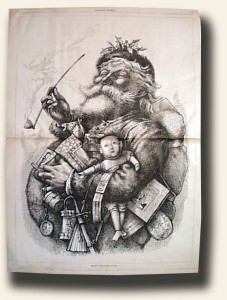 Thomas Nast ranks as one of the most successful, powerful, and prolific artists of the 19th century, and is a name linked closely to one of the most successful, powerful, and prolific newspapers of the 19th century. Through their successes, both Nast and Harper’s Weekly gained sufficient power to influence American politics in the second half of the 19th century and help shape the political climate of America during the industrial revolution.
Thomas Nast was German born, moving to America in 1846. Skilled as an artist, he first went to work for Frank Leslie’s Illustrated Newspaper in 1859, but within 3 years he began working for its competitor, Harper’s Weekly. His work continued to appear in Harper’s thru 1886.
It was a symbiotic relationship for the two. Circulation of Harper’s Weekly grew as Nast drawings were found in more and more of its pages, and Nast‘s notoriety and popularity grew in large part to the increased circulation of Harper’s Weekly. Nast‘s powerful pen in support of the prosecution of the Civil War was honored by President Lincoln when he called Nast “our best recruiting sergeant”.
With original artwork by Thomas Nast commanding prices far beyond the pocketbooks of most collectors, prints found in Harper’s–and only in Harper’s–remain a popular way to assemble a collection of this famed artist’s work at relatively low prices given the current availability of genuine issues.
For today’s collector, interest in Nast falls into three categories:
1) His portrayal of battles & events of the Civil War, which often featured human interest themes & the effect of the war on those back home, remain as some of the best and most heart-felt scenes of the Civil War. Daily newspapers only provided written text; Harper’s Weekly and the prints of Thomas Nast provided a visual representation of the reality of war.
2) Perhaps most noticed as a political cartoonist, his work did much to expose the graft and corruption of William “Boss” Tweed, the powerful Tammany Hall political machine of New York City. In fact it was a Nast cartoon which caused Tweed to be arrested following his escape from jail and flight to Spain. A customs official recognized him from his many appearances in “Harper’s Weekly”. Nast has been credited with doing much to cause elections of all in the hands of those he supported (Grant’s two Presidencies), and cause to fail those he disliked.
 It was Nast who created the caricatures of the Democratic donkey and the Republican elephant to represent those parties, political icons which remain to this day. Desired among collectors are the first donkey to appear in the pages of Harper’s Weekly (January 15, 1870) and the first elephant to appear (November 7, 1874), as well as the first time they appeared together (December 27, 1879). All three command premium prices due to their desirability, but collectors are encouraged by the inexpensive prices for other genuine issues of Harper’s which include Nast illustrations of both.
3) Santa Claus prints. It is Thomas Nast who is credited with creating the modern version of Santa Claus, the jolly, rosy-cheeked, rotund purveyor of gifts in the uniform as we know him today. Nast’s first Santa Claus to appear in Harper’s Weekly was titled “Santa Claus in Camp” from during the Civil War, appearing on the front page of the January 3, 1863 issue. Yet it is the January 1, 1881 issue which has the Santa Claus centerfold which still appears in many Christmas advertisements and is perhaps his most famous rendition. There are many issues of Harper’s Weekly which have Santa Claus prints, all very desired among collectors.
True to any symbiotic relationship, with Nast leaving Harper’s Weekly at the end of 1886, he lost his forum to reach the masses, and in losing Nast, Harper’s Weekly lost its political importance. Nast continued his work in other publications, none being very successful, until his death in 1902 to yellow fever. Harper’s Weekly never regained its success from the Nast years, and it ultimately ceased publication in 1916.
Harper’s Weekly issues with Nast prints are very displayable, particularly those which feature Nast images on the front page, or notable icons such as popular politicians, Santa Claus, Uncle Sam and Abraham Lincoln. A very famous Nast cartoon featuring Lincoln is the “Long Abraham Lincoln A Little Longer” cartoon which is in the November 26, 1864 issue, signifying his successful second Presidential election.
All issues offered by Hughes Rare & Early Newspapers are genuine & complete in 16 pages, save for a few described otherwise. In many cases two or three Nast prints appear in one issue.
Black History Month… looking back…
February 22, 2013 by GuyHeilenman · Leave a Comment
 Slavery. The word itself stirs intense emotions for nearly all who hear it… even for those who have not been directly confronted with the institution. For some it brings feelings of guilt… “How could my forefathers have engaged in such activity?” For others it brings feelings of oppression… anger… and more. While many people groups have been subjected to this burdensome yoke of man through time, for Americans, none is quite as impacting as the enslavement of African Americans. In honor of Black History Month, Timothy Hughes Rare & Early Newspapers has created a Pinterest Board which takes a look back at a time in U.S. history when slavery was alive and (not so) well:
Pinterest… Slave Ads & Related Woodcuts Prints
Additionally, we’ve arranged our available authentic newspapers related to Black Americana in chronological order (recent first) to provide a snapshot into the past for those interest in reviewing how slavery in general, and Black History more specifically, has been depicted in newspapers over the past few centuries. They may be viewed at:
African-American / Black Americana / Slavery…
Pictures… Is a thousand words always enough?
January 27, 2013 by GuyHeilenman · Leave a Comment
 The New York Times of October 20, 1862 includes a wonderful article which eloquently combats any romanticized view of the Civil War. Sometimes, far from the realities of the slaughter (in time and distance), we fail to properly connect with the tragedy and horror experienced by so many. The article includes, in part, “There is one side of the picture that the sun did not catch, one phase that has escaped photographic skill it is the background of widows and orphans, torn from the bosom of their natural protectors by the red remorseless hand of Battle, and thrown upon the brotherhood of God. Homes have been made desolate, and the light of life in thousands of hearts has been quenched forever. All of this desolation imagination must paint — broken hearts cannot be photographed.” Rather than say more, we’ll let the article speak for itself. The actual original article itself may be viewed in full at:
Brady’s Photographs; Pictures of the Dead at Antietam
The Traveler… The Emancipation… the last look… and today…
January 21, 2013 by The Traveler · Leave a Comment
 This week I traveled 150 years back in time and through the activities of the Civil War via the Harper’s Weekly dated January 24, 1863. This issue contains a double-page illustration by Thomas Nast entitled “The Emancipation of the Negroes, January, 1863 – The Past and The Future.” Mr. Nast shows their present life in the center circle, of a happy home including a picture of President Lincoln hanging on the wall. The illustrations to the left show obstacles they had to endure — being sold at auctions and separated from loved ones, beatings, and being chased (if running away). The illustrations to the right show what they are looking to in the future with the implementation of the Emancipation Proclamation — owning a home, children going to public school, being treated fairly by the employer and being paid for working.
This illustration has an accompanying article that describes the illustration and also includes text from the Tribune of March 11, 1859, which dealt with the largest single sale of humans (slaves) in the United States. Mr. Pierce M. Butler of a city near Savannah, Georgia, sold 486 slaves — men, women and children — to pay his debts. This gives a prospective of what the slaves had to endure as they were being separated from each other as family members and long term friends.
As a contrast , this issue also presents a look into the past with an illustration and small article, “A Slave-Pen at New Orleans – Before the Auction. A Sketch of the Past.”
Today we also celebrate Martin Luther King, Jr. day. Let us all remember his famous words… “Free at last. Free at last. Thank God Almighty we are free at last.“
~The Traveler
The Assassination of Abraham Lincoln… one the the very best…
January 18, 2013 by GuyHeilenman · Leave a Comment
The April 22, 1865 issue of the National Police Gazette, New York, printed what many consider to be the best illustrated newspaper related to the assassination of President Abraham Lincoln. Judge for yourself. Regardless of your final analysis, please enjoy the images from this incredible authentic newspaper compliments of Timothy Hughes Rare & Early Newspapers… History’s Newsstand… via Pinterest:
Ben Edwards… Walking Boston…
November 30, 2012 by GuyHeilenman · Leave a Comment
 Ben Edwards, a highly sought after tour guide on Boston’s Freedom Trail, discusses how he uses authentic newspapers on his tours to bring history to life. Please enjoy his story at: Touch Authentic History – Real Colonial Newspapers Shared On Tour!
When Ben is not leading tour groups he spends quite a bit of time writing. Some of his recent efforts include his children’s book, “One April In Boston“, the Teach History blog, and additional efforts, one of which includes a few interesting tidbits regarding Abraham Lincoln: Abraham Lincoln and his Ancestors. We appreciate all of Ben’s efforts to foster a love of history in others and his ongoing use of historic newspapers to bring history to life.
Details of a slave auction…
November 26, 2012 by TimHughes · Leave a Comment
Mentions in pre-Civil War newspapers of slave auctions are not uncommon, and those which mention prices fetched for various slaves are somewhat more rare. But it is very difficult to find period articles which offers detail as to how an auction is conducted, how the slaves are examined, and comments on the slaves’ reaction to their sale.
The “New York Tribune” issue of April 28, 1860 includes an article titled: “The Negro Market In Savannah” which has such detail. It offers an interesting perspective on this institution which seems so barbaric today, but which was an accepted part of business in the pre-war South. A snippet of the text is found below, with the text in it’s entirety, along with a report of a fugitive slave case, is found at: “The Negro Market In Savannah“.