
Search
The Rare & Early Newspapers Hobby

Receive the Newsletter

Buy Historic Newspapers

A gem from the American Antiquarian Society… The Kentucky Spy…
August 8, 2016 by TimHughes · Leave a Comment
In celebration of its 20oth anniversary the American Antiquarian Society published a beautiful exhibition catalog titled “In Pursuit Of A Vision – Two Centuries of Collecting at the American Antiquarian Society”. Featured are a fascinating array of books, documents, maps & other paper ephemera, as well as several very rare & unusual newspapers we felt worthy of sharing with our collectors (with permission from the A.A.S.).
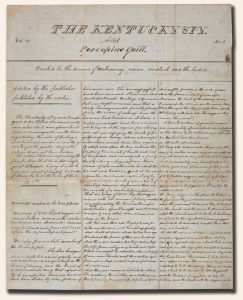 181. “The Kentucky Spy and Porcupine Quill“, Frankfort, Kentucky, January 25, 1849
In recent years AAS has actively collected issues of pre-1877 American manuscript periodicals. These handwritten examples mimic printed periodicals in format and content, containing stories, news, and advertisements. Sometimes they were produced by individuals, serving as the manuscript equivalent of amateur newspapers, and sometimes they were issued by small groups. Others were produced as an activity of a school or lyceum.
AAS has held manuscript periodicals since the nineteenth century; but because these were long shelved alongside printed periodicals, they were easily overlooked. In the 1990s AAS staff began to pull them together into a separate collection, in the process discovering not only how many titles were already at AAS, but also the frequency with which they were produced. As it became apparent that the more specimens AAS had, the more they collectively revealed about early American scribal culture, AAS began to seek them actively. The collection now numbers more than sixty titles.
One of the more unusual is “The Kentucky Spy and Porcupine Quill.” The masthead claims that it is “Devoted to the science of matrimony, union, wedlock and the ladies.” However, the chief story, entitled “Wonderful rumpus in the town of Irvine,” is a fictional account, humorous in tone, of a revolt by 5,000 heavily armed slaves which in the story turns out to be a hoax. The editor and contributor(s) are unnamed.
An August, 2016 stroll back thru time – 50, 100, 150, 200, & 250 years ago…
August 4, 2016 by GuyHeilenman · Leave a Comment
 What news was reported in the month of August – 50, 100, 150, 200, and 250 years ago (1966, 1916, 1866, 1816, 1766)? Such a walk back through time via the eyes of those who read the daily and weekly newspapers of the period can be quite revealing. This is why we often say, “History is never more fascinating than when it’s read from the day it was first reported.” The following links will take you back in time to show the available newspapers from the Rare & Early newspapers website. There’s no need to buy a thing. Simply enjoy the stroll.
The Holocaust… Truth be told…
July 28, 2016 by GuyHeilenman · Leave a Comment
TRUE: The Nazis inflicted unspeakable atrocities on millions upon millions of people.
TRUE: Most of the world was shocked as details of the horrors were revealed after the war.
FALSE: The Nazis’ agenda was a deep-kept secret.
FALSE: Remaining silent and/or turning a blind eye to evil makes it go away.
How could the Hitler-orchestrated holocaust have happened without the world’s knowledge? Since the end of WWII many have distanced themselves from complicity due to inaction. Nations and individuals both often declare they had no idea such atrocities were taking place – stating evidence of Adolph Hitler’s extreme intentions were kept under wraps. However, truth be told, the entire world was not unaware of Hitler’s desire and willingness to do whatever it took to create a so-called “pure” race. Articles regarding his agenda reached American newspapers as far back as the early 1930’s.  This point was recently brought to our attention as we were perusing the New York Times for December 8, 1931. There we found a front page report with the two-column heading: “Nazis’ Would Assure Nordic Dominance, Sterilize Some Races, Ban Miscegenation”, with considerable details to follow. Perhaps the world didn’t realize the extent of the horrors that were occurring, but this article, as well as a score of others, certainly should not have gone unnoticed.
This certainly begs the question: “Are similar atrocities happening today? Are other mass-forms of oppression, brutality, or worse taking place within our reach? We can look away, but a verse from the Bible reminds us: “Remember, it is sin to know what you ought to do and then not do it (James 4:17).” We may put our head in the sand, but we are not without excuse. Hopefully the truth regarding our past mistakes will spur us to proper action today.
A curious find that lead to more than expected…
July 25, 2016 by TimHughes · Leave a Comment
Although not a poetry aficionado, I am aware that “Leaves Of Grass” by Walt Whitman is considered a seminal work in 19th century literature. So when I stumbled across a small article on page 7 of a New York Tribune issue dated Oct. 10, 1855 I took a moment to read it. Most of the report is taken up with a letter signed in type: R. W. Emerson, so my interest was piqued.
After a number of Google searches I discovered this report to be much more significant that I might have thought.
Although considered highly controversial during his era, “Leaves of Grass” has infiltrated popular culture & been recognized as one of the central works of American poetry. As such, the article is interesting, mentioning in part: “…call the attention of our readers to this original & striking collection of poems, by Mr. Whitman…could not avoid noticing certain faults which seemed to us to be prominent in the work. The following opinion, from a distinguished source, views the matter from a more positive and less critical stand-point:…” and what follows is the famous letter by Ralph Waldo Emerson–who inspired this work by Whitman–in which he comments: “…I find it the most extraordinary piece of wit and wisdom America has yet contributed…I am very happy in reading it, as great power makes us happy…” and even more, signed in type: R. W. Emerson. This original letter is in the Library of Congress.
This letter’s appearance in the Tribune would seem to be the only newspaper printing of the time, as records indicate that the: “…letter to Whitman from Ralph Waldo Emerson, 21 July, 1855 is among the most famous letters ever written to an aspiring writer…Without asking Emerson’s permission, Whitman gave this private letter to Charles Dana [managing editor of the New York Tribune] for publication in the New York Tribune on October, 1855.” (see this hyperlink).
The put it in print… Killing them with kindness?
July 11, 2016 by TimHughes · Leave a Comment
The August 15, 1945 “Evening Standard” newspaper from London, on the day they reported the surrender of Japan to end World War II, included an extract from a Reuter’s message quoting Admiral Halsey on the end of the war: “…Looks like the war is over. Cease firing, but if you see any enemy planes in the air shoot them down in a friendly fashion.”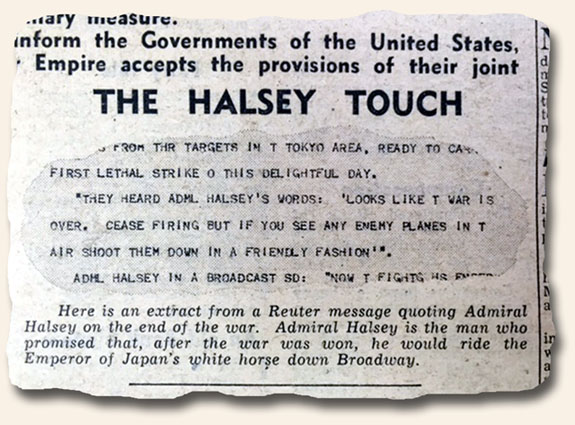
Chuckle for the day…
June 9, 2016 by TimHughes · Leave a Comment
The “Pennsylvania Packet“, Philadelphia, issue of September 24, 1788 contains on page 3: “Dean Swift’s idea of an attorney…”. You can read it for yourself (see below).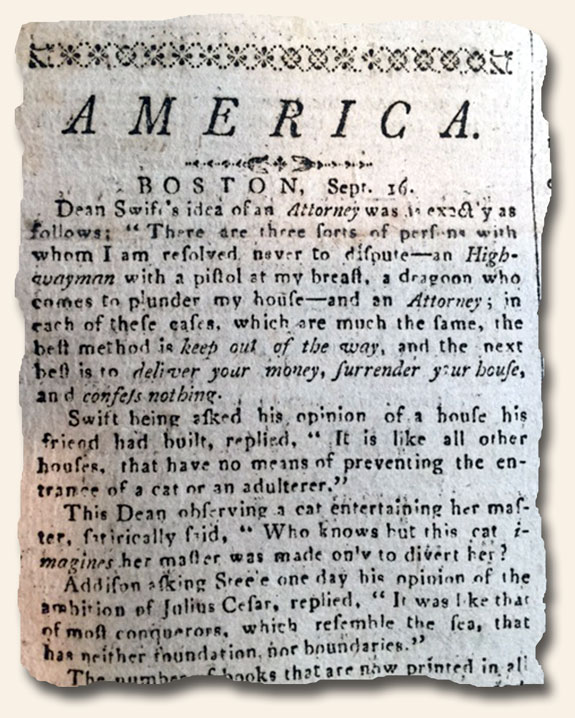
A June, 2016 stroll back thru time – 50, 100, 150, 200, & 250 years ago…
June 2, 2016 by GuyHeilenman · Leave a Comment
 What news was reported in the month of June – 50, 100, 150, 200, and 250 years ago (1966, 1916, 1866, 1816, 1766)? Such a walk back through time via the eyes of those who read the daily and weekly newspapers of the period can be quite revealing. This is why we often say, “History is never more fascinating than when it’s read from the day it was first reported.” The following links will take you back in time to show the available newspapers from the Rare & Early newspapers website. There’s no need to buy a thing. Simply enjoy the stroll.
The Louisiana Purchase is useless to the United States…
May 23, 2016 by TimHughes · Leave a Comment
 It is always interesting to read criticisms of political decisions of centuries ago with the luxury of hindsight. Early newspapers allow today’s reader to recognize just how much thought was not just wrong, but laughably wrong.
One example is in the August 6, 1803 issue of the “Columbian Centinel” which contains a letter complaining about Presidents increasing the national debt: “…those very papers are now extolling the wisdom of Mr. Jefferson in adding eleven millions of dollars to the funded debt of the United States. Great clamour was raised against the administration of Mr. Adams because he did not effect a greater reduction of the national debt…Now in a time of profound tranquility the national debt is to be increased fifteen millions of dollars in one year, for the purchase of a country most of which is uninhabited and totally useless to the United States.”
From that purchase in 1803 would be carved fifteen future states as well as two Canadian provinces. Its value to the United States would be incalculable today, and in fact was considered an incredible bargain many years before the Civil War.
Obtaining the Value of a Newspaper or Collection…
May 12, 2016 by GuyHeilenman · Leave a Comment
We do not monitor requests concerning the value of newspapers through this venue – but we would be glad to assist. If you have a newspaper or a collection for which you are seeking an appraisal, please contact us directly at info@rarenewspapers.com. Please include as many details as possible. Thanks.
Presumed guilty… Lizzie given the ax by some before the end of the trial…
April 25, 2016 by TimHughes · Leave a Comment
 It can be interesting to read headlines in newspapers of past centuries and note quickly how politically incorrect publishers were, and how there was little concern to presume a defendant guilty in the press before a trial even began.
The renowned case of Lizzie Borden, accused of murdering her parents, found coverage in “The Memphis Appeal-Avalanche” issue of August 30, 1892. Even during the inquest the newspaper was quick to include column heads, almost poetically presented: “About Miss Lizzie Borden” “Nearer and Nearer Looms the Gallows-Tree Before Her” “Clearer and Clearer It Appears She’s a Murderess” and more (see). In today’s world publishers are quick to use words such as “alleged”, or “accused of” which make no inference of guilt of innocence. Not so in the 19th century.