
Search
The Rare & Early Newspapers Hobby

Receive the Newsletter

Buy Historic Newspapers

19th century Harper’s Weekly reviewed…
December 11, 2017 by GuyHeilenman · 2 Comments
Over the years we have made several mentions of Harper’s Weekly, one of the most beloved illustrated newspapers of the 19th century. This title is also one of the most sought-after collectibles through our website,
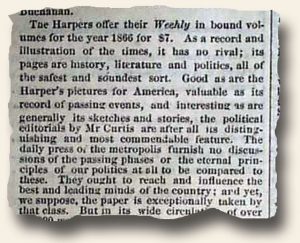
RareNewspapers.com. Although I’m sure many others exist, I was pleasantly surprised to find a contemporary review of this publication on the front page of the Springfield Republican dated February 13, 1867. Even more pleasing was my discovery that, unlike It’s a Wonderful Life, the works of Vincent Van Gogh, and Thoreau’s Walden, along with a host of other now-popular people, songs, products, books, etc., which initially found it difficult to gain traction, at least in one journalist’s opinion was seen as an unrivaled, gem of a publication. Their review stated, in part:
“The Harpers offer their Weekly in bound volumes for the year 1866 for $7. As a record and illustration of the times, it has no rival; its pages are history, literature and politics, all of the safest and soundest sort. Good as are the Harper’s pictures for America, valuable as its record of passing events, and interesting as are generally its sketches and stories…” (view entire article).
The link RareNewspapers.com will take you to our website where nearly every Harper’s Weekly has been photographed and described for your reading and viewing pleasure. Please enjoy.
Headlines of History… The St. Louis Mercantile Library…
November 13, 2017 by GuyHeilenman · Leave a Comment
If you are in the St. Louis area in the near future, you may want to stop by the St. Louis Mercantile Library to view their new exhibit: “Headlines of History: Historic Newspapers of St. Louis and the World Through the Centuries at the St. Louis Mercantile Library Association.” A few related links are as follows:

Posted Interview Regarding the Exhibit
Political bias no stranger to today’s newspapers…
October 23, 2017 by TimHughes · Leave a Comment
It seems the polarizing of day’s media is greater than ever, but it is certainly nothing new under the sun. Practically since the creation of the first newspaper political opinion was a focus the publisher, supporting or opposing the efforts of those in power. And as popular as we view Abraham Lincoln today (he consistently ranks among the top three in scholarly polls) he was not liked by all during his time in office.
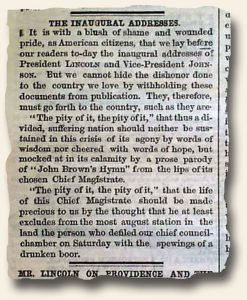 “The World” newspaper from New York City was the leading democratic organ at the time, while Lincoln was a Republican. In their issue of March 6, 1865 which reported his inauguration & inaugural address the editorial page contained at least two biting commentaries. One includes in part: “It is with a blush of shame and wounded price, as American citizens, that we lay before our readers to-day the inaugural address of President Lincoln…But we cannot hide the dishonor done to the country we love by withholding these documents from publication…The pity of it…that the life of this Chief Magistrate should be made precious to us by the thought that he at least excludes from the most august station in the land the person who defiled our chief council chamber on Saturday with the spewings of a drunken boor…”.
The other can be seen in the photos.
“Texas Made A Nation” was the result of Operation Longhorn…
August 17, 2017 by TimHughes · Leave a Comment
 Occasionally an “odd-ball” newspaper comes into our inventory, and our “Lampasas Dispatch” is certainly one. With a dateline of “Juvember 33, 1969” (not a typo on our part) and a banner headline announcing: “TEXAS MADE A NATION” we knew this wasn’t a legitimate newspaper. The masthead also includes: “For Maneuver Purposes Only—This Publication Created for Operation Long Horn–Not Intended For General Distribution.” So with a bit of searching on the web we soon learned of the story behind this newspaper.
See this website for much more on “Operation Longhorn“. The site begins: “In the spring of 1952, as Cold War tensions heightened, Lampasas Countians’ worst fears seemingly materialized, as “enemy troops” stormed the area, “captured” Lampasas and declared martial law. The U.S. military simulation, dubbed “Operation Longhorn,” was just a test…One of the largest peacetime military exercises ever implemented in the United States, Operation Longhorn took place in March and April 1952, and cost an estimated $3.3 million“.
This is just a single sheet with the reverse being page 8 of the “Lampasas Dispatch” April 3, 1952, coinciding with the date of Operation Longhorn. A fascinating fictitious newspaper from a long-forgotten event in American history.
They put it in print… aerial garage?
August 10, 2017 by TimHughes · Leave a Comment
Articles of the past century can bring up interesting changes in what words were used for various items, places, or events. An article on the Wright brothers from 1908 (The Omaha Daily Bee, Sept. 9, 1908) mentioned a curious term for what we commonly call a “hangar”, where airplanes are stored. The article reads in part: “…and on another trip flew over the ‘aerial garage’ where the aeroplane is housed…”. The quotation marks for “aerial garage” were the writer’s addition, as if the person did not know what else to call it, or perhaps the term “hangar” had yet to be commonly used. But “aerial garage would seem to be a more logical term! Wonder why it never caught on?
The photo below shows the full text of the article.
Fake Lincoln Proclamation… An attempt to profit in the gold market…
July 24, 2017 by TimHughes · Leave a Comment
The “Boston Daily Courier” of May 19, 1864, contains a fascinating sidebar in American history, the printing of a “fake” Lincoln Proclamation which appeared in two New York newspapers but was ultimately determined to be bogus. The “proclamation” is prefaced with a cautioning statement: “The document which made its appearance yesterday, purporting to be a proclamation of President Lincoln, is copied for the information of our readers:”, then the full text (see below).
This was a scheme by Joseph Howard, a newspaper journalist and a bit of a prankster throughout his career. Howard and an acquaintance had hoped to make a profit on declining gold prices if news from the front was bad. They acquired the stationery and other items necessary to make it look as if a story had come in on the wires to the headquarters of the Associated Press of New York, the clearing house for official wire stories coming from Washington. They forged the Proclamation from the president, which called for the drafting of an additional 400,000 soldiers, obvious evidence the war wasn’t going well. It was delivered to the offices of various New Your newspapers. Only two actually published the story but it caused such that Howard was arrested two days after the story appeared and placed in Prison. He was released on Lincoln’s personal order on August 24, 1864.
Are Presidential proclamations for thanksgiving and prayer unconstitutional?
June 26, 2017 by GuyHeilenman · 2 Comments
Over the years we have written multiple posts featuring noteworthy Presidential proclamations for days of thanksgiving, humiliation, and prayer, and have listed quite a few on the Rare & Early Newspapers website. Not too long ago we came across an issue of The Boston Investigator for November 10, 1880 which contained an article focused on a view that such proclamations are/were unconstitutional. So, although we passionately disagree with this opinion, in an effort to be fair and balanced, we present the article below. Feel free to respond with your thoughts.
It’s amazing what one often finds buried in old newspapers…
June 22, 2017 by GuyHeilenman · Leave a Comment
 Flowers, leaves, photos, clumps of hair, historic trinkets… The list of what might be found buried within and among the inside pages of historic newspapers continues to foster our love for the collectible. The latest discovery? As we were scanning a September 22, 1880 issue of The Boston Investigator hoping to find a mention of Thomas Edison (which turned out to be successful), we noticed an article titled: “Strange Tribe Of Jews Discovered In The Caucasus”, which turned out to be quite interesting:
Death of Button Gwinnett: rare find in an American newspaper…
June 8, 2017 by TimHughes · Leave a Comment
The name “Button Gwinnett” is one most have never heard, yet his signature remains perhaps the most rare and valuable of all Declaration of Independence signers.
 Why? He was a relatively obscure figure prior to the war, and he died less than a year after signing the Declaration. Those who like to assemble a complete set of signatures of the 56 signers of the Declaration of Independence need his signature, and only ten are known to exist in private hands.
The reason for his early death after the 4th of July is a duel. He had disagreements with a rival military commander, Lachlan McIntosh, concerning a military defeat in Florida. Gwinnett & McIntosh blamed each other for the defeat and McIntosh publicly called Gwinnett “a scoundred and lying rascal.” Gwinnett challenged McIntosh to a duel which was fought on May 16, 1777. They exchanged pistol shots at 12 paces, both wounded, with Gwinnett dying of his wounds 3 days later.
The July 24, 1777 issue of the “Continental Journal” newspaper from Boston provides a very rare report of Gwinnett’s death by duel. This is the first we have encountered in an American newspaper.
Great to find an obscure report about an equally obscure but notable name from the Revolutionary War era.
Glorious or sad/bad timing? The death of William Wilberforce… Slavery abolished…
May 25, 2017 by GuyHeilenman · Leave a Comment
 The Gentleman’s Magazine of September, 1773 has a 3+ page obituary of the famed British abolitionist, William Wilberforce. If you are not familiar with this early 18th century member of the British Parliament, you may want to settle in with family and friends and watch the acclaimed movie, Amazing Grace. However, as a primer, feel free to read the complete obituary at: William Wilberforce Death Report. Ironically, you’ll need to scroll past much on the India slave trade in order to view the obituary.
Speaking of irony… The date of his death is sandwiched between the Slavery Abolition Act of 1833’s passage in the House of Commons on July 26, 1833 and its Royal Assent a month later (on August 28th). Whereas the entire obituary can be read through the link above, as of the date of this post, it is also available as an eBay auction at: Wilberforce’s Obit (on eBay).