

Search
The Rare & Early Newspapers Hobby

Receive the Newsletter

Buy Historic Newspapers

“Rag paper” allowed newspapers to pass the test of time…
May 10, 2013 by GuyHeilenman · Leave a Comment
One of the biggest surprises–and a pleasant one–novice collectors of newspapers discover is that the oldest newspapers they purchase, those from before 1870, are in much better condition than the more recent “old” newspapers of the late 19th or 20th centuries. How could this be?

Printed on "Rag Paper"
It’s all in the paper. and I literally mean in the paper. Prior to the 1870’s, newsprint was primarily made of cotton & linen fibers. It was handmade and very dependent upon the raw ingredients being available, which was not always the case. It was common to find newspaper advertisements seeking “rags” for the printer, to be used to make the paper upon which the newspaper was printed. Equally as common would be a note from the printer that an issue would have fewer pages or be skipped altogether due to the lack of newsprint. “Rag” paper, as it is called, was not an inexpensive or easily made commodity.
Typically, the older the newspaper, the better the quality. It is not uncommon to find newspapers from the 1680’s which are very white, relatively thick, and extremely pliable. They can be bent, folded, creased, wrinkled and no harm will be done. Do the same to a newspaper of the 1890’s or early 20th century and it will crack and crumble. I recall some years ago a novice customer returning an issue of the London newspaper “The Observator“, 1683, because he claimed “it looked to new to possibly be over 300 years old”. I could not convince him otherwise. Newsprint of 300 years ago simply does not yellow. We occasionally receive similar feedback from similar titles: The Spectator, The Post-Boy, and more. Even a select number of 20th century papers were printed on rag linen as well, typically for use in institutions.
Such handmade paper, particularly that used in the 17th and 18th centuries, can be distinguished from paper made later by holding it up to a light and looking for “chain-lines” which are left from the wires in the paper mold. With this method, fewer fibers accumulate directly on the wire, so the paper is slightly thinner and more transparent to light. This pattern is usually very apparent and appears as lines that run about an inch apart, with several horizontal short lines connecting the long wire lines. Some modern paper has artificially-applied chain lines, and is usually referred to as “laid” paper, which is the name given to handmade chain-line paper.
The handmade chain-line paper made of cotton and linen rags which were soaked in liquid until the fibers broke down into very small bits. Paper was formed by hand by dipping a paper mold into the fiber suspension, and then lifting and shaking off the excess water. The paper sheet was then partially dried before being removed from the mold. Modern handmade paper (used in fine printing of small editions by private presses, as well as in artists books) is basically made by the same process.
The high quality of newsprint was an expensive process & caused newspaper subscriptions to be beyond the means of the average citizen. Consequently holdings of newspapers are relatively small. They were never printed in huge quantities because they cost too much to be widely purchased by the populace. And keep in mind that the percentage of literate people in the 18th and early 19th centuries was not what it is today.
The use of “rag paper” for the publishing of early newspapers is one of the great joys of this hobby. Early newspapers–including issues dating back to the Revolutionary War and beyond–need very little care to maintain their state of preservation. We keep such issues on open shelves where they have been for years to no harm. They can be handled & read from beginning to end without risk of damage or harm. Truly, a collector can hold history in his hands, enhancing the tactile experience this hobby enjoys beyond others where “do not touch” is more the norm.
Another benefit of rag paper is that it allows for easy detection of reprint or facsimile newspapers. A common question crossing our desk is “are you sure it is a genuine newspaper?” or “is my newspaper genuine or not?” When I authenticate newspapers one of the easiest determinants is the quality of paper. If the newsprint is browned or yellowed and fragile to the touch, chances are exceedingly good it is not a pre-1870 newspaper (although there are exceptions). Newspapers from the Revolutionary War should not crack when folded or creased.
The vast majority of reprint or facsimile newspapers on the market were never meant to deceive the collector but rather were anniversary issues, done 50, 100 or 200 years after a significant event, or in celebration of the very first edition of that title. They were often give-aways to subscribers. The “New York Herald” of April 15, 1865 is perhaps the most commonly found reprint newspaper, and most fail the rag paper test; they are much to browned or fragile to have been printed in 1865.
It was the industrial revolution of the latter half of the 19th century which resulted in the technology to create newsprint from wood pulp and chemicals. It was a welcomed innovation for publishers as newsprint become much less expensive to make, but it began the downfall for long-term preservation. But then, newspapers were never intended to last more than a day. Another issue would be on the streets for the consumer the next morning, to the delight of publishers across the country.
Collecting the Revolutionary War on a budget…
March 28, 2013 by TimHughes · 2 Comments
 I would argue that beyond the Civil War, the era of American history which evokes the most interest among our collectors is unquestionably the Revolutionary War. With a cast of characters who still rank among the most memorable in history—Washington, Adams, Hancock, Jefferson, Henry, Franklin, Paine, and more—and a plot, which if it were not true history would serve as an excellent screenplay for an exciting movie—an oppressed, energized people seek to break free from the reigns of oppression and dominance from abroad—it is easy to see how the events of the Revolutionary War continue to intrigue and offer a foundation upon which to reflect as today’s world grapples with many of the same issues despite the 230+ years which distance us from those notable events.
And what could be better than experiencing those events just as those who lived through them? Newspapers offer that opportunity. Genuine issues, once held and read by those who lived through those turbulent days before being relegated to the back shelves of libraries, are now part of the inventory of Hughes Rare & Early Newspapers. And at prices which might surprise many (see Revolutionary War issues for $60 and under), as a hobby which is relatively unknown to the collecting world has yet to cause demand and scarcity to drive prices beyond the means of the average collector. Of course, there are still many that fall into the category of what we refer to as, “The Best of the Best – Revolutionary War Edition“.
Of significance is that British titles, which offer excellent coverage of all American events given their role in attempting to placate the demands of the Americans while maintaining control of their colonies, allow ownership of battle reports of the war for under $100, with  some very notable events in the $200-$300 range. American newspapers remain among the most desired but their scarcity is reflected in their prices. With a collection of the “Pennsylvania Evening Post” which included the Declaration of Independence bringing $600,000 in auction recently, it would amaze many that the same document is available in London’s “Gentleman’s Magazine” issue of August, 1776 (took news 3-4 weeks to traverse the Atlantic) for under $4,000. Other disproportionate prices between British and American newspapers entice many to gravitate to the British titles while prices and availability remain attractive.
The “London Chronicle” is one of the better British titles in reporting the Revolutionary War. From the Battle of Lexington and Concord, to Bunker Hill, Battle of New York, Saratoga, Washington crossing the Delaware, treason of Benedict Arnold, Guilford Court House, to Cornwallis’ surrender at Yorktown, this newspaper offers coverage which equals the American newspaper accounts. In fact many British reports were taken verbatim from American newspapers. Of equal quality in report news of the day was the “Edinburgh Evening Courant” from Scotland as I have found all events of the Revolutionary War to be reported in this title as well. Other UK titles which covered the war include “The Glocester Journal”, “Aris’s Birmingham Gazette”, the “Edinburgh Advertiser” and the “Glasgow Mercury” to name a few.
But perhaps the best and most available title of the Revolutionary War period would be the “Gentleman’s Magazine” from London, it having a long printing history from 1731 to the 20th century so it encompasses not just the Revolutionary War in great detail by the entire scope of American history. As an added treat this title typically included one of more plates within each issue, which included maps as well. And during the years of the Revolutionary War were found many maps of American colonies, battle sites as well as large foldout maps showing the entire scope of the united colonies at that time. The maps alone have found a keen interest among collectors, separate from the issues in which they were stored for over 200 years. As is true with the British titles mentioned, “Gentleman’s” included all notable events and documents, including the Articles of Confederation, the Causes and Necessity For Taking Up Arms, all major battles of the war thru the treaty between Washington and Cornwallis, and even the document by King George III which officially ended the war. And all the major names of the war from both the British and American sides have found their way into the pages of “Gentleman’s Magazine”.
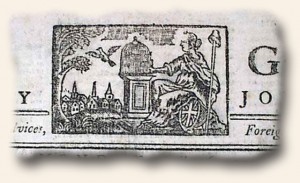
 American titles are available as well. Some of the more rare would be those from the South which are virtually impossible to find, and when they do surface their prices are beyond the means of most collectors. Some of the more commonly found titles would be the “Pennsylvania Evening Post” from Philadelphia, the “Pennsylvania Ledger” “Boston Gazette” (which featured an engraving by Paul Revere in the masthead), “The Pennsylvania Gazette” and “Pennsylvania Packet” among others. And dipping back a few years before the outbreak of the war, when tensions were building with much evidence in the newspapers of the day, the “Pennsylvania Chronicle” and the “Boston Chronicle” offer excellent insight into events of the day from the years 1767-1769 for under $200 for most issues.
Regardless of your interest in the Revolutionary War, whether it be the famous names that came to prominence, the battles of the war, or a focus on a singular event or locality, genuine newspapers of the day are available for the collector. It is a hobby with limitless possibilities, and offers a unique opportunity to literally hold history in your hands.
The 1600’s and 1700’s on a budget…
March 25, 2013 by TimHughes · Leave a Comment
A genuine collectible, over 300 years old, for $60 or less. Is there a field of collecting today which has items of such age– in nice condition–for $60? The hobby of collecting rare & historic newspapers likely sits at the top of what must  be a very short list. And such prices, along with tremendous availability of titles & content, are part of the intrigue of this fascinating hobby which remains unknown to almost everyone. And this, in large part, is the reason prices are outrageously low in comparison to the relative rarity of other collectibles. While issues do run the gamut price-wise from newsbooks (at the upper end) to coffeehouse newspapers (typically at the lower end), it is a fascinating field for the historical hobbyist on a budget ($20 and under).
The ‘London Gazette‘ is the world’s oldest continually published newspaper, having begun in 1665 and is still publishing today. With such historical depth you would expect to find virtually every major event in world history within its pages, and you would be right. The Great Plague and Great London Fire, William Penn being granted land in the New World, the death of noted pirate Captain Kidd, the battles of the French & Indian War and Revolutionary War and so much more are found in not only this title but other newspapers of the era. First reports of such notable events can sell in the thousands of dollars, but an interesting facet of this hobby is that follow-up reports of a few days later can fall well within the comfort level of the average collector.
Both age and graphic appeal come together in the London ‘Post-Boy‘ newspaper, with issues from the 1718-1725 period featuring two ornate engravings in the masthead in addition to a very decorative first letter of the text. Add to this the relative small size of this single sheet newspaper and you have a terrific item for display for under $55.
With American newspapers not beginning until the first decade of the 18th century (one title was published in 1690 but lasted just one day), and most American newspapers through the Revolutionary War being very rare, British titles are an excellent source for collecting all the notable events not only in American history, but in world history as well. And the reporting was often extensive, for remember that the colonies were part of Great Britain through 1776.
The ‘London Chronicle’ was a popular British newspaper which documented amongst its pages virtually all American events since its founding during the French & Indian War. Yet another periodical, the ‘Gentleman’s Magazine‘, is an 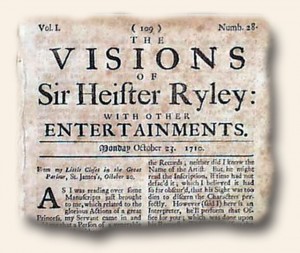 excellent source for period reports of American events since its beginning in 1731, and one of its features was the printing of maps of all corners of the globe, many of which show North America and specific colonies. From James Oglethorpe’s settling the colony of Georgia, to Ben Franklin‘s famous kite experiment, installation of the Liberty Bell, the enactment & repeal of the hated Stamp Act, all events of the Revolutionary War, to the mutiny on the Bounty & so much more, the ‘Gentleman’s Magazine’ offers a terrific repository of American and world history at very affordable prices. Plus, there are reports of Colonel George Washington from 1754 when he was just 22 years old and relatively unknown, and for the music buffs there are works by the composers Hayden, Handel, and death reports of Mozart and Beethoven within its pages. The early battles of Napoleon & other European reports are logically found in this title as well.
While American newspapers of the Revolutionary War and before are generally pricey, ranging in the $400 – $1000+ range, two notable exceptions exist being the ‘Boston Chronicle’ and the ‘Pennsylvania Chronicle’, both from the 1768-1769 years. Because their circulation was widespread they are among the more commonly held colonial titles by institutions, & consequently come on the market when libraries convert from hard copy to microfilm or digital. They detail the entire spectrum of American life from just before the Revolutionary War while providing an interesting perspective on American politics during those critical years. Complete, genuine issues are typically available for under $200.
American newspapers from after the American Revolution become more available and at dramatically lower prices while still containing a wealth of notable content on the founding years of the federal government. The ‘Pennsylvania Packet’ of Philadelphia was one of the more successful titles, and was the very first to print the Constitution of the United States. While that issue, September 19, 1787, ranks well into six figures, 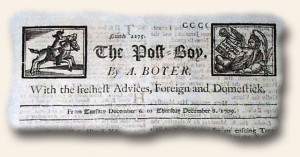 dates surrounding it are typically found in the $45 – $80 range and offer a perspective of life in the city where and when the Constitution was being created. The ‘Columbian Centinel’ from Boston was perhaps the most successful title in 18th century America and its pages document the complete scope of America politics and life from 1785 thru Washington’s election and inauguration to his death just weeks before the end of the century.
Other 18th century American titles which are within the budgets of even the most modest collectors are the ‘Connecticut Courant’, ‘Dunlap’s American Daily Advertiser’, ‘Gazette of the United States’, the ‘Massachusetts Spy’, and ‘The Herald, A Gazette For The Country’ and others. Nice issues from the formative years of the federal government can be had for under $50 each.
While first reports of the most historic events of the 17th and 18th centuries will always command top dollar among the most savvy of collectors, the hobby of collecting rare newspapers offers a tremendous wealth of issues at surprisingly low prices, while at the same time offering fascinating content on life only known to others through history books. And this hobby is one that offers the entire spectrum of political, economic, and social history to every collector. What other hobby can make that claim? But perhaps most importantly, this hobby let’s you hold—quite literally—history in your hands.
Black History Month… looking back…
February 22, 2013 by GuyHeilenman · Leave a Comment
 Slavery. The word itself stirs intense emotions for nearly all who hear it… even for those who have not been directly confronted with the institution. For some it brings feelings of guilt… “How could my forefathers have engaged in such activity?” For others it brings feelings of oppression… anger… and more. While many people groups have been subjected to this burdensome yoke of man through time, for Americans, none is quite as impacting as the enslavement of African Americans. In honor of Black History Month, Timothy Hughes Rare & Early Newspapers has created a Pinterest Board which takes a look back at a time in U.S. history when slavery was alive and (not so) well:
Pinterest… Slave Ads & Related Woodcuts Prints
Additionally, we’ve arranged our available authentic newspapers related to Black Americana in chronological order (recent first) to provide a snapshot into the past for those interest in reviewing how slavery in general, and Black History more specifically, has been depicted in newspapers over the past few centuries. They may be viewed at:
African-American / Black Americana / Slavery…
Patrick Henry bio in the Citizen Soldier… 1840…
January 16, 2013 by GuyHeilenman · Leave a Comment
The following is a 2nd look at a post from a few years ago. We’ve updated the images to make the text easier to read. Please enjoy.
Although much has been written about Patrick Henry, a December 18, 1840 issue of the Citizen Soldier, Vermont, gives us a glimpse as to how he was viewed within less than 50 years of his death. The end of the biography has a few extra treats as well. Although quite lengthy… it is certainly worth the read:
Ben Edwards… Walking Boston…
November 30, 2012 by GuyHeilenman · Leave a Comment
 Ben Edwards, a highly sought after tour guide on Boston’s Freedom Trail, discusses how he uses authentic newspapers on his tours to bring history to life. Please enjoy his story at: Touch Authentic History – Real Colonial Newspapers Shared On Tour!
When Ben is not leading tour groups he spends quite a bit of time writing. Some of his recent efforts include his children’s book, “One April In Boston“, the Teach History blog, and additional efforts, one of which includes a few interesting tidbits regarding Abraham Lincoln: Abraham Lincoln and his Ancestors. We appreciate all of Ben’s efforts to foster a love of history in others and his ongoing use of historic newspapers to bring history to life.
Reflecting on a Day of Thanksgiving & Prayer from 1776…
November 22, 2012 by GuyHeilenman · Leave a Comment
On this (American) day of thanksgiving, it seems appropriate to reflect on such a day from the past through the eyes of those who were embarking on what may have been the most historic event in U.S. history – July 4, 1776. A special thanks is in order for our friends in Scotland who captured this significant moment on the pages of the Edinburgh Evening Courant, dated September 2, 1776. Please enjoy:
Thanksgiving Proclamations… a survey through American History…
November 21, 2012 by GuyHeilenman · Leave a Comment
 This Thanksgiving, why not take the family on a historically “Pinteresting”walk through a survey of Thanksgiving Proclamations made at key moments in American History?
http://pinterest.com/rarenewspapers/thanksgiving-proclamations/
Happy Thanksgiving!
Beyond the historic headline…
November 1, 2012 by TimHughes · Leave a Comment
 “Newspapers that shaped the world…“
Some of the better & more fascinating items found in old newspapers are not the most historic or significant, but rather the casual appearance of seemingly innocuous reports which excite collecting interest beyond the historic headline or dramatic presentation which are the more usual draw.
Much of what intrigues collectors can be lost within the body of reports, yet they tell a story of their own, such as the patriotic fervor of some colonist during the Revolutionary War. I recall an issue of the Edinburgh Evening Courant of June, 1776 reporting on American soldiers: “…Their uniform is a dark grey coarse linen frock, which covers the whole body…with the words, ‘Death or Liberty’ marked in large red letters on the right sleeve; and many of them are so enthusiastic as to have them marked with their own blood…”. This report is almost lost on page 3 yet its message is very telling of the spirit which caused the Americans to win the war against a world power despite insurmountable odds.
Some reports are fascinating by their bias. A Richmond newspaper of July, 1863 reporting on the Battle of Gettysburg notes: “…The Confederates did not gain a victory, neither did the enemy. He succeeded in defending himself & we failed in some portions of an attack…We killed more of the enemy than we lost; we took very many more prisoners than lost. The Confederate army did not leave the enemy until it had tried every link of his armour…” Another newspaper notes: “ ..Information, certainly authentic, is in the hands of the Government, which leaves no doubt of the safety & triumph of the noble army. General Lee was victorious in all the combats which have taken place. He has been engaged with the whole force of the United States & has broken its backbone…”, Perhaps the most extraordinary example of optimism appeared in the Richmond Examiner of July 25: “…The result was not a defeat, it was not a loss; it was only not a victory…It was little else than a disappointment of extraordinary expectations…”. What a precious statement as an example of Confederate optimism.
Other little gems were very prophetic in their reporting, particularly when read with an historic perspective. A Scottish newspaper from 1775 sensed a lasting war with America as it reflected on the Battle of Bunker: “…The mischiefs which have already arisen & the greater calamities which are threatened from the unnatural war excited in America…It is impossible we can see, without the utmost alarm, preparations making for the prosecution of an expensive & ruinous war with our own Colonies…”. Some can be very recent, like the New York Times comment on rookie Mickey Mantle in 1951: “…Mantle, who gives every promise of developing into an outstanding baseball star, was ordered to report to his draft board next Wednesday…” An editorial comment in the Army & Navy Journal just after the Gettysburg Address opined: “…a dedicatory speech by President Lincoln, which we give in full, as decidedly the best feature of the occasion, as well as one of the most felicitous utterances of its author.” How true.
Some were prophetic even when the reports were simply wrong, like the Illustrated American article of 1898 reporting on “A New Flying Machine That Flies”–five years before the Wright brothers–when it said: “…It is impossible to imagine without terror the day when these mechanical birds, these flying apparitions, will be able to rain upon armies, hostile towns and escalating parties most deadly and most destructive explosives…”. How true it would become.
There can be much to be found in newspapers beyond the headline. What a thrill it is to discover such hidden gems; reports that have escaped hundreds of years of history only to rediscovered with new-found relevance today. Such are just some of the joys of collecting early newspapers.
Please enjoy: “Newspapers that shaped the world…“
Countdown to “Newspapers that changed the world…”
October 24, 2012 by GuyHeilenman · Leave a Comment
Each month Timothy Hughes Rare & Early Newspapers releases a catalog containing a new set of historic and collectible newspapers (1600′s through 20th century). However, on November 1, 2012, at 12:01 AM ET, the special edition, “Newspapers that changed the world…” will be released. Whether you already collect newspapers, or desire to simply view a sampling of what the hobby has to offer, check back for this special occasion:
Prior to November 1, 2012 and after November 30, 2012, the link below will take you to the most recent offerings of Timothy Hughes Rare & Early Newspapers… History’s Newsstand! During the month of November it will take you to the special release catalog, “Newspapers that changed the world”.
View: “Newspapers that changed the world…“