
Search
The Rare & Early Newspapers Hobby

Receive the Newsletter

Buy Historic Newspapers

Quotes defining history…
July 13, 2009 by Morris Brill · 2 Comments
When I was fourteen years old (ah, so many years ago) I acquired an interest in quotations. By the time I was twenty-one I had read the entire collection of Bartlett’s Famous Quotations and recorded each of the quotes that had significance for me. I have since added to my list of favorites.
Coincidentally, when I was twenty-one, I also bought my first collectable newspaper; The Assassination of President John F. Kennedy.
Many years ago I concluded that often a quote, paired with a specific headline, added profound meaning to the headline. The right quotation enhanced the moral or social significance of the headline. Often, the right quote was able to capture the ‘essence’ of the headline.
Quotes, like newspapers, unite us with the past. They provide us with the thoughts of those who came before us. Additionally, within a newspaper, you may find text that contains a statement that later becomes a famous quote.
For instance: the Boston Gazette of December 26, 1805 contains a report on the Battle of Trafalgar. The article quotes British Admiral Horatio Nelson as saying, “England expects that every man will do his duty.” And we all know of President Franklin Roosevelt’s quote in his inaugural acceptance speech in 1933, “There is nothing to fear but fear itself,” which can be found on the front page of many newspapers of the time.
Of course, each individual would select different quotes to pair with a headline. I believe that the quotes a person prefers are a reflection of that person’s personal social background, religious background, education, and political persuasion.
With that said, and with your indulgence, I would like to share with you a very small sample of my pairings.
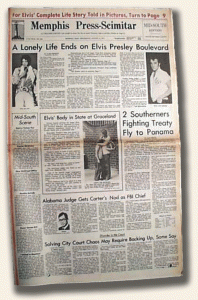
“It is loneliness that makes the loudest noise. This is true of men as of dogs.” – Eric Hoffer
Headline: Treaty of Peace – Pennsylvania Packet – 11/08/1783
Quote: “What a free society offers to the individual is much more than what he would be able to do if only he were free.” – F.S. Hayek
Headline: Death of Benjamin Franklin – The Gentleman’s Magazine – 06/01/1790
Quote: “It is sweet to serve one’s country by deeds, and it is not absurd to serve her by words” – Sallust
Headline: Death of President Washington – The True American – 01/01/1800
Quote: “A patriot must always be ready to defend his country against his government” – Edward Abbey
Headline: Queen Victoria Coronation – Main Farmer/Journal of Useful Arts – 08/07/1838
Quote: “Uneasy is the head that wears a crown” – William Shakespeare
Headline: This “Flying Machine” Flies – Philadelphia Press – 12/19/1903
Quote: “I think for months and years. Ninety-nine times, the conclusion is false. The hundredth time I am right” – Albert Einstein
Headline: Life Terms in Prison for Leopold and Lobe – Los Angeles Evening Herald – 02/04/1924
Quote: “Being brilliant is no great feat if you respect nothing” – Johann Wolfgang von Goethe
Headline: Death Takes Stalin’s Reign – Syracuse Herald-Journal – 06/06/1954
Quote: “O, it is excellent to have a giant’s strength! But it is tyrannous to use it like a giant.” – William Shakespeare
Headline: Eichmann Convicted – Los Angeles Mirror – 12/11/1961
Quote: “The belief in a supernatural source of evil is not necessary; men alone are quite capable of every wickedness.” – Joseph Conrad
Headline: A Lonely Life Ends on Elvis Presley Boulevard – Memphis Press Scimtar – 08/17/1977
Quote: “It is loneliness that makes the loudest noise. This is true of men as of dogs.” – Eric Hoffer
Thank you for attention and interest.
Morris Brill
Darwin’s “other” sons…
July 11, 2009 by TimHughes · Leave a Comment
 The Ogden Junction newspaper from Utah, dated September 6, 1873, includes this small comic tidbit making light of Darwin’s theory of evolution.
Encouraging newspaper collecting in 1862…
July 2, 2009 by TimHughes · Leave a Comment
An article in the “Charleston Mercury” of June 13, 1862 has a curious item concerning the collecting of early newspapers, and even includes a statement about the value in keeping current (meaning 1862) issues for future posterity:
“NEWSPAPERS—Many people like newspapers but few preserve them; yet the most interesting reading imaginable is a file of old newspapers. It brings up the past age with all its bustle and every day affairs, and marks its genius and its spirit more than the most labored description of the historian. Who can take up a paper half a century old without the thought that almost every name there printed is now upon a tombstone at the head of an epitaph? The newspaper of the present day will be especially interesting years hence, as containing the current record of events fraught with tremendous import to the cause of freedom in all the civilized world. We therefore would urge upon all the propriety of preserving their papers. they will be a source of pleasure and interest to them hereafter.”
The trek from boyhood to manhood…
June 20, 2009 by TimHughes · Leave a Comment
 The Boston Evening Transcript of July 21, 1862 has an interesting article on the front page headed “Youth And Manhood”, which is the writer’s reflection upon how–for him–the step from youth to manhood was a singular, notable
“Today we are children; tomorrow we are not. Today we stand in life’s vestibule; tomorrow we are in the temple… awed… humbled… and smitten…”
Although a bit morose in tone, it is nicely written and worth sharing.
So what’s the earliest “London Gazette”?
May 21, 2009 by TimHughes · Leave a Comment
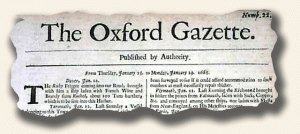 The world’s oldest continually published newspaper was begun in 1665 and still prints today, a staggering 345 year history which likely will never be broken by any other single title. Indeed, the newspaper still publishes today so it sets a more unbeatable record as each year passes.
The newspaper is titled “The London Gazette“, but collectors have occasionally seen issues of “The Oxford Gazette” and wondered about the connection.
First, the most convincing derivation of the term “gazette” is from “gaza”, the Greek word for a treasury or store. That newspapers are a “treasury or store” of information would allow for a plausible adoption of the term “gazette”.
In 1665 the Royal Court had been removed from London due to the Plague which had been ravaging the city. The smaller towns in the country seemed less susceptable to the contagion. So with a newspaper serving as a mouthpiece of the Royal Court it was logical that it would set up shop in Oxford, calling itself “The Oxford Gazette“.
But when the affects of the Plague seemed to have abated sufficiently for the Court to return to London, so did the newspaper. Twenty-three issues were published in Oxford, and with issue number 24 was the first with the title “The London Gazette“, a title which has remained unchanged for over three centuries.
So there might be a bit of a debate as to what the earliest issue is of “The London Gazette“. The earliest with this title would be issue #24, dated February 5, 1665 (1666 by today’s calendar), but argument certainly could be made that the first issue of “The Oxford Gazette” would qualify, it dated November 16, 1665.
Given its short life under the earlier title of “The Oxford Gazette”, such issues are extremely elusive. We have sold many over the past 33 years but rarely find them today.
Baseball fans… can you help?
May 11, 2009 by TimHughes · Leave a Comment
 A customer was requesting a newspaper with a report of Nap LaJoie, one of the more notable names in baseball in the early 20th century, ending the 1901 season with a .422 batting average. He was one of only a few to do so in the 20th century (there’s been a 67 year dry spell since Ted Williams was the last to do so, in 1941).
Finding reports of batting averages in 1901 is very difficult, but I did find a report at the end of the season which notes: “Lajoie…took part in 131 games. He was at bat 554 times, made 226 singles, 48 doubles 12 triples and 13 home runs…”.
Never mind that the numbers are slightly off from the official record book, which notes 543 games, 229 singles, 48 doubles (only one correct), 13 triples and 14 homers, as such errors might be understandable. But even given the accurate numbers, in calculating his average one comes up with a sum of 304 successful at bats, divided by the number of games (543) giving an average of .560. But curiously, if you just took his 229 singles divided by 543 the result is exactly his recorded batting average: .4217, rounded out to .422.
Should I surmise that the term “singles” actually means “hits” by today’s terminology ? Was this the common practice back then, to call any type of “hit” a “single”? If so, when did they make the switch?
Thanks for your help !
Tim
Sharing My Story… How I got started…
May 7, 2009 by TimHughes · 1 Comment

Tim Hughes, founder
Invariably there is the quizzical stare I get from anyone who asks “what do you do?” and I answer by saying, “I sell old newspapers.” The typical response is, “…what??” Any follow-up to the inquiry usually leads to, “How did you get started?”
We all have our own stories of what lead us to early newspapers, and mine may not but much different from yours.
I have always collecting something. I guess I was always intrigued by what was old, and coin collecting captured my interest when I was in 3rd or 4th grade, a hobby which still gets my attention but on a dramatically smaller scale. Collecting coins lead to old books, which lead to old bottles, which lead to old radios; and perhaps a few other items which struck my interest through the years.
I eventually found coin collecting a bit frustrating, as the rarities I needed to fill some holes in my collection were way beyond my budget. Coin collecting has always been a well exploited hobby so rare items were almost impossible to find at reasonable prices as the “heavy hitters” kept the prices quite high. I always dreamed of finding a collectible which few people knew about, where truly rare & historic items could be found at reasonable prices.
One day while browsing a local flea market I cam across an 1846 Philadelphia newspaper for $3. I was intrigued. I knew an 1846 coin in nice condition would be ten times that amount. I bought it, took it home and read all four pages and was fascinated by the content. I had found my new collectible and was hoping my dream had come true.
I expended much effort over the next several years looking for more newspapers and found several sources for 18th & 19th century issues at what I thought were amazingly low prices given my coin collecting experience.
Then one day I asked a source from whom I had been buying issues for $3 each if I could get a better price if I bought more than one. His response was fateful and set the course for the rest of my life: he said, “If you take 100 issues you can have them for $1 each”.
Although $100 was likely half of my net worth at the time, I sent the check, received my 100 issues, and starting advertising the issues for sale at $3 each (plus 25 cents for postage; which actually covered the cost).
As I sold the issues I bought more, and found more sources for different titles and different time periods. I eventually found several auction halls which regularly listed newspapers, and established contacts in England for early British material. In time I would travel not only throughout the Middle Atlantic & New England states but went to London each year to to search the back roads for antique & book shops which had material I could use.
Those were very exciting days, as material was plentiful and I bought voraciously. Buying today is more of a challenge so I take great comfort in knowing my appetite some 30 years ago was justified as much of our inventory of over 2 million newspapers was purchased long ago.
Good material still comes our way. Having our name in the marketplace for over 30 years and maintaining considerable Internet presence has allowed much great material to end up at our doorstep, a trend which–hopefully–will continue as we allow my dream to be realized by our customers: rare, historic material at reasonable prices.
In the coming months we will be posting the stories of other collectors as well. Details are forthcoming.
Rare newspaper collector’s inspiring story…
February 26, 2009 by GuyHeilenman · Leave a Comment
Over the years we have had the opportunity to establish relationships with many wonderful people within the rare newspapers community. On occasion, we are blessed to hear about the story behind the voice on the other end of the phone. One such person is Robert (Bob) Cassidy, of Pekin, Illinois. He is one of those individuals whom always has something positive to say, and who manages to make everyone he speaks with feel important. What a gift. This gift is especailly noteworthy considering the health issues he must hurdle in order to communicate. It is obvious he is a man of strong character, and of even stronger faith. It is the combination of both traits which provide the backdrop for… his story:
Disease inspires man to paint…
(Source: The Journal Star by Elise Zwicky)
“For some, a diagnosis of Parkinson’s disease might end an art career; for Bob Cassidy, it was the catalyst for getting started. ‘God, in his infinite wisdom, gave me Parkinson’s to see if I still had a sense of humor. And I did, thank God,’ said the 73-year-old retired speech specialist. Cassidy is planning an open house at the end of February or early March at his new art studio…” (read more)
Thanks Bob. You are an inspiration to us all.
An Interview with Timothy Hughes…
February 16, 2009 by GuyHeilenman · 1 Comment
 BakerTowne Collectibles recently filmed an interview with Tim Hughes on their Collectibles Corner TV website. Tim appears about midway through the show at the 4:38 time stamp. Once the program fully loads you can drag the time tracker to this spot; however, if you have the time, Tammy’s (the host) entire program is enjoyable to view.
The interview may be found at: http://www.collectiblescornertv.com/?p=114; even better, view the interview below.
Thanks Tammy for your addition to the Rare Newspapers Community.
Waiting to be discovered…
February 9, 2009 by TimHughes · Leave a Comment
The History Channel has sparked much interest in events of the past which otherwise have gone unnoticed through the years. Whether it’s a biography of notable name, a little-known yet significant war battle, or a political event which had notable consequences years later, it’s not uncommon for us to receive calls from hopeful collectors wanting a period account of the event. Many times we are successful in the search, other times not.
Occasionally present-day events noting an anniversary or discovery spark similar interest. We have noticed a significant interest in Abraham Lincoln material with the approach of the 200th anniversary of his birth. And the very recent discovery of the British ship “H.M.S. Victory” got even us intrigued about the possibility of finding a 1744 newspaper or magazine reporting its loss.
As a bit of background, a report dated February 5, 2009 from the “Best Syndication News” service brought this event into the 21st century with its breaking news reading:
“The HMS Victory ship sunk in stormy seas back in 1744 but it wasn’t until this week, when an American company called Odyssey discovered what they call “the most significant shipwreck discovery in history.” The HMS Victory was a warship that had a crew of around 1,100 that died when it went underwater. The estimated treasures with gold coins and artifacts could be worth potentially $1 billion. The Odyssey company is undergoing a legal battle to allow them to recover the treasures and artifacts. Because the HMS Victory is a military ship she is the property of the British government according to the laws of marine salvaging.”
As luck would have it we were successful. Keeping in mind that there were no survivors, details were obviously sketchy back then, but both the October and November issues of the “Gentleman’s Magazine” reflected upon the disaster.
All of us, as collectors, literary keep history on our shelves. Who knows when the next discovery might relate to an innocuous report in one of your newspapers. Have you discovered in one of your issues an item brought to light by present-day events? Such finds are always fascinating–it’s part of the intrigue of the hobby.