
Search
The Rare & Early Newspapers Hobby

Receive the Newsletter

Buy Historic Newspapers

The “top ten”: 18th century…
December 14, 2009 by TimHughes · 9 Comments
Continuing with our “top ten events to be found in newspapers” for various periods of time, today we consider the 18th century.
What an event-filled one hundred years it was. As you can tell by the list my focal point is on the American Revolution, but there are other events or specific newspapers which made it into my top ten.
Again I offer apologies to our non-American friends as this list has a decidedly American bias, primarily because the vast majority of those who purchase from us are American.
Here we go, starting with number ten:
 10) Death of George Washington, 1799 (Front page, preferably in a Virginia Gazette)
9) Hanging of Captain Kidd, 1701 (Just can’t resist a great pirate hanging, he being perhaps the most famous of all time)
8.) Any newspaper with the first installment of Paine’s “The Crisis” (“These are the times that try men’s souls…” has to be one of the more famous beginnings of all time)
7) Full text of the Stamp Act (Certainly a trigger event that would lead to the Revolution)
6) Boston Tea Party (In a Boston newspaper. An event every school kid knows about)
5) The Pennsylvania Journal, Nov. 1, 1765 “skull & crossbones” engraving (Replaced its normal masthead on this date: seen in most history books)
 4) Battle of Lexington & Concord with mention of Paul Revere’s ride (The beginning of the Revolutionary War. I had one once with mention of Revere–exceedingly rare–great to have in a Boston area newspaper)
3) The Boston News-Letter, 1704 (Great to have issue #1 of America’s first successful newspaper, but any issue from 1704 would do)
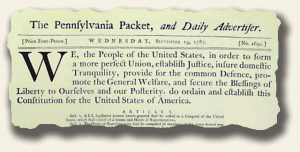
2) The Pennsylvania Packet, Sept. 19, 1787 (First newspaper to print the Constitution, & done in broadside format. Need I say more?)
1) The Declaration of Independence, 1776 (Ideally the Pennsylvania Evening Post, July 6, 1776, but the Packet of July 8 would work too as it contains the Declaration entirely on the front page: better for display).
Top 10 lists…
December 3, 2009 by GuyHeilenman · Leave a Comment
Top 10 lists are always fun to consider. Their strength is in their ability to generate thought, reflection, and opinion. We all acknowledge that no two top ten lists are the same, and whereas going to experts in the field may add a certain level of credibility to a list, even an amateur/novice can bring food for thought to the discussion. Everyone has an opinion, and each and every opinion has some some value. In the end, the greatest benefit may well be in the journey traveled as we formulate and consider both our own views as well as the views of others.
It is with this in mind we plan to offer 4 top ten lists over the course of the next four Mondays. The focus will be on giving thought to the top ten most historic newspapers from each of the following eras: 17th century and earlier (12/7/2009), 18th century (12/14/2009), 19th century (12/21/2009), and 20th century & beyond (12/28/2009). In some cases we may choose a specific newspaper title (any date), realizing that having any issue of the title is of note. In other instances we may focus on a specific title and date of a newspaper – these being the “holy grails” of the hobby. Yet in other cases we’ll include a more general top ten entry, focusing on the event itself, acknowledging that finding any newspaper coverage of the event is noteworthy.
As we proceed through the month, we invite both reactions to our lists and the submission of your own “top tens”.
 In an effort to help kick-start your walk into the past, we invite you to enjoy a recent post which appeared on OnLineSchool.net titled, “100 Great Moments in American History You Can Catch on YouTube”, by Amber Johnson: (http://onlineschool.net/2009/11/18/100-great-moments-in-american-history-you-can-catch-on-youtube/).
Lincoln establishes a national Thanksgiving Day…
November 26, 2009 by TimHughes · 1 Comment
Appropriate for this day we show photos of the official Proclamation by Abraham Lincoln establishing the “…last Thursday in November…” as a day of Thanksgiving.
In the midst of the Civil War and with the troubles the nation was facing, he thought it appropriate that: “…fellow citizens in every part of the United States…to act apart & observe…a day of Thanksgiving & Prayer to our beneficent Father…due to him for such singular deliverances and blessings, they do also, with humble penitence for our national…disobedience, commend to His tender care…implore the interposition of the Almighty hand to heal the wounds of the nation & to restore it...” (see photos).
This text appeared in the New York Daily Tribune of October 5, 1863. A beautifully written piece by the President in the midst of so much national turmoil & bloodshed. Please enjoy:

A modest resume…
November 23, 2009 by TimHughes · Leave a Comment
“The Crisis” newspaper from Columbus, Ohio, dated May 24, 1863 ran the piece on Lincoln shown in the photo. Keep in mind that this was a “copperhead” newspaper (northern paper opposed to the war, even advocating the continuance of slavery) so there was much criticism to Lincoln and his administration throughout it’s print run, so it is likely the piece was printed to emphasize the “modestness” of his resume.
From what we know of Abraham Lincoln this short piece he submitted, despite likely edits by the newspaper publisher, is largely correct and emphasizes the humble background of the man whom history arguably ranks as among the best of American Presidents. Certainly the trappings of wealth, family pedigree and the best of education which are traits common to leaders in other parts of the world are not prerequisites to success in America. This simple piece in a 146 year old newspaper is evidence that “the American dream” has been alive and well on this side of the Atlantic for many years.

Definition of terms…
November 12, 2009 by TimHughes · Leave a Comment
Many thanks to fellow collector Morris Brill for the following. I’m sure we all can relate:
 A few days ago I was browsing through a popular auction website. Imagine my surprise when I saw a listing for an “Ancient” newspaper. “Wow,” I thought, “I never knew newspapers were published before the end of the Roman Empire in 476 A.D.” I couldn’t wait to see this ‘ancient’ newspaper and immediately clicked only to experience that letdown feeling as I gazed upon a 1954 newspaper concerning the Korean War.
But, I really wanted to find something to purchase, and then I saw it. The heading read: “Rare Newspaper.” Knowing that ‘rare’ is defined as being marked by unusual quality, merit, or appeal. Distinctive, seldom occurring or found, I clicked again. There it was, the blaring headline “Reagan Shot.” Hmmm….so much for rare.
But, I was undaunted. And for good reason for just a few listings down I was struck with the description, “Vintage” “This must be it,” I thought, knowing that ‘vintage’ was of old, recognized, and enduring interest, importance, or quality. But, alas, what I found was a newspaper on the subject of a public transportation strike in Youngstown, Ohio.
Did I give up? Heck No. There just had to be something of importance among all these listings. And my wish was soon granted when I saw the ad that read, “Historical.” Knowing that ‘historical’ relates to or has the character of history. Famous in content or significance, I knew this was what I was looking for. Though my clicking finger was getting sore I stoically endured and clicked to find a Philadelphia newspaper of the Phillies winning the World Series last year.
I was determined though. I was certain I would soon find that gem. And there it was, an
“Authentic Historical Newspaper.” Knowing that ’authentic’ was something that was not imaginary, false, or imitation. Genuine, without counterfeiting, admixture or adulteration,
I just knew this was the answer to my quest. I was so excited as my finger hovered over my mouse. Click…and there is was. An authentic NEW reprint. Imagine my thrill to know that this was not just any authentic reprint, it was a New authentic reprint.
With my last ounce of strength I clicked the red X in the upper right of your screen.
Even then they wondered, “what’s next?”…
October 10, 2009 by TimHughes · Leave a Comment
 The “Mother Lode Magnet” newspaper from the small mining town of Jamestown in Northern California had an interesting item in its September 14, 1898 issue. One wouldn’t be surprised if it appeared in a newspaper today:
Before they became famous…or “infamous”…
September 19, 2009 by TimHughes · 2 Comments
 A special desire for many collectors is to find a newspaper mentioning a name which would not become famous for many years, such as the “Lincoln & Herndon” attorney advertisements from Springfield, Illinois in 1857, or a newspaper ad noting John Wilkes Booth appearing in a play in 1863.
The item shown in the photo fits this category, appearing on the front page of the “Detroit Free Press” in its November 1, 1959 newspaper. If a Kennedy assassination plot existed, the plans may have begun as early as…
Early printing in the New World…
September 10, 2009 by TimHughes · Leave a Comment
Another book I find very useful, although out of print, is “Printing In The Americas” by John Clyde Oswald, 1937. From time to time I will print excerpts from it which hopefully will be of interest to collectors, including the following which touches upon the very earliest years of printing in the “new world”.
 “Printing in the English colonies began during the first half of the 17th century, at which time the art was at a low ebb in Europe, and it is therefore not surprising that the printers who came to the western shore of the Atlantic Ocean were not of outstanding ability; they were but representative of the class from which they sprang.
The first person to print in what is now the United States was a boy 18 years of age, upon whose immature shoulders had unexpectedly been thrown a heavy burden of responsibility. This boy, Matthew Daye (later in life he dropped the final ‘e’), began to print in a newly built house on the bleak shore of New England, on the edge of the forbidding wilderness that surrounded it on all sides but that which faced the sea. The year was 1638, just 18 years after the Pilgrims landed.
A new nation was in the making, in which life eventually came to embrace everything worth while, but in which in the beginning, as was to be expected, artistic accomplishment & progress were almost wholly absent. The settlers were too much occupied with the immediate necessity of clearing away the forests, harnessing the water power, building homes, founding towns and setting up local governments, to be able to find time to devote to the refinements of daily living. The primal wants had first to be satisfied. Then came the Revolutionary War, with its strain upon their resources, and later the need of facing and solving the world problems that accompanied the birth of the new nation.
The scarcity of great printers in Europe during the 17th century is to be ascribed to the fact that printing, controlled by Church and State, had ceased to be a means of art expression and had become merely a vehicle for the transmission of information (and misinformation). In England the number of printers and type founders was limited, and they were licensed and operated under strict surveillance. Restrictive measures of a somewhat similar nature were enforced in other countries.
The ruling powers endeavored to stretch a restraining army across the Atlantic to the colonies newly planted there, and they were at first partly successful because they were represented by governors subservient to their whims. the oft-quoted remark of Sir William Berkeley, governor of Virginia, will be recalled:
But, I thank God, there are no free schools nor printing, and I hope we shall not have these hundreds years; for learning has brought disobedience, and heresy, and sects into the world, and printing has divulged them, and libels against the best government. God keep us from both.”
King James II, on ascending the English throne in 1685, sent this instruction to Governor Dongan, in New York:
“And for as much as great inconvenience may arise by the liberty of printing within our province of New York; you are to provide by all necessary Orders that noe person keep any press for printing, nor that any book pamphlet or other matters whatsoever bee printed without your special leave & license first obtained.”
For 40 years thereafter this paragraph appeared in the instructions to colonial governors. Great was the respect paid by the common people of Europe to constituted authority. The bowed head and bended knee were therefore attitude familiar to the colonists; but contact with this constituted authority came to them only through the local governors and their minions, and often the closeness of the contact disclosed the fact that the supposed gods were in reality made of clay. Respect, reverence even, might for a time be publicly shown for a governor in gold lace, who proved on acquaintance to be vain, shallow, and incompetent, but it could not be privately felt, and under such circumstances the public showing was certain in time to come to an end.”
How to be a cowboy: The protocol in 1882…
August 13, 2009 by TimHughes · Leave a Comment
 It’s interesting how the stereotype of the cowboy as created by Western movies and the lore generated by Western writers can hold true to reality. This was my thought when I can across an interesting tidbit from a Yuma, Arizona, newspaper of January 7, 1882—from a truly Western town at the high point of the Wild West era:
“He Wanted to be a Cowboy”
A youth recently went all the way from Chicago to New Mexico to become a cowboy. When there he explained his desire to a typical mountaineer whom he met and asked for instructions in the role he had wished to assume. Grasping him by the hand the mountaineer said: “You want to get a buckskin suit with plenty of fringe, a pair of high boots and a pair of high spurs. Then you want to get a broad-rimmed hat–the broader the better; two fort-fives, a knife, a Winchester rifle and a horse; then you want to get drunk and get on your horse; then take the reins in your teeth, a revolver in each hand, and go down the street at a full run, shooting at every jump. then come back and yell as loud as you can: ‘My name is ______ and I’m stinking for a fight; I’m a sone-of-a-gun from the plains.’ After that you will be a cowboy.” The picture is duly referred to the cowboy’s prototype in Western Missouri.”
Preserving shelf space: beginning of microfilm…
August 3, 2009 by TimHughes · Leave a Comment
We again credit follow collector Paul Sarna for providing the following information concerning the very beginning of microfilm as a means of allowing libraries to preserve valuable shelf space. It is excerpted from “News-Week” magazine of Oct. 28, 1933:
“…Another idea which got yet more attention was presented by Eastman Kodak Company. A new apparatus can photograph whole newspaper pages on a strip of film one and three-eights inches wide. An eight page paper would require a strip only twelve inches long, and a complete month’s file of a bulky metropolitan newspaper could be recorded on a four inch reel of film.
Any person wanting to find an item, for instance, in the Atlanta Constitution of July 15, would ask for the film of that date at the library desk. The film would then be snapped on an axle on top of a projection box. With the light switched on, a shadow, much like that cast by any motion picture projector, appears on a slanting screen before which the reader sits. A knob on the side of the apparatus moves the film rapidly until the desired page is reached.
One big advantage of the apparatus is that the items, thrown in clear relief, appear 50% larger than in newspapers. A year’s file, instead of occupying six feet of double shelving, would not take up much more room than a shoe box.
Furthermore the non-explosive film could be renewed an indefinite number of times and reprints of news items could be made by placing photosenstive paper on the projection screen.
The ingenious apparatus is largely the work of Roy S. Hopkins of the Eastman Research Laboratory…”.
An interesting review of the birth of microfilm. I would not have guessed it dated back to 1933.
Thanks Paul!