
Search
The Rare & Early Newspapers Hobby

Receive the Newsletter

Buy Historic Newspapers

Collecting Historic and Rare Newspapers Basics (Part II)
August 9, 2010 by GuyHeilenman · 1 Comment
The following guide is posted on History’s Newsstand’s eBay Store. It is the second part of a primer on collecting Rare & Early Newspapers:
 The purpose of this 2nd guide concerning historic, original, collectible and/or rare newspapers is to answer additional questions related to the hobby:
- Why are they so inexpensive?
- What might I find within the pages of a Rare Newspaper?
- What is the background of the (apparent) use of “f” vs. “s”?
- What is meant by “2nd-rate”?
- What is the value of my newspaper?
- How was 17th & 18th Century paper made?
- Are early issues with irregular type-set authentic?
1. Why so inexpensive?
You can find newspapers published during George Washington’s administration for $35, issues with front page accounts of Indian skirmishes for $25, and genuine issues published in 1685 for as little as $30. A hobby still very much undiscovered by the public, prices for genuine, complete newspapers dating as far back as the 1600’s are very low due to limited demand (at this time). For more than 30 years, we have dealt exclusively in the niche market of early newspapers, buying in huge quantities at very low prices to amass an inventory of over 2 million issues which are now available for the historical hobbyist. There is no better time to begin amassing ah historical newspaper collection – while still on the up-side of the hobby’s appeal.
2. What might I find within the pages of a Rare Newspaper?
Read the Boston Gazette of March 12, 1770 and learn of the massacre in that city and gain an appreciation of the revolutionary spirit never before imagined. Read 1st hand reports on the Civil War. View ads and reports from the American Wold West. View the Banner Headlines of some of the biggest events from the 20th Century. Historic newspapers are a firsthand reflection of life at a time when descriptive ads for runaway slaves were commonplace; when Paul Revere advertised his bell foundry in local papers; when recently enacted laws, signed in type by George Washington, were published in the daily paper. There is no better way to obtain an intimate view of life during nearly any chosen period from 1666 through the late 1900’s.
Since all are original issues (not reproductions), slight imperfections such as light foxing or staining, small margin tears, an occasional front page original owner (often library) stamp, and slight fold or edge wear are common. Most issues were once bound into volumes at the end of a year for preservation and bear minor left margin irregularities due to the disbinding process. None of these potential typical imperfections cause content loss. Many newspapers dated from the 1880’s through the 1920’s are pulpish (fragile) due to commonly used print materials used during this period, and appropriate care must be given to these issues. Some issues (especially magazines) were originally published with covers or wrappers, but unless described otherwise, they have long since been removed.
3. What is the historical background of the use of “f” vs. “s”?
Centuries ago before the printing press there were grammatical reasons for use of a serpentine-styled “s” to be used rather than the more typical “s”. Its look was much as if an “s” was elongated and leaned to the right. When this letter was converted to a block letter for the printing press (around 1500) it looked much like an “f” but with the slash through one side & not the other–look carefully and note the difference. This letter caused confusion with the “f” ever since, and around 1750 publishers were abandoning this letter in favor of the more typical “s”, and by 1800 it was almost universally abandoned.
4. What is meant by “second rate”?
A “second rate” issue is somewhat worn, possibly with edge tears, some light staining, rubbing, or other minor disfigurements. All pages are present with no cut-outs, but the prints contained within the issue, if prints are present, would not be suitable for framing. An acceptable issue for researching content only, or if condition is inconsequential. Please do not request for us to confirm that an issue offered at the 2nd rate price contains prints that are in good condition. A 2nd rate issue is 2nd rate throughout.
5. What is the value of my newspaper?
As one might suspect there are many factors which determine value. Much like a jeweler cannot give a value of a diamond via email or a phone call, ethics would not permit anyone to place values on newspapers without seeing the issues in hand to determine authenticity condition, news placement, etc. Although viewing issues of similar date, condition, and displayablity on eBay and/or on reputable websites may give a general sense of their potential value, your best bet is to contact a reputable dealer in historic and/or rare newspapers.
6. How was 17th & 18th Century paper made?
The handmade paper used in the 17th and 18th centuries can be distinguished from paper that was made later by holding the paper up to a light and looking for “chain-lines” which are left from the wires in the paper mold. With this method, fewer fibers accumulate directly on the wire, so the paper is slightly thinner and more transparent to light. This pattern is usually very apparent and appears as lines that run about an inch apart, with several horizontal short lines connecting the long wire lines. Some modern paper has artificially-applied chain lines, and is usually referred to as “laid” paper, which is the name given to handmade chain-line paper. The handmade chain-line paper was made of cotton and/or linen rags, which were soaked in liquid until the fibers broke down into bits. Paper was formed by hand by dipping a paper mold into the fiber suspension, and then lifting and shaking off the excess water. The paper sheet was then partially dried before being removed from the mold. Modern handmade paper (used in fine printing of small editions by private presses, as well as in artists books) is basically made by the same process.
Wood pulp paper (made with a sulfite process that causes high acid residue in the paper) wasn’t widely used in the U.S. until after the American Civil War. Breakthrough in paper-making occurred when “wove” paper was invented. Wove paper was first used in a book printed in America in 1795 in a book by Charlotte Smith entitled “Elegiac Sonnets and Other Poems”. Wove paper, which shows no chain-lines, is made on a wire mold often made of brass and/or bronze wires that have been woven like fabric. Therefore, there is no chain-like pattern, and the paper has a much smoother appearance. After 1800, wove paper became the standard paper for books and other uses, although there was still some laid or chain-link paper in use through the 1820s and beyond.
The first machine-made paper in America was made in 1817 in Brandywine, Delaware, and the first newspaper printed on this paper was “Poulson’s Daily Advertiser. The major start in manufacturing paper by machine began when a French paper machine called the Fourdrinier was introduced in New York in 1827, followed by the manufacture of more of the machines two years later in Connecticut. Machine-made paper is more uniform in thickness, lacks the uneven edges of handmade paper and is weaker and more prone to tearing. Machine-made paper is made on a continuous wire mold which usually has watermarks. Although it can be hard to tell machine-made wove paper from handmade wove paper, handmade paper is usually thicker and also varies in thickness from piece to piece.
The last major development in paper manufacture was the development of wood pulp paper, which was much less expensive to manufacture than rag paper. The first successfully-made wood pulp paper was manufactured in Buffalo, New York, in 1855. By 1860, a large percentage of the total paper produced in the U.S. was still rag paper. Most of the newspapers printed in the U.S. during the Civil War period survived because they were essentially acid-free 100% rag paper, but the newspapers printed in the late 1880s turn brown because of the high acid content of the wood pulp paper. In 1882, the sulfite wood pulp process that is still in use today was developed on a commercial scale and most of the high acid content paper was used thereafter in newspapers, magazines and books.
7. Are eary issues (pre-1800) with irregular type-set authentic?
Pre-1800 Printing – A Little Background: Type was handset in the 18th century and all margins were (typically) of equal size from top to bottom. As part of the inherent crudeness of making paper back then, individual sheets might have slightly different shapes but in general all sheets were rectangular, wider than tall with pages 1 & 4 of a newspaper printed on one side and pages 2 & 3 printed on the other, then folded in half to produce the typical 4 page newspaper. It was rather common for even a regularly shaped sheet to be put on the printing press slightly askew, causing the printed sheet to appear somewhat crooked, keeping in mind everything was done by hand, and often by young hired hands. We have seen a few instances where an irregularly shaped sheet caused the print to run off one of the edges. Also, newspapers and magazines were often bound into volumes at the end of the year with the three exposed edges trimmed to look neat, and in the trimming process some text can be trimmed off if the newspaper was bound into the volume askew, or if the trimmer simply took off too much blank margin to even up the edges.
(Note) Invitation: In order to provide an ongoing resource for newcomers to the hobby, feel free to add additional insight which you feel might be beneficial to those entering the hobby on the ground floor. Our hope will be to include many of these comments within a future post. Thanks in advance for your contributions.
Collecting Historic and Rare Newspapers Basics – Part One
August 2, 2010 by GuyHeilenman · 14 Comments
The following guide is posted on History’s Newsstand’s eBay Store. It is the first part of a primer on collecting Rare & Early Newspapers:
The purpose of this guide concerning historic, original, collectible and/or rare newspapers is to answer the three most common questions related to the hobby: How you can determine if an issue is authentic, the meaning of commonly used terms related to the hobby, and why the original issues do not just fall apart.
How Can You Determine If An Issue Is Authentic?
It was not unusual for newspapers to celebrate the anniversary of an historic event or their inaugural issue by reprinting that issue for their subscribers or the general public. Never meant to deceive, through the years such issues were tucked away in attics and dresser drawers as interesting souvenirs only to be uncovered by distant relatives convinced they found the genuine item.
Although only an expert examination can definitively qualify a newspaper as genuine or a reprint and such experts with sufficient knowledge & experience are few & far between, there are a few clues which can guide a novice in making a determination:
* Does the newsprint match that used at that time? Genuine pre-1880 newsprint usually has a high rag content and is very pliable, sturdy & reasonably white. Most reprints in the post-1880 era are more browned, fragile and lacking in physical substance.
* Does the issue contain an historic or significant report? Many reprints contain very historic reports rather than mundane news of the day, and such genuine issues are rarely found randomly outside of a larger collection.
* Is the issue a volume one, number one issue? They were commonly reprinted on anniversary dates.
* Does the format, content or any extraneous printing on the issue appear out of the ordinary? Many reprints were used for promotional purposes and altered to serve another purpose beyond just reprinting a genuine newspaper.
Reprint, fake, or facsimile newspapers are a rarity in this hobby with the vast majority of such issues limited to less than 20 titles. The Library of Congress maintains a check-list of points to look for on most of these issues and can be accessed through their website.
What Are The Most Frequently Used Terms & What Do They Mean?
* Octavo (8vo): Approximately 8 1/2 by 5 inches. Popular size for 18th Century magazines.
* Quarto (4to): Approximately 12 by 9 inches. Common size for many early newspapers.
* Folio: Full size. Eighteenth century issues are approximately 17 by 11 inches, while 19th century issues come closer to present day newspapers.
* Foxing: Dark spots due to age, chemical content of the paper, or storage environment.
* dblpgctrfld: Doublepage centerfold. A print, typical in Harper’s Weekly, which stretches across two pages.
Why Do The Issues Simply Not Fall Apart?
To the surprise of many, newspapers published before 1880 remain in very nice condition as the paper had high cotton and linen content. Most issues from the 1600’s and 1700’s are in much better condition than issues from World War I, hence little care is needed for issues over 120 years old.
(Note) Invitation: In order to provide an ongoing resource for newcomers to the hobby, feel free to add additional insight which you feel might be beneficial to those entering the hobby on the ground floor. Our hope will be to include many of these comments within a future post. Thanks in advance for your contributions.
Recommended reading…
June 26, 2010 by GuyHeilenman · Leave a Comment
 Jim Wheeler, one of our “rare newspaper” friends, recently sent us an e-mail with the following recommendation for our summer reading list:
The Constitutional Convention: A Narrative History from the Notes of James Madison, by Edward J. Larson & Michael P. Winship, ISBN 0-8129-7517
This book essentially condenses and annotates Madison’s notes taken throughout the Convention so that the language and the important concepts that were discussed can be understood today. The book includes a list of those attending the convention and their respective states. When you keep a 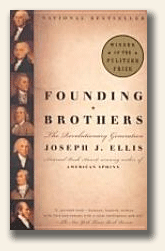 copy of this list handy while reading the notes, you can get a clear picture of the regional motives behind the discussion as the constitution was developed. This book, in conjunction with The Founding Brothers, John Ellis, were both extremely helpful in developing a working understanding of what I consider to be one of the most interesting 10 to 20 year time period in US history.
I thought that in addition to all of your other reading, these two items may be interesting and helpful.
Thanks for your suggestions Jim. To the readers of this post: “If you have a chance to read either of these (or have already done so), the community would love to hear your reactions as well.
Your help would be appreciated…
June 14, 2010 by TimHughes · 10 Comments
 Rick Brown, not unknown in our little world of newspaper collecting, is embarking upon a project and seeks your help.
Rick published “Collectible Newspapers” for many years and created the Newspaper Collectors’ Society of America along with producing several projects which remain valuable to our hobby today, including the “List of Common Reprints” found on our website. His current project is producing a list of all known reprint editions of the New York Herald of April 15, 1865, perhaps the most commonly reprinted newspaper on the market. He has identified 35 different versions and is lacking a few including:
* Kitchel’s Liniment for 1890, 1892 through 1899, 1903 and 1904, 1906
through 1908. (The date for each can be found at the
top margin of page 2.)
* Smith’s Buchu Lythia Pills
He also wishes to produce a reprint of the front pages of each of the four
genuine editions of the newspaper for free online use. Should you have a genuine New York Herald, April 15, 1865 in your collection, or one of the reprint edition editions noted above, please be in touch with Rick directly for details on how to assist in his project: Curator@historybuff.com
Rare Newspapers – distracting?
May 6, 2010 by GuyHeilenman · 2 Comments
One of the most common questions our Rare Newspapers’ staff is asked is, “How do you ever get anything done? Don’t you get distracted by the interesting content within the issues?” The answer is an enthusiastic, “YES!” One of the most enjoyable aspects of our daily interaction with early newspapers are these very “distractions”. Hardly a day goes by where we aren’t fascinated by or engaged in conversation resulting from the content within the issues we find.
One such discussion (distraction) was recently inspired by an issue of the Omaha Daily Bee dated June 28, 1919, which originally caught our attention because of its dramatic WWI headline, “PEACE TREATY SIGNED”, with a corresponding subhead, “China Alone Refuses To Sign Covenant That Ends Greatest War in History”. However, what caused our “distraction” was the front page text (shown in the image) regarding the “World’s Ten Greatest Peace Treaties“. Although this issue is no longer available, it can be viewed at: http://www.rarenewspapers.com/view/570082?acl=781584385. Much has occurred since the early 20th century. We wonder what such a list might include if it were printed on the front page of a tomorrow’s newspaper?
Featured websites – The Liberator Files…
April 22, 2010 by GuyHeilenman · Leave a Comment
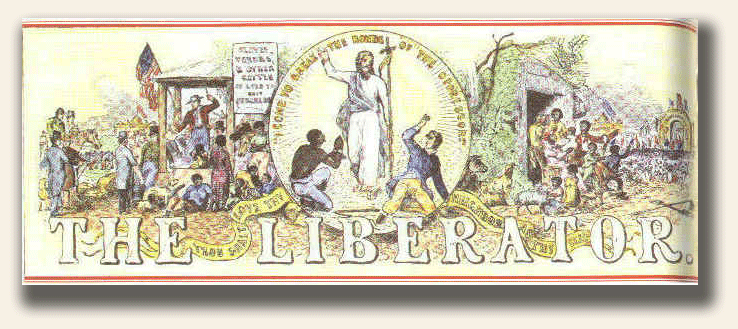 Within the past few months, three members of Timothy Hughes Rare & Early Newspapers each recommended the same website, The Liberator Files, as a great resource for exploring this well-known abolitionist title from the early/mid 1800’s. This Boston paper was published by William Lloyd Garrison, and provides wonderful context for this formative period in U.S. history – from the early 1830’s through the end of the Civil War. The Liberator Files, developed and maintained by Horace Seldon, includes a wealth of abolitionist related commentary in conjunction with a host of scanned Liberator images from William Lloyd Garrison’s own collection, which are currently held at the Boston Public Library. Thanks Horace, for your significant contribution to the world of rare & historic newspapers. Please enjoy!
Feel free to share with the rare newspapers community other historical and/or rare newspaper oriented websites you’ve found to be of use.
Featured websites – TeachHistory.com
March 18, 2010 by GuyHeilenman · Leave a Comment
 Teachers with a love of history, listen up! The following resource can improve your curriculum and make you a stronger educator. Students of history will enjoy the breadth and depth of the historical journey as well.
TeachHistory is a fantastic website (blog), developed and maintained by Ben Edwards, which provides engaging information & a plethora of useful educational resources related to history. It describes itself as:
“a blog dedicated to social studies and history teachers across the United States who use Colonial American history, imagination and multisensory teaching methods to inspire their students. Our goal is to provide a resource where teachers like you can access information about colonial history plus technologies, methods and products that are making a difference in education today.”
While Ben’s experience with teachers and students is varied, perhaps the most useful channel for keeping him in touch with the pulse of teacher/student interests and needs occur via the many intimate conversations had while engaging teachers and students through his Walking Tours of Historic Boston. Combine this with both his (historic) heritage and his natural love of history, and you have the making of a blog which is sure to stay relevant over time. Some of the recent posts include:
Colonel Shaw, Sergeant Carney and the 54th Massachusetts
Remembering Alex Haley and Roots
Black History Month: A Tribute to Phillis Wheatley
Young Ben Franklin and the Silence Dogood Letters
Teachers: Are You Engaging AND Empowering Your Students?
Many of the posts include detailed images and reference accounts of actual Rare & Early Newspapers – most of which come from his personal collection. Ben fully grasps a foundational truth regarding primary sources: “History is never more fascinating than when it is read from the day it was first reported.” Thanks Ben, for your contributions to both the Rare Newspapers and Educational communities.
Featured websites – RagLinen.com
March 11, 2010 by GuyHeilenman · Leave a Comment
 From time to time we like to take a look at various websites which may enhance our Timothy Hughes Rare & Early Newspapers‘ members collecting experience. Todd Andrlik’s “Rag Linen“, is such a site. It describes itself foremost as “…an educational archive of rare and historic newspapers, which serve as the first drafts of history and the critical primary source material for historians, authors and educators.” A sample of Rag Linen’s posts on the corresponding blog include:
- A Short Narrative of the Horrid Massacre in Boston
- B. Franklin’s Confession to Leaking Hutchinson’s Letters
- Paul Revere’s “View of the Year 1765″
- The Stamp Act Teaser of 1764
- The Great Scottish Witch Hunt of 1661-1662
- The 12 Letters That Preceded The Burr-Hamilton Duel
- The Original Flag of the Thirteen United States
- Three Cheers for Lincoln’s Gettysburg Address
- An Unlikely Spy Embedded as a Newspaper Printer
- The Real First President of the United States
Rag Linen also has useful information on the History of Newspapers, the Condition & Preservation of newspapers, and more. Well done Todd. Thanks for your contributions to the rare newspapers community.
Top ten: 16th and 17th centuries…
December 7, 2009 by TimHughes · 3 Comments
As Guy introduced a few days ago, we will use the Mondays of December to consider the top ten events to be found in newspapers for various periods of time. In a few cases the desired “event” is actually a specific newspaper.
 Today we consider the 16th & 17th centuries, which is a bit difficult as the mere existence of newspapers–or even their predecessors: newsbooks–is limited. And all would be European, as no American newspapers existed in this time period (only exception noted below). Nonetheless I’ve created what I consider to be the top ten historical events or newspapers collectors would love to add to their collections.
I do offer apologies to our non-American friends as this list, and those to follow, have a decidedly American bias, primarily because the vast majority of those who purchase from us are American. But there are a few European events noted.
Here we go, beginning with number ten and ending with the most desired event or newspaper:
10) Coronation of William & Mary, 1689 (after all, they were the king & queen of colonial residents as well. Almost like a very early Presidential “inauguration”)
9) King Philip’s War, 1675-6 (America’s first war)
8.) William Penn’s charter for land in the New World, & his settlement there, 1682 (an issue of the London Gazette includes: “…Mr. Penn bound for Pennsylvania with a great many Quakers to settle there…”)
7) Capture of Capt. Kidd near Boston, 1699 (who wouldn’t want a period report of this very famous pirate)
6) Defeat of the Spanish Armada, 1588 (my one entry from the 16th century; available in period newsbooks)
4) The volume 1 number 1 issue of the Oxford Gazette, Nov. 16, 1665 (great to have the first issue of the world’s oldest continually published newspaper: become the London Gazette with issue #24)
3) Salem Witchcraft trials, 1692 (famous event, but try to find period reports of it!)
2) Settlement in the “New World” from 1607-1630 (from the very earliest period of European settlements in America, predating newspapers but newsbooks did exist)
1) Public Occurrences Both Foreign and Domestick, Boston, Sept. 25, 1690 (America’s first newspaper. To this date only one issue has surfaced. Could there be another?)
Top 10 lists…
December 3, 2009 by GuyHeilenman · Leave a Comment
Top 10 lists are always fun to consider. Their strength is in their ability to generate thought, reflection, and opinion. We all acknowledge that no two top ten lists are the same, and whereas going to experts in the field may add a certain level of credibility to a list, even an amateur/novice can bring food for thought to the discussion. Everyone has an opinion, and each and every opinion has some some value. In the end, the greatest benefit may well be in the journey traveled as we formulate and consider both our own views as well as the views of others.
It is with this in mind we plan to offer 4 top ten lists over the course of the next four Mondays. The focus will be on giving thought to the top ten most historic newspapers from each of the following eras: 17th century and earlier (12/7/2009), 18th century (12/14/2009), 19th century (12/21/2009), and 20th century & beyond (12/28/2009). In some cases we may choose a specific newspaper title (any date), realizing that having any issue of the title is of note. In other instances we may focus on a specific title and date of a newspaper – these being the “holy grails” of the hobby. Yet in other cases we’ll include a more general top ten entry, focusing on the event itself, acknowledging that finding any newspaper coverage of the event is noteworthy.
As we proceed through the month, we invite both reactions to our lists and the submission of your own “top tens”.
 In an effort to help kick-start your walk into the past, we invite you to enjoy a recent post which appeared on OnLineSchool.net titled, “100 Great Moments in American History You Can Catch on YouTube”, by Amber Johnson: (http://onlineschool.net/2009/11/18/100-great-moments-in-american-history-you-can-catch-on-youtube/).