
Search
The Rare & Early Newspapers Hobby

Receive the Newsletter

Buy Historic Newspapers

Thomas Nast in Harper’s Weekly…
March 1, 2013 by TimHughes · 2 Comments
 Thomas Nast ranks as one of the most successful, powerful, and prolific artists of the 19th century, and is a name linked closely to one of the most successful, powerful, and prolific newspapers of the 19th century. Through their successes, both Nast and Harper’s Weekly gained sufficient power to influence American politics in the second half of the 19th century and help shape the political climate of America during the industrial revolution.
Thomas Nast was German born, moving to America in 1846. Skilled as an artist, he first went to work for Frank Leslie’s Illustrated Newspaper in 1859, but within 3 years he began working for its competitor, Harper’s Weekly. His work continued to appear in Harper’s thru 1886.
It was a symbiotic relationship for the two. Circulation of Harper’s Weekly grew as Nast drawings were found in more and more of its pages, and Nast‘s notoriety and popularity grew in large part to the increased circulation of Harper’s Weekly. Nast‘s powerful pen in support of the prosecution of the Civil War was honored by President Lincoln when he called Nast “our best recruiting sergeant”.
With original artwork by Thomas Nast commanding prices far beyond the pocketbooks of most collectors, prints found in Harper’s–and only in Harper’s–remain a popular way to assemble a collection of this famed artist’s work at relatively low prices given the current availability of genuine issues.
For today’s collector, interest in Nast falls into three categories:
1) His portrayal of battles & events of the Civil War, which often featured human interest themes & the effect of the war on those back home, remain as some of the best and most heart-felt scenes of the Civil War. Daily newspapers only provided written text; Harper’s Weekly and the prints of Thomas Nast provided a visual representation of the reality of war.
2) Perhaps most noticed as a political cartoonist, his work did much to expose the graft and corruption of William “Boss” Tweed, the powerful Tammany Hall political machine of New York City. In fact it was a Nast cartoon which caused Tweed to be arrested following his escape from jail and flight to Spain. A customs official recognized him from his many appearances in “Harper’s Weekly”. Nast has been credited with doing much to cause elections of all in the hands of those he supported (Grant’s two Presidencies), and cause to fail those he disliked.
 It was Nast who created the caricatures of the Democratic donkey and the Republican elephant to represent those parties, political icons which remain to this day. Desired among collectors are the first donkey to appear in the pages of Harper’s Weekly (January 15, 1870) and the first elephant to appear (November 7, 1874), as well as the first time they appeared together (December 27, 1879). All three command premium prices due to their desirability, but collectors are encouraged by the inexpensive prices for other genuine issues of Harper’s which include Nast illustrations of both.
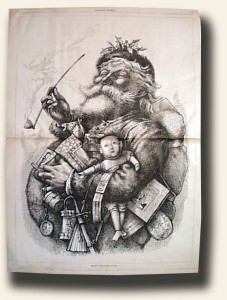
3) Santa Claus prints. It is Thomas Nast who is credited with creating the modern version of Santa Claus, the jolly, rosy-cheeked, rotund purveyor of gifts in the uniform as we know him today. Nast’s first Santa Claus to appear in Harper’s Weekly was titled “Santa Claus in Camp” from during the Civil War, appearing on the front page of the January 3, 1863 issue. Yet it is the January 1, 1881 issue which has the Santa Claus centerfold which still appears in many Christmas advertisements and is perhaps his most famous rendition. There are many issues of Harper’s Weekly which have Santa Claus prints, all very desired among collectors.
True to any symbiotic relationship, with Nast leaving Harper’s Weekly at the end of 1886, he lost his forum to reach the masses, and in losing Nast, Harper’s Weekly lost its political importance. Nast continued his work in other publications, none being very successful, until his death in 1902 to yellow fever. Harper’s Weekly never regained its success from the Nast years, and it ultimately ceased publication in 1916.
Harper’s Weekly issues with Nast prints are very displayable, particularly those which feature Nast images on the front page, or notable icons such as popular politicians, Santa Claus, Uncle Sam and Abraham Lincoln. A very famous Nast cartoon featuring Lincoln is the “Long Abraham Lincoln A Little Longer” cartoon which is in the November 26, 1864 issue, signifying his successful second Presidential election.
All issues offered by Hughes Rare & Early Newspapers are genuine & complete in 16 pages, save for a few described otherwise. In many cases two or three Nast prints appear in one issue.
Additional kudos for, “Reporting the Revolutionary War”…
February 15, 2013 by GuyHeilenman · 2 Comments
 Additional recognition has been received for “Reporting the Revolutionary War“, by Todd Andrlik:
Reporting the Revolutionary War: Before It Was History, It Was News (ISBN: 9781402269677; November 1, 2012; $39.99 U.S.; History; Hard Cover) by Todd Andrlik is being awarded the annual prize of best American Revolution book by The New York Revolutionary War Round Table.
Summing up the Revolutionary War through 1779…
January 25, 2013 by TimHughes · Leave a Comment
The front page of “The Edinburgh Advertiser“, July 23, 1779, has a great letter (see below) signed by “An Englishman” which pretty much sums up the Revolutionary War through the mid-point of 1779. Never before have I seen a more accurate appraisal of the situation in so few words.
A gem in the American Antiquarian Society… Charleston Mercury Extra…
January 14, 2013 by TimHughes · Leave a Comment
In celebration of its 20oth anniversary the American Antiquarian Society published a beautiful exhibition catalog titled “In Pursuit Of A Vision – Two Centuries of Collecting at the American Antiquarian Society”. Featured are a fascinating array of books, documents, maps & other paper ephemera, as well as several very rare & unusual newspapers we felt worthy of sharing with our Rare & Early Newspapers’ collectors (with permission from the A.A.S.).
 “Charleston Mercury Extra“, December 20, 1860
The divisive political events of the 1850s had pitted North against South on numerous issues, including the expansion of slavery into the western territories, tariffs on goods such as cotton, and broader concepts of states’ rights vs. federal law. Political compromises made throughout the decade in an attempt to keep the nation together effectively collapsed with the election of Abraham Lincoln in November 1860. South Carolina, heir to the legacy of states’ rights lion John C. Calhoun, was the first to address the possibility of leaving the Union. On November 10, 1860, four days after the presidential election, South Carolina brought the issue to a head by calling a secession convention for the following month.
Considered by virtue of timing to be the first Confederate imprint, this broadside announced to the public the convention’s declaration, on December 20, 1860, that South Carolina would secede from the United States. This sheet was removed from a wall in Charleston by the Boston-born author Caroline Howard Gilman (1794-1888), who had moved permanently to Charleston following her marriage to the Rev. Samuel Gilman. Gilman mailed the broadside to her daughter Eliza in Salem, Massachusetts. Eliza in turn presented the document to AAS member Nathaniel Paine who, heeding the Society’s call to preserve all printed material relating to the unsettling national events, passed the broadside along to AAS.
A high-resolution image of this issue is viewable at: American Antiquarian Society, #47
A New Year’s Retrospective thru Historic Newspapers…
December 31, 2012 by GuyHeilenman · Leave a Comment
 A New Year’s-themed Pinterest pin-board has just been created through Timothy Hughes Rare & Early Newspapers… History’s Newsstand which we think you will enjoy. Happy New Year!
Pinterest: A New Year’s Retrospective thru Historic Newspapers…
It looks like we might make it to 2013…
December 28, 2012 by GuyHeilenman · 2 Comments
 While the jury is still out, it looks like we just might make it to 2013. The Mayans certainly gave us a few things to think about (or at least the head of the Mexican Bureau of Tourism – what a genius). Apocalyptic fears have generated quite a bit of stir over time and have motivated (inspired?) many to think through the eternal vs. the temporal. While this version of the “end of days” may have been misconceived, the process of giving our mortality serious consideration is certainly worth the exercise. In the meantime, please enjoy a newspaper-based look back at similar end of the word fears posted by the British Newspapers Archives:
It’s not the end of the world!
Historical Newspaper Stories About the End of the World
Merry Christmas… looking back…
December 24, 2012 by GuyHeilenman · Leave a Comment
A few year’s ago we posted an article which is worthy of a revisit. It regards the interaction of enemy troops on Christmas Eve from during WWI. Some stories are worth repeating (see link below). We’ve also created a Christmas-themed Pinterest pinboard we believe will be worth your time to view. Please have a wonderful Christmas. As for our Jewish friends, thanks for providing us with the reason for our season. Happy Chanukah to you as well.
Pinterest: Viewing Christmas thru Historic Newspapers…
Christmas Eve – WWI: A Christmas thought… loving our enemies…
George Washingon speaks out…
December 21, 2012 by GuyHeilenman · Leave a Comment
 As the so-called fiscal cliff rapidly approaches and political tension fills the air, let’s take time to reflect on a time when unity of spirit & purpose under the blessing of God were all we had going for us… and as time would quickly show, it was all that we needed. The September 3, 1777 issue of the Edinburgh Evening Currant, Scotland, contains George Washington’s Manifesto of America. As Tim Hughes describes it:
I’m not sure I’ve seen a newspaper from the UK so replete with American content than this one. One-third of the front page is taken up with the complete & lengthy text of: “The Manifesto of America, By George Washington, Esq., Commander in Chief of the Forces of the United States, In answer to General Burgoyne’s Proclamation“. This document begins: “The associated armies of America act from the noblest motives, and for the purest purposes. Their ‘common principle’ is virtue, their ‘common object’ is Liberty!…” followed by a litany of eloquence which must be read. In the document he makes much reference to Christian values and the guidance of God, bits including: “…that the content has been made a foundation for the completed system of tyranny that ever God, in his displeasure, suffered for a time to be exercised over a forward & stubborn generation…Thus hath God, in his divine and just displeasure, suffered for a time, the exercise of the completest system of tyranny…In our consciousness of Christianity we pray, in all humility, for peace and good will among men, & invite all nations to mutual friendship and brotherly love. These truly Christian objects, we conceive, are to be attained only by Christian means…” and near the end: “…Its event we submit to Him, who speaks the fate of nations, in humble confidence, that as his omniscient eye taketh note even of the sparrow that falleth to the ground, so he will not withdraw his countenance from a people who humbly array themselves under his banner in defence of the noblest principles with which he hath adorned humanity.” The document is signed in type: George Washington.
To view the entire content along with images, please go to: Washington’s Manifesto
Reading the entire Manifesto of America will be worth your time!
Historic newspapers make current headlines… an interview on CNN…
December 14, 2012 by GuyHeilenman · Leave a Comment
A little more than a month ago we introduced Reporting the Revolutionary War: Before It Was History, It Was News, a new book by a collector friend Todd Andrlik. His endeavor, which tells the story of the American Revolution through the eyes of Rare Newspapers, received national recognition through a recent interview on CNN. Please enjoy: History As It Happened
Alister & Paine Magazine visits Timothy Hughes Rare & Early Newspapers…
December 10, 2012 by GuyHeilenman · 1 Comment
 A few weeks ago the staff of Alister & Paine Magazine came to South Williamsport, PA to visit our historic newspapers archives and to interview Tim for the purpose of introducing their readership to the world of Rare & Early Newspapers. It was fun getting to know such well-traveled individuals – introducing them to the hobby and hearing of their varied experiences. Sharing the love for collecting historic newspapers is always a pleasure… and based upon their reactions, “History continues to never be more fascinating than when read from the day it was first reported. The feature story may be viewed at:
Alister & Paine Magazine
Thanks Jenna, Brian, and Kaitlin