

Search
The Rare & Early Newspapers Hobby

Receive the Newsletter

Buy Historic Newspapers

The Frederick Douglass’ Paper… Solomon Northup…
February 24, 2014 by GuyHeilenman · Leave a Comment
 I absolutely love this collectible!
We had in our possession for a number of years an original issue of the Frederick Douglass’ Paper, dated March 17, 1854. It certainly was a grand paper – it being a continuation of Douglass’ North Star. However, while the notoriety of the title was well-established and the angst of slavery oozed throughout, it was a 21st century movie which infused new life into it’s weary 150+ year-old raglinen pages.
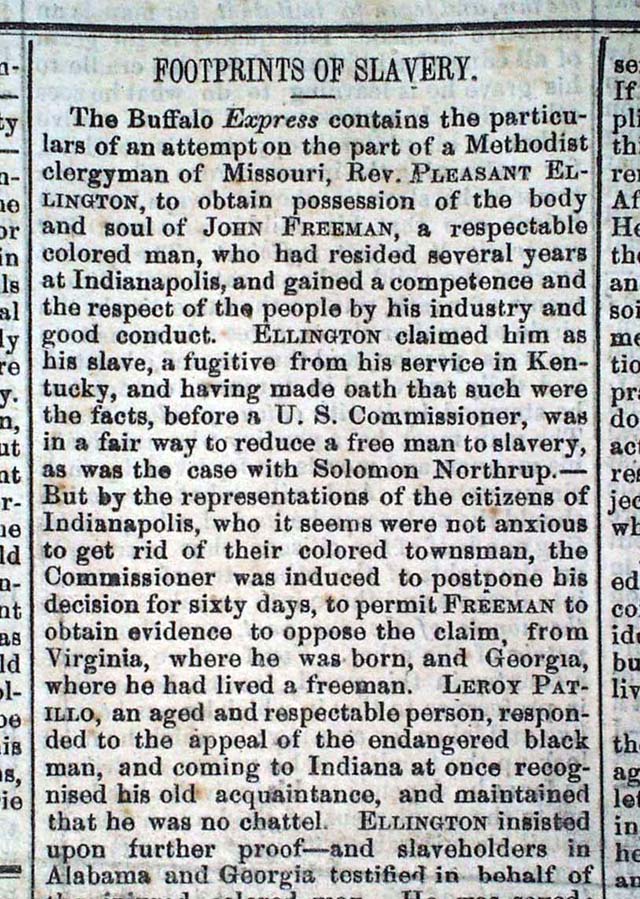
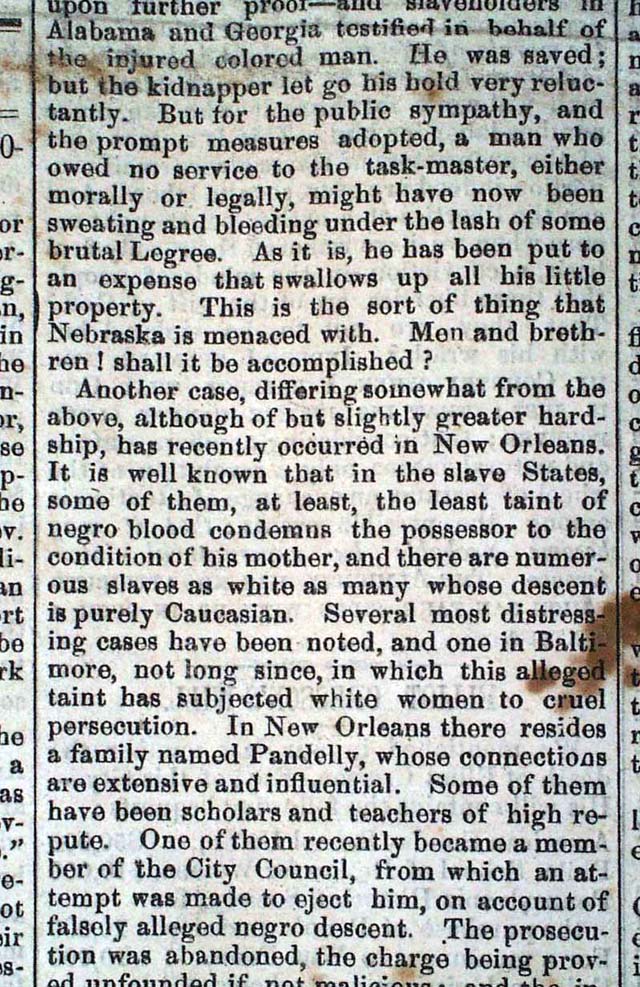
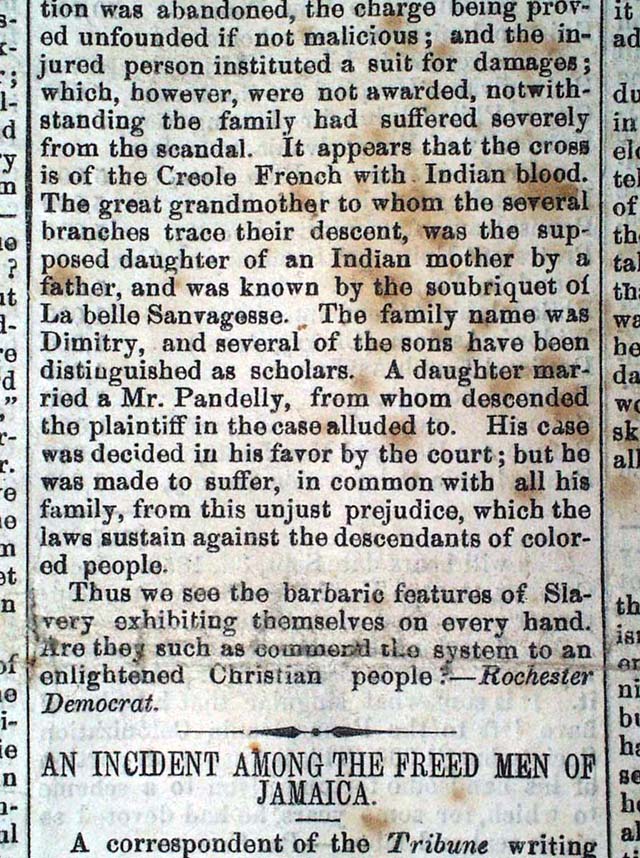
A collector recently went to see the theatrical adaptation of “Twelve Years a Slave – The Memoir of Solomon Northup“, and was moved to visit the Rare & Early Newspapers‘ website to see if we had newspapers with his mention. Searches for his name were unsuccessful – but this collector was not to be deterred. Having previously viewed the Frederick Douglass’ Paper in question, he took the next step and began to go over the corresponding images with a fine-tooth comb. Success. The newspaper was not only noteworthy for its editor and rarity, but it also had an article on the front page with mention of Solomon Northrup (see below). Fantastic.
Like I said, I love this collectible!
A Christmas wish… 2013…
December 23, 2013 by GuyHeilenman · Leave a Comment
While Christmas is certainly a time when many who would not normally do so reflect on the spiritual, historic newspapers reveal a time when the lines between the spiritual and the physical were not nearly so distinct. Religion, while largely stripped from the currently public square, was part and parcel of daily conversation in the not to distant past. An example would be the following report of the importance of religion in the lives of Civil War soldiers found in the Hammond Gazette (Point Lookout, MD) of September 22, 1863. My Christmas wish is that we would regain our previous understanding of the role of true religion in everyday life, minus the driving harsh conditions of the past. Please enjoy.


Where has all the time gone?
November 18, 2013 by GuyHeilenman · Leave a Comment
 Fifty years ago this week my older sister and I came in from carving Matchbox-car-sized roads through the previously well-manicured turf of our backyard to find our mother staring at the semi-snowy, partially visible screen of our black and white television with tears streaming down her face. Not being prone to such outward displays of emotion, her anguish screamed to us that something tragic had happened. This moment was emblazoned in our minds for life… and was reinforced days later when she took us by the hand to lead us on the long trek to the railroad overpass a few miles from our home to peer over the edge to watch a train draped with a flag pass under our feet. President John F. Kennedy was dead! While at the time my sister and I had no idea whether or not he was a good president (for to a child, all presidents are good), one thing we knew for sure, something vanished from people’s eyes which has yet to return – American innocence.
 As we reflect on this snap-shot of innocence lost, we wonder where it all began – that is, the overwhelming common-man devotion which inspired many to “Ask not what your country can do for you…”. When did the admiration of the crowd begin? Was it when he was proclaimed a WWII hero as the Captain of PT-109, or did it spring-forth from his impact as a Massachusetts Representative with his first political election victory? While it may be hard to sort out how he had become so beloved, one thing is certain: a split-second in time along a Dallas street changed everything.
Feel free to share your “memory” of November 22, 1963.
To commemorate this historic moment (November 22, 1963), we’ve assembled a host of “assassination-report” newspapers from all over the country. They are viewable at: JFK Assassination.
Lincoln’s famous letter to Lydia Bixby…
October 28, 2013 by TimHughes · Leave a Comment
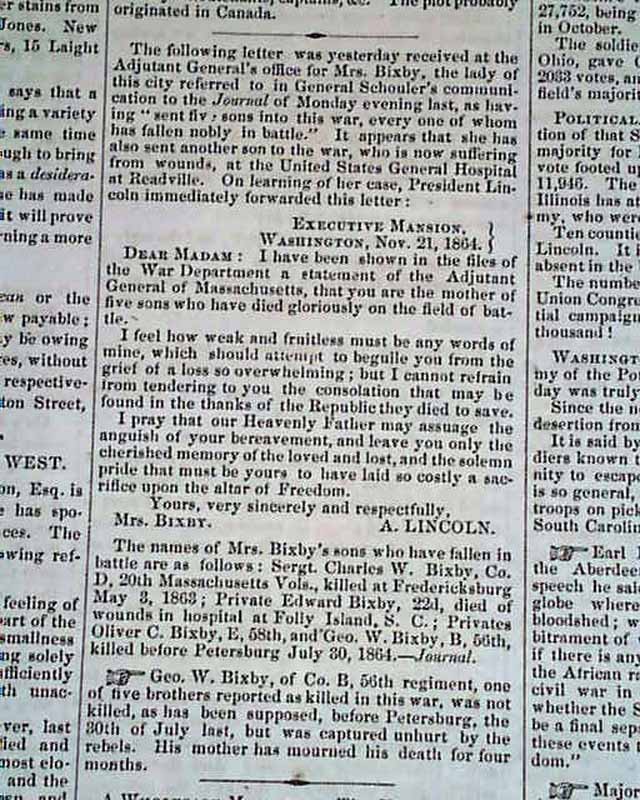
The photo shows the report in the December 2, 1864 issue of “The Liberator” of Lincoln’s very famous & heart-felt letter to a woman who lost five sons in the Civil War. A very sobering report which gives one a small sense of the horror of war not just on the battlefield, but at home as well. This letter has been praised by many as among Lincoln’s best works of writing, along with the Gettysburg Address and second inaugural address.
Historic newspapers… entering on the ground floor of a collectible…
September 30, 2013 by TimHughes · 2 Comments
 In the world of collectables, early newspapers by no means rank among the most well-known of hobbies. In fact most would be surprised that it even is a hobby. Who knows anyone who collects early newspapers?
That was exactly my thought nearly 40 years ago. Having been a coin collector since I was a kid, I knew that hobby well. I knew it well enough to recognize that no bargains could be had for the truly rare coins. Coin collecting was, and is, a well exploited hobby. The number of serious collectors must run in the hundreds of thousands with a proportionate number of dealers who make a living selling coins. So as a youngster with only grass-cutting money in my pocket, it didn’t take long to become frustrated when trying to find the last few desirable coins to fill out a set. I simply could not afford them. Everyone knew they were rare, and with more people wanting them than inventory allowed, prices were beyond my reach.
I liked collecting and I wanted a hobby that dealt with history. Holding a coin minted during the time when Lincoln was President, or when Indian battles were still raging on the Plains, intrigued me. I felt like I was touching history. But I needed a collectable that was yet to be exploited. One which few people were involved in. More importantly, one where I could hope to amass a reasonably nice collection without breaking the bank.
 So it was by accident that while browsing through a local flea market that I came across a Philadelphia newspaper from 1846. I was intrigued, not only by the price–$3—but by what I would get. Quickly my mind ran through the host of various coins from 1846 which would require more than ten times the price tag, and what do you get but a hunk of medal with a date & an image of a dead President? A coin could be fully examined in seconds. But this 1846 newspaper would take half an hour to absorb. So $3 exchanged hands and the newspaper was mine.
Handling this newspaper was better than touching history. Yes, someone in 1846 held this newspaper in their hands, just like coins of the era, but this collectable actually CONTAINED history. News of the day, including events of the Mexican-American War, were within its four pages. Political reports from the term of James K. Polk were scattered throughout. Even the advertisements were fascinating.
I was hooked. The coin collection went on a shelf and I pursued whatever old newspaper I could find. It didn’t take long to discover a whole new world of collectables. Better yet, because so few people were collecting old newspapers prices seemed such a bargain compared to what coins or stamps or any other collectable with similar rarity would cost. I was convinced I got in on the ground floor.
As the years passed my hobby turned into a business catering to a niche market. At best I would suspect there are less than 2000 serious collectors of rare newspapers. Compare that number to the world of stamps, coins, books, or autographs, which hundreds of thousands consider their hobby.
 A hobby still yet to be discovered by the collecting world, prices remain attractive for the most modest of budgets. Consider that a genuine New York Times in very nice condition from 1863 with front page Civil War reports sells for less than $30. Or consider that a genuine London Gazette from 1680—a 330+ year old newspaper—is available for under $50. Of course content certainly drives interest and price so a newspaper reporting the Battle of Gettysburg can exceed $500, while the same in a Confederate title (much more rare) could be triple the price. But still, genuine issues covering the War of 1812 sell for $25; newspapers with Indian battles are under $35; issues with baseball reports from the 1880‘s can be had for $25; newspapers from during the administration of George Washington for $45. Is there a hobby where genuine items of comparable vintage are at comparable prices? Certainly not.
Rare newspaper collecting is a fascinating world which awaits any historical hobbyist. Whatever event or era in history intrigues, newspapers covered those events. From the Great Plague of London in 1666, to reports of pirates Blackbeard and Capt. Kidd, to the French & Indian War, the Revolutionary War, the Lewis & Clark Expedition, the Texas War for Independence, every presidential election & inauguration (and death), the outlaws of the West—you name it. Newspapers exist which document those occurrences and every other transforming event in American & world history.
Don’t just touch history with your hobby. Read history from the very day it was reported. You, too, will be hooked on a hobby you never knew existed.
A video look at Rare & Early Newspapers – revisted…
September 23, 2013 by GuyHeilenman · Leave a Comment
 Over the past 10 years we (RareNewspapers.com) have put together a series of videos designed to help educate novices about the hobby of collecting historic newspapers. While some may be a smidge old (compared to today’s high-tech standards), the information within is still pertinent. Pick a topic of interest, turn up the volume, and enjoy our perspective on the collectible.
Collecting 20th Century Authentic Newspapers
Enhance Your Sports Collectible with Historic Ne…
Collecting Scientific American Issues w/ Historic Content
Collecting 19th Century Authentic Newspapers
Original Wild West Era Newspapers – Rare Newspapers
Meet the Staff of Timothy Hughes Rare & Early Newspapers
Harper’s Weekly & The Civil War – Illustrated Collectibles!
The History of Rare & Historic Newspapers & The Hobby!
Collecting 18th Century (and earlier) Authentic Newspapers
The Rare Newspapers’ Private Collection – Collecting Ideas
Rare Newspapers as an Educational Tool
Exploring the Civil War… 150 years ago, September, 1963…
August 30, 2013 by GuyHeilenman · Leave a Comment
 Last week we explored: “What were those living 150 years ago reading about in the newspapers during the last week of August (1863)” . The response was very positive. We hope you enjoyed the trip back in time. Today we thought we’d look ahead into the past by assembling a similar, by longer chronological list of authentic newspapers from the entire month of September, 1863. Similar to last week, the following link will take you to authentic newspapers that were held by those whose loved ones were fighting to realize their greatest convictions – whether it was to set slaves free, preserve state’s rights over federal dominance, to protect house and home, or another noble cause. The issues have been arranged in chronological order. Enjoy your visit back to this incredibly formative time in American history: Authentic Newspapers (September, 1863)
What meaningful gift do you give to a 90-year-old?
May 31, 2013 by GuyHeilenman · 1 Comment
One of the greatest challenges when it comes to gift-giving is what to purchase for someone in their 50’s-90’s+ that is both unique and meaningful. While we at Rare Newspapers specialize in offering historic newspapers from the 1600’s, 1700’s, and 1800’s, we also offer Birthday Newspapers – issues from  the day someone was born. A recent note from a purchaser of such a gift warmed our hearts. Thanks to R.M. for allowing us to share his response:
Original newspapers for the “Day You Were Born” do make wonderful gifts.
The Civil War in newspapers…
April 29, 2013 by TimHughes · 1 Comment
Could there be a period in American history which fascinates and intrigues more than the Civil War? As we celebrate the 150th anniversary of the battle between the North and the South, collecting interest in genuine newspapers which reported the news as it was happening, remains strong among the relatively small number of rare newspaper collectors. Any visit to a Civil War collector’s show will give evidence to the high prices of genuine memorabilia, from guns to uniforms to every bit and scrap of war-related material a collector might desire. But newspapers remain a very welcomed low-priced option, perhaps largely because they have yet to be discovered by majority of Civil War collectors.
But that has always been the case with this hobby, regardless of the time period. Rare newspaper have always remained relatively unknown in the world of historical collectables—a reality which continues to amaze—but its consequence has provided one of the benefits of those who enjoy the hobby: low prices. Across the entire spectrum of collectables, be they coins, stamps, furniture, books, autographs, toys—you name it–items of comparable age to newspapers are much higher than newspapers.
And what a world is available to the Civil War collector who discovers rare newspapers. You name the battle or political event that happened from 1861 to 1865 and it will be found in a newspaper of the day. And this hobby allows a collection to showcase not just the events of the war but the lead-up to the conflict between the states, as the issue of slavery and the troubling relationship between the Northern and Southern states making news for more than a decade before the outbreak of war.
From the Battle of Fort Sumter to the assassination of Abraham Lincoln, a collector can create a notable collection of newspapers as large or small as their budget will allow. Some might focus on the top ten most significant battles of the Civil War (see previous post) and include newspapers with accounts of Fort Sumter, First and Second Bull Run (Manassas), Hampton Roads (the Monitor vs. the Merrimac), Shiloh (Pittsburg Landing), capture of New Orleans, Antietam, Gettysburg, Vicksburg, Chickamauga, fall of Atlanta, Savannah and Richmond as well as the surrender of General Lee to U.S. Grant. Wikipedia offers an excellent and very inclusive list of all the battles of the Civil War which can be used as a checklist for the collector seeking the most notable events of the war.
Typically daily newspapers have war reports on the front page with additional news on inside pages as well, and a select few included graphics. The “New York Times”, “New York Tribune” “New York Herald” and the “Philadelphia Inquirer” are—in my opinion—the “big 4” titles of the war, as they more than most printed Civil War maps and other war-related graphics on their front pages. Such issues remain favorites for framing and display.
Not to be overlooked are the political events and speeches which were perhaps more significant than the battles, including the election and inauguration of Abraham Lincoln, the Emancipation Proclamation and the Gettysburg Address. All events appeared in newspapers within a day of their happening.
Yet another area of focus for various collectors is the gathering of contemporary reports surrounding certain historic figures such as Abraham Lincoln, Robert E. Lee, Ulysses S. Grant, “Stonewall” Jackson, George Meade, James Longstreet, William Sherman, Jefferson Davis, Ambrose Burnside, Nathan B. Forrest, Colonel Robert Shaw, John Hunt Morgan (and his raiders), to name a few. Textbooks simply cannot capture the essence of these noteworthy individuals in the same way newspapers can.
Some collectors might focus on the Civil War from the Confederate perspective as newspapers from the Southern state are available, albeit more rare, and offer an interesting perspective on the events of the war. Issues from Richmond, the capital of the Confederacy, offer some of the best coverage of the war as all news eventually found its way to Richmond. And the editorials offer fascinating reading in the “Daily Richmond Examiner” or the “Daily Dispatch”. Charleston newspapers also offer great coverage, after all the war began in its harbor. The “Charleston Daily Courier” was one of the best, and one of but a few Southern newspapers which printed in the masthead “Confederate States of America”. Venturing beyond the more “common” of the Confederate titles, newspapers from other states are available, a few of the more accessible being the “Daily Progress” (from Raleigh) and the “Louisville Daily Courier” from Kentucky. The “Daily Memphis Appeal” is an intriguing title, as during its Civil War history it was chased by the Yankees out of Memphis and published in 8 other Confederate cities before succumbing in the final weeks of the Civil War.
A “Confederate” newspaper from the North might seem like a oxymoron, but “The Crisis” from Columbus, Ohio, was an intriguing newspaper by a copperhead publisher who was very much opposed to the Lincoln administration and strongly supported the Confederate effort believing that slavery could not be prohibited by law.
One cannot mention newspapers of the Civil War without discussing “Harper’s Weekly”, the illustrated newspaper which put all the action, drama and cruelty of war into the homes of every American. For the first time, citizens were able to see what their leaders looked like, as an abundance of portraits of the Civil War officers appeared throughout the war years, not to mention the great wealth of battle scenes and city views not found elsewhere during the Civil War. Not to be outdone by the Yankees, the Confederates created their own version of “Harper’s Weekly”, titled the “Southern Illustrated News” published in Richmond, but it was a poor imitation at best. It’s lack of success resulted in a considerably smaller circulation and obviously more rare title for collectors today.
Whatever your interest in the Civil War, collectible newspapers have much to offer. With prices relatively low for 150 year old items and containing virtually every event which happened during that fascinating era, a notable collection can be amassed which can be enjoyed and admired without breaking the bank. A fascinating world awaits those who discover this interesting collectible.
Collecting the Revolutionary War on a budget…
March 28, 2013 by TimHughes · 2 Comments
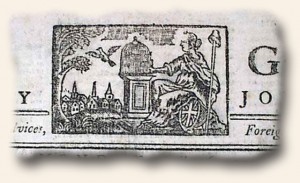 I would argue that beyond the Civil War, the era of American history which evokes the most interest among our collectors is unquestionably the Revolutionary War. With a cast of characters who still rank among the most memorable in history—Washington, Adams, Hancock, Jefferson, Henry, Franklin, Paine, and more—and a plot, which if it were not true history would serve as an excellent screenplay for an exciting movie—an oppressed, energized people seek to break free from the reigns of oppression and dominance from abroad—it is easy to see how the events of the Revolutionary War continue to intrigue and offer a foundation upon which to reflect as today’s world grapples with many of the same issues despite the 230+ years which distance us from those notable events.
And what could be better than experiencing those events just as those who lived through them? Newspapers offer that opportunity. Genuine issues, once held and read by those who lived through those turbulent days before being relegated to the back shelves of libraries, are now part of the inventory of Hughes Rare & Early Newspapers. And at prices which might surprise many (see Revolutionary War issues for $60 and under), as a hobby which is relatively unknown to the collecting world has yet to cause demand and scarcity to drive prices beyond the means of the average collector. Of course, there are still many that fall into the category of what we refer to as, “The Best of the Best – Revolutionary War Edition“.
Of significance is that British titles, which offer excellent coverage of all American events given their role in attempting to placate the demands of the Americans while maintaining control of their colonies, allow ownership of battle reports of the war for under $100, with 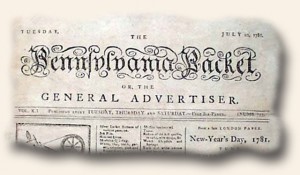 some very notable events in the $200-$300 range. American newspapers remain among the most desired but their scarcity is reflected in their prices. With a collection of the “Pennsylvania Evening Post” which included the Declaration of Independence bringing $600,000 in auction recently, it would amaze many that the same document is available in London’s “Gentleman’s Magazine” issue of August, 1776 (took news 3-4 weeks to traverse the Atlantic) for under $4,000. Other disproportionate prices between British and American newspapers entice many to gravitate to the British titles while prices and availability remain attractive.
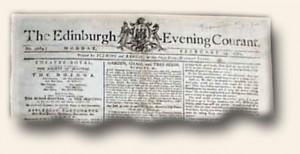
The “London Chronicle” is one of the better British titles in reporting the Revolutionary War. From the Battle of Lexington and Concord, to Bunker Hill, Battle of New York, Saratoga, Washington crossing the Delaware, treason of Benedict Arnold, Guilford Court House, to Cornwallis’ surrender at Yorktown, this newspaper offers coverage which equals the American newspaper accounts. In fact many British reports were taken verbatim from American newspapers. Of equal quality in report news of the day was the “Edinburgh Evening Courant” from Scotland as I have found all events of the Revolutionary War to be reported in this title as well. Other UK titles which covered the war include “The Glocester Journal”, “Aris’s Birmingham Gazette”, the “Edinburgh Advertiser” and the “Glasgow Mercury” to name a few.
But perhaps the best and most available title of the Revolutionary War period would be the “Gentleman’s Magazine” from London, it having a long printing history from 1731 to the 20th century so it encompasses not just the Revolutionary War in great detail by the entire scope of American history. As an added treat this title typically included one of more plates within each issue, which included maps as well. And during the years of the Revolutionary War were found many maps of American colonies, battle sites as well as large foldout maps showing the entire scope of the united colonies at that time. The maps alone have found a keen interest among collectors, separate from the issues in which they were stored for over 200 years. As is true with the British titles mentioned, “Gentleman’s” included all notable events and documents, including the Articles of Confederation, the Causes and Necessity For Taking Up Arms, all major battles of the war thru the treaty between Washington and Cornwallis, and even the document by King George III which officially ended the war. And all the major names of the war from both the British and American sides have found their way into the pages of “Gentleman’s Magazine”.
 American titles are available as well. Some of the more rare would be those from the South which are virtually impossible to find, and when they do surface their prices are beyond the means of most collectors. Some of the more commonly found titles would be the “Pennsylvania Evening Post” from Philadelphia, the “Pennsylvania Ledger” “Boston Gazette” (which featured an engraving by Paul Revere in the masthead), “The Pennsylvania Gazette” and “Pennsylvania Packet” among others. And dipping back a few years before the outbreak of the war, when tensions were building with much evidence in the newspapers of the day, the “Pennsylvania Chronicle” and the “Boston Chronicle” offer excellent insight into events of the day from the years 1767-1769 for under $200 for most issues.
Regardless of your interest in the Revolutionary War, whether it be the famous names that came to prominence, the battles of the war, or a focus on a singular event or locality, genuine newspapers of the day are available for the collector. It is a hobby with limitless possibilities, and offers a unique opportunity to literally hold history in your hands.