

Search
The Rare & Early Newspapers Hobby

Receive the Newsletter

Buy Historic Newspapers

Yet another discovery… I love this hobby!
March 27, 2015 by GuyHeilenman · 1 Comment
From time-to-time we (Rare & Early Newspapers) talk about one of the joys of the hobby being the unearthing of unexpected “finds”. A few weeks ago this was played out in spades as

Guy Heilenman, President, Timothy Hughes Rare & Early Newspapers
we learned that the same issue we had sold for under $50 sold at a well-known auction house for well over $5,000 – the price driven by content we did not know was present. While we do our best to discover such hidden gems before offering issues, the reality is, it is nearly impossible to find everything of historical interest and/or collectable value. Some wonder if hearing about such events bothers us. Quite the contrary. This is one of characteristics of collecting old newspapers which make the hobby so enjoyable. While not all “finds” bring financial reward, it is rare to read through a rare newspaper from cover to cover without finding something unexpected beyond the original reason for purchasing – an interesting ad, the mention of a noteworthy name, contemporary viewpoints which add depth to the key content, etc. What fun!
While we won’t mention the exact date or title (that would be too easy), we will say the issue was from the 1760’s and was not American. 🙂
The City of Boston receives noteworthy journalism award…
March 9, 2015 by GuyHeilenman · Leave a Comment
The following is a note we recently received from one of the collector friends of Rare & Early Newspapers:
Happy to report that the section “Boston Journalism Firsts” and other contents of the Boston Journalism Trail site were used to nominate Boston for the Historical Site in Journalism Award given by the American Society of Professional Journalists, the largest journalists organization in the United States. The organization gave its 2014 award to Boston, thus for the first time honoring a whole city for the totality of its contributions to journalism. The organization’s president is to present the city’s mayor with a memorial plaque to be placed in a public space in downtown Boston in 2015. Thanks for all your support over the years.
To view details:
http://www.spj.org/news.asp?REF=1260
A broken heart… 200+ years ago… today?
February 27, 2015 by GuyHeilenman · Leave a Comment
Anguish… deep sorrow… pain and emptiness that engulf and suffocate… As the saying goes: “The more things change, the more they stay the same.” No matter how far we advance as a race over time, the death of a loved one elicits the same paralyzing emotions today as it did 100… 1000… 5,000 years ago, and will continue to do so as long as humanity walks this earth. Such is the case (in spades) with a parent’s crushed spirit upon the loss of a child. While searching through an original printing of The American Magazine, Philadelphia, dated May, 1792 in the hopes of finding historical content, I came across the printing of a letter from a Father who was trying to come to terms with the untimely loss of his child. Language usage and expression aside, this letter written 200+ years ago could easily have been written yesterday. It also made me thankful for a hope beyond the grave – a hope that shouts from a Father’s pen as he attempts to express his heart… his love… his hope: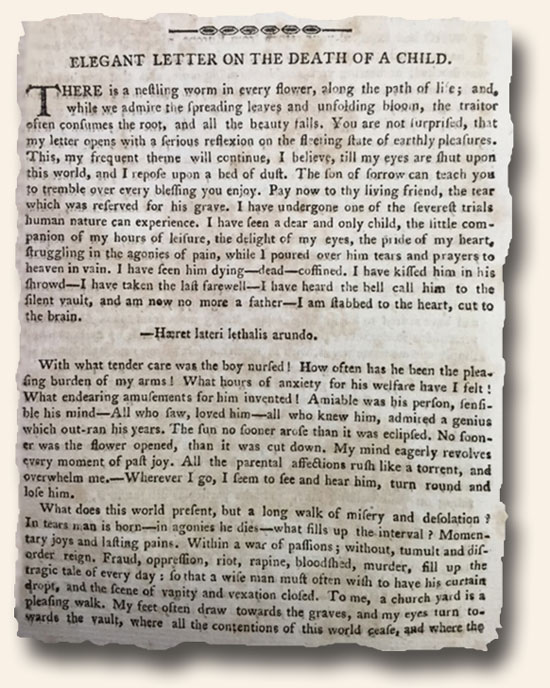

Prices of newspapers… How have the changed?
February 20, 2015 by GuyHeilenman · 10 Comments
One of the questions we often receive at Rare Newspapers relates to the collectible investment value of newspapers over time. Most indicate they do not collect for investment reasons; rather, they do so for the love of “History in your hands.” The embrace our motto: “History is never more fascinating than when it’s read from the day it was first reported.” Newspapers provide glimpses of history in the context of both the exciting and mundane of the era in which it was reported. Still, the question remains. How has the value of Rare & Early Newspapers progressed over time? We posed this question to our founder, Tim Hughes, and the following was his response:
We have to keep in mind that this hobby is a very small one, and when I began 39+ years ago there essentially was no established market, nor any sort of price guide which offered a baseline of values based on content, condition, etc.
I came from the coin collecting hobby and knew from it that the more rare the item, the more values increased through the years. Common date pennies were selling in the 1970’s for about the same prices as from a decade earlier, while the rare dates/coins had increased substantially. I took this information with me when I opted for a hobby which had yet to be exploited by an established collecting industry such as coins, stamps, books, etc. Although I purchased veraciously during my earlier years, always fearful the supply of 150+ year old newspapers would dry up, I have found that the common, generic material was always plentiful—and still is today. What has not been plentiful are newspapers with historic reports, and newspapers which are themselves very rare. The “less plentiful” issues have appreciated considerably over the last 39 years, while generic issue values are really not much different today than they were 39 years ago. Example: I always offered a 10-issue wholesale lot ever since my first catalog, then priced at $19.50. The same lot today is $24.95, and I suspect some of that increase is more to help offset increased shipping costs. And I think we have a virtually unending supply.
How much have values of historic & rare issues increased? It can be difficult to say as we have never made a point to keep comparative records as it seemed a bit meaningless for our purposes. But in general I would say they have increased 5-fold to 10-fold in the post 30 years. I’m not going to consider my first 9 years in the business as any sort of gauge as I was still feeling my way thru the hobby; raising & lowering prices as my customers would react (or not react). An anecdotal story: early on in my enterprise I purchased a bound volume of a Santa Fe, NM newspaper from 1881. Amongst the 150 or so issues was a run of, perhaps, 40 issues each having a little reward ad for the capture of Billy the Kid. Figuring a novice such as myself coming across the volume, and the fact that there were so many issues with the ad, I logically presume it was not very rare. I think I sold those issues for $35 or so each. If I would have those issues today I think we could get $700 each. That  doesn’t mean the value has increased by 2000%. It speaks more to my ignorance of what they should have sold for 35 years ago. Unfortunately that incident wasn’t my last such learning experience.
Perhaps one of the more “common” of the very historic issues would be the Gentleman’s Mag. with the Declaration of Independence. We sold it for under $2000 ten years ago, and now we sell them for $4000. So this document in this title has doubled in 10 years, and I could never say that it is “rare” as we encounter this issue perhaps twice a year. It is extremely historic, but not truly rare. Truly rare items would have increased much more dramatically. In fact truly rare items don’t come on the market any more. I have few qualms offering a truly rare event/newspaper for 4 or 5 times our last price if we only had it twice in 39 years.
As is always the case–and as it truly should be in a free market economy–the collectors ultimately determine the prices of our material. There have always been high-income collectors who have kept the rare items rising in value at a consistent rate, while more common items have languished in value because collectors are not taking them off our shelves.
I cannot say that there has been any period over the last 39 years when the hobby was either “hot” or “cold”. I think whether values have rising nominally or dramatically, they have done so in a rather consistent curve, unaffected by the economy or stock market ups & downs.
I still believe the hobby is very much in its infancy. The vast majority of people have no idea that our hobby exists, and I have always felt the time will come when that will change. I don’t have to tell you that in a comparative sense with other collectables, our hobby seem dramatically undervalued.
Tim
People collect rare newspapers for various reasons – investment purposes being one of them. Finding hidden historical gems, preserving history, immersing oneself in an era and/or event, as a companion collectible to another collectible interest, etc. What a great hobby!
How Paul Revere’s Ride Was Published And Censored IN 1775…
February 6, 2015 by GuyHeilenman · Leave a Comment
 Todd Andrlik, founder and editor of Journal of the American Revolution, and curator, author and editor of Reporting the Revolutionary War: Before It Was History, It Was News (Sourcebooks, 2012), has assembled and written a great piece of scholarship in regards to Paul Revere – specifically, how he was viewed by his contemporaries, using the lens of original newspapers of his day. An excerpt is as follows:
Because of Henry Wadsworth Longfellow’s famous poem, “Paul Revere’s Ride,” most people think that Revere was critical to the start of the Revolutionary War. In trying to dispel Longfellow’s myth of a lone hero, modern scholars have portrayed Revere as just one rider among dozens on 18-19 April 1775, and argued that his previous rides for the Patriot cause might have been more important. A survey of newspapers from 1774 and 1775 shows that in fact those earlier rides had made Revere prominent enough that he did stand out in reports of the fighting at Lexington and Concord, even as Massachusetts authorities kept the extent of his activities quiet.
Paul Revere was a man who wore many hats. He was well known throughout New England for his engravings, his silver work, his Masonic fellowship and his political activity. Plus, in 1774 and early 1775, Revere worked as an express rider for the Boston Committee of Correspondence and the Massachusetts Committee of Safety. He frequently carried letters, newspapers and other important communication between cities, including Boston, Hartford, New York and Philadelphia. Revere’s early dispatches related to some of the biggest American events of the eighteenth century, including the destruction of the tea, the Boston Port Bill and the Suffolk Resolves. In December 1774, at the age of 39, he rode to Portsmouth to alert local Patriot leaders that the Royal Navy was on its way to seize gunpowder and arms from Fort William and Mary. Newspaper printers would eagerly print Revere’s tidings, frequently attributing…
This is a must-read article! View Todd’s scholarship in its entirety at:
How Paul Revere’s Ride Was Published And Censored In 1775
Before heading out to Your New Year’s Eve Party…
December 31, 2014 by GuyHeilenman · Leave a Comment
While celebrating the onset of the New Year through alcohol-blurred eyes has become an international tradition for many, before heading out to this year’s party, perhaps a gander at Dr. Benjamin Rush’s well known “Moral & Physical Thermometer” from the 18th century is in order (see below). While this work certainly holds a degree of validity, I wasn’t aware God measured morality according to such a scale, and I’ve searched without success to find such a tool within His Word. Might Dr. Rush have been using a different translation – or was this creation garnered from years of observation??? 🙂 Regardless, while no such measuring stick has been bestowed upon humanity by their Creator, taking heed to the inherit dangers of over-consumption and His warnings regarding drunkenness would be both a wise and safe way to begin the new year. The passengers and drivers of vehicles you’ll be passing on your way home thank you in advance. Cheers!
For United We Stand…
December 8, 2014 by GuyHeilenman · Leave a Comment
“And if a house is divided against itself, that house will not be able to stand.”
(God, as written by Mark in Mark 3:25)
“United we stand, divided we fall.”
(Aesop)
“A house divided against itself cannot stand.”
(Abraham Lincoln)
“For united we stand; Divided we fall. And if our backs should ever be against the wall. We’ll be together…”
(The Brotherhood of Man)
Bringing people together is no small task. Those who have the ability to rally factions behind a common cause are few and far between. Those who can do so for a noble cause are a true rarity.
While we all acknowledge Abraham Lincoln’s efforts to this end as exemplified in both his “House Divided” speech and yet again in his “Gettysburg Address”, it was another relatively unknown true American patriot who was instrumental in doing the same soon after the close of the American Revolutionary War: Dr. Benjamin Rush. Below please find (and enjoy) the full text of “Address to the People of the United States”, which begins:
“There is nothing more common that to confound the terms of the American revolution with those of the late American war. The American war is over; but this is far from being the case with the American revolution.”,
and concludes:
“PATRIOTS of 1774, 1775, 1778—HEROES of 1778, 1779, 1780! come forward! your country demands your services!—Philosophers and friends to mankind, com forward! your country demands your studies and speculations! Lovers of peace and order, who declined taking part in the late war, come forward! your country forgives your timidity, and demands your influence and advice! Hear her proclaiming, in sighs and groans, in her governments, in her finances, in her trade, in her manufactures, in her morals, and in her manners, ‘THE REVOLUTION IS NOT OVER!’ “, Dr. Benjamin Rush, MD.
What a tremendous rally for all Americans to unite behind a noble cause: the establishment of a nation like none other!
To read the complete text of this amazing speech, go to: American Museum, January, 1787
Exploring newspapers, 1900-1949… Any Discoveries?
November 14, 2014 by GuyHeilenman · 3 Comments
A unique pleasure one often experiences from the collecting of Rare & Early Newspapers is the hidden nuggets found within nearly every issue. Whereas collectible newspapers are often purchased due to their historic headlines or perhaps their rarity, the undisclosed content – whether articles or ads – often provides intrigue and a historical perspective that go far beyond the original reason for seeking the issue.
With this in mind, let’s have some fun!
This post will serve as a home for collectors to brag about the non-headliner discoveries they’ve found within newspapers dated from 1900-1949. Share your finds. All we ask is for everyone to refrain from using this post as a means for offering collectible newspapers for sale. It’s intended to purely be a “no-agenda” platform for sharing one of the simple joys of collecting.
If you are new to the hobby (or already are a collector) and would like to join in the hunt, to help you get started we are offering a highly discounted set of 5 issues, one per decade, covering the 1st half of the 20th century. This offering may be viewed at: Five-Issue Set (1900-1949)
13th to 19th Amendments and Beyond…
September 29, 2014 by GuyHeilenman · 1 Comment
 The National Park Service recently posted a page on one of their park sites titled: “Brown vs. Board of Education – The 13th to 19th Amendments and Beyond”. The post certainly is informative and their use of historic newspapers and magazines (Harper’s Weekly, Frank Leslie’s Illustrated, The Crisis, Taunton Daily Gazette) to provide visual and historic depth to the topic will be of particular interest to rare & early newspaper collectors. Please enjoy: Brown vs. Board of Education
A gem in the American Antiquarian Society…
July 28, 2014 by TimHughes · 1 Comment
In celebration of its 20oth anniversary the American Antiquarian Society published a beautiful exhibition catalog titled “In Pursuit Of A Vision – Two Centuries of Collecting at the American Antiquarian Society”. Featured are a fascinating array of books, documents, maps & other paper ephemera, as well as several very rare & unusual newspapers we felt worthy of sharing with our collectors (with permission from the A.A.S.).
 63. “The New-England Courant“, Boston, February 5, 1722
As a member of the family which controlled the Boston Globe,and as the newspaper’s treasurer from 1893 to 1937, Charles Henry Taylor avidly collected publication on the history of American printing and journalism. He generously donated to AAS anything it lacked. Among his gifts were runs of many important American newspapers, including this issue — the second earliest at AAS — of The New-England Courant.
Only the third newspaper to be printed in Boston, The New-England Courant was published by James Franklin from 1721 to 1726. During the Courant’s first two years, its popularity was bolstered by the publication of fourteen letters from one “Silence Dogood,” the nom de plume of James’s younger brother and apprentice, Benjamin Franklin. But the Courant had a contentious history, as James was often at odds with the provincial government, the powerful Mather family, and other influential Bostonians. In 1723 James was imprisoned by the Massachusetts General Court and ordered to suspend the Courant, a ban which James circumvented by issuing the paper under his brother’s name. Even after Benjamin ran away to Philadelphia in October of that year, the Courant continued to appear under this imprint until it ceased publication.
The front page of this issue contains an extensive article on the smallpox inoculation controversy then raging in Boston. While Cotton Mather and other clergy supported inoculation, many Bostonians disagreed. James Franklin opposed the practice in this and many subsequent articles.