
Search
The Rare & Early Newspapers Hobby

Receive the Newsletter

Buy Historic Newspapers

The Traveler… the first “learned society” of Washington, D.C.
August 15, 2016 by The Traveler · Leave a Comment
I traveled today to Washington, D.C. by the way of the National Intelligencer dated August 15, 1816. I found there the announcement of the creation of the first “learned society” in Washington D.C.: “A number of the citizens of the District of Columbia, impressed with the importance of forming an association for the purpose of promoting useful knowledge, met on the 28th day of June, 1816,… agreeably to public notice the committee appointed as aforesaid reported the following draft of a constitution which was unanimously agreed to, after having changed the name of the association to that of the COLUMBIAN INSTITUTION for the promotion of Arts and Sciences…” (see image below).
They were responsible for the acquiring the many different species of plants and trees, an idea to apply to Congress for “the appropriation of about 200 acres of ground called “the Mall” which was designed in the original plan of the city for a public garden, the beginning of the botanic garden, many items which are now in the Smithsonian Institute, and more. Many prominent people of the day became were members, including some Presidents.
~The Traveler
Great Headlines Speak For Themselves… the Hindenburg tragedy!
August 11, 2016 by The Traveler · 2 Comments
The best headlines need no commentary. Such is the case with the NEW YORK AMERICAN, May 7, 1937: “HINDENBURG EXPLODES AT LAKEHURST; 35 DEAD“:
A gem from the American Antiquarian Society… The Kentucky Spy…
August 8, 2016 by TimHughes · Leave a Comment
In celebration of its 20oth anniversary the American Antiquarian Society published a beautiful exhibition catalog titled “In Pursuit Of A Vision – Two Centuries of Collecting at the American Antiquarian Society”. Featured are a fascinating array of books, documents, maps & other paper ephemera, as well as several very rare & unusual newspapers we felt worthy of sharing with our collectors (with permission from the A.A.S.).
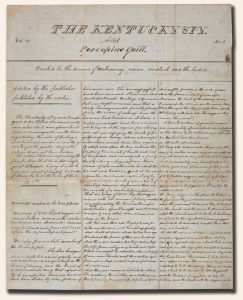 181. “The Kentucky Spy and Porcupine Quill“, Frankfort, Kentucky, January 25, 1849
In recent years AAS has actively collected issues of pre-1877 American manuscript periodicals. These handwritten examples mimic printed periodicals in format and content, containing stories, news, and advertisements. Sometimes they were produced by individuals, serving as the manuscript equivalent of amateur newspapers, and sometimes they were issued by small groups. Others were produced as an activity of a school or lyceum.
AAS has held manuscript periodicals since the nineteenth century; but because these were long shelved alongside printed periodicals, they were easily overlooked. In the 1990s AAS staff began to pull them together into a separate collection, in the process discovering not only how many titles were already at AAS, but also the frequency with which they were produced. As it became apparent that the more specimens AAS had, the more they collectively revealed about early American scribal culture, AAS began to seek them actively. The collection now numbers more than sixty titles.
One of the more unusual is “The Kentucky Spy and Porcupine Quill.” The masthead claims that it is “Devoted to the science of matrimony, union, wedlock and the ladies.” However, the chief story, entitled “Wonderful rumpus in the town of Irvine,” is a fictional account, humorous in tone, of a revolt by 5,000 heavily armed slaves which in the story turns out to be a hoax. The editor and contributor(s) are unnamed.
An August, 2016 stroll back thru time – 50, 100, 150, 200, & 250 years ago…
August 4, 2016 by GuyHeilenman · Leave a Comment
 What news was reported in the month of August – 50, 100, 150, 200, and 250 years ago (1966, 1916, 1866, 1816, 1766)? Such a walk back through time via the eyes of those who read the daily and weekly newspapers of the period can be quite revealing. This is why we often say, “History is never more fascinating than when it’s read from the day it was first reported.” The following links will take you back in time to show the available newspapers from the Rare & Early newspapers website. There’s no need to buy a thing. Simply enjoy the stroll.
The Traveler… senseless tragedy…
August 1, 2016 by The Traveler · Leave a Comment
 Today I traveled to New York City by the way of The New York Times dated August 2, 1966. There I found tragedy had stuck the campus of University of Texas. “An architectural honor student who had been undergoing psychiatric care carried an arsenal of rifles and pistols to the top of the 27-story University of Texas tower today and shot 12 persons to death before the police killed him. The student’s wife and mother were later found dead in their homes… The police identified the man as Charles J. Whitman…”. In all, he had shot an additional 34 people.
~The Traveler
The Holocaust… Truth be told…
July 28, 2016 by GuyHeilenman · Leave a Comment
TRUE: The Nazis inflicted unspeakable atrocities on millions upon millions of people.
TRUE: Most of the world was shocked as details of the horrors were revealed after the war.
FALSE: The Nazis’ agenda was a deep-kept secret.
FALSE: Remaining silent and/or turning a blind eye to evil makes it go away.
How could the Hitler-orchestrated holocaust have happened without the world’s knowledge? Since the end of WWII many have distanced themselves from complicity due to inaction. Nations and individuals both often declare they had no idea such atrocities were taking place – stating evidence of Adolph Hitler’s extreme intentions were kept under wraps. However, truth be told, the entire world was not unaware of Hitler’s desire and willingness to do whatever it took to create a so-called “pure” race. Articles regarding his agenda reached American newspapers as far back as the early 1930’s.  This point was recently brought to our attention as we were perusing the New York Times for December 8, 1931. There we found a front page report with the two-column heading: “Nazis’ Would Assure Nordic Dominance, Sterilize Some Races, Ban Miscegenation”, with considerable details to follow. Perhaps the world didn’t realize the extent of the horrors that were occurring, but this article, as well as a score of others, certainly should not have gone unnoticed.
This certainly begs the question: “Are similar atrocities happening today? Are other mass-forms of oppression, brutality, or worse taking place within our reach? We can look away, but a verse from the Bible reminds us: “Remember, it is sin to know what you ought to do and then not do it (James 4:17).” We may put our head in the sand, but we are not without excuse. Hopefully the truth regarding our past mistakes will spur us to proper action today.
A curious find that lead to more than expected…
July 25, 2016 by TimHughes · Leave a Comment
Although not a poetry aficionado, I am aware that “Leaves Of Grass” by Walt Whitman is considered a seminal work in 19th century literature. So when I stumbled across a small article on page 7 of a New York Tribune issue dated Oct. 10, 1855 I took a moment to read it. Most of the report is taken up with a letter signed in type: R. W. Emerson, so my interest was piqued.
After a number of Google searches I discovered this report to be much more significant that I might have thought.
Although considered highly controversial during his era, “Leaves of Grass” has infiltrated popular culture & been recognized as one of the central works of American poetry. As such, the article is interesting, mentioning in part: “…call the attention of our readers to this original & striking collection of poems, by Mr. Whitman…could not avoid noticing certain faults which seemed to us to be prominent in the work. The following opinion, from a distinguished source, views the matter from a more positive and less critical stand-point:…” and what follows is the famous letter by Ralph Waldo Emerson–who inspired this work by Whitman–in which he comments: “…I find it the most extraordinary piece of wit and wisdom America has yet contributed…I am very happy in reading it, as great power makes us happy…” and even more, signed in type: R. W. Emerson. This original letter is in the Library of Congress.
This letter’s appearance in the Tribune would seem to be the only newspaper printing of the time, as records indicate that the: “…letter to Whitman from Ralph Waldo Emerson, 21 July, 1855 is among the most famous letters ever written to an aspiring writer…Without asking Emerson’s permission, Whitman gave this private letter to Charles Dana [managing editor of the New York Tribune] for publication in the New York Tribune on October, 1855.” (see this hyperlink).
If we only new just how close… But what we don’t no won’t hurt us…
July 21, 2016 by GuyHeilenman · Leave a Comment
 Have you ever tried to be ind to someone or to treat them like an ing? Does your house have an itchen and do people need to nock before they enter? Have you ever seen a football player run back an ickoff for a touchdown or a boxer ock-out his opponent with a single punch? Thanks to the impassioned early 19th century arguments in defense of keeping the letter “K” in our alphabet, the answer to all the above is an emphatic “no”. Of course we are left with the tension created by “know” vs. “no” and “knew” vs. “new”, but such stressors are a small price to pay for being able to get down on one knee to propose or to greet a loved one with a kiss. I for one are sure glad we ept it! The complete article may be read at: The Port Folio, May 23, 1801.
The Traveler… born to raise !%@#…
July 18, 2016 by The Traveler · Leave a Comment
 Today I traveled to New York City through The New York Times dated July 18, 1966. The headline was announcing “Suspect in 8 Killings to Get Hearing Today”. “Richard Franklin Speck, the suspect in the slaying of eight women in a nurses’ dormitory last Thursday, was under heavy guard today. Speck was taken into custody early this morning after he had been raced from a skid row hotel to Cook County Hospital for treatment of self-inflicted arm wounds in an attempted suicide… The police were guarding against a possible assassination attempt…”
The surgeon caring for Speck’s wounds is the person that positively identified him and had the police called. Shortly before he saw Speck, he had read the newspaper article and saw his photo. “…I picked up his head and looked at the nurse to see if she had noticed. I said to her, ‘Get the paper.’ I remembered the tattoo… Born to Raise Hell… Then he moistened his finger tips and began rubbing the patient’s left arm and disclosed the tell-tale marking…”. Later Speck asked the doctor what he was going to do with the $10,000 reward.
~The Traveler
Don’t believe everything you read… Hitler rise to power unlikely!
July 14, 2016 by GuyHeilenman · Leave a Comment
One of my favorite quotes regarding the internet, but whose founding warning-principle is rooted in print media is:
“The problem with internet quotes is that you can’t always depend on their accuracy.” -Abraham Lincoln, 1864
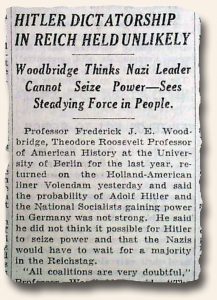 You simply cannot believe everything you read, hear, and in some cases, see. In most instances the misinformation is at least somewhat unintentional. However, sometimes even the well-intended get it wrong – including the so-called experts. Such is the case with a report in the August 16, 1932 edition of the New York Times. The heading in question reads: “Hitler Dictatorship In Reich Held Unlikely“. Just to be sure the heading would not be misinterpreted, a segment of the corresponding text states: “…the probability of Adolph Hitler and the National Socialists gaining power in Germany was not strong…” Let’s just say Frederick J. E. Woodbridge, an esteemed professor of American History at the University of Berlin, was a bit off the mark.