

Search
The Rare & Early Newspapers Hobby

Receive the Newsletter

Buy Historic Newspapers

The Traveler… the loss of a first…
July 17, 2017 by The Traveler · Leave a Comment
I traveled today to Philadelphia, Pennsylvania, by the means of The Pennsylvania Gazette of July 16, 1767. Within the issue I found the report  about the death of the first child ever born in Philadelphia. “At Kennet, in Chester County, the 5th Instant, died JOHN KEY, in the 85th Year of his Age, and the next Day was interred in the Burial Place belonging to the People called Quakers, in the Township, attended by a large Number of reputable People, his Neighbours, and Acquaintance, —- He was born in a Cave, long afterwards known by the Name of Penny-Pot, near Race-street, and WILLIAM PENN, our first Proprietor, gave him a Lot of Ground, as a Compliment on his being the first Child born in this City… His Constitution was very healthy till about 80, when he was seized with the Palsy, and continued weakly till his Death, —- About 6 Years ago he walked on Foot from Kennet to Philadelphia in one Day, which is near 30 Miles…”
He sounded like a very remarkable man.
~The Traveler
Are you smarter than a 18th century 5th grader? Math exercises within Gentleman’s Magazines…
July 13, 2017 by GuyHeilenman · 2 Comments
As we continue to explore the diversity of content found on the pages of 18th and 19th century Gentleman’s Magazines, our attention was drawn to the abundance of Mathematical challenges found within many issues – particularly those from the 1700’s. Rather than opining on the difficulty level of the quests as opposed to what might be expected of the average reader of a common (blog) post or publication of the 21st century, especially since we have no idea as to the intended target audience. Instead, let’s just enjoy the challenge as if we were living just prior to the American War for Independence.
The challenge: On a somewhat regular basis the publisher would provide a set of Mathematical exercises and invite their subscribers to submit solutions. These responses would then be printed (along with the names of those who submitted them) within a future magazine – typically 1-3 months later. The set shown below is from an issue dated May, 1768. Go ahead and give the problems a try. As an act of 21st century kindness, next Thursday I’ll post the solutions which were submitted in 1768. Are you bold? Go ahead and reply with your solutions prior to next Thursday and allow the collectible world to observe your mathematical genius – or at least your ability to rival the math-prowess of a 17th century 5th grader – or mathematics professor of the period. Enjoy.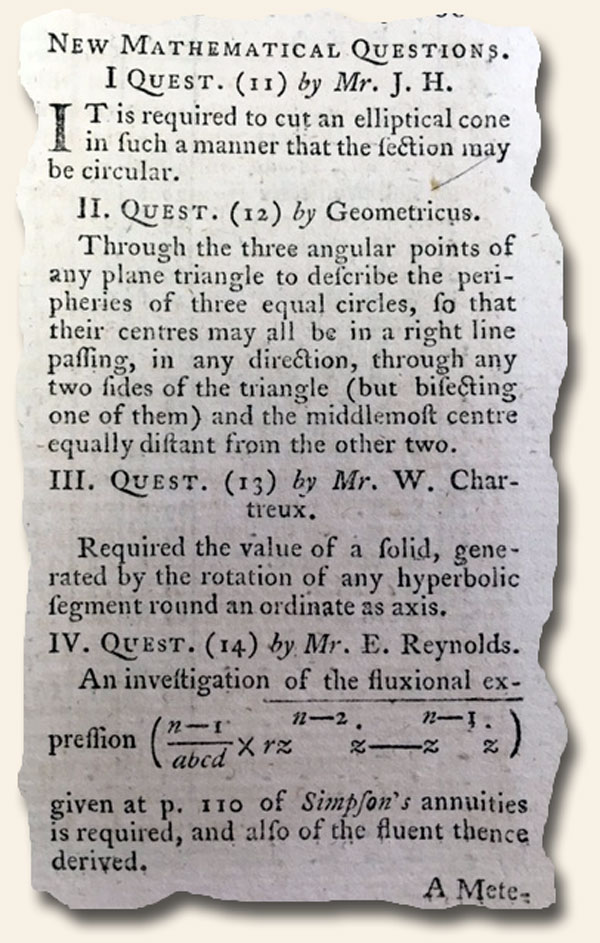
Some things actually do change…
July 10, 2017 by GuyHeilenman · Leave a Comment
 One of the things that struck me while discussing the American Declaration of Independence and Constitution with my children earlier this month was the insight of the American forefather’s demonstrated in their framing of the foundation of this new experiment in self-rule. While some might point to the flaws found within many of the founding documents, procedures, underlying beliefs, and early practices to poke holes in our current state of government, truth be told the seeds of change were sewn throughout the fabric of this new society – avenues which have allowed for peaceful and rightful adjustments to be made over time. Sure, there were times when peaceful change took a backseat, however, many changes have occurred through the prescribed method for making country-wide adjustments: the amendment process. This truth came to light recently when I came across a headline (Los Angeles Times, June 11, 1979) announcing a Supreme Court decision regarding the rights of the handicapped (see images). Was their prior decision regarding the Rehabilitation Act of 1973 correct? How about this related-decision? How were the rights of the handicapped perceived prior to the 1973 decision? Now? Sometimes the changes made over time are quite dramatic. At other times, the adjustments have as much to do with how we describe things, such as the 1990 Amendment which replaced all appearances of the word “handicapped” with “disabled.” Things really can and do change over time.
As a side note, I also happened to notice that on the same day, The Supreme Court refused to hear an appeal by Madalyn Murry O’Hair aimed at having the inscription, “In God We Trust” eliminated from all U. S. coins. Wikipedia notes: “”In God We Trust” as a national motto and on U.S. currency has been the subject of numerous unsuccessful lawsuits. The motto was first challenged in Aronow v. United States in 1970, but the United States Court of Appeals for the Ninth Circuit ruled: “It is quite obvious that the national motto and the slogan on coinage and currency ‘In God We Trust’ has nothing whatsoever to do with the establishment of religion. Its use is of patriotic or ceremonial character and bears no true resemblance to a governmental sponsorship of a religious exercise.” Yes, somethings do change, but others, at least for now, remain the same. However, thanks to the wisdom of those who have gone before us, “We, the People” have a given means for expressing our views and may continue to do so until those who wish to silence dissent rule the day. 
The Traveler… O Canada!
July 6, 2017 by The Traveler · 2 Comments
 Earlier this week I traveled to New York City by the way of The New York Times dated July 2, 1867 where I found the headline “The Dominion of Canada” with the subhead “Inauguration of the Confederation — A General Holiday — Lord Monck Sworn in — Review of Troops”. “This day has given birth to the political infant, the Dominion of Canada…” This was the announcement of the birth of Canada.
Happy (belated) birthday Canada!
~The Traveler
Announcing: Catalog #260 (for July, 2017) is now available…
July 3, 2017 by GuyHeilenman · Leave a Comment
Rare Newspapers’ monthly offering of collectible newspapers, Catalog 260, is now available. This latest collection of authentic newspapers is comprised of nearly 350 new items. Some of the noteworthy content includes:
• Period printing of the Declaration of Independence…
• Lincoln delivers his Gettysburg Address…
• Dealing with the hated tea tax…
• Washington’s Farewell Address…
• First report of Lincoln’s assassination…
• Displayable Battle of Gettysburg issue…
To view the above key issues and a whole lot more, go to: Catalog 260
(The catalog links shown above will redirect to the latest catalog in approximately 30 days.)
Victor Hugo – poetry in early 19th century Gentleman’s Magazines…
June 29, 2017 by GuyHeilenman · Leave a Comment
In our opinion, one of the early titles we come across, The Gentleman’s Magazine, is grossly underappreciated. This London “Reader’s Digest-sized” publication which spanned the early 18th through mid-19th centuries and was known for great reporting from throughout the world, was also pregnant with book reviews, poetry, mathematical challenges, birth and death notices, and an abundance of plates depicting everything from maps to sketches of rare animals, historical cathedrals, and notable men and women of the era. While we’ve written about this title in previous posts (view posts), our attention this time around is in regards to poetry – with a question.
Whereas nearly every issue contains poetry of the period, the poets are often unknown to me, and therefore, rarely catch my eye. However, during the process of scanning The Gentleman’s magazine for July, 1833 looking for content related to the Slavery Abolition Act of 1833, one name in the heading of a poem caught my eye: Victor Hugo. After reading the poem – and being moved, I became curious as to whether this was an early (1st???) printing – and therefore more valuable as a collectible, or if he had penned it many years prior. Unfortunately a cursory on-line investigation came up empty in regards to a validation that the poem was even written by him, let alone its original date of publication. Of course this begs the question: Can anyone attribute this to him and/or confirm its first printing? If anyone is in the know, please share your knowledge with the collectible community. Thanks in advance. AND as for the poem itself:
It’s amazing what one often finds buried in old newspapers…
June 22, 2017 by GuyHeilenman · Leave a Comment
 Flowers, leaves, photos, clumps of hair, historic trinkets… The list of what might be found buried within and among the inside pages of historic newspapers continues to foster our love for the collectible. The latest discovery? As we were scanning a September 22, 1880 issue of The Boston Investigator hoping to find a mention of Thomas Edison (which turned out to be successful), we noticed an article titled: “Strange Tribe Of Jews Discovered In The Caucasus”, which turned out to be quite interesting:
The Traveler… boxed himself into a corner…
June 19, 2017 by The Traveler · Leave a Comment
 Today I traveled to New York City by the way of The New York Times dated June 21, 1967. I found on the front page “Clay Guilty in Draft Case; Gets Five Years in Prison” “U. S. Judge Also Fines the Boxer $10,000 for Refusing Induction”. “A Federal District Court jury tonight convicted Cassius Clay [Muhammad Ali], deposed heavyweight champion, of violating the United States Selective Service Code by refusing to be drafted into the armed services. The offense is a felony… sentenced to five years in prison and fined him $10,000… draft boards had had ample reason to deny Clay an exemption from military service on his contention that he was a minister for the Black Muslims… The 25-year-old boxer offered almost no defense against the Government’s charge and did not take the witness stand himself…”
~The Traveler
The June (2017) Newsletter from Rare & Early Newspapers…
June 17, 2017 by GuyHeilenman · Leave a Comment
 Each month the staff of Timothy Hughes Rare & Early Newspapers sends out a newsletter to our members which includes special offers, discounts, alerts to new inventory, and information related to the rare newspaper collectible. Our most recent newsletter may be viewed at:
JUNE (2017) NEWSLETTER – RARE & EARLY NEWSPAPERS
A June, 2017 stroll back thru time – 50, 100, 150, 200, & 250 years ago…
June 12, 2017 by GuyHeilenman · Leave a Comment
 What news was reported in the month of June, exactly 50, 100, 150, 200, and 250 years ago (1967, 1917, 1867, 1817, 1767)? Such a walk back through time via the eyes of those who read the daily and weekly newspapers of the period can be quite revealing. This is why we often say, “History is never more fascinating than when it’s read from the day it was first reported.” The following links will take you back in time to show the available newspapers from the Rare & Early newspapers website. There’s no need to buy a thing. Simply enjoy the stroll.