
Search
The Rare & Early Newspapers Hobby

Receive the Newsletter

Buy Historic Newspapers

A 49 year search comes to an end… The 1765 “Tombstone” issue…
September 1, 2025 by TimHughes · Leave a Comment
There are a number of iconic American newspapers that every collector desires, most are for content alone such as the Declaration of Independence, the Constitution, the assassination of Abraham Lincoln, etc.
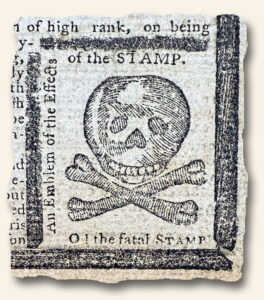 Not many are desired for both historical significance as well as graphic appeal, but such is the case with the Pennsylvania Journal of October 31, 1765. Having been aware of it for many years (photos are found in many high school history books), I had always been in the search for a genuine issue (beware: many reprints exist). I came close about 35 years ago when an institution, which had two in their collection, gave thought to exchanging one with me for an unknown Philadelphia newspaper I had discovered. Ultimately, they opted not to do the swap, so the search was back on.
It ended earlier this year.
This particular edition, famously known as the “tombstone edition,” used striking visual and textual elements to express colonial outrage over the Stamp Act tax, which required many printed materials, including newspapers, to bear a revenue stamp. This tax directly impacted printers and publishers, placing a heavy economic burden on them and fueling widespread resistance.
As seen in the photos, the masthead featured a skull and crossbones, a powerful symbol representing the “death” of the press under the weight of the Stamp Act. Also, an engraving of a coffin appears at the bottom of the back page, captioned: “The last Remains of the PENNSYLVANIA JOURNAL Which departed this Life, the 31st of October, 1765, Of a Stamp in her Vitals, Aged 23 Years.”
Publisher William Bradford begins the issue with poignant commentary, including: “I am sorry to be obliged to acquaint my readers, that as The Stamp Act is fear’d to be obligatory upon us after the First of November ensuing (the fatal to-morrow) the publisher of this paper unable to bear the burthen, has thought it expedient to stop a while, in order to deliberate whether any methods can be found to elude the chains forged for us…”.
Published just one day before the Stamp Act’s enforcement, this edition cleverly voiced dissent without yet violating the law, making it a strategic act of defiance.
This “tombstone edition” of the Pennsylvania Journal captured this economic strain and transformed it into a public rallying cry.
This edition stands as a vivid example of how the colonial press used creativity to oppose British policies, contributing to the growing revolutionary sentiment. It underscores the critical role newspapers played in shaping public opinion and mobilizing opposition in the years leading up to the American Revolution.
While other newspapers also protested the Stamp Act, the Pennsylvania Journal’s dramatic tombstone imagery made it particularly memorable and influential. It galvanized public resistance, cementing its place as a powerful symbol of defiance in American history.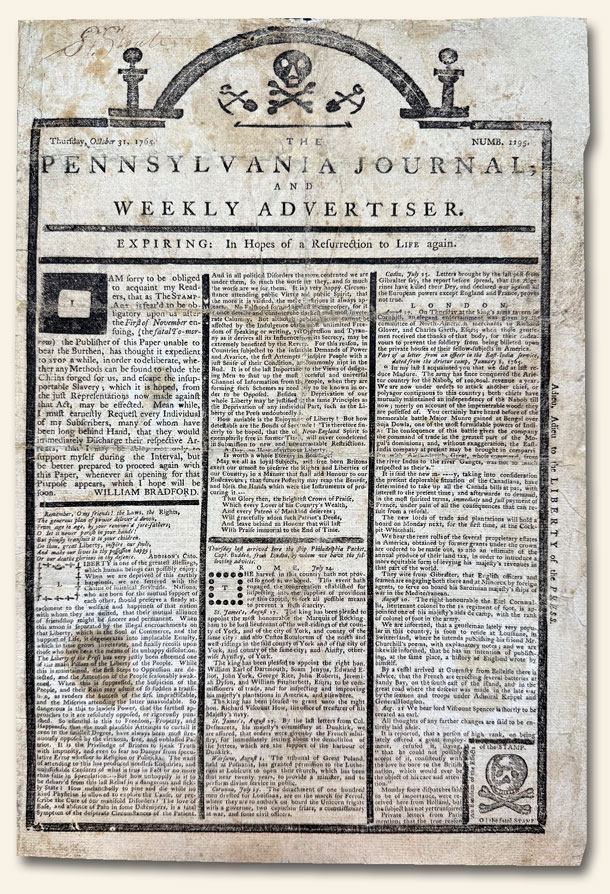
Announcing: Catalog #358 for September, 2025 – Rare & Early Newspapers…
August 29, 2025 by GuyHeilenman · Leave a Comment
|
 September’s catalog (#358)
|
A “hidden gem” within a 1785 newspaper leads to discovery, inspiration, and a correction…
August 22, 2025 by GuyHeilenman · Leave a Comment
Just for fun, guess the author and approximate date the following “Address to America” was published:
“PEOPLE of North America! Let the example of all nations which have preceded you, and especially that of the mother country, instruct you. Be afraid of the influence of gold, which brings with luxury the corruption of manners and contempt of laws; be afraid of too unequal a distribution of riches, which shews a small number of citizens in wealth, and a great number in miser; whence arises the insolence of one, and the disgrace of the other, Guard against the spirit of conquest; the tranquility of the empire decreases as it is extended; have arms to defend yourselves, and have none to attack.
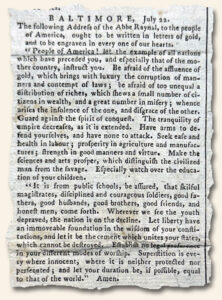 Seek ease and health in labour; prosperity, in agriculture and manufactures; strength, in good manners and virtue. Make the sciences and arts prosper, which distinguish the civilized man from the savage. Especially watch over the education of your children.
It is from public schools, be assured, that skillful magistrates, disciplined and courageous soldiers, good fathers, good husbands, good brothers, good friends, and honest men come forth. Wherever we see the youth depraved, that nation is on the decline. Let liberty have an immovable foundation in the wisdom of your contributions and let it be the cement which unites your states, which cannot be destroyed. Establish no legal preference in your different modes of worship. Superstition is every where innocent when it is neither protected nor persecuted; and let your duration be, if possible, equal to that of the world.”
I recently discovered this address on page 3 of The Independent Gazetteer; or, The Chronicle of Freedom dated July 30, 1785. After a bit of digging, in my humble opinion, a trek into the life of its author, Abbé Raynal, promises to not disappoint.
As for his “Address to America” itself, one cannot help but think his words fell on deaf ears. Sadly, even if we wanted to hit the reset button and start again while heeding his warnings, the last paragraph is problematic considering the current state of public education. However, as difficult as it would be to change course, status quo is obviously not an option.
As for the correction mentioned in the above heading for this post…
Multiple resources claim Abbé Raynal’s Address was first published posthumously (in 1800). It’s always fun when an old newspaper can prove the “experts wrong”.
A summary of the address using multiple AI resources is as follows:
Abbé Raynal’s “Address to America” is a powerful message written during the American Revolution in which the French Enlightenment thinker praises the American colonies for their fight for independence from British rule. He commends the courage of the revolutionaries and their commitment to liberty, viewing the struggle as a monumental step forward for human freedom. Raynal sees the revolution as a chance for a new nation to break from the oppressive traditions of Europe and create a society founded on justice, equality, and natural rights.
However, Raynal does not offer unconditional praise. He sharply criticizes the continued practice of slavery in the American colonies, pointing out the contradiction between fighting for freedom while denying it to enslaved people. He also expresses concern over the treatment of Indigenous peoples and warns the new republic against replicating the colonial abuses of European empires. His address is both a celebration of America’s potential and a moral challenge to align its actions with the ideals it professes.
The significance of Raynal’s message lies in its early and public call for America to confront its moral failings. His address exemplifies the Enlightenment belief that political freedom must be accompanied by social and ethical responsibility. By urging America to live up to its revolutionary ideals, Raynal’s words contributed to a broader conversation about liberty, justice, and the true meaning of independence—conversations that would shape not only American history but global ideas about human rights.
One that didn’t get away: a golden nugget discovered within an 1884 newspaper…
August 11, 2025 by GuyHeilenman · Leave a Comment
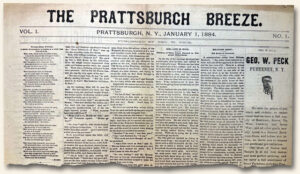 Over the years we have emphasized one of the pleasures that is relatively unique to the hobby of collecting rare and early newspapers; that is, discovering hidden gems within their pages. These “finds” are most-often unearthed by those who call to tell us what we missed, and their stories rarely disappoint. In some cases the golden nuggets may significantly impact the collectible value of the issue – such as finding a period mention of Abraham Lincoln prior to him entering the national stage buried deep within a newspaper, or, thanks to the advanced search capabilities now available through the internet, learning that an unsigned letter in an issue of The Gentleman’s Magazine out of London was actually written by Ben Franklin. However, in other instances the value gained is personal.
Such was the case with the January 1, 1884 issue of The Prattsburgh Breeze (NY) – and thankfully, it was discovered while we still had the issue in hand. We already knew it was the 1st issue (vol. 1, #1) of this extremely rare title, and it was listed as such. However, when someone from a (ok, “an”) historical society contacted us to ask if there was a mention of a the neighboring town, as we carefully read through the pages, we discovered the following:
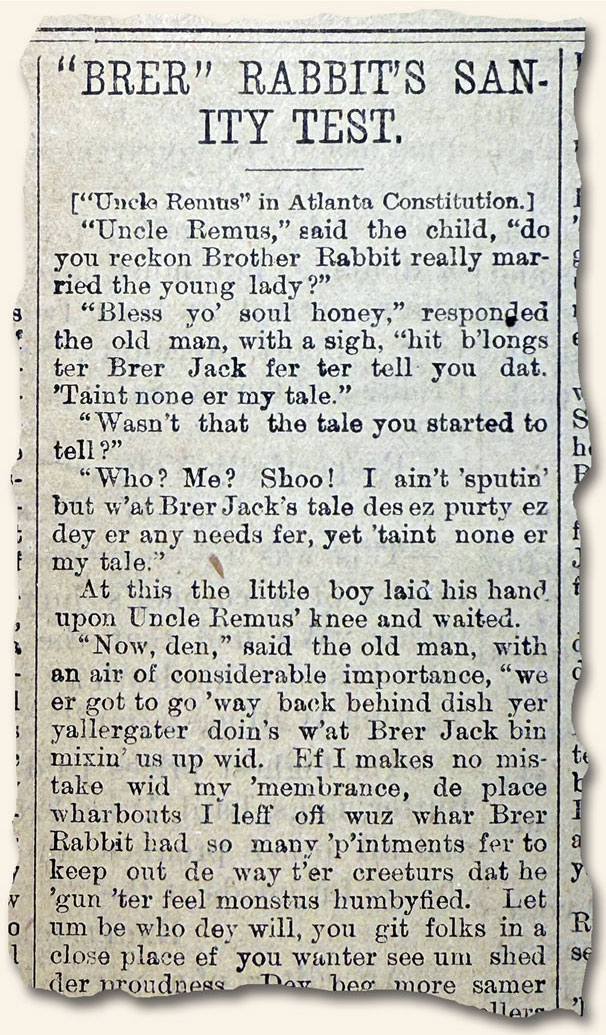
While this may not seem significant to most, it delighted my wife who is an avid fan of all things Joel Chandler Harris in general, and Uncle Remus in particular. If you are unfamiliar with either Mr. Harris or the beloved Uncle Remus, a deep dive into this tandem will be well-rewarded.
Since the saying ‘Happy wife, happy life’ is emphatically true—and since this discovery just upgraded my wife’s happiness—once again, I am compelled to proclaim: ‘I love this hobby!’.
Great Headlines Speak for Themselves… The Nuremberg Trials…
August 8, 2025 by GuyHeilenman · Leave a Comment
The best headlines need no commentary. Such is the case with the October 2, 1946 issue of the Fort Worth Star-Telegram which reported the final outcome of the Nuremberg Trials:
“12 NAZIS GET DEATH, 7 PRISON; 3 FREED”

This is certainly one of the best we’ve seen.
An historic broadside with a connection to early newspapers… revisiting “The Gerry-Mander”…
August 7, 2025 by TimHughes · Leave a Comment
Shown below the following video is a reposting of Timothy Hughes’ original post regarding “The Gerry-Mander”. We are revisiting the topic due to current events. We hope you enjoy.
Although we just discussed the historic broadside, “The Gerry-Mander”, a few days ago, since it was initially part of Timothy Hughes’ personal collection, we thought it might enjoy hearing from him directly. Enjoy.
From Tim…
Many years ago I had access to a very unusual broadside (single sheet, printed on one side only) titled: “Natural And Political History of THE GERRY-MANDER! In Two Chapters…..With Cuts.” Although it was not a newspaper, which was always my focus, a little investigation showed it had a newspaper collection. It would not be until many years later that I discovered how historically significant it really was.
“Gerrymander” is an interesting term that came into being in 1812 at a meeting of Federalist political leaders and newspapermen in Boston. Complaints about the efforts of their Republican opponents to rig state elections by altering voting districts led artist Elkanah Tisdale to add a head and wings to an outlined map of a new senatorial district in Essex County and name it the “gerrymander” after the leader of the Jeffersonians, Governor Elbridge Gerry. The cartoon shocked the public and proved very effective. Gerrymander has since become embedded in the political lexicon of America.
 This broadside we offer is described by dealer Barry Lawrence Ruderman as a “Rare political broadside featuring the first political cartoon in American history to visualize and satirize gerrymandering, one of the most enduring distortions of democratic representation…”.
As seen in the photos, this broadside pairs two woodcut maps with satirical letterpress text mocking the 1812 Massachusetts Senate redistricting law. The cartoon appeared in the Boston Gazette in March 1812, and quickly spread.
The left woodcut depicts the now-famous creature with wings, claws, and a serpent-like neck, labeling the towns it distorts. The right side features a straightforward district map of Essex County showing the two senatorial districts under the new law. The surrounding text is divided into “Natural History” and “Political History.” The first, reprinted from the Gazette, invents a monstrous genealogy for the gerrymander; the second details the law’s consequences—particularly how the Democratic-Republicans expanded their Senate majority from 21–19 to 29–11 despite losing the popular vote.
The American Antiquarian Society tentatively dates this broadside printing to between 1813 and 1822, the latter date coinciding with renewed controversy around redistricting. The cartoon here is virtually identical to the original Gazette version, suggesting either reuse of the block or a careful recutting of it.
Everything about this broadside makes this a landmark artifact of political commentary and electoral history in the United States.
It measures 18 by 20 inches, has minimal foxing, and is in nice condition. One dealer offers this very same broadside for $24,500.
Gerrymandering… (1813-1822) – an extremely rare find…
August 6, 2025 by GuyHeilenman · Leave a Comment

The following is being republished due to current events. Enjoy!
And so it began… but not without a bit of push back…
Shown below is a somewhat detailed analysis of an intriguing item which is rarely seen. When published in the early 1800s it brought to light a new technique in the election process which was certainly not conceived by the original “founders” of the United States: Gerrymandering. Whereas a brief description can be found posted on the item’s listing (The Gerry-Mander!), due to the volume of information available through multiple sources – especially in the face of its under-the-radar significance and rarity, we thought others might appreciate learning about the broadside as much as we have. We hope you enjoy.
Summary
The broadside “Natural And Political History of THE GERRY-MANDER! In Two Chapters…..With Cuts” is likely from 1813–1822, published in Boston, and satirizes early U.S. gerrymandering. It reprints an 1812 cartoon and article coining “gerrymander,” linking to Governor Elbridge Gerry’s redistricting favoring Democrat-Republicans. Included are two sections:
• “Natural History”: Reprints the 1812 Boston Gazette piece, humorously describing the “Gerry-mander” as a new political monster.
• “Political History”: An original essay explaining the 1812 redistricting’s origins, noting it favored Democrat-Republicans (winning 29 seats to Federalists’ 11, despite more votes for Federalists). It calls for ending such practices, though gerrymandering persists today.
The broadside is a historically significant document which is only found in a few institutions – one being the Massachusetts Historical Society. It is not listed in Shaw & Shoemaker, a bibliography of early American imprints, underscoring its rarity.

Historical Context and Origin of “Gerrymander”
The term “gerrymander” emerged in 1812 during the governorship of Elbridge Gerry, a prominent figure in early American politics who signed the Declaration of Independence and served as James Madison’s vice president. In February 1812, Massachusetts Republicans, led by Gerry, engineered a radical redistricting plan to disadvantage the Federalist majority in the upcoming state senatorial elections. This plan was particularly evident in Essex County, where one district was redrawn into an irregular, elongated shape that resembled a salamander. The cartoon, first published in the Boston Gazette on March 26, 1812, was attributed to illustrator Elkanah Tisdale, who added wings, claws, and fearsome teeth to the map, transforming it into a monstrous creature. The term “Gerry-mander” was coined during a dinner conversation, possibly by painter Gilbert Stuart or poet Richard Alsop, combining Gerry’s name with the mythical beast.
The redistricting was highly effective: in the 1812 election, the Republicans’ majority grew from 21-19 to 29-11, despite the Federalists receiving more votes. This outcome highlighted the manipulative potential of gerrymandering, where politicians could pick their voters rather than voters choosing their representatives. However, ironically, Gerry lost his re-election bid in 1812, and there is little evidence he strongly supported the redistricting law, though his name became indelibly linked to the practice.
Additional Details & Summary
The broadside reprints the original 1812 cartoon and article from the Boston Gazette (March 26, 1812), attributed to illustrator Elkanah Tisdale, which depicted the district as a winged, clawed monster with satirical text. It is a rare and historically significant artifact that encapsulates the early American political practice of gerrymandering, a term and concept that remain central to discussions of electoral fairness. Its call for ending gerrymandering contrasts with its persistence, as seen in modern debates over redistricting and voting rights. It serves as a reminder of the long-standing tension between political strategy and fair representation, with the term “gerrymander” remaining a symbol of electoral manipulation. The pronunciation note from some sources, suggesting it should be “gerrymander” with a hard ‘g’ rather than the common “jerrymander,” adds a linguistic dimension to its legacy, reflecting regional and historical variations in usage.

The following video was added after the post went live:
When is dead really dead – USSR edition?
August 4, 2025 by GuyHeilenman · Leave a Comment
 Is a chicken dead when its head is cut off, or when it finally stops moving? How about the flower your grandchild just presented to you as a gift? Was it dead as soon as it was severed from the plant, or will it not be dead until it turns brown? How about a marriage (a court document vs. a covenant before God), our very existence (a doctor’s declaration vs. spiritual implications), or a nation – especially if its formation is similar to The United States of America? How many states would need to secede before one could truthfully claim “The United States is no more”?
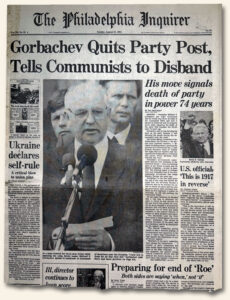
These were some of my ponderings as I recently came across two issues related to the demise of The Soviet Union. The first was The Philadelphia Inquirer dated August 25, 1991 which reported Mikhail Gorbachev’s resignation and his formal statement requesting for the Soviet Communist Party to dissolve, and the second was a December 9, 1991 issue of The Los Angeles Times which had the bold heading: “Slavic States Call Soviet Union Dead, Form a Commonwealth”. The dissolution may not have been official until December 26, 1991, but many would argue the death really took place back in August when Gorbachev made his announcement and plea. Still some would say its status is more like that of a cicada. Buried, but latently waiting for just the right moment to rise again and loudly make its presence known (the last statement read with the Jaws soundtrack playing in the background). Regardless of how things play out over time, the list of once-powerful nations which no longer exist is a sober warning to anyone who thinks today’s top players will exist forever.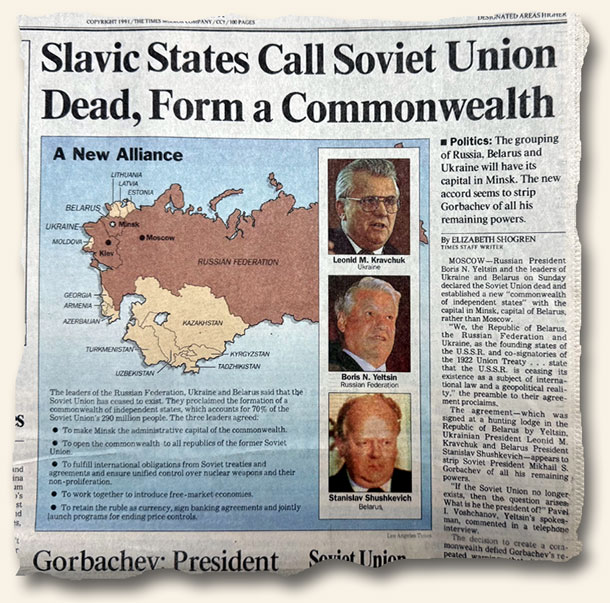
Announcing: Catalog #357 for August, 2025 – Rare & Early Newspapers…
August 1, 2025 by GuyHeilenman · Leave a Comment
|
 August’s catalog (#357)
|
Ben Franklin’s 1st contribution to The Gentleman’s Magazine, London…
July 25, 2025 by GuyHeilenman · 1 Comment
Many are aware Ben Franklin was a frequent contributor to The Gentleman’s Magazine (London); however, few can name his 1st appearance. What makes the task more difficult is his proclivity for signing his work using pseudonyms. Thankfully his work has been extensively researched – an effort which was aided by his prolific record keeping.
So, was it an article related to electricity, a game (“the morals of chess”), a puzzle (“magic square of squares”), he thoughts on marriage, or a treatise regarding the poor? No, it was the text of a speech (supposedly) given before a Colonial Court by a woman named of Polly Baker.
Thanks to enhanced research tools, a synopsis is as follows:
“The Speech of Polly Baker” is a satirical essay first published anonymously in The Gentleman’s Magazine in April 1747. It is now widely attributed to Benjamin Franklin, who is believed to have written it around 1746. Although the piece was initially published without attribution, Benjamin Franklin is almost certainly the author. This is supported by evidence from Franklin’s own correspondence, accounts from contemporaries, and stylistic analysis. Franklin was known for using pseudonyms and anonymous satire to criticize social and political norms, and this work fits that pattern.
Summary
- The essay takes the form of a fictional courtroom speech by a woman named Polly Baker, who is on trial for the fifth time for having an illegitimate child out of wedlock—a crime under colonial law.
- In her speech, Polly eloquently defends herself by questioning the justice of punishing women for fornication while men (the fathers) go unpunished and even rise to positions of honor.
- She argues that she has done nothing wrong morally, since she brought children into the world and cared for them, and should be praised, not punished.
- The satire points to:
- Hypocrisy in the legal system.
- The unequal treatment of women, particularly in matters of sexuality and reproduction.
- Broader critiques of colonial laws and moral attitudes.
Historical Significance
- “The Speech of Miss Polly Baker” is one of the earliest American critiques of gender inequality.
- It reflects Enlightenment ideals—particularly reason, natural rights, and critiques of tradition.
- The piece prefigures later feminist arguments about the double standards in sexual morality.
Reception in 1747
- When it was published, readers largely did not know it was a satire by Franklin.
- Many believed the account was true, and some thought Polly Baker was a real person.
- The piece generated significant interest and discussion in Britain and the American colonies, especially because of its radical tone.
- It was reprinted widely in newspapers and magazines, suggesting it was popular and provocative.
Some clergy and conservative voices were critical, viewing the essay as undermining traditional moral values, while Enlightenment thinkers and reform-minded readers praised its rhetorical skill and boldness.
Legacy
- Today, “The Speech of Polly Baker” is studied as a landmark example of early American satire and as a precursor to later feminist and legal critiques.
- It shows Franklin’s ability to use humor and irony to challenge unjust systems and conventions.

Note: The full text of this Franklin work can be read at Founders Online of the National Archives.