
Search
The Rare & Early Newspapers Hobby

Receive the Newsletter

Buy Historic Newspapers

Edward Gallaway – bibliophile, publisher, circus performer, cardshark – help needed…
April 25, 2022 by GuyHeilenman · Leave a Comment
A collecting friend is doing research on Edward Gallaway (1868-1930). Perhaps the collecting community can help. He sent the following note:
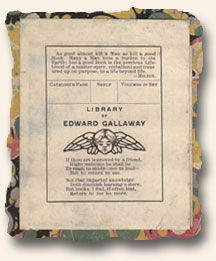
You can help a research project into a largely unknown bibliophile from Chicago, Edward Gallaway, by checking if you have any of the following in your collection:
1) Anything with the bookplate shown in the image.
2) Any issue or clipping from the Payne Weekly People, published in Fort Payne Alabama in October of 1889. This weekly newspaper, published by Edward Gallaway, discontinued roughly a year later end of 1890. This town experienced a boom during those years and many investors hailed from Massachusetts. Thus issues may have been transported back to the New England region.
3) Any issue from the Fort Payne Journal before 1891.
4) Any issue from the Fort Payne Herald.
5) Any issue from the Delphos Kleeblatt before 9th May 1891. The Delphos Kleeblatt was a German newspaper out of Delphos, Ohio, published by Carl A. Jettinger, who was a friend of Edward Gallaway.
Edward Gallaway had a fascinating life. He was born in Delphos, Ohio, in 1868. Already with 14 he became a printer’s devil at the local Delphos Weekly Herald newspaper, where he learned the printer’s art. From 18 years old to 21 he worked as a traveling typesetter. Eventually, he followed his older brother Alexander August Gallaway to Fort Payne, Alabama, where he established the short lived Payne Weekly Newspaper during the coal and iron boom years there. After the boom collapsed, Edward completely changed course and he became a circus performer working from 1892 until about 1895 at small traveling circuses such as the W.D. Ament sideshow. He performed mostly under the stage name Prof. Charles P. Wilson. His act consisted of Punch and Judy as well as magic. He would also work as barker, canvass boss man, as well as sideshow manager.
Edward Gallaway had a secret life as a cardshark. Later in 1902 he would write a manual of sleight-of-hand with cards educating readers on cheating at the card table as well as how to perform magic card tricks. This book, The Expert at the Card Table, was published under the pseudonym S.W. Erdnase, and it is to this day the most important book on sleight-of-hand with cards. It was decades ahead of its time.
Eventually, he found back to his printing profession and he started either alone or with others various job printing business, all of which were short lived. Around 1900 he is employed by the Bentley Murray printing company where he honed his skill on the Monotype typesetting machine which lead him to write the Monotype System books and other educational matter for Lanston Monotype. He started to teach estimating at the United Typothetae which brought him to the attention of Donnelley where he was later employed as estimator. There he rose up through the ranks to reach the position of director of estimating. In other words, he was the chief estimator at the largest privately owned printing company in the US. In 1925 he left and established his own School for Estimating in Chicago, the only school focusing on that particular aspect of printing. He died 1930 in Chicago.
During his life Edward Gallaway accumulated a large library with many precious books which his wife after his death sold through Chicago second-hand book dealers. This was the ‘pension’ she lived on until her death in 1943.
If anyone can be helpful in regards to this research project, please contact me (Guy) at guy@rarenewspapers.com. Thanks.
Exploring “This Day in History” through Rare & Early Newspapers…
April 22, 2022 by GuyHeilenman · Leave a Comment
Who among us isn’t a bit curious as to what occurred on our birthday (or today’s date) through time? The concept of exploring a specific day (month/day) through history has always been intriguing, but before the internet, such knowledge was not easy to obtain. However, in the present world of data explosion, websites which explore “This Day in History” do the job quite nicely and have become very popular. One of my favorites is HISTORY.COM maintained by The History Channel.
Of course, as a collector and reseller of old newspapers, this trek is amplified by the capability of holding authentic newspapers containing contemporary reporting of these events – to not only read the articles themselves, but to explore the context of what else was going on as the events unfolded.
Thanks to ongoing requests from collectors, we’ve created an interface on our website which enables the seeker to explore what is available at any given moment for any month/day. Even if you are not looking to add to your collection, perusing through the issues can be fascinating. If you have interest in giving this a try, the steps below are provided to help you get started.
This feature is available at: Explore: “THIS DAY IN HISTORY”
– – –
I tried own birthday and came up with the following: January 2nd Through Time
Don’t forget the “Sort” feature which will give you multiple ways to arrange your search results. Have Fun!

Great Headlines Speak for Themselves… The Sinking of the Titanic!
April 11, 2022 by GuyHeilenman · Leave a Comment
The best headlines need no commentary. While there are many dramatic headlines regarding the Sinking of the Titanic, the April 16, 1912, New York American is considered one of the very best: “J. J. ASTOR LOST ON TITANIC” “1500 TO 1,800 DEAD” (see below). Of course, the striking illustration certainly helps. We also have a nice Pinterest board with Titanic headlines: Titanic

Insight into the mind of Tesla…
April 4, 2022 by LauraH · Leave a Comment
I am always dumfounded by the breadth of brilliance some well-known inventors of the past possessed. Leonardo da Vinci, who is credited with the invention of the parachute, the barreled cannon, the Helical aerial screw, the winged flying machine, diving equipment & the self-propelled cart, also painted the Mona Lisa. How can one not stand in awe? Let’s face it, inventors are often trend setters who give the world around them inspiration as well as practical solutions for common problems.
 On Oct. 14, 1893, SCIENTIFIC AMERICAN featured an article by Nikola Tesla which caught my attention. We think of Tesla as one of the 2-3 most famous “explorers” who contributed to our current-day electrically powered world. However, in this article, he is using his study of the eye to further his insight into electrical currents. Below is a fitting quote from the article by this genius from the late 19th and early 20th centuries:
“The day when we shall know what ‘electricity’ is, will chronicle an event probably greater and more important than any other in the history of the human race.” Much ground has been covered in this regard since he made this statement, but most would agree we have yet to arrive.
Here’s Hoping History Doesn’t Repeat Itself… 1693…
March 28, 2022 by LauraH · Leave a Comment
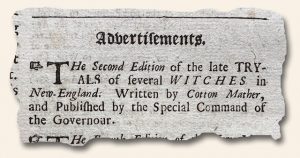 They say those who do not learn from history are doomed to repeat it. I’m pretty sure they only break out that proverb when discussing something horrific. So it is with The Salem Witch Trials. On February 7, 1693, THE ATHENIAN MERCURY out of London advertised the book: “The Second Edition of the late TRYALS of several WITCHES in New-England. Written by Cotton Mather”. The ad was “Published by the Special Command of the Governor”. Perhaps he wanted to make sure the readers were not doomed…
Collecting Old/Historic Newspapers: The 1600s & 1700s…
March 24, 2022 by GuyHeilenman · Leave a Comment
 At Timothy Hughes Rare & Early Newspapers (rarenewspapers.com), we are often asked what types of “old Newspapers” are worth collecting. One of the beauties of the hobby is that the possibilities are endless. While we have our own preferences, once a month we will simply direct readers of the History’s Newsstand blog to an era, theme, topic, etc. for which our collector friends have expressed interest. This month’s focus is shown below. Feel free to email me at guy@rarenewspapers.com with your own collecting preference/s. Perhaps one day we’ll feature it/them as well.
The 1600s and 1700s
The End of Something Bad… The Kickoff to Something Good…
March 24, 2022 by LauraH · Leave a Comment
 In the moment, we are often oblivious to the long-term impact significant newsworthy announcements will have as time goes on. “Henry Ford has made a car nearly anyone can afford” – eventually smog make city -living unbearable and the ozone takes a beating. “Computers can be made both inexpensively and small enough for daily use at home” – pornography spreads like wildfire. “A new substance called ‘plastic’ will revolutionize our lives” – our landfills overflow and our oceans are overcome with garbage which will take many lifetimes to decompose (if ever). However, not all unexpected “consequences” are bad.
The announcement on May 8, 1945 that the war with Germany was over (aka, V-E Day), wildly celebrated throughout much of the World, was such a case in point. Amidst all the exuberance, most people were probably not cognizant of the marvelous “consequences” which would arrive within a year’s time. Introducing: “The Baby Boomers – 1946 Edition!” Here, have a cigar.
The front page of this issue of THE MORNING CALL (Patterson, NJ) is one of the many reports which helped inspire the creation of an entire generation.
Collecting Old/Historic Newspapers: The Revolutionary War…
March 17, 2022 by GuyHeilenman · Leave a Comment
 At Timothy Hughes Rare & Early Newspapers (rarenewspapers.com), we are often asked what types of “old Newspapers” are worth collecting. One of the beauties of the hobby is that the possibilities are endless. While we have our own preferences, once a month we will simply direct readers of the History’s Newsstand blog to an era, theme, topic, etc. for which our collector friends have expressed interest. This month’s focus is shown below. Feel free to email me at guy@rarenewspapers.com with your own collecting preference/s. Perhaps one day we’ll feature it/them as well.
The Revolutionary War
They put it in print, 1926 – “With just the naked eye and a glove…”
March 11, 2022 by GuyHeilenman · Leave a Comment
Some feats seem more like folklore than reality. Can a person, unaided in any way, catch a baseball dropped from a plane with a standard baseball glove? If it weren’t for the many witnesses who observed this amazing feat first-hand, who would have believed this actually occurred? However, on July 23, 1926, the New York Times published details of Babe Ruth’s amazing accomplishment – a record setting one at that. How do we know” They put it in print:

Announcing: Catalog #316 (for March, 2022) – Rare & Early Newspapers (for purchase)
February 25, 2022 by GuyHeilenman · Leave a Comment
|
|
The links above will redirect to the latest catalog in approx. 30 days,
upon which time it will update to the most recent catalog.