
Search
The Rare & Early Newspapers Hobby

Receive the Newsletter

Buy Historic Newspapers

#18 – America’s first newspaper… Check your attics. (*revisited)
April 18, 2014 by GuyHeilenman · Leave a Comment
The very first newspaper printed in the American colonies was published in Boston in 1690 and titled “Publick Occurrences Both Foreign and Domestick”. It was a little paper with three pages of text. The fourth page was left blank for others to write handwritten pieces of news before being passed on to others. It was published by Benjamin Harris who had experience in publishing another newspaper in London several years prior to his arrival in the colonies, titled “Domestick Intelligence, Or News Both from City & Country”.
His Boston effort focused on local news but it also included gossip and unflattering reports. One account notes it contained: “…affections of a very high nature: As also sundry doubtful and uncertain Reports…”. The mixture of doubtful and uncertain reports, as well as a ban on printing without a license which Harris did not have, caused his first issue to also be his last. Reports note that the royal governor had the printing press destroyed and all known issues of that one date of September 25, 1690 confiscated.
To this day only one genuine issue of the newspaper is known to exist, and unfortunately it’s not in the United States: it is in the Public Records office in London. Some years ago it was loaned to The Newseum in Washington, D.C. (then located across the Potomac in Virginia) for a period of time, but I believe it has been returned to London.
The intriguing part of this story is that “all known issues were confiscated and destroyed”. But exactly when did this happen? Was it done several hours since it was printed, or a few days later? It was intended to be a monthly publication. Certainly the possibility exists that a few issues were not found & confiscated, and with the owners knowing of the search they may have purposely hidden them away.
Could an issue or two still exist in a Boston attic somewhere? Is there a private library where an issue was hidden among the pages of a book in hopes of not being confiscated? Could a renovation project to a Boston area home reveal an issue tucked within its walls over 300 years ago? It is fascinating to think that some examples could be found so long after being published. But to this date none have surfaced.
Speculation runs wild as to the value of an issue should it surface. It’s America’s very first newspaper, and none exist in America. What sort of price could be set on such an issue? What should be the future home of an issue should it be found?
Feel free to comment!
—————
*The Fall of 2013 marked the 5th anniversary of the History’s Newsstand Blog by Timothy Hughes Rare & Early Newspapers. We are grateful to have the opportunity to contribute to the newspaper collecting community, and appreciate those who have participated through guest posts, comments, and readership. This year (2014) we are revisiting the top 25 posts (measured by activity), with the number 1 post being re-posted during the first week of 2015. Please enjoy. If you would like to contribute a post for consideration of inclusion on the blog, please contact Guy Heilenman at guy@rarenewspapers.com.
An unusual two issue set… a disaster and a massacre…
April 11, 2014 by GuyHeilenman · Leave a Comment
 The Set: FRANK LESLIE’S ILLUSTRATED NEWSPAPERS, New York, both dated May 3, 1873.
The Intrigue: A two issue set of the same title with the exact same date? Yes. In regards to standard daily newspapers, especially those printed for major city distribution, it was not uncommon for there to be multiple editions of the newspaper printed on the same day – perhaps a morning and evening edition. However, we have yet to discover a weekly illustrated newspaper who printed more than one version of an issue on the same day. It is this lack of discovery to-date which makes this two-issue set rather interesting. Frank Leslie’s Illustrated apparently printed two nearly identical but different issues for May 3, 1873… each having a different cover. One might think they accidentally reprinted a cover from a previous week for some of the issues, but we have had the other issues surrounding this date, and none of them have either cover in question. Additionally, while the inner pages are almost all the same, there is also another page (pg 125) which is different. Everything else is identical.
If anyone is aware of the background concerning this set, please share.
Note: Additional (and quite interesting) information concerning both front pages may be found at Colfax Massacre and Richmond Switch Disaster (Rhode Island).
#20 – Thoughts on the most historic 19th century report… (*revisited)
March 21, 2014 by GuyHeilenman · Leave a Comment
A few weeks ago we had some interesting comments on what collectors thought was the most historic 20th century newspaper report. Let’s try the same with the 19th century. But given the tremendous diversity of events from 1801 thru 1900 I’m going to break the century into three parts: pre-Civil War; the Civil War; and post-Civil War. Let’s work our way backwards and discuss the post-Civil War era first.
There are many ways to approach “most historic”. My approach will be the most life-altering event with emphasis on “event”. One could argue that the second Industrial Revolution dramatically changed the world but it cannot be pinned down to a single date or event.
 Several items come to mind: the first successful Atlantic cable in 1866 was a major step in causing the world to be much smaller–a trend which continues to this day; the completion of the transcontinental railroad in the United States was a major step in the westward expansion & settlement of the United States which changed the country in many ways; and then there is the Battle of Wounded Knee which was the last battle in the American Indian Wars and the official end of the Old West. Not to be omitted would be the invention of the automobile by gentlemen in Germany in 1889.
I’m going to go with the completion of the transcontinental railroad. In thinking of the multitude of events which played off this event and how it changed the fabric of America (pardon the ethnocentrism) I’ll vote for it as the most historic event of the 19th century post-Civil War era.
What are your thoughts?
—————
*The Fall of 2013 marked the 5th anniversary of the History’s Newsstand Blog by Timothy Hughes Rare & Early Newspapers. We are grateful to have the opportunity to contribute to the newspaper collecting community, and appreciate those who have participated through guest posts, comments, and readership. This year (2014) we are revisiting the top 25 posts (measured by activity), with the number 1 post being re-posted during the first week of 2015. Please enjoy. If you would like to contribute a post for consideration of inclusion on the blog, please contact Guy Heilenman at guy@rarenewspapers.com.
The Battle of Los Angeles…
March 14, 2014 by TimHughes · 2 Comments
 The “Los Angeles Times–Extra” of February 24, 1942 has one of the more dramatic, screaming headlines to be found in any newspaper: “L.A. AREA RAIDED ! ” with a smaller head noting: “Jap Planes Peril Santa Monica, Seal Beach, El Segundo, Redondo, Long Beach, Hermosa, Signal Hill”. The report begins: “Roaring out of a brilliant moonlit western sky, foreign aircraft flying both in large formation and single, few over Southern California early today and drew heavy barrages of anti-aircraft fire–the first ever to sound over United States continental soil against an enemy invader…” (see).
The Battle of Los Angeles, also known as The Great Los Angeles Air Raid, is the name given to this rumored enemy attack and subsequent anti-aircraft artillery barrage which took place from late February 24 to early February 25, 1942 over Los Angeles. The incident occurred less than three months after the United States entered World War II as a result of the Japanese Imperial Navy’s attack on Pearl Harbor.
Initially, the target of the aerial barrage was thought to be an attacking force from Japan, but speaking at a press conference shortly afterward, Secretary of the Navy Frank Knox called the incident a “false alarm.” Newspapers of the time published a number of reports and speculations of a cover-up. Some modern-day UFOlogists have suggested the targets were extraterrestrial spacecraft. When documenting the incident in 1983, the U.S. Office of Air Force History attributed the event to a case of “war nerves” likely triggered by a lost weather balloon and exacerbated by stray flares and shell bursts from adjoining batteries.
Air raid sirens sounded throughout Los Angeles County on the night of February 24-25, 1942. A total blackout was ordered and thousands of air raid wardens were summoned to their positions. At 3:16 am the 37th Coast Artillery Brigade began firing .50 caliber machine guns and 12.8-pound anti-aircraft shells into the air at reported aircraft; over 1,400 shells would eventually be fired. Pilots of the 4th Interceptor Command were alerted but their aircraft remained grounded. The artillery fire continued sporadically until 4:14 am. The “all clear” was sounded and the blackout order lifted at 7:21 am.
Several buildings and vehicles damaged by shell fragments, and five civilians died as an indirect result of the anti-aircraft fire, three of them killed in car accidents in the ensuing chaos and two of heart attacks attributed to the stress of the hour-long action. The incident was front-page news along the U.S. Pacific coast, and earned some mass media coverage throughout the nation.(credit to Wikipedia)
The peaceful transfer of power…
March 10, 2014 by GuyHeilenman · Leave a Comment
As we approach President’s Day, there is a part of me which is somewhat sentimental about my childhood memories surrounding Washington’s Birthday. I sure do miss it as a stand alone national celebration. I fondly remember my father bringing home a cardboard version of an ax (with a chocolate-covered cherry hidden within) to present to each of us to commemorate the holiday, and without fail, reminding us to be just like George Washington – that is, to never tell a lie. Was there a bit of lore surrounding this sacred event? Sure. Did it teach us a valuable lesson? Absolutely. Somehow we’ve lost the innocence and value of oral tradition, and I wonder if we are the better for it.
Perhaps Washington never chopped down a cherry tree… and my guess is he probably told a lie at some point, but I challenge anyone to name another political leader who, in the face of such power, tradition, and popularity, was willing to hand over the reigns of power with such humility and grace. The Massachusetts Spy, Or Worcester Gazette for March 15, 1797 records much of the proceedings of this momentous event. The link provides access to considerable details. Of particular note is his response to the Massachusetts’ Representatives of Congress who basically asked him, “What now?” His response is precious (see below). Please enjoy!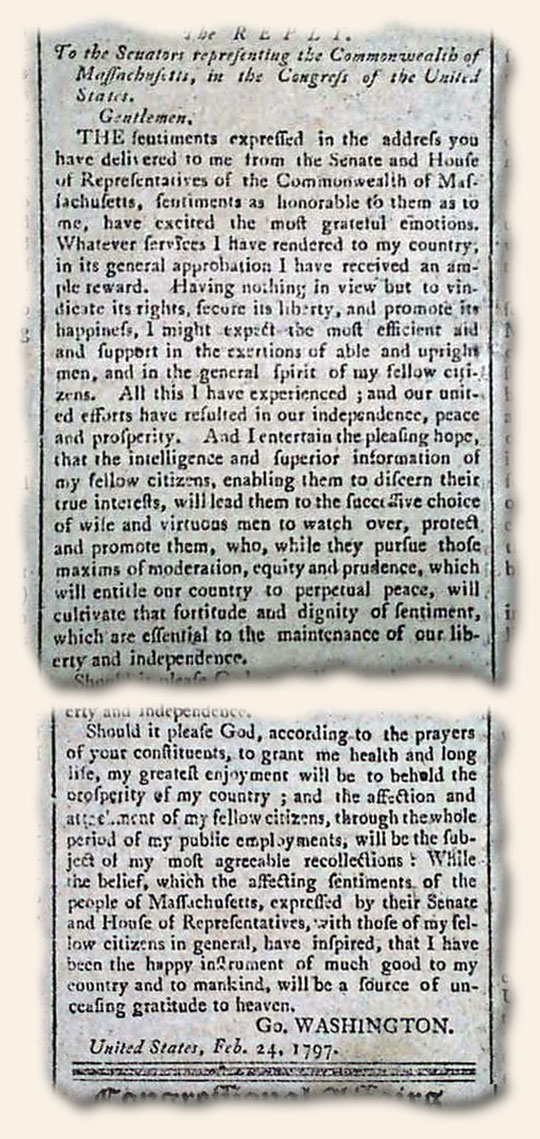
#21 – Pricing newspapers over 30 years ago… (*revisited)
March 7, 2014 by GuyHeilenman · Leave a Comment
 In conversations with people about how I started this business, a common question is, “How did you know how to prices newspapers back then?” Well, the short answer is I didn’t.
This venture started as a hobby with no thought of it turning into a business. But when I started getting too many of a similar title or date, selling off the “unwanteds” became a more common occurrence. My simple thought was, if I had $3 for it, try to sell it for $5. If I did, the price stuck for future issues; if it didn’t, the price dropped to $4.
But this became trickier years later when I was buying for resale but didn’t have enough experience to know what to pay, nor what to price them at. Nor did anyone for that matter, as there were no price guides, nor sufficient auction records to offer a clue.
I was flying by the seat of my pants. If I thought an event was historic, say a major Civil War battle, I would pay the $5 price and increase it by 50% or so. If it sold, then the next time I inched it up a bit more. If it didn’t, I reduced the price a bit. Never knowing how high customers might go for an event, I might have “inched up” the price of an event 15 times over the coarse of 4 or 5 years until there was some resistance. I was careful to keep records of sales through the years–even in the pre-computer days–which was a tremendous assistance in assigning values to the myriad of historical events covering 300 years of history.
 Did I sell some great material too cheaply in the early years? I sure did. Looking at some of my earlier catalogs I gladly pay five times the selling price of many items I sold. But it was part of the process. I remember nce having a volume of a Las Vegas, New Mexico newspaper from 1881. There must have been 30 or 40 issues with a small “Reward” ad for the capture of Billy the Kid. I think I sold those issues for less than $20 each. If I had 40 of them how rare could they be? Certainly I’ve learned through the years, and became smarter as well.
But we are still challenged today with some items. As we continue to find truly rare, almost unique issues it becomes difficult to assign values with no history or prior sales. But these are the fun challenges. As much as you may enjoy finding interesting items in our catalogs, I enjoy finding the unusual to offer.
Although this is a business, I have always gotten more joy from buying newspapers than selling them.
—————
*The Fall of 2013 marked the 5th anniversary of the History’s Newsstand Blog by Timothy Hughes Rare & Early Newspapers. We are grateful to have the opportunity to contribute to the newspaper collecting community, and appreciate those who have participated through guest posts, comments, and readership. This year (2014) we are revisiting the top 25 posts (measured by activity), with the number 1 post being re-posted during the first week of 2015. Please enjoy. If you would like to contribute a post for consideration of inclusion on the blog, please contact Guy Heilenman at guy@rarenewspapers.com.
The Frederick Douglass’ Paper… Solomon Northup…
February 24, 2014 by GuyHeilenman · Leave a Comment
 I absolutely love this collectible!
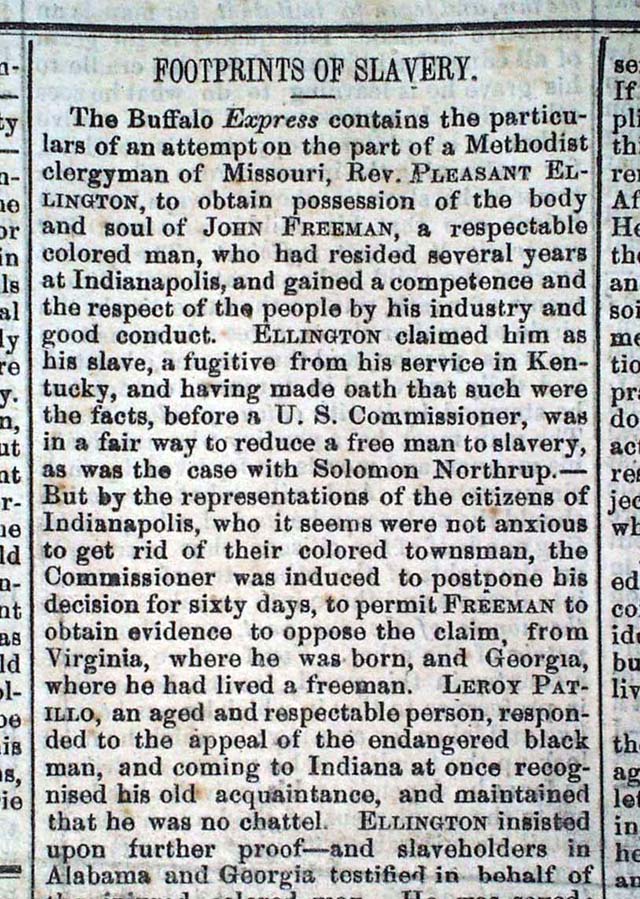
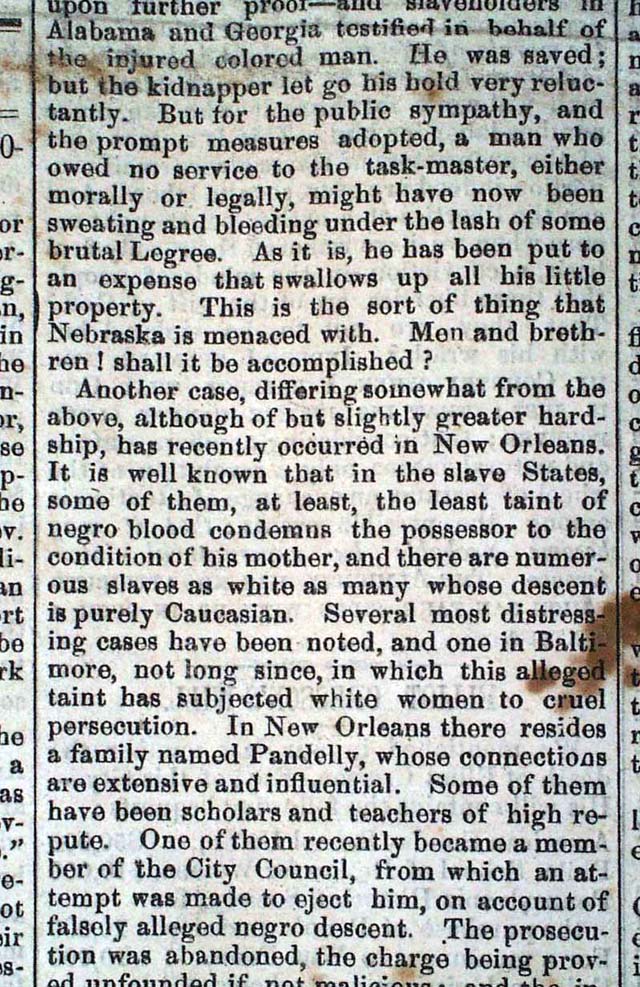
We had in our possession for a number of years an original issue of the Frederick Douglass’ Paper, dated March 17, 1854. It certainly was a grand paper – it being a continuation of Douglass’ North Star. However, while the notoriety of the title was well-established and the angst of slavery oozed throughout, it was a 21st century movie which infused new life into it’s weary 150+ year-old raglinen pages.
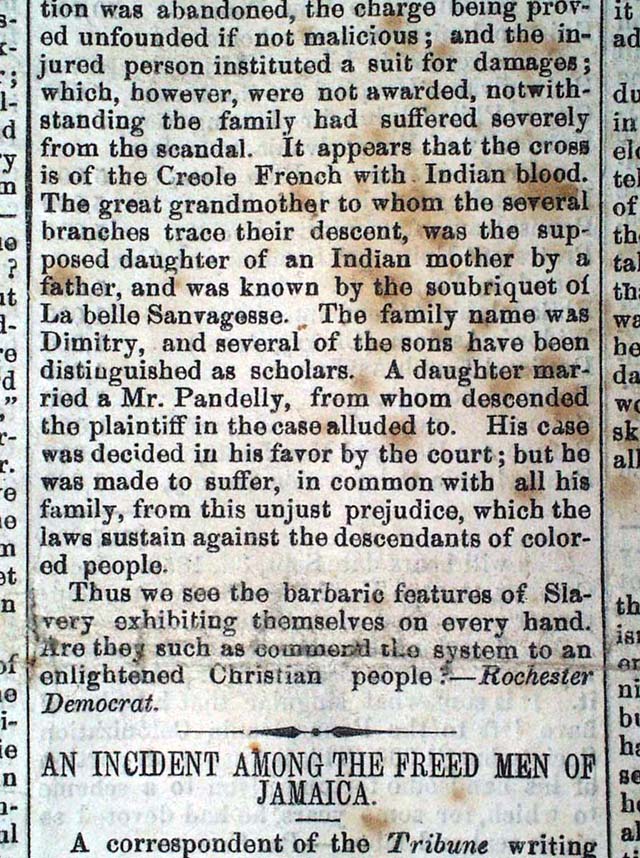
A collector recently went to see the theatrical adaptation of “Twelve Years a Slave – The Memoir of Solomon Northup“, and was moved to visit the Rare & Early Newspapers‘ website to see if we had newspapers with his mention. Searches for his name were unsuccessful – but this collector was not to be deterred. Having previously viewed the Frederick Douglass’ Paper in question, he took the next step and began to go over the corresponding images with a fine-tooth comb. Success. The newspaper was not only noteworthy for its editor and rarity, but it also had an article on the front page with mention of Solomon Northrup (see below). Fantastic.
Like I said, I love this collectible!
#24 – Lincoln’s assassination in a Washington, D.C., newspaper… (*revisted)
January 17, 2014 by GuyHeilenman · Leave a Comment
 One of the (positive) frustrations we have always dealt with as a rare newspaper dealer is not being able to share some of the best material which comes our way. Not surprisingly very rare and very historic items have a waiting list of customers waiting for it to come into inventory and such newspapers are typically sold before they have the opportunity to be listed in a catalog. But here is where our blog is of value, allowing us an opportunity to share some nice material even though no longer available for purchase.
Holding true to the belief that newspapers from cities where historic events took place are the best to have, our recent sale of the “Daily Morning Chronicle” of April 15, 1865 from Washington, D.C. fits this description very well. Although purchased by a member with a *“want list” for such material, the issue is too fascinating not to share with others, hence this link to the listing and photos.
Enjoy one of the best newspapers to have on Lincoln’s assassination.
Note: Although we manage a want list for key material, with thousands of such wants, the system is not perfect (i.e., we occasionally miss an item on someone’s want list and it ends up being purchased through a member or public offering). We simply promise to do the best we can. If you have key content of interest, feel free to be in touch.
*The Fall of 2013 marked the 5th anniversary of the History’s Newsstand Blog by Timothy Hughes Rare & Early Newspapers. We are grateful to have the opportunity to contribute to the newspaper collecting community, and appreciate those who have participated through guest posts, comments, and readership. In 2014 we will revisit the top 25 posts (measured by activity), with the number 1 post being revisited during the first week of 2015. Please enjoy. If you would like to contribute a post for consideration of inclusion on the blog, please contact Guy Heilenman at guy@rarenewspapers.com.
Gentleman’s Magazine: a little gem packed with history…
December 27, 2013 by TimHughes · Leave a Comment

As dealers we have been very true to our focus on rare newspapers, and—for the most part—only newspapers. Yes, we have ventured into the occasional old document, pamphlet, colonial currency and the other items I’ve found intriguing, but otherwise we offer only historic newspapers.
But one big exception has been 18th century magazines. As is likely the case with most collectors of history, the over-riding aim is to find historic news reports dated as early as possible, and the availability of newspapers runs quite thin before 1760 (the London Chronicle dates to 1755 and is the single biggest source of period reports back to this period) if British titles are accepted, and only back to about 1787 if American newspapers are the only option.
It was many years ago that I discovered one of the best titles of the 18th century for period news reporting, and it wasn’t even a newspaper. It is a magazine. More specifically, “The Gentleman’s Magazine” from London. Having begun in 1731, its pages captured news reports concerning America which could never be found in period American newspapers, and rarely found in period British newspapers. From its earliest years “The Gentleman’s Magazine” printed reports on the creation of the colony of Georgia, the founding of the town of Savannah, with many issues mentioning James Olgethorpe. From 1736 are reports of William Penn laying out the city of Philadelphia, and the 1730’s has several reports of pirates operating in the Caribbean and the Atlantic, as well as famous highwayman Dick Turpin. Slave revolts in Jamaica, “Customs of the Jews” and other smaller reports from the American colonies round on the 1730’s.
The 1740’s have several items on the slavery issue which would be a topic of discussion on both sides of the Atlantic well into the 19th century. And relating to slavery are several issues of the 1770’s on famous slave/poet Phillis Wheatley.
There are early reports on the sport of cricket, and much on the Jacobite Rebellion including mention of “Bonnie Prince Charlie”. Other curious reports from the 1740’s include text on Handel and his “Messiah”, Ben Franklin mention with various electricity experiments, the death of astronomer Edmund Halley, the origin of the game of chess, and a curious item on a northwest passage to China through Canada. Military events in periodicals are never-ending, and this decade prints the text of the Treaty of Aix la Chapelle, among many other military events.
The 1750’s are highlighted by much reporting on the French & Indian War between the French & the British, with mention of Quebec, Crown Point, Fort DuQuesne and all the other major battle sites. Keep in mind that the American colonies were British possessions at the time so there was much interest in
“The Gentleman’s Magazine” has nice reporting on Ben Franklin’s lightening rod experiments, and there is also a terrific—although inconspicuous—mention of what would become known to all Americans as the Liberty Bell. Under the heading: “America” and with a “Philadelphia, May 10” dateline from 1753 is a report reading:

“Last week was raised and fixed, in the State-House Steeple, the great bell, weighing 2080 lb. cast here, with this inscription,
‘Proclaim liberty throughout all the land, to the inhabitants thereof.” This is how they reported the installation of what would become known as the Liberty Bell.England in reporting events relative to the colonies. A special feature of Gentleman’s was their very early mention of George Washington, a Major in the Virginia military in 1754 and 1755 when he lead others into battle in Pennsylvania. Such mention of Washington in an American newspaper would result in a price well beyond the budget of most collectors.
The 1760’s in “The Gentleman’s Magazine” are highlighted by the growing tensions between the colonies and England. The full text of the hated Stamp Act is found within its pages, and just a year later is found the formal repeal of the Stamp Act by the British King. Other Acts of Parliament harmful to colonial relations are reported as well.
News from the 1770’s begin with the Boston Massacre (and the trial details of those involved), reported in Gentleman’s in nice detail. All the events of the Revolutionary War received excellent coverage, from the Boston Tea Party to Lexington & Concord, the Battle of Bunker Hill, Saratoga, White Plains, Ticonderoga, Cowpens, Guilford Court House and the other military initiatives of the war with considerable mention of George Washington, Gage, Gates, Burgoyne, Ethan Allen, Howe, Greene, Cornwallis, John Paul Jones, and others. There is even much detail on the infamous Benedict Arnold/Major Andre treason.
Historic documents are found within the pages of “Gentleman’s Magazine” as well, including the Articles of Confederation, the “Causes & Necessity for Taking Up Arms”, the Constitution of the United States (in 1787), and the most desired document of all, the Declaration of Independence. At a time when a period printing of the Declaration in an American newspaper will sell for over a quarter of a million dollars, to be able to purchase a 1776 magazine with a timely printing of the Declaration of Independence for under $4000 is a rare opportunity for any collector.
The 1780’s begin with the closing events of the Revolutionary War, including the surrender of Cornwallis to Washington at Yorktown, Virginia, and shortly thereafter the formal text of the Treaty which ended the Revolutionary War. There are reports on Captain James Cook’s famous voyages of exploration, the obituary of Benjamin Franklin, and with attention focusing more on European reports later in the decade are reports of the fall of the Bastille and the French Revolution, and into the 1790’s with the mutiny on the Bounty, the guillotine execution of Louis XVI and Marie Antoinette, then into the early 19th century with the Battles of Trafalgar and Waterloo. Gentleman’s also printed the text of Washington’s final state-of-the-union address, and then just a few years later, his death.
A very nice bonus found in many of the pages of Gentleman’s is maps & plates. They cannot be found in newspapers of the day. Printed separately from the regular pages of the issue and tipped within, most of the maps fold out to be double the size of the issue, and they includes some of the more desired maps one would want of the 18th century, including Philadelphia, the colonies (from 1755), Pennsylvania, Connecticut, Rhode Island, the Caribbean, St. Augustine, the entire western hemisphere and so much more. Many collectors choose to frame the maps separate from the issue as they are very decorative and are typically dated in an upper corner.
Plates include the Philadelphia State House, later to be known as Independence Hall; St. Philip’s Church in Charleston, the fort at Bunker’s Hill, Ben Franklin’s ‘Square of Squares’, the guillotine which beheaded Louis XVI and his wife, a slavery medal, and even a plate of the Garden of Eden. Plus there is so much more.

The “Gentleman’s Magazine” is a little gem packed with all the history one would want to find from the 18th century. Measuring about 5 by 8 inches and typically having about 40 pages they take up very little room in a collection. But best of all it is an accessible title, and at prices far below what would be found in comparable American & British newspapers of the same period.
There can be little excuse for holding back on buying the best events in American history if one is willing to add this famous & successful title to their collection. And there certainly will be a time when even this title will become very scarce as others discovery it as the little gem just begging to be collected.
Note: Rather than include an endless number of (annoying) links above, if you have interest in any of the topics discussed, simply go to the following link and enter the topic into the search field: www.RareNewspapers.com
A Christmas wish… 2013…
December 23, 2013 by GuyHeilenman · Leave a Comment
While Christmas is certainly a time when many who would not normally do so reflect on the spiritual, historic newspapers reveal a time when the lines between the spiritual and the physical were not nearly so distinct. Religion, while largely stripped from the currently public square, was part and parcel of daily conversation in the not to distant past. An example would be the following report of the importance of religion in the lives of Civil War soldiers found in the Hammond Gazette (Point Lookout, MD) of September 22, 1863. My Christmas wish is that we would regain our previous understanding of the role of true religion in everyday life, minus the driving harsh conditions of the past. Please enjoy.

