
Search
The Rare & Early Newspapers Hobby

Receive the Newsletter

Buy Historic Newspapers

“The United States of America”… humble beginnings?
September 14, 2012 by GuyHeilenman · 2 Comments

One of our rare newspaper friends recently discovered an interesting news item regarding the (potential) first use of “The United States of America” as referring to the American colonies. If true, the first use appeared in a newspaper – a Revolutionary War Era issue of The Virginia Gazette. To add to the intrigue, the origin of the phrase still retains an element of mystery as the article in which it appears was merely signed, A Planter. Thanks to the Byron DeLear of The Christian Science Monitor, and to NBCNEWS.com for bringing this to light. To view the entire article, please see: Who coined ‘United States of America’? New twist to mystery…
The Hatfields & McCoys… on Pinterest…
September 3, 2012 by GuyHeilenman · Leave a Comment
 There are few conflicts which have been romanticized as much as the quarter-century battle between two extended families from the boarder mountains of West Virginia and Kentucky. Wikipedia describes the ongoing struggle as follows:
The Hatfield–McCoy feud (1863–91) involved two families of the West Virginia–Kentucky area along the Tug Fork, off the Big Sandy River. The Hatfields of West Virginia were led by William Anderson “Devil Anse” Hatfield while the McCoys of Kentucky were under the leadership of Randolph “Ole Ran’l” McCoy. Those involved in the feud were descended from Ephraim Hatfield (born c. 1765) and William McCoy (born c. 1750). The feud has entered the American folklore lexicon as a metaphor for any bitterly feuding rival parties. More than a century later, the story of the feud has become a modern symbol of the perils of family honor, justice, and vengeance… (view more via Wikipedia)
At Timothy Hughes Rare & Early Newspapers we’ve created a Pinterest Board so that those interested in seeing how these events were reported in the newspapers of the day can enjoy contemporary reports. As we often say, “History is never more fascinating than when it is read from the day it was first reported”.
Please enjoy: Hatfields & McCoys – The Famous Feud… on Pinterest
A Labor Day Weekend Tribute through rare newspapers…
August 31, 2012 by GuyHeilenman · Leave a Comment
 What was originally intended as a means for honoring the hard-working common laborers who helped build the United States into a prosperous nation (please, no “You didn’t build that!” comments), is now more closely associated with the end of summer. Families and friends join together in one final effort to squeeze the last drop of relaxation from their laborious efforts exerted through the Fall, Winter, and Spring seasons. Perhaps in the end this transition is well-suited to the intentions of the original proponents of the holiday… and much more has been gained than lost.
With appreciation for both the original and morphed sentiments of the holiday, the following links are intended to take you on a small trip back through the 19th and early 20th centuries, to view Labor Day through the eyes of those who have toiled before us. Please enjoy…
Labor Day as seen through:
Harper’s Weekly Labor Day issue of 1913
And a number of categories available via the History’s Newsstand eBay Store:
Thanks again to all those who have given so much to help make the world a better place. 🙂
Newspaper error editions… by Rick Brown
August 27, 2012 by GuyHeilenman · 1 Comment

An Authentic Issue
Rick Brown at Historybuff.com provides some interesting information regarding a couple of known error editions, including the highly collectible “Dewey Defeats Truman” issue of the Chicago Daily Tribune:
The Eleven Editions of the November 3, 1948 Chicago Daily Tribune
You’ve heard of the famous error paper “Dewey Defeats Truman”. Well, they produced ten more error headlines that day.
The Story Behind the “Dewey Defeats Truman” error issue
You’ve heard of the edition, but how did it happen? You’ll find the answer here.
The Tilden-Hayes Election of 1876
“Dewey Defeats Truman” was not the only presidential election error headline. Here’s another one.
Thanks, Rick, for your ongoing contributions to the hobby.
Historic Newspapers in the classroom…
August 13, 2012 by GuyHeilenman · 2 Comments
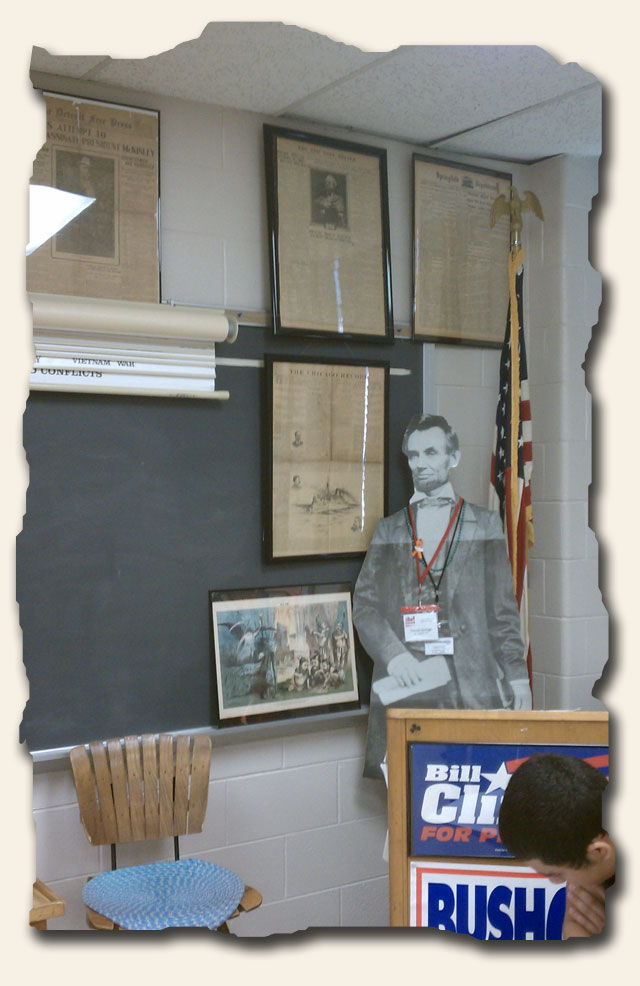 We received the following note from one of our collector friends and thought our readers might enjoy his note:
Dear Tim Hughes and Rare Newspapers:
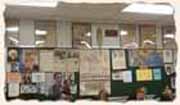
and rote memorization of facts. Rather, I teach that history is the interpretation of the present as viewed through a prism of past human experiences. I encourage my students to realize that “historical figures” were once living breathing human beings. They may be gone, but the life lessons that they left behind can still empower us to improve our lives and to better understand our world. I believe that “hand’s on learning” provides students with the most ownership of their knowledge. For this reason, my classroom is a museum filled with dozens of historical artifacts and framed newspapers. For example, when studying the Lincoln assassination, I allow students to hold a tear-stained Philadelphia Inquirer from April 1865. My students have even had the opportunity to re-‐enact the 2000 Florida Presidential election on an actual Dade County voting machine. As a practitioner of Problem Based Learning, I believe giving students access to actual historical documents and relics makes the lesson a truly authentic learning experience. I want my students to realize that history is a never-‐ending story of human triumphs and tragedies. It is a story to which they are contributing. That is a powerful lesson.
Newspaper Reports of Olympic Proportions…
August 10, 2012 by GuyHeilenman · Leave a Comment
 As the 2012 Olympics come to an end, the staff at Timothy Hughes Rare & Early Newspapers thought our readers might appreciate reviewing collectible newspapers with coverage of past Olympics. While considerably more issues are available within our inventory than what is shown, at least the list will provide a snap-shot of such greats as Jesse Owens, Nadia Comaneci, Jim Thorpe, Gertrude Ederle, and more. Please ignore the few scattered issues within this link that do not belong, and enjoy your walk back through Olympic history. View Newspapers With Olympic Coverage
Rick Brown’s Primer on Collecting Old & Historic Newspapers…
July 30, 2012 by GuyHeilenman · Leave a Comment
 Several year’s ago, a newspaper enthusiast by the name of Rick Brown had a passion to spread the love of collecting “history in your hands… from the day it was first reported”. One of his efforts was to print a newsletter for the hobby. An early entry was a primer on collecting newspapers. While many of the prices are out-of-date, we invite you to enjoy this original contribution to the hobby: Primer on Collecting Old & Historic Newspapers
We will continue to post additional contributions to the collectible experience in future posts.
Jack the Ripper… on Pinterest
July 20, 2012 by GuyHeilenman · Leave a Comment
Jack the Ripper may very well be the most infamous serial killer in World History. While others may have murdered more people, the terror he caused to what was arguably the most recognized city of the time is 2nd to none. While authentic reports are hard to come by, The Times (London) did an excellent job of following the case. At Timothy Hughes Rare & Early Newspapers we’ve put together a set of images which help to tell the story, arranged chronologically, as the readers of the day would have read about it. I’d like to say enjoy…, but somehow such a term doesn’t sound fitting. The images may be viewed via Pinterest at: Jack the Ripper on Pinterest
Only Through the Innocence of Children…
July 6, 2012 by GuyHeilenman · 2 Comments
Our friends at HistoryBuff.com recently posted a newsletter which included an article regarding an early 20th century newsboy. Please enjoy!
Only Through the Innocence of Children
A Memoir of a Newsboy in 1939
The following is a personal memoir of Stanleigh Nettleton written in 1987. Unfortunately, he died a number of years ago – but his memoir lives on!
About 1939 I was working the complaint desk on the Chicago Herald-American one Sunday morning. The complaint desk was simply where people call in that missed their paper and I would call the branch manager and he would send a kid over there with another paper. However, it was also the message center for 7 district managers and 91 branch managers who were supervising 3000 carriers delivering over 100,000 home delivery papers in Chicago.
About 6:30 I got a call from Freddy, the branch manager in 158. He called in and simply said, “The boss is looking for me, tell him I’ll call him when I get back. I just got a call from Austin Avenue Police Station that they are holding a couple of my kids out there, so I am going out there now to see what the beef is.”
Well, about 8:30 Freddy calls and he says, “I’m back and everything is OK.” I asked “What about the kids the cops picked up?” He says, “Well, that’s a long story. I’ll tell you Tuesday when I come in the office.”
Come noon Tuesday Freddy comes over to the desk and says, “Let’s go eat.” As we ate lunch Freddy tells me about the carriers.
Out on Wilcox Avenue in Chicago’s West Side there was this big apartment building that was entirely occupied by Jewish families. In one of these apartments was an old Jewish fellow who managed to flee the Gestapo and came to live with his son in Chicago. One Sunday morning the father goes out into the hall to pick up the paper and as he turns to come back in the apartment, he freezes with fear, for right in the center of the door was a big “X” mark made from white chalk. This was exactly the way the Gestapo would mark the houses in Germany when they took the Jews away to the concentration camps.
He finally stopped shaking enough to go in… (Unfortunately the original link to this story is no longer active. -If anyone can find an online printing of the story, please let us know and we will update the link.)

Civil War Era Newspapers on Pinterest…
June 29, 2012 by GuyHeilenman · Leave a Comment
 We at Timothy Hughes Rare & Early Newspapers have made a brief attempt at providing an overview of the Civil War via images of historic newspapers. These images may be viewed at: Rare Newspapers on Pinterest. We invite you to join with us in telling the story by going to www.rarenewspapers.com to find additional issues you believe should be added to “the story”. Feel free to provide us with the item number(s) of any you would like to have added. You may contact us by responding to this post or by e-mail (guy@rarenewspapers.com).