
Search
The Rare & Early Newspapers Hobby

Receive the Newsletter

Buy Historic Newspapers

Exploring the Civil War… 150 years ago, end of August, 1863…
August 23, 2013 by GuyHeilenman · Leave a Comment
 What were those living 150 years ago reading about in the newspapers during the last week of August? The following link will take you to authentic newspapers that were held by those whose loved ones were fighting to realize their greatest convictions – whether it was to set slaves free, preserve state’s rights over federal dominance, to protect house and home, or another noble cause. The issues have been arranged in chronological order. Enjoy your visit back to this incredibly formative time in American history: Authentic Newspapers (8/24/1863 – 8/31/1863)
Top ten battles of the Civil War… Just for fun…
August 14, 2013 by GuyHeilenman · 1 Comment
 A common way to collect historic newspapers is to assemble reports regarding various “top ten” lists. In the past, we have explored several such lists:
When it comes to the Civil War (one of the most popular targets within the collectible community), “top tens” can take on various forms: Top ten noteworthy Generals, top ten most impacting events, top ten naval battles, top ten events/causes for the war, etc. In this vein, shown below are various links focused on top ten battles. Which were the most important? Opinions certainly will vary… which is why no two collections are the same. As an added bonus, how about exploring the top ten “under the radar” battles which do not typically make a top ten list? We’d love to have input.
Top 10 Battles of the Civil War – by Charles Gromley on Prezi
The Ten Costliest Battles of the Civil War
Top 10 Civil War Sites
Ten Bloodiest Civil War Battles
Top ten battles in civil war – WikiAnswers
Civil War Top 10 Lists
Decorative newspapers on Pinterest…
August 9, 2013 by GuyHeilenman · Leave a Comment
 When most think of newspapers, while flashy headlines and occasional dramatic images may come to mind, for the most part small black text on pale newsprint is what is imagined. However, there was a time when the images printed within newspapers verged on the cusp of being considered art. Woodcuts prints of the mid-19th century and the early color images are still highly sought after for framing. While the former typically receive all of the attention, we’ve recently put together a Pinterest board showing a number of wonderful prints which appeared in newspapers from 1850-1875. Please enjoy: Decorative Prints [1850-1875]
Will the real Abraham Lincoln please stand up?
July 29, 2013 by GuyHeilenman · Leave a Comment
There is no doubt Abraham Lincoln is one of the most beloved historical figures of all time. Similar to how Robert E. Lee is respected by “Yankees”, as time goes by Abe Lincoln also seems to garner mutual appreciation. Once seen as polarizing, he is now credited with opposite – preserving unity. To what can we  credit the change in how he was/is viewed? Perhaps it was his address at Gettysburg or our post-Civil War hindsight which appreciates (or at least acknowledges) the end result – that we remain a united nation. However, one danger in turning a flesh-and-blood human being into an icon is that we lose perspective on the conflicted realities the people of this era were facing. We also tend to eliminate anything about such individuals which may present them in a light which bristles against how we perceive them. Doing so marginalizes the issues they were grappling with and minimizes the complexities surrounding change. It is with this in mind we invite you to explore another side of Abraham Lincoln – as he discusses his views on what to do about the slave issue. The best way to take this journey is to read his thoughts via the images provided through the link to the Liberator of August 22, 1862: Abraham Lincoln on African Colonization
60 years ago today… the Corvette…
July 1, 2013 by GuyHeilenman · Leave a Comment
Chevy rolls out the 2014 Corvette Stingray today, just in time for the 60th anniversary. How much has changed in 60 years? The following link will take you back to a newspaper report of the first release. Please enjoy this walk down memory lane. It’s hard to imagine the initial cost was only $3,250!
1953 Chevy Corvette
Gettysburg revisted… 150 years ago…
June 28, 2013 by GuyHeilenman · 2 Comments
 Since the birth of the United States, there may not be a single more formative event than The Battle of Gettysburg. Authentic newspapers containing first-hand accounts continue to be one of the most sought after within the collectible. Over the years several History’s Newsstand posts have been written about these contemporary reports. A sample of a few are:
The ultimate optimist…
Beyond the big, historic headline…
The Civil War…
The “top ten”: 19th century…
Most historic Civil War event…
The following are the currently available original newspapers with reports related to the Battle of Gettysburg. Please enjoy a brief walk into the heart of “America in crisis” (arranged in chronological order): Battle of Gettysburg
Who is Toussaint L’Ouverture?
June 21, 2013 by GuyHeilenman · Leave a Comment
 Every now and then we’ll come across an article which either illustrates a different side of a well-known historic figure, or provides a glimpse of someone whom we wonder why they have not received more recognition over time. Every now and then we’ll try to bring some of these to light. In this instance, our attention is drawn to Toussaint L’Ouverture. While he may be known to historians, the average person has most likely never heard of him. However, there was a time when this was not the case. In the mid-1800’s, his influence was known world-wide, and the ripple effects of his actions continue to be felt today. If you desire to know more, a lengthy biographical sketch by the often-verbose Wendell Phillips printed in the April 3, 1863 issue of The Liberator might be an excellent launching point. The entire article may be viewable at: The Liberator, April 3, 1863.
Wikipedia also does a pretty good job of providing additional details regarding his fascinating life. While most are no longer available, a few additional tidbits may be gleaned from other newspapers of the period: Toussaint L’Ouverture
Enjoy!
What meaningful gift do you give to a 90-year-old?
May 31, 2013 by GuyHeilenman · 1 Comment
One of the greatest challenges when it comes to gift-giving is what to purchase for someone in their 50’s-90’s+ that is both unique and meaningful. While we at Rare Newspapers specialize in offering historic newspapers from the 1600’s, 1700’s, and 1800’s, we also offer Birthday Newspapers – issues from  the day someone was born. A recent note from a purchaser of such a gift warmed our hearts. Thanks to R.M. for allowing us to share his response:
Original newspapers for the “Day You Were Born” do make wonderful gifts.
Collecting 19th Century… Pre-Civil War… Hidden gems abound…
May 17, 2013 by GuyHeilenman · Leave a Comment
An era rich in history… with hidden gems throughout…
Many rare newspaper collectors focus on the more memorable eras of history such as the Revolutionary War, the Civil War, or World War II. Brief date periods –as war events tend to be—can allow for a more concise collection without becoming unduly large if one concentrates on just the major events. Consequently, less notable eras often get over-looked without realizing there is a treasure trove of events which are both fascinating and historically significant found in period newspapers, and well within the range of the average collector.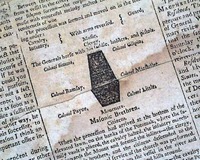
One such era would be the 1800-1860 period which we designate on our website as the “Pre-Civil War Era”. This was a transitional time in American history as the events of the Revolutionary War and the struggles with creating the federal government gave way to a more secure nation and a more independent America as the nation grew in both size and complexity.
This sixty year era offers a great wealth of events which were formative for the American landscape. The century began with continual coverage of the funeral of George Washington who died less than 3 weeks before the new century began. Thomas Jefferson was the first President to be elected in the 19th century and he did not escape the headaches of war, as the “Barbary Wars” fell within his tenure. He also lead the charge for the Louisiana Purchase which more than doubled the size of the nation and would be home, in full or in part, for 15 new states that would eventually join the Union. Newspaper reports on the Lewis & Clark Expedition were few and far between, but finding even brief mentions in a period newspaper can be quite a thrill.
As the country grew a wealth of notable events transpired & were noted in newspapers of the day. Presidential elections and inauguration are always popular, and there were many in this era: Jefferson, Madison, Monroe, John Quincy Adams, Jackson, Van Buren, William Henry Harrison, Tyler, Polk, Taylor, Fillmore, Pierce, Buchanan, and of course Lincoln, who was elected in this era, but would be inaugurated in the “Civil War Era”, a fascinating chapter of American history onto itself. For those who like to have :complete” collections, finding every election and inauguration is a doable quest.
The War of 1812 falls within this era and provides an opportunity for a sizable and notable collection on its own, from the declaration of War to the many naval battles, the attacks on Baltimore & Washington, the significant battle of New Orleans, and the treaty which ended the war. Collectors like that war events typically allow for collection “bookends” (war declaration and treaty of peace), between which they can become as focused as their budget will allow in collecting the major events.
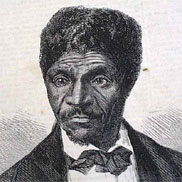 The slavery issue would remain a stain on the American fabric during this era, with events such as the Denmark Vesey and Nat Turner insurrections, and the more notable John Brown raid at Harper’s Ferry, as lead-ins to the Civil War. Abolitionist newspapers would be created, including the Liberator & the Emancipator among others, and names such as Frederick Douglass, Dred Scot, and William Lloyd Garrison would make their marks in American history forever. And it was very much a political issue as well with the Missouri Compromise being just one of several federal decisions which had slavery as a basis. Relations with the Native Americans were troubling also, with the Seminole War, the “Trail of Tears”, and the many broken treaties commonly reported in newspapers of the day.
The Texas Revolution of 1835-1836 has a spice of historical romance similar to the events of the Old West, as both were dramatized in movies. The memorable Battle of the Alamo (starring John Wayne on the big screen) and its fiercely heroic soldiers & citizens, who knowingly faced death to establish the independence of Texas, remains a proud moment in not just Texas but American history. The battles which lead up to that event, and those which followed can be found in newspapers of the day, and mention names we remember from history books including Sam Houston and Davy Crockett.
The Mexican War was another event which resulted in the expansion of the nation with all the major battles reported in newspapers of 1846 to 1848. Just a few years latter attention focused once more on the West with the California Gold Rush and all the romance of a nation heading west to find their fortune. The newspapers reported those thrills, but also reported the struggles & hardships which would befall the many on the trek to the West. Newspapers of the day were more frank than were history books 100 years later.
Westward expansion wasn’t limited to the battle fronts or the quest for gold, as the Missouri River Expedition, The Yellowstone Expedition, the Rocky Mountain exploration, and reports on the Santa Fe Trail were all reported as the adventurous were discovering and creating history—and reported first in newspapers of the day. Such expansion was responsible for states to be created, and reports of statehood for Alabama, Indiana, Michigan, and Illinois among others were detailed in newspapers, as were reports of changes needed in the United States flag to honor such additions.
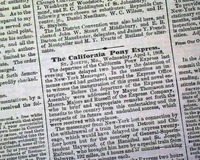
The Erie Canal, creation of the cotton gin and the Pony Express were notable events during this period. Famous names were commonly found as their reports were making history & reported in newspapers as such, including the likes of Daniel Boone, John Jacob Astor, Bolivar, John Jay, Henry Clay, Horace Greeley, and Kit Carson to name but a few. Of special intrigue is finding reports of famous names before they became famous, such as inconspicuous mentions of Abraham Lincoln from 1848 when he was a member of Congress, or Jefferson Davis from 1833, nearly 30 years before becoming President of the Confederacy.
 Judaica interest, reports of pirates, the Black Hawk Indian War, runaway slaves, William Henry Harrison’s one month Presidency, and the earliest reports of the Mormons and the journey across the country provide fascinating reading in newspapers of the pre-Civil War era. The Monroe Doctrine is just one of an endless list of historical documents and landmark Supreme Court decisions which were reported in newspapers of the day. Early newspapers from Hawaii, Florida, and Kentucky among others, more commonly found after the 1870’s are a special treat when found before the Civil War. And more than American history found their way into American newspapers. The Battle of Waterloo and the other Napoleonic Wars with mention of Buonaparte, Wellington and other key European figures put world history into perspective when such reports are found alongside notable events in American history.
If capturing history in the pages of the nation’s newspapers is your hobby, certainly there is much from the 1800 – 1860 period to excite any historical hobbyist. Do not overlook this fascinating era in the growth & development of the United States of America.
The War of 1812… through contemporary newspapers and more…
May 13, 2013 by GuyHeilenman · Leave a Comment
 Rare & original newspapers have always been an excellent resource for capturing the context, contemporary response, and details of historic events. This truth was brought home recently via Todd Andrlik’s, “Reporting the Revolutionary War: Before It Was History, It Was News“. Moving slightly into the future, Vice Admiral, U.S. Navy (retired) George W. Emery does the same in his work, “In Their Own Words – The Navy Fights The War Of 1812“. Yet again we are reminded that “History is never more fascinating than when it’s read from the day it was first reported.” Additional details worth exploring may be found at:
In Their Own Words: A New Look at the Naval War of 1812
Thanks for this latest contribution which brings the past into the present through the eyes of those who experienced the War of 1812 first-hand.