
Search
The Rare & Early Newspapers Hobby

Receive the Newsletter

Buy Historic Newspapers

Reflecting on 2020 as we approach Thanksgiving…
November 23, 2020 by GuyHeilenman · Leave a Comment
“Count your blessings, name them one by one…”
2020 has certainly been quite the year. There’s no doubt it came with more than its share of difficulties; however, history is pregnant with years fraught with an abundance of pain, suffering, and death. I admit, there have been occasions when the onslaught of bad news has weighed heavily upon my mind, but thankfully, there have been more than enough moments when I’ve been checked back from allowing negative thoughts to win the day.
Such was the case when I took notice of the November 18, 1918 issue of the Springfield Republican (see below). In the midst of the horrors brought on by the Spanish Flu Epidemic, President Woodrow Wilson continued the presidential tradition of proclaiming a day for thanksgiving and prayer. What particularly caught my attention was seeing the bordered text of the Thanksgiving Proclamation surrounded on three sides by WWI reports from all over the world, a mere 6 inches from an article updating the readers of the current death toll of the pandemic. “A rose among thorns” came to mind, followed by a flashback to my childhood – as I could almost hear my (recently deceased) mother’s words yet again: “No matter how bad you think things are, there are people throughout the world who have it much worse than you do. Never stop counting your blessings.” Of course I wouldn’t always immediately comply, which prompted her follow-up: “Wipe that sour look off your face before it gets stuck that way.”
So, it is with these thoughts in mind I hope, wish, and pray for our “collecting” family to have a Thanksgiving overflowing with… thanksgiving.

When upon life’s billows you are tempest-tossed,
When you are discouraged, thinking all is lost,
Count your many blessings, name them one by one,
And it will surprise you what the Lord has done.
Refrain:
Count your blessings, name them one by one,
Count your blessings, see what God has done!
Count your blessings, name them one by one,
And it will surprise you what the Lord has done.
Are you ever burdened with a load of care?
Does the cross seem heavy you are called to bear?
Count your many blessings, every doubt will fly,
And you will keep singing as the days go by.
[repeat refrain]
When you look at others with their lands and gold,
Think that Christ has promised you His wealth untold;
Count your many blessings—money cannot buy,
Your reward in heaven, nor your home on high.
[repeat refrain]
So, amid the conflict whether great or small,
Do not be discouraged, God is over all;
Count your many blessings, angels will attend,
Help and comfort give you to your journey’s end.
[repeat refrain]
Lyrics by Johnson Oatman, Jr.
Snapshot 1870… The 15th Amendment – Not So Fast!
November 19, 2020 by GuyHeilenman · Leave a Comment
The 15th Amendment states: “The right of citizens of the United States to vote shall not be denied or abridged by the United States or by any State on account of race, color, or previous condition of servitude.” (www.History.com)
However…
Despite the amendment, by the late 1870s discriminatory practices were used to prevent blacks from exercising their right to vote, especially in the South. (www.History.com)
We recently unearthed a pair of issues from The New York Times dated in 1870 which shed some early-morning light on the dawn of the 15th Amendment, and the struggle it faced on its path to realizing its intent – a struggle which made significant headway with the passage of the Voting Rights Act in 1965.
The Constitution of the United States is second-to-none, and the wisdom of the Founders to frame it in such a way as to make it a work in progress was genius. However, making adjustments along the way, although appropriately difficult, was part of the original intent. The greater problem and most difficult hurdle is bringing the hearts of humanity in line with “red & yellow, black and white; they are precious in His sight” – and should be seen and treated as such. 
Snapshot 1945… America’s youth are too soft…
November 12, 2020 by GuyHeilenman · Leave a Comment
WW2 was finally over, but much was to be done. Trials, international agreements, boundaries of country’s which had been conquered by the Nazis… What to do with the millions who had lost their homes due to destruction, fleeing life-threatening circumstances, or having been carted off to concentration camps? What about the abundance of parentless children? How to rebuild? Who would pay for the rebuilding of countless areas of devastation? What about the atom bomb? What does this new power mean?
In the midst of all of these critical and time-sensitive concerns at the forefront of President Truman’s mind, one which caught my eye was found on the front page of a Wilmington Morning Star (NC) from October 24, 1945. What do we do to prepare our nation for future conflicts? While a great question, his focus was thought-provoking:
The youth of America are too soft, and something needs to be done, now!
The image below shows a portion of both Truman’s thoughts and his plan of action – initial steps which would eventually blossom into President Eisenhower’s “President’s Council on Youth Fitness” in 1956. These actions, along with similar measures taken over the 40 years to follow, led me to wonder whether it is time to take a look at this question once again. After all, raising up the next generation to be characterized by the fragile term “snowflakes” does not bode well for the future of “life, liberty, and the pursuit of happiness”. 
Snapshot 1966… Cancel culture, free speech, and a civil society…
November 9, 2020 by GuyHeilenman · Leave a Comment
What to cancel vs. what to keep? Revisionism vs. an accurate accounting?
The practice of what we currently refer to as “Cancel Culture” is nothing new. Few details remain of China’s glorious early history due to the practice of each new dynasty expunging any evidence regarding the former so-as to elevate itself to the top of the historical record. Other religions and societies have done the same in order to eliminate the warts which are common to all. While some believe it is important to remember history, no matter how ugly, in the hope that future generations will learn from past mistakes, others are convinced the past is too painful, and must therefore be eradicated from wherever it might rear its ugly head.
Although statues, flags, and other symbols have been the most recent targets of this tension, the written word was the most common target of past generations, and was realized through both the banning and burning of books which were deemed too immoral, too painful, or too revealing of “whatever we currently don’t want to be known” to be read. Examples include Uncle Tom’s Cabin, 1984, Animal Farm, Brave New World, and the feature of this post, To Kill A Mocking Bird. Published in 1966 to overwhelming critical approval, it wasn’t too long before it began to receive considerable resistance for a plethora of objections, and although included on many high school and junior high school reading lists, attempts to remove it from school libraries were quite common. The article below highlights one such a case, with the New York Times of January 16, 1966 printing Harper Lee’s own response to a local schoolboard near Richmond, Virginia.
The purpose of this post is not to resolve the issues created by both free speech and revisionism; rather, to merely ponder these issues in light of the past. My only editorial contribution is that I’m glad I can still look back at such accounts as printed in old newspapers and hopefully glean perspective on how and where I’d like to tread in the present. 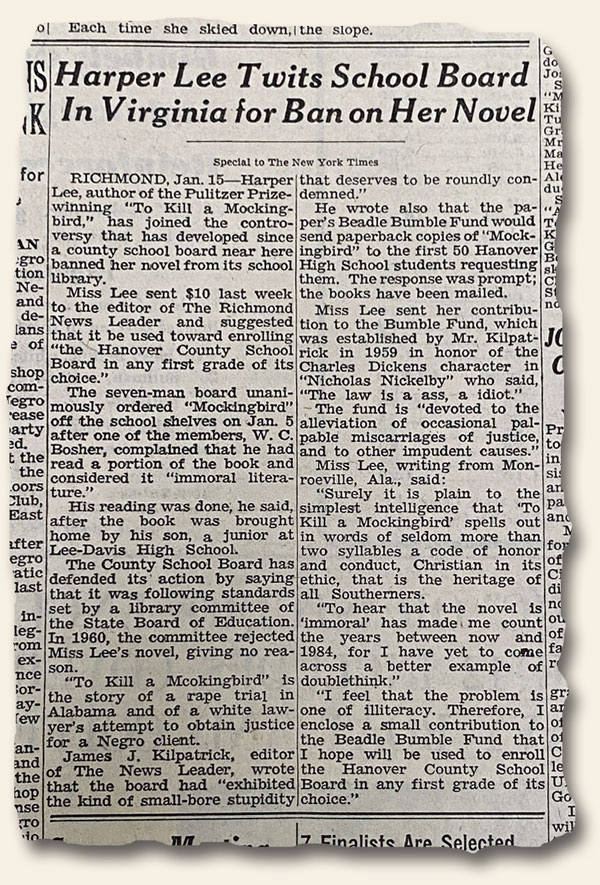
Announcing: Catalog #300 (for November, 2020) is now available…
October 30, 2020 by GuyHeilenman · Leave a Comment
- Catalog 300 (in its entirety)
- Noteworthy Catalog 300 ($250+)
- Combined Catalogs (current, w/ remnants of previous)
Don’t forget about this month’s DISCOUNTED ISSUES.
The links above will redirect to the latest catalog in approx. 30 days,
upon which time it will update to the most recent catalog.
They Put It In Print (1918)… “The 19th Amendment fails by 1 vote…”
October 26, 2020 by GuyHeilenman · Leave a Comment
Does one vote matter? Does every vote count?
Since the passage of the 19th Amendment, the impact of women on the political climate, and therefore, on both the course and civil fabric of the United States cannot be understated. Since 1964, more women have voted in presidential elections than men – as measured by both actual quantity and as a percentage of their respective genders. While this “right” was not realized until 1920, few know that the (women’s suffrage) Amendment nearly passed two years earlier, but came up short by a single vote. Sadly, not all Senators were present to vote. How do we know? They put it in print in The Christian Science Monitor (Boston) dated October 2, 1918. 
Snapshot 1807… William Cowper and the Slave Trade…
October 22, 2020 by GuyHeilenman · Leave a Comment
We recently discovered a Gazette Of The United States, For The Country (Philadelphia), dated May 25, 1807 which had a timely reprinting of William Cowper’s poem regarding the abolition of the Slave Trade – just a few weeks after the enactment of the Slave Trade Act of 1807 (United Kingdom). It would still be another quarter-century before slavery within the Britain Empire would be abolished. 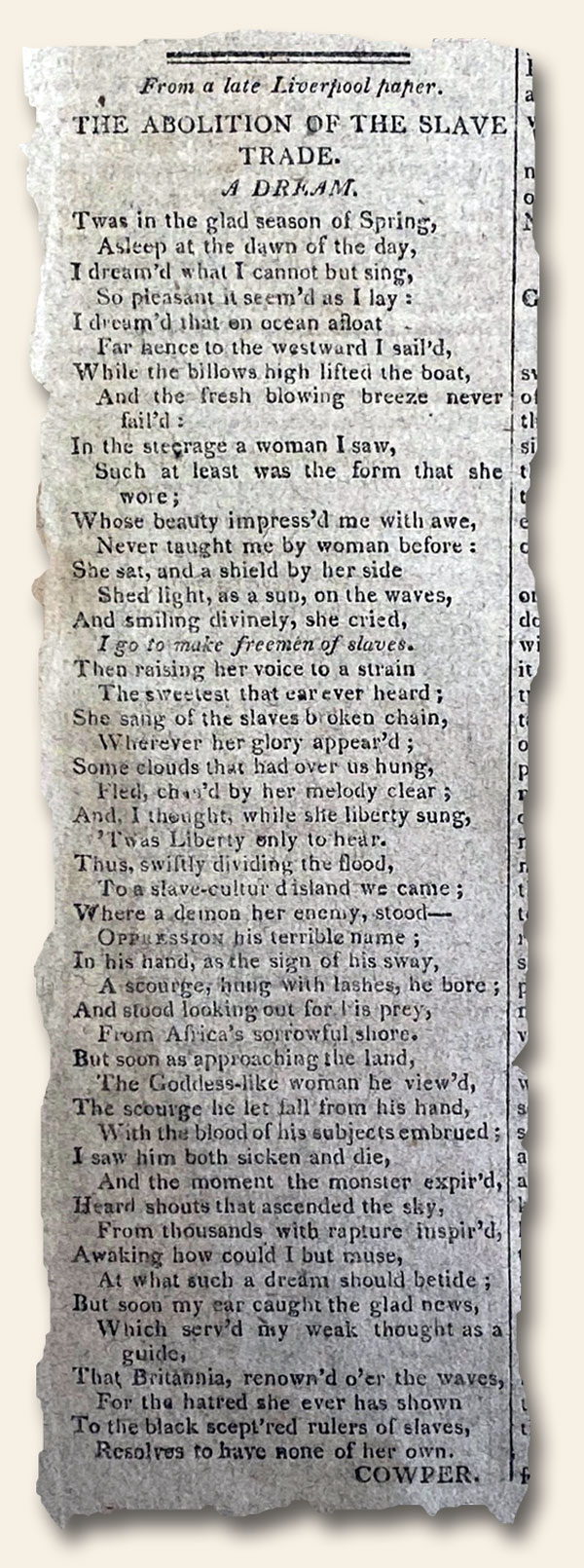
Hidden gems within Niles’ Weekly Registers…
October 16, 2020 by GuyHeilenman · 4 Comments
 Approximately a dozen years ago, shortly after the History’s Newsstand Blog was birthed, we ran a series of posts which focused on the joy of finding hidden gems within Rare & Early Newspapers. The introduction to this series, in part, stated:
“What do gold prospectors, pirates, treasure hunters, archeologists, and rare newspaper collectors have in common? They all share the thrill of the hunt and the reward of discovery. When it comes to rare newspapers, finding the unexpected, in contrast to other collectibles, is often a good thing – and at times can even be quite valuable. Since the inception of the History’s Newsstand Blog, a number of posts have focused on this intrinsic pleasure of the hobby, and several readers have responded with ‘discoveries’ of their own.”
Twelve years later we are revisiting this theme once again – but with a specific focus on one title: The Niles’ Register. If you have ever obtained a Niles’ Register (Weekly Register) and discovered within its pages content which was undisclosed – i.e., a “hidden gem”, you are invited to respond to this post with a comment describing your “find”. Please include the exact date of the issue and the page number(s) were the content is located. Feel free to include additional information either about the content itself, or why you found it compelling. Every now and then we will pull a few responses and post them for others to see.
If you would like to learn more about Niles’ Registers, you can read additional posts about this intriguing title HERE.
My collecting story… P.S. from City of Industry, CA…
October 8, 2020 by GuyHeilenman · Leave a Comment
Below we continue our series in which we post the “stories” graciously submitted by our collecting friends during the pandemic of 2020.
The Workman and Temple Family Homestead Museum in the City of Industry, California, east of Los Angeles, interprets the region’s history from 1830 to 1930 and, among the approximately 30,000 artifacts in the artifact collection are hundreds of historic newspapers, most dating to the 1870s, a key time period in our interpretation. Among the more unusual of the papers is the first of twelve issues of the “Willow Dale Press,” an amateur paper published by 13-year old Florence Carter and her 10-year brother, Arthur, children of rancher and developer Nathaniel Carter. The family migrated in 1874 from Lowell, Massachusetts to the San Gabriel Valley east of Los Angeles for a reason many others did: health. Nathaniel Carter suffered from serious pulmonary issues and the temperate climate of the valley proved to be a balm for his ailments. The Carters, who bought their 17-acre spread from George Stoneman, a Union Army general during the Civil War and future California governor, and christened it “Willow Dale.” Widely known for its picturesque location, fine home, and its landscaping, Willow Dale was photographed by Carleton Watkins, famed for his images of Yosemite. The site is in today’s city of San Marino, very near the Huntington Library, Art Galleries and Botanical Gardens.
The Carter siblings were provided with a small foot-treadle operated press with a self-inking action made in Boston and which produced a dual-column sheet measuring 6 inches by 9 inches. The duo’s sheet was among many so-called “juvenile papers” published throughout the nation as literacy rates skyrocketed. This first issue, for January 1879, appeared late the following month, as one of the major dailies in Los Angeles, the Herald, noted in its Christmas 1878 edition that “we are indebted to our editorial confreres of the Willow Dale Press for a handsome chromo of the ‘Village Mill’,” this chromolithograph produced on their press being a free gift with a subscription, a savvy marketing tool for the young entrepreneurs, who were appealing “to our young friends” in making their “editorial bow.”
In fact, Florence and Arthur felt compelled to state “one of us has hardly reached, while the other has just entered our teens, and so our readers as they look over the paper will please pass judgment accordingly.” They intended “to present each month, a good selection of reading matter, with articles which will be written expressly for this paper.” They also added that “we will be glad to receive communications from any of the young folks, also charades, enigmas or conundrums which are original.” Moreover, the Carters expressed a willingness to exchange with other like publications and made the offer to “each month present for THE OLD FOLKS a column which we hope they will find interesting and profitable, as we find it the most profitable to us.” Another promotion was that a person who secured the most subscribers would get 500 cards with more than 200 types to choose from and room for up to three names, while the second and third highest producers would receive 300 and 100 cards, respectively. Elsewhere, the pair advertised for the “latest styles” in New Year’s presentation cards.
Humor, or the attempt at, proved to take up much of the space in the issue, including this example: a small store about ten feet by twelve in East Los Angeles [a neighborhood now known as Lincoln Heights] has three large signs—MARKET—upon it, which nearly cover the building. Florence said we rode along, she did not think they need “Mark-It” any more. Another bit of humor was reprinted from the popular Youth’s Companion, and told of a woman who got chills from sitting on a rock until she learned that it was a block of ice covered with carpets to delay its melting. For the “Old Folks Column,’ that consisted of an ad for a local doctor, a nearby nursery, and for the well-known resort, the Sierra Madre Villa, which was north of the Carter’s place.
Though the paper moved up in summer to a larger size of 9 ¼ x 7 ¼ with three columns and a new masthead with an increase in the subscription rate to 25 cents per year, at which time the Herald acknowledged receipt of the sixth issue and called the Press “a spicy, readable sheet,” the Carters only kept the journalistic endeavor going to the end of 1879. Two issues were produced by their father because Florence and Arthur took a long trip to see their maternal grandmother in Northern California. When the paper folded, the  explanation was that the closure was due to “school work, baseball and archery,” these being childhood concerns that made eminent sense for the practical business decision reached by the young proprietors.
Just after the shuttering of the paper, the Carters moved to a new 103-acre tract known as “Carterhia,” while Nathaniel developed another 1000 acres and developed the town of Sierra Madre at the base of the chain of mountains once known by that name and later changed to the San Gabriel range. Florence later married a prominent Y.M.C.A. official in Los Angeles and raised a family. After she was widowed, she worked as a librarian and a Christian Science practitioner. Arthur, who remained at Sierra Madre, became a ranger in the newly created national forest in the mountains above the town and ran the Carter’s Camp resort in Big Santa Anita Canyon above Sierra Madre. Later, he was an orange grower in town, where he and his wife raised their family.
So, while the Willow Dale Press was short-lived, it was significant in that it was the first amateur or juvenile paper in greater Los Angeles and, in fact, was the first paper at all in the western San Gabriel Valley, as even the new town of Pasadena did not have one until the early 1880s.
As additional “stories” are posted they will be available at: MY COLLECTING STORY. We did this many years ago as well – and their posts are also included.
My collecting story… B. C. in Trion, Georgia..
October 5, 2020 by GuyHeilenman · Leave a Comment
Below we continue our series in which we post the “stories” graciously submitted by our collecting friends during the pandemic of 2020.
I am the published author of over a dozen books of fiction and nonfiction. A few years ago, my publisher suggested that I write a book about Kathryn Kelly, the wife of “Machine Gun” Kelly and also the “brains” behind the crimes they committed over several years. What little I could find about K athryn was interesting, but since no other books had ever been written about her, research was difficult. I turned to the FBI Vault of historical documents and personally interviewed people who lived during the Great Depression and the “Gangsta” Era. And then I came across “Timothy Hughes: Rare & Early Newspapers.” It was like finding a gold mine. I was able to access the newspapers from that time period that followed the crimes and eventual arrest of Kathryn Kelly and Machine Gun Kelly. With this information, along with the other research I had gathered, I wrote the book, Kathryn Kelly: The Moll behind Machine Gun Kelly. It was recently optioned for a major film. The newspaper I have saved for my collection is “The Bethlehem Globe-Times” – Tuesday, September 26, 1933. On the front page is the headline: “Machine Gun” George Kelly Is Captured. The sub-headline reads: Desperado Surrenders Without Resistance – Wife Is Also Taken Into Custody.
As additional “stories” are posted they will be available at: MY COLLECTING STORY. We did this many years ago as well – and their posts are also included.