
Search
The Rare & Early Newspapers Hobby

Receive the Newsletter

Buy Historic Newspapers

Reasons for the Declaration of Independence. . . Step by Step Logic…
August 28, 2026 by Laura Heilenman · Leave a Comment
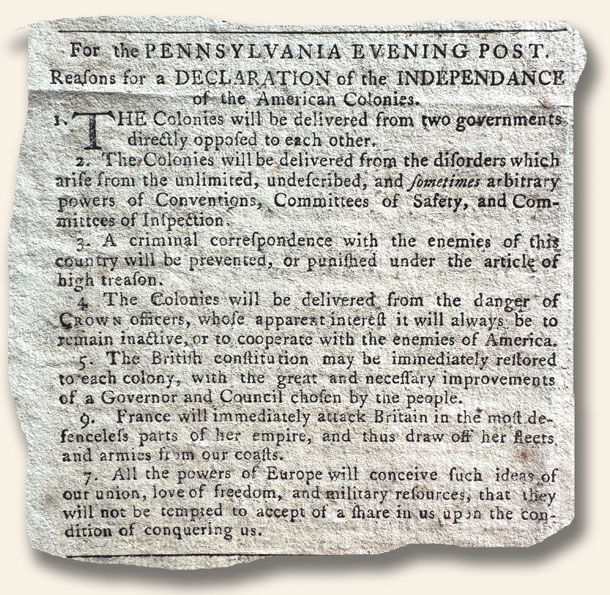 Often as we have big decisions ahead of us, wise council around us may prompt us to ask ourselves the question. . . why? Knowing the whys can often help point us to answer the more logistical question of how. In April of 1776, the Pennsylvania Evening Post attempted to lay out the why of the enormous decision facing the colonies. Below, read the text and reasoning laid before the citizenry.
Reasons for a DECLARATION of the INDEPENDANCE of the American Colonies.
- THE Colonies will be delivered from two governments directly opposed to each other.
- The Colonies will be delivered from the disorders which arise from the unlimited, undescribed, and sometimes arbitrary powers of Conventions, Committees of Safety, and Committees of Inspection.
- A criminal correspondence with the enemies of this country will be prevented or punished under the article of high treason.
- The Colonies will be delivered from the danger of Crown officers, whose apparent interest it will always be to remain inactive, or to cooperate with the enemies of America.
- The British constitution may be immediately restored to each colony, with the great and necessary improvements of a Governor and Council chosen by the people.
- France will immediately attack Britain in the most defenseless parts of her empire and thus draw off her fleets and armies from our coasts.
- All the powers of Europe will conceive such ideas of our union, love of freedom, and military resources, that they will not be tempted to accept of a share in us upon the condition of conquering us.
If only we could all present our logical arguments in such a concise and impactful manner.
A recently released video related to this post is available at: Independence was Destiny – The Case for Independence
When crises happen, publishers can be creative… Ben Franklin & the Stamp Act…
August 24, 2026 by TimHughes · Leave a Comment
Occasionally, a newspaper just doesn’t look like a newspaper. When crises happen, some newspaper publishers can be creative and angry, resulting in “newspapers” that are quite unusual. Here is one.
Looking very much like a broadside (although it is four pages), an issue we purchased many years ago is simply headed: “REMARKABLE OCCURRENCES”, having no date, no city of publication, and no issue number.
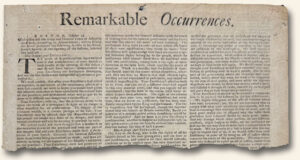 With some investigation, we learned that this is actually the November 14, 1765 issue of the famous “Pennsylvania Gazette” printed by Ben Franklin and David Hall. The hated Stamp Act took effect on Nov. 1, 1765. Therefore the paper was suspended and in its place a broadside entitled “No Stamped Paper to be had” was printed for Nov. 7, and this four page issue titled: “Remarkable Occurrences” was created for Nov. 14. The regular title and numbering were resumed with the Nov. 21 issue but without the imprint. No name of publisher appeared until the Feb. 6, 1766 issue printed by David Hall, as the partnership with Franklin had been dissolved.
Never, previously, have we ever handled either of these two issues.
The entire front page is taken up with Stamp Act content. Page 2 has content from Europe, and pages 3 and 4 have content with datelines from Boston, Newport, Philadelphia, and New York with again, much of the content related to the Stamp Act.
This is treasured as one of the more intriguing newspapers in our inventory, and is even more notable with its connection to the Stamp Act.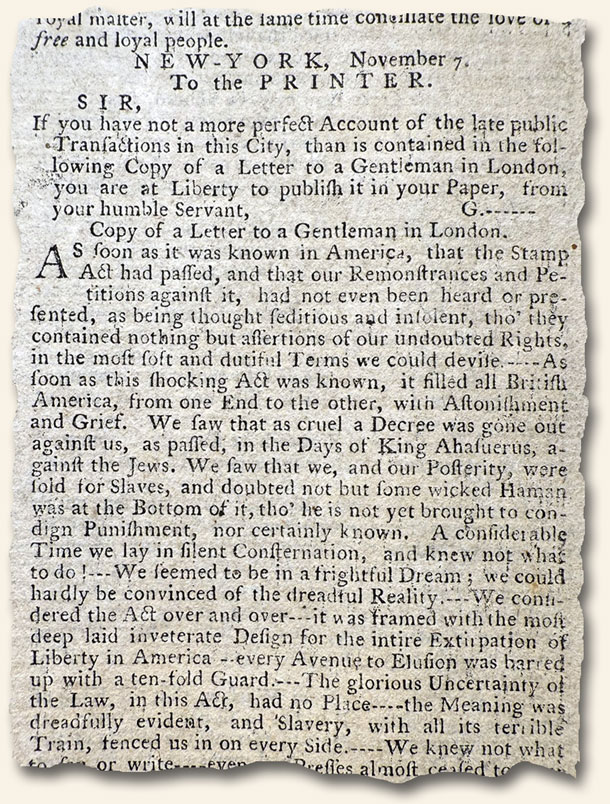
Blockbusters of the Past. . . Movies Bring Nostalgia…
August 21, 2026 by Laura Heilenman · Leave a Comment
Summer blockbusters and Christmas releases are often a highlight as family and friends gather for celebrations. As evenings grow darker in late summer, or as the last of the Thanksgiving or Christmas dinner dishes are washed and dried, those big-budget Hollywood movies often tempt merrymakers out of the house and down the street to the local theater. One of the delights of working at RareNewspapers is unearthing nostalgic ads for movies from our past. We often shake our heads and remark to each other, “They don’t make them like that anymore.” While that sentiment may or may not be true, those films will always hold a special place in our hearts. If you love old movies. . . especially those from the final decades of the 20th century. . . perhaps the following full-page movie ads from the Los Angeles Times, Hollywood’s hometown paper, will renew your memories, hopefully bringing a smile to your face and possibly inspire a trip down the street to your local theater.
The reason I collect it: stunning graphics inside… Lincoln’s Funeral…
August 17, 2026 by TimHughes · Leave a Comment
We have handled many Lincoln assassination and funeral issues, and many can be graphic in terms of type size and drama of the column headlines. Most notably, the ‘Philadelphia Inquirer’ had several issues from April 17 to 25 with very nice graphic appeal.
But never have we seen inside pages so dramatically presented as with the ‘Cleveland Morning Leader’ issue of April 28, 1865. Although the front page is focused on the capture and death of John Wilkes Booth, as well as reports on the Lincoln funeral (all page 1 and 4 columns have wide, black mourning rules), pages 2 and 3 are consumed with broadside-like graphics, offering no text save for that found within the graphics. Page 2 appears much like a monument in memory of Lincoln, and page 3 has a black border surrounding short poems and portions of a “Speech of Abraham Lincoln” and a line from his “Emancipation Proclamation”.
When first encountered I noticed the ink bleed-through on page 1 and thought it was offsetting from the previous issue (not uncommon). But when I opened the newspaper I discovered something I had never seen the likes of before.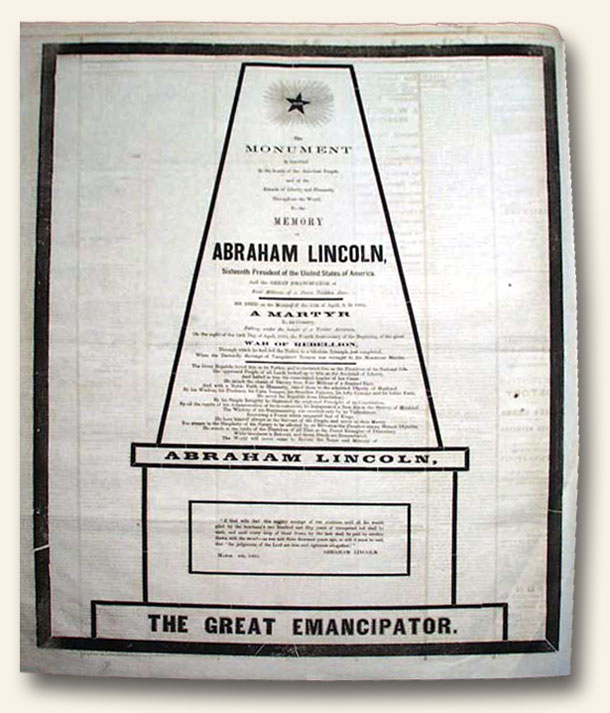
August 2026 Newsletter – Rare & Early Newspapers…
August 14, 2026 by GuyHeilenman · Leave a Comment
|

|
Who’s Who in Newspapers? George Ray Tweed edition (1944)…
August 10, 2026 by GuyHeilenman · 1 Comment
If you’re a World War II history enthusiast, you might recognize the name George Ray Tweed — a U.S. Navy radioman known to the world as the “Ghost of Guam.” Yet few realize the sheer grit, luck, and quiet resistance required to pull off one of the most remarkable survival stories in American military history.
When Japanese forces invaded Guam in December 1941, Tweed refused to surrender alongside his comrades. Instead, he slipped into the island’s rugged jungle with little more than a rifle, a radio, and an unwavering determination to stay free. For over two and a half years, Tweed evaded intense enemy patrols, relying on the immense courage of local Chamorro families who risked torture and execution to keep him hidden, fed, and supplied. Using his background as a technician, he even built a crude radio receiver to gather Allied news, transforming himself into a symbol of hope for the occupied islanders.
If you are fascinated by human resilience—and the incredible bravery of civilians who risked everything in wartime—spending a little time researching Tweed’s survival on Guam is deeply inspiring. It serves as a powerful reminder of how ingenuity, faith, and the loyalty of brave allies can overcome seemingly impossible odds.
We discovered him quite by accident as we were searching for a client’s request for a “birthday newspaper“ from the same week. Thankfully, while extracting the date he wanted, we noticed this headline and corresponding photo (in the Minneapolis Morning Tribune, Aug. 11, 1944) which motivated us to see what we could learn about him.
Below is a photo featuring the bold front-page headline: “Dodges Japs 2 1/2 Years on Guam”.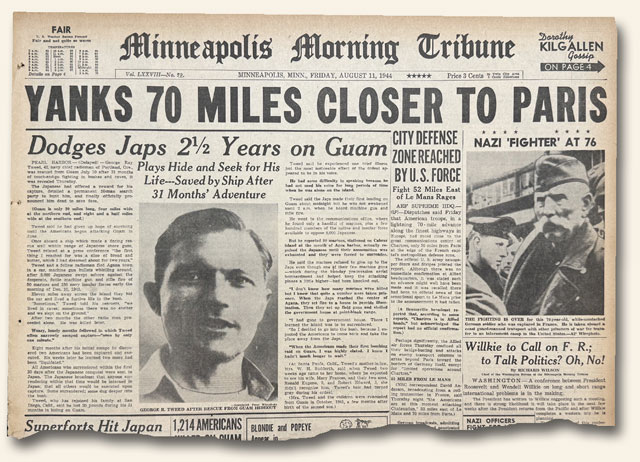
Ballot Box Standoff…Veterans Bring Justice…
August 7, 2026 by Laura Heilenman · Leave a Comment
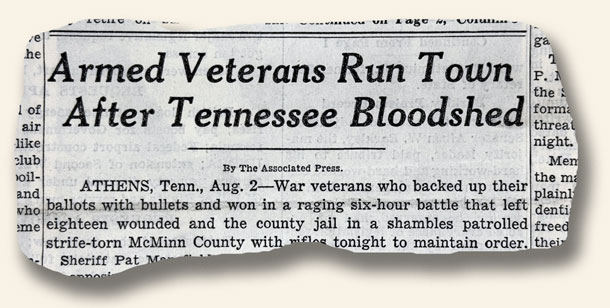 On August 2, 1946, as reports from the previous night’s violence in McMinn County began reaching national newsrooms, The New York Times carried early accounts of the Ballot Box Standoff in Athens, Tennessee. Initial wire dispatches described a chaotic election-day confrontation in which returning World War II veterans, alleging that a corrupt local machine was preparing to steal the vote. Clashes ensued with heavily armed deputies, and one early headline erroneously claimed a sheriff had been slain, reflecting the confusion of overnight bulletins as the story was still unfolding. By the next morning’s August 3 edition, the Times gave the story prominent front-page treatment with an Associated Press report headlined “Armed Veterans Run Town After Tennessee Bloodshed.” Datelined Athens, August 2, the article detailed how GI-backed citizens had besieged the county jail after deputies seized ballot boxes, exchanged gunfire for hours, used dynamite, and ultimately forced the surrender of roughly fifty deputies. Eighteen people were wounded; the veterans then patrolled the streets with rifles to maintain order while the ballots were recovered and counted. An editorial on page 10, titled “Election in Tennessee,” weighed the deeper meaning of the events. It acknowledged the veterans’ conviction that a dictatorial political machine had long falsified results and that peaceful avenues of reform seemed closed. Yet the editorial also cautioned that taking the law into one’s own hands—however understandable the grievances—threatened the orderly processes essential to democracy, leaving readers with a sober reflection on both the courage and the risks of the armed stand for honest elections.
California’s Workaround… a Prohibition loophole…
August 3, 2026 by Laura Heilenman · Leave a Comment
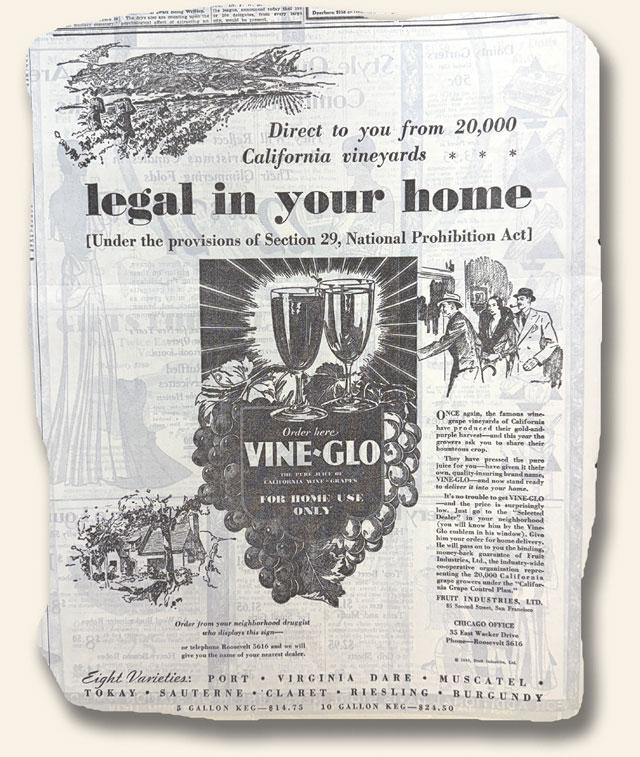 When Prohibition took effect on January 17, 1920, under the 18th Amendment and the Volstead Act, American grape growers and winemakers faced a philosophical crisis. Commercial production, sale, and transportation of alcoholic beverages were suddenly illegal, threatening to wipe out California’s thriving vineyards. Many growers considered ripping out their vines and planting other crops. Yet a crucial loophole in Section 29 of the Volstead Act offered a lifeline: households could legally produce up to 200 gallons of non-intoxicating fruit juices or cider each year strictly for personal home consumption. Demand for wine grapes soared almost overnight as people began crushing and fermenting them themselves, and prices climbed dramatically.
Enterprising producers soon refined this workaround into a convenient product known as grape bricks (or wine bricks). Companies such as Vino Sano (appearing around 1921) and later Vine-Glo compressed concentrated grape juice into solid, shelf-stable blocks that could be shipped anywhere and stored for months. Customers simply dissolved a brick in a gallon of water to create grape juice. The bricks came in flavors that conveniently matched popular wines—port, sherry, burgundy, claret, muscatel, and others—making the intended use obvious to anyone paying attention. An ad for these grape bricks, by the company Vine-Glo, is found in THE CHICAGO DAILY TRIBUNE for December 8, 1930.
This innovation kept many vineyards alive and even made some growers wealthy during the dry years. The most memorable feature of these bricks was the carefully worded “warning” printed on the packaging. Labels instructed buyers on how to reconstitute the juice and then solemnly cautioned them not to leave the mixture in a cool cupboard for twenty or twenty-one days, not to add sugar in certain amounts, and not to fail to add benzoate of soda—because otherwise the liquid would ferment into wine. These reverse instructions served as a thinly veiled recipe while allowing the sellers to claim they were only providing a legal non-alcoholic product. The wink-and-nod approach worked for years, turning grape bricks into one of Prohibition’s most ingenious (and widely enjoyed) workarounds until court challenges and the eventual repeal of the ban in 1933.