

Search
The Rare & Early Newspapers Hobby

Receive the Newsletter

Buy Historic Newspapers

California’s Workaround… a Prohibition loophole…
August 3, 2026 by Laura Heilenman · Leave a Comment
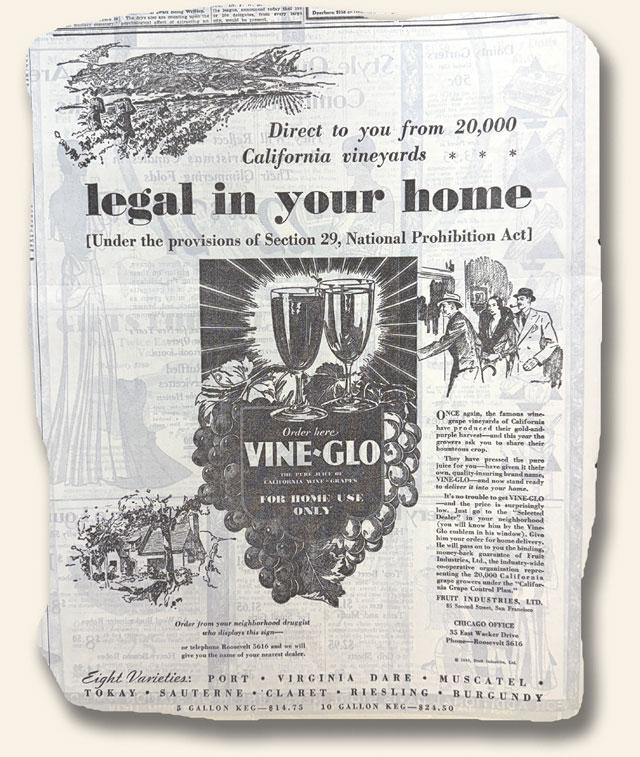 When Prohibition took effect on January 17, 1920, under the 18th Amendment and the Volstead Act, American grape growers and winemakers faced a philosophical crisis. Commercial production, sale, and transportation of alcoholic beverages were suddenly illegal, threatening to wipe out California’s thriving vineyards. Many growers considered ripping out their vines and planting other crops. Yet a crucial loophole in Section 29 of the Volstead Act offered a lifeline: households could legally produce up to 200 gallons of non-intoxicating fruit juices or cider each year strictly for personal home consumption. Demand for wine grapes soared almost overnight as people began crushing and fermenting them themselves, and prices climbed dramatically.
Enterprising producers soon refined this workaround into a convenient product known as grape bricks (or wine bricks). Companies such as Vino Sano (appearing around 1921) and later Vine-Glo compressed concentrated grape juice into solid, shelf-stable blocks that could be shipped anywhere and stored for months. Customers simply dissolved a brick in a gallon of water to create grape juice. The bricks came in flavors that conveniently matched popular wines—port, sherry, burgundy, claret, muscatel, and others—making the intended use obvious to anyone paying attention. An ad for these grape bricks, by the company Vine-Glo, is found in THE CHICAGO DAILY TRIBUNE for December 8, 1930.
This innovation kept many vineyards alive and even made some growers wealthy during the dry years. The most memorable feature of these bricks was the carefully worded “warning” printed on the packaging. Labels instructed buyers on how to reconstitute the juice and then solemnly cautioned them not to leave the mixture in a cool cupboard for twenty or twenty-one days, not to add sugar in certain amounts, and not to fail to add benzoate of soda—because otherwise the liquid would ferment into wine. These reverse instructions served as a thinly veiled recipe while allowing the sellers to claim they were only providing a legal non-alcoholic product. The wink-and-nod approach worked for years, turning grape bricks into one of Prohibition’s most ingenious (and widely enjoyed) workarounds until court challenges and the eventual repeal of the ban in 1933.
What was Happening 100 Years Ago – March 6, 1923…
March 6, 2023 by LauraH · Leave a Comment
We frequently receive requests for “birthday newspapers” for friends and family of our collectors. Giving a person, young or old, a glimpse of the world as reported on the day they were born is certainly a convivial and thoughtful gift. Being a bit more creative, some gift-givers branch out and select an issue from 100 years prior to their birthdate in order to help the receiver capture a snapshot of life a century prior to their birth. With this on my mind today, I went looking for a common title people often select, the New York Times. In this particular instance (March 6, 1923), being smackdab in the middle of Prohibition, a sampling of the headlines included: “CITY WANTS WHISKY FOR HOSPITAL USE”, “MODERN PAUL REVERE WARNS OF LIQUOR RAID”, and “RUM-RUNNING ON THE SOUND”. There was also an eclectic mix of other headlines which included: “LAUDS NEGRO EDUCATION”, “Harding Foresees Beneficent Results to Race and Nation”, “’Human fly’ FALLS 10 STORIES TO DEATH”, and “Harry F. Young, Scaling Martinique Hotel for a Movie Film, Misses His Grip”. Take a peek at this issue to see additional details regarding these stories and more.
With over 3-million newspapers within our archives, perhaps someday someone will send you a newspaper from the day you were born – or a 100-year prequel.
Medical marijuana! How about a prescription for beer?
October 10, 2016 by TimHughes · Leave a Comment
The controversy over medical marijuana is nothing new in attempts to circumvent the law for outlawed drugs. Shortly after Prohibition became the law of the land in 1919, the “New York Times” reported in its Oct. 26, 1921 issue: “Beer As Medicine In Nine States Only” “New Treasury Regulations Inoperative in States Having Local Prohibition” “Thinks People of Nation Will Object When They See Drug Stores Handling Booze”. The article begins: “The brewers have several hurdles yet to make before medical beer is a reality…” with much more.