

Search
The Rare & Early Newspapers Hobby

Receive the Newsletter

Buy Historic Newspapers

Mystery Solved … The Ancestry of Abraham Lincoln Clarified…
March 23, 2026 by Laura Heilenman · Leave a Comment
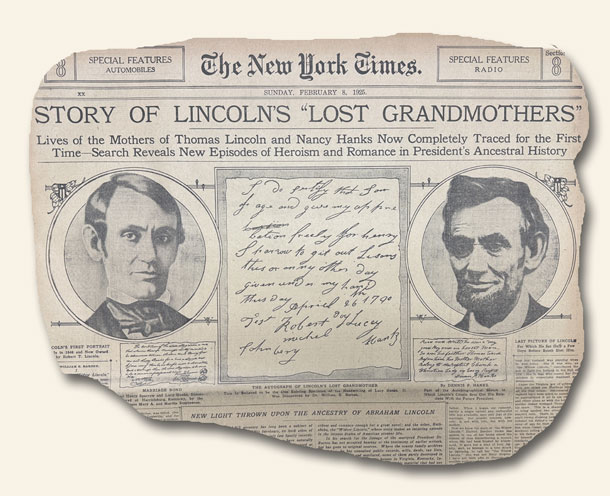
We often discuss the legacy of our founding fathers and American heroes… highlights of their lives which leave an indelible impression on us as individuals or on the country we cherish. With all this focus, it is a shame we often miss the stories of their ancestry… the people and events that molded them into the larger-than-life figures we admire. Such is the case with Abraham Lincoln. Although we have all learned of his self-education in a one room log cabin and the deep loses he suffered as a young man, it wasn’t until 1925 that we were able to get a clearer picture of family members who came before and how their stories might have impacted the Lincoln. On February 8, 1925 The New York Times had substantial coverage of Abraham Lincoln’s grandmothers who had, until this point, not been confirmed. The paper goes on to say the stories of these ladies reveal. “Episodes of Heroism and Romance in the president’s Ancestral History”. Not unlike today, apparently, people at the turn of the century longed for a good paparazzi story as well.
Vanguard to Revolution…
March 20, 2026 by Laura Heilenman · Leave a Comment
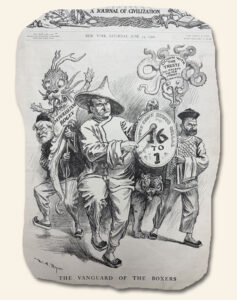 One of the fascinating areas of historic newspaper collecting is the ability to see patterns over time. Last week, I found a Harper’s Weekly for a collector with a fascinating front page print that caught my attention and the caption triggered a deeper search. The Boxer Rebellion of the 1900’s included a group called “Vanguards”. Although familiar with this term, I was curious as to other times this concept had popped up throughout history. The following is an overview of my discovery…
March Newsletter (2026) – Timothy Hughes Rare & Early Newspapers…
March 16, 2026 by GuyHeilenman · Leave a Comment
|
|
St. Patrick’s Day…
March 14, 2026 by Laura Heilenman · Leave a Comment
St. Patrick’s Day is right around the corner and with it comes a festive feel and a great reason to celebrate. Whether you are planning on a great meal at your local Irish Pub or some homemade Corned beef & Cabbage, there is something about St. Patrick’s Day that highlight’s Springs fast approach. So, enjoy your pint and grub, a good Irish movie (The Quiet Man is my favorite) and a walk down memory lane as you scan coverage of the oldest continuously running St. Patrick’s day parade in the world highlighted in the Mid-Week Pictorial & The New York Herald. Whatever your mode of celebration… May the Luck of the Irish be with you!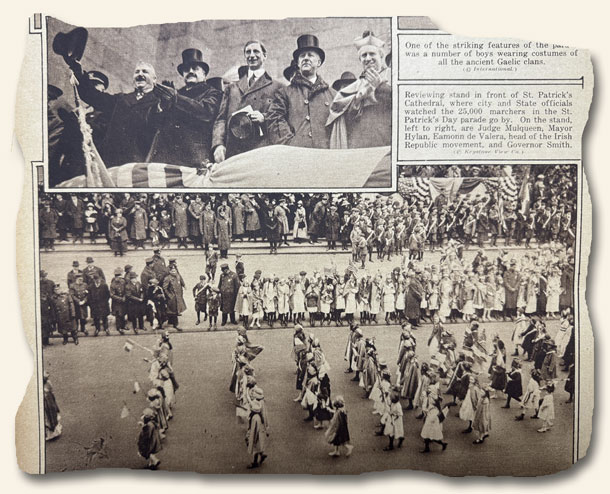
This Day Through History (as reported in authentic newspapers)…
March 12, 2026 by GuyHeilenman · 1 Comment
A birthday newspaper is a wonderful gift. But what if you could choose from dozens of newsworthy dates — all sharing that same special day of any month? NOW YOU CAN!
Pick any month and day below and we’ll instantly show you every historic newspaper we have from that exact date — regardless of the year.
Example 1:
Example 2: Newspapers Published on July 4th
Real newspapers • Real history • Real fast
Significant Discovery: Horace Greeley’s “views” of Freedmen (1865)…
March 9, 2026 by GuyHeilenman · Leave a Comment
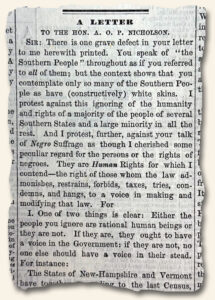
After being heavily engrossed in the rare & early newspapers collectible for over 50 years, encountering “new” discoveries within our own archives has not abated. Case in point: We recently identified a significant letter in the August 26, 1865, issue of the New York Daily Tribune that had previously gone unnoticed. Located on page 4 and signed simply “H. G.” (Horace Greeley), this letter addressed to the Hon. A. O. P. Nicholson offers a profound look into the intellectual climate of the immediate post-Civil War era. Perhaps it was the inconspicuous single column heading, “A Letter”, which was complicit in our oversight. Such “discoveries” are one of the reasons why we love this hobby.
As far as the letter itself is concerned… The exchange occurred during a pivotal window of Reconstruction. With the war concluded and the Thirteenth Amendment in the process of ratification, the nation was gripped by a debate over the “physical, intellectual, and emotional condition” of newly emancipated African Americans. While many, including Nicholson, sought to categorize or question the capabilities of the formerly enslaved through a lens of racial “fitness,” Greeley used his editorial platform to push back against these prejudices.
In this letter, Greeley argues that any perceived deficiencies in the Black population were not inherent traits, but the direct result of the “degradations” of the institution of slavery. By advocating for education and the rights of “Free Labor,” Greeley was effectively laying the groundwork for the so-called “Radical Republican” agenda that would eventually lead to the 14th and 15th Amendments.
For collectors of Civil War, Reconstruction-era, and Black-Americana ephemera, this issue serves as a primary source document and captures the exact moment the country transitioned from a military conflict to a philosophical battle over the true meaning of citizenship – a powerful step towards realizing the founding charge that all (people) are created equal.
Lead-up to a Nation… as reported in the newspapers of the day (February, 1776)…
March 6, 2026 by GuyHeilenman · 1 Comment
-
Magazines of the Revolution – Wide Range of Daily Life (Lead-up to a Nation – E27)
-
Reports from the New-England Chronicle – Assault on Quebec (Lead-up to a Nation – E28)
-
The Massachusetts-Bay Proclamation – Turning Point Before Independence (Lead-up to a Nation – E29)
-
Paul Revere – The Essex Journal & New Hampshire Packet (Lead-up to a Nation – E30)
We hope you are enjoying this year-long trek to the 250th anniversary of The United States through the eyes of those who were fully engaged, first hand. As mentioned previously, all accounts are rooted in what they read in the newspapers of the day.
“History is never more fascinating than when read from the day it was first reported.” (Timothy Hughes, 1975)
“Printing In The Americas” – A reference book for your shelves…
March 2, 2026 by TimHughes · Leave a Comment
 There are very few reference books which are exclusive to newspapers, so some of the better ones are about printing in general, peppered with historical accounts of newspaper publishing as well.
One of my favorites is such a book, titled “Printing In The Americas” by John Clyde Oswald. Done by the Gregg Publishing Company in 1937 it unfortunately is out of print, however copies can be found on book dealer shelves across the country. With the broad scope of internet sites abebooks.com and alibris.com I suspect it would not be difficult to find a copy.
There are 91 chapters totaling over 560 pages but it can essentially be considered to have three parts. first: a general history of printing in colonial America which includes much on early newspapers; second: a state by state review of the their first printing efforts, most of which were newspapers rather than books or pamphlets; and third: printing history in other countries of the Western hemisphere including Canada, Central America, South America and the West Indies, typically not dealt with in most printing history efforts.
I find the Midwest and Western states to have the most intriguing histories, filled with stories of tragedy & hardship in trying to operate a printing establishment in the wilds of America. There were far more failures than successes. Early printers must certainly have come from hearty and optimistic stock.
While we do not have one to offer, this is a title I would suggest you pursue. Given its format it doesn’t have to be read cover to cover, but rather chapters of interest stand alone as little histories in just a few pages.