

Search
The Rare & Early Newspapers Hobby

Receive the Newsletter

Buy Historic Newspapers

Thomas Jefferson helps to codify George Washington’s footsteps…
December 12, 2025 by GuyHeilenman · Leave a Comment
When it comes to collecting rare and early newspapers, those containing the text of presidential annual messages are quite desirable. While a handful are well known (Lincoln’s 2nd annual address, Washington’s 1st, Kennedy’s 1st, etc.), others fly well under the radar. A recently discovered broadsheet (Republican Argus, Extra, Oct. 16, 1808), containing Thomas Jefferson’s final address in 1808 brought this latter group to mind, yet, upon analysis in light of current events, seems to hold its own historically. The summary below, modified from multiple AI sources, is provided so you can draw your own conclusion. Enjoy.
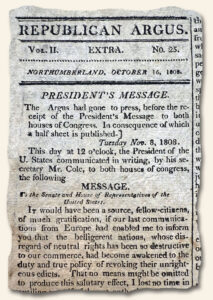
Thomas Jefferson’s Eighth Annual Message to Congress, delivered on November 8, 1808, came at the close of his presidency during a time of international conflict and domestic unrest. He used the address to defend the Embargo Act of 1807, which aimed to protect U.S. neutrality and avoid war with Britain and France by halting foreign trade. Despite its economic toll on American farmers and merchants, Jefferson maintained that economic pressure was preferable to military conflict. The speech also reflected ongoing foreign policy tensions, particularly regarding maritime rights, and the young republic’s efforts to uphold sovereignty amid European aggression.
Jefferson’s speech highlighted the challenges of maintaining neutrality, the importance of strengthening U.S. military defenses, and his vision for internal development, including peace through trade with Native American tribes. It also revealed the political friction of the time, with Jefferson facing criticism from both Federalists and members of his own party over the embargo and proposed federal infrastructure projects. This period of political division underscored deeper questions about the role and limits of federal power in a republic still defining itself.
Most significantly, Jefferson’s 1808 address signaled the end of his presidency and affirmed his decision not to seek a third term. Although he had announced this publicly in 1807, his final annual message served as a symbolic and practical demonstration of his commitment to republican principles. By following George Washington’s example, Jefferson helped establish the precedent that presidents should serve no more than two terms. This voluntary transfer of power reinforced the principle that no individual should hold executive power indefinitely, a safeguard essential to American democracy.
Jefferson’s choice not to pursue a third term, especially during a time of national strain, cemented a critical political norm that influenced every president until Franklin D. Roosevelt. The importance of this precedent lies in its protection against the concentration of power and its promotion of leadership rotation—core values in a constitutional republic. Jefferson’s 1808 address, then, is not just a reflection on policy but a foundational moment in American political tradition, ultimately leading to the formalization of the two-term limit through the 22nd Amendment.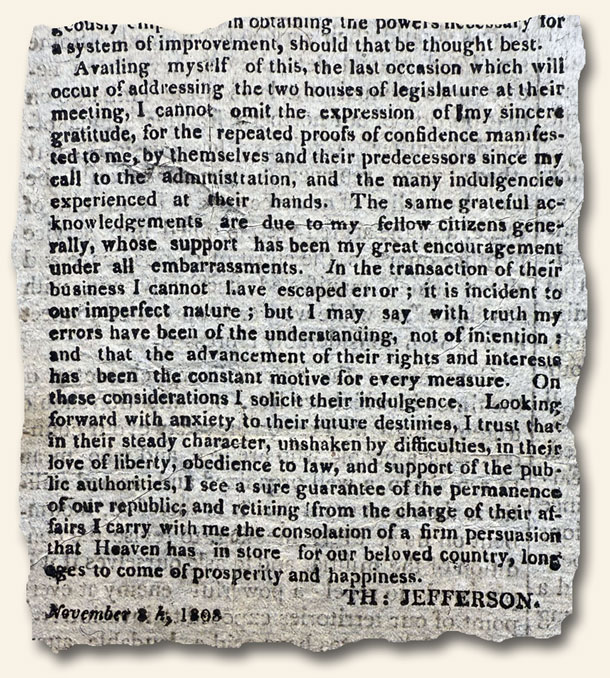
The Whole World’s Watching: George Washington’s 1st State of the Union Address…
May 3, 2024 by LauraH · Leave a Comment
 The State of the Union Address. . . a phrase which probably brings varying emotions depending on who you are. I love to watch these speeches as they give me more insight into the man than into the state of the Union. Most of us already have a pretty good read on how our country is doing. . . the economy, the culture, the defense, threat assessments. . . but, watching the leader of the Free World explain his take helps me grasp where we are headed. I wonder if the citizens of the USA in 1795 felt the same way as they read the Columbian Sentinel from December 19. President Washington had given his 1st State of the Union Address and it was printed, as all presidential speeches, in the newspaper. We have much to thank George Washington for, as he defined so many aspects of our country, government and the presidency. I think we can add instituting the Annual State of the Union Address to his very long list of accomplishments.
The State of the Union… Did you know…?
March 20, 2023 by GuyHeilenman · Leave a Comment
 Did you know, starting with George Washington and lasting through much of the 20th century, most newspapers printed the entire text of each President’s Annual Message (State of the Union Address)? Although in some cases only excerpts were given, including the full text was the common practice, and would often take a page or more to print. One of the benefits of this practice was that it enabled newspaper recipients to read the President’s message in-line with a bit of editorial commentary, and then see how people reacted by reading related reports and letters to the editor over the course of the next several days (or more).
Although these issues are very popular with collectors, we (RareNewspapers.com) are always on the hunt for more to offer. Our current inventory may be viewed at:
*State of the Union Addresses
The addresses have been arranged in chronological order so even if you do not wish or are unable to add any to your collection, you can still enjoy reading portions through the images and descriptions to capture the progression of Presidential thought through time.
*The link contains newspapers with both S.O.U.’s and follow-up reporting.