
Search
The Rare & Early Newspapers Hobby

Receive the Newsletter

Buy Historic Newspapers

One never knows what will be found…
June 7, 2010 by TimHughes · 4 Comments
I suspect I have reflected several times upon the great wealth of interesting information which can be found in a seemingly “generic” issue. Recently I came across an item which was unfound for over 30 years until time permitted a closer look.
I have always touted the value of London’s “Gentleman’s Magazine” as a great periodical, as few world events of the 18th century escaped its pages, including American events from after the Revolutionary War. As a title which has always be somewhat common in a relative sense, when American titles of the 18th century have become almost impossible to find, key issues in “Gentleman’s Magazine” offer an excellent opportunity to add period, historic reports to a collection at a relatively modest cost.
 Admittedly, volumes of this title have become more difficult to come by in recent years, prompting us to take a closer look at some issues which used to go out the door almost as quickly as they came in. The June, 1790 issue was seemingly just another innocuous magazine from the post-war era, and which I suspect we sold dozens of times for $15 to $25 or so. But a week ago I took a more careful look and found an excellent obituary of Benjamin Franklin, taking over 1 1/2 pages, even including is very famous self-written obituary which includes: “The body of Benjamin Franklin, Printer, like the cover of an old book, its content torn out & stript of its lettering & gilding, lies here food for worms…”.
You may have purchased this June, 1790 issue from us in years past. If you have, take a look at pages 571-3 and elevate the status of this issue from generic to significant. Even with this wonderful content, we still offer this issue for less than 1/3 the price of comparable reports in American newspapers.
I wonder how many other significant issues we’ve sold over the past 34 years not fully knowing what was inside? Hopefully you have discovered some gems which escaped my eye….it’s all part of the thrill of collecting!
Uncut newspapers: leave as they are?
March 20, 2010 by TimHughes · 1 Comment
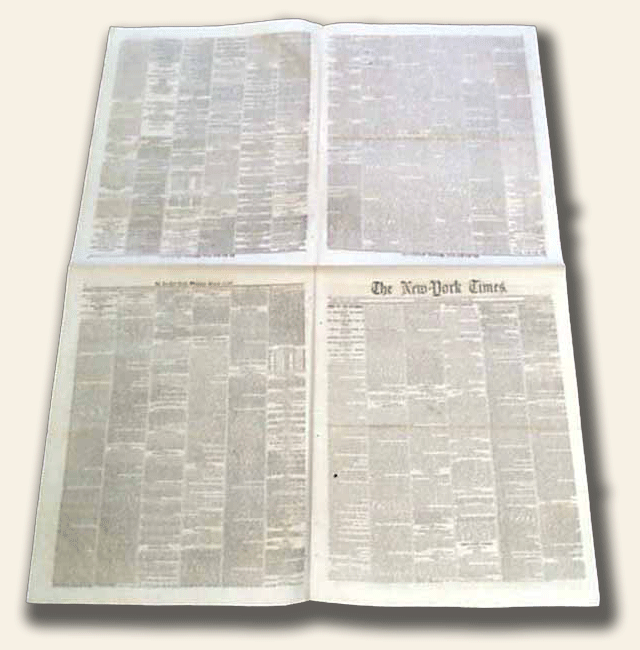 Fellow collector Morris Brill poses an interesting question worth sharing with others, along with my thoughts on the issue.
I suspect we have all encountered “uncut” newspapers from the 19th century, issues which are eight pages in length but which are essentially one large sheet of paper printed on both sides, then folded twice to produce the eight pages. This is how they came off the printing presses . Morris inquires:
“For the sake of maintaining the monetary value of such a newspaper is it best to leave the paper in this one piece condition or is it best to cut the paper so it folds normally like a book and the pages can be turned individually?”
Uncut issues are, for the most part, those which have survived the years by not being bound, kept loose by previous owners and eventually finding their way into the hands of collectors. Given that the vast majority of early newspapers in the collector market came from bound volumes once stored by libraries or other institutions then “disbound” into individual issues, uncut newspapers are relatively few in number. Once bound all margins, save for the spine, are guillotined at the bindery to produce an even, book-like edge thus losing the attachment at the top.
Since uncut issues are newspapers in the original state, as they were sold on the streets, my preference would be to keep them as such. Most collectibles tend to be more desirable in their original state: never clean an old coin; never paint an antique wagon; don’t removed the aged patina from an antique desk, etc. Are such newspapers more clumsy to read? Yes, to some degree. But they can be folded back and all 8 pages read with little difficulty. It’s obviously how it was done years ago as I’ve purchased several boxes of uncut 19th century newspapers which were folded many different ways, left as such by the reader.
They only time I might suggest cutting the top of an uncut sheet is the rare occasion when an issue was bound, causing all four leaves to be attached at the spine, yet the tops have not been trimmed. In such situations the newspaper cannot be folded back because of the attachment at the spine. I would take an exacto knife and cut the very top along the fold. Not much else can be done if the interior pages are to be read.
Collectors may have noticed that we charge a small premium for uncut newspapers. A downside to an uncut issue is they tend to be more worn than those bound as they have not been protected through the years by the bindings, but if one can obtain an issue which is both uncut and in great condition–and contains the Gettysburg Address–there’s a great item for any collection!
Featured websites – TeachHistory.com
March 18, 2010 by GuyHeilenman · Leave a Comment
 Teachers with a love of history, listen up! The following resource can improve your curriculum and make you a stronger educator. Students of history will enjoy the breadth and depth of the historical journey as well.
TeachHistory is a fantastic website (blog), developed and maintained by Ben Edwards, which provides engaging information & a plethora of useful educational resources related to history. It describes itself as:
“a blog dedicated to social studies and history teachers across the United States who use Colonial American history, imagination and multisensory teaching methods to inspire their students. Our goal is to provide a resource where teachers like you can access information about colonial history plus technologies, methods and products that are making a difference in education today.”
While Ben’s experience with teachers and students is varied, perhaps the most useful channel for keeping him in touch with the pulse of teacher/student interests and needs occur via the many intimate conversations had while engaging teachers and students through his Walking Tours of Historic Boston. Combine this with both his (historic) heritage and his natural love of history, and you have the making of a blog which is sure to stay relevant over time. Some of the recent posts include:
Colonel Shaw, Sergeant Carney and the 54th Massachusetts
Remembering Alex Haley and Roots
Black History Month: A Tribute to Phillis Wheatley
Young Ben Franklin and the Silence Dogood Letters
Teachers: Are You Engaging AND Empowering Your Students?
Many of the posts include detailed images and reference accounts of actual Rare & Early Newspapers – most of which come from his personal collection. Ben fully grasps a foundational truth regarding primary sources: “History is never more fascinating than when it is read from the day it was first reported.” Thanks Ben, for your contributions to both the Rare Newspapers and Educational communities.
19th century newspapers… revisited…
December 26, 2009 by GuyHeilenman · 1 Comment
Over the past three weeks Timothy Hughes has explored his thoughts concerning what he believes to be the top ten newspapers from each of the pre-18th, 18th, and 19 centuries (see below), the most recent being the latter. Some of his thoughts concerning the 1800’s historic newspapers were captured in the following video:
Collecting authentic rare and historic newspapers from the 1800’s can be exciting, rewarding and surprisingly affordable. Daily newspaper reports of America’s tumultuous 19th Century included first hand accounts of historic turning-points like….. the Louisiana Purchase…the Civil War…and Spanish-American conflict. As cries of “manifest destiny” signaled America’s unbridled expansion west, newspapers became a crucial link for a people suddenly united in a common quest that would set their young nation on a course of unprecedented and historic prosperity.
There are many sought after “holy grails” from the 19th century, including: o President Abraham Lincoln’s Assassination o Battle of Gettysburg and the Gettysburg Address o Battle of the Alamo o Deaths of Jessie James and Billy the Kid o Issue from Tombstone Arizona (Tombstone Epitaph) o Winslow Homer’s “Snap the Whip”
Of course, select accounts of the most historic & desired events of 19th century America are available for premium prices.
However, a wealth of fascinating original newspapers from the vast inventory of Timothy Hughes Rare & Early Newspapers are available for much less…often as little as $30 – $50. These include first-hand news from the War of 1812, Yankee & Confederate Civil War battle reports, slave ads from the South, the California Gold Rush with outlaw & Indian battle accounts, the Mormon migration to Utah and fascinating reports of when baseball was in its infancy.
The “Old West” and America’s westward expansion are represented in genuine newspapers from California, Utah, Nevada, Montana, and Arizona. You’ll also find affordable issues from the illustrated press which graphically documented every aspect of 19th century America in the pages of Harper’s Weekly, Frank Leslie’s Illustrated, Gleason’s, Ballou’s, and The London Illustrated News.
Whether your interest is in the War of 1812, westward expansion and the gold rush, the Civil War, and/or the Wild West, original newspapers provide an excellent view of history in context. History is never more fascinating than when when it’s read from the day it was first reported. If you love history… you deserve to have it in your hands. Rare newspapers make this possible. Please enjoy the hobby.
Top ten newspapers: 16th and 17th centuries…
Top ten newspapers: 18th century…
Top ten newspapers: 19th century…
A look back at the past’s look into the future…
November 14, 2009 by GuyHeilenman · Leave a Comment
 One of the many pleasures of the Rare Newspaper collecting hobby is often quoted within our material:
“History is never more fascinating than when it’s read from the day it was first reported”. In fact, this look back is the impetus for the name of this blog, “History’s Newsstand”. However, occasionally these excursions can also provide us with a glimpse of just how far we’ve come in comparison to the expectations of those who lived in the past. It is such a look into the future, from exactly 100 years prior to today’s posting, that is available to us through an old newspaper section we found within our archives pulled from the Cleveland Leader, November 14, 1909. Please enjoy this look back at the past’s look into the future: The Cleveland Leader, 11/14/1909. The link will take you to a brief description of the article in question, with images of the entire article. Did we surpass their expectations? We’d love to know your thoughts.
Twenty years later: revisiting an international event…
November 5, 2009 by TimHughes · 1 Comment
Those of us who may reluctantly fall into the category of the “middle aged” can reflect upon a number of historic events and our thoughts on when they happened. For me John F. Kennedy’s assassination and its announcement when I was in elementary school was the first major historic event I lived through, and experiences relating to it are still etched in my mind.
 Some events seem impossible to be reaching notable anniversary status as they seem to have happened in the recent past. Man walking on the moon is one–it recently passed its 40th anniversary–and the Nixon/Watergate mess is now over 35 years in the past.
The fall of the Berlin Wall is now at it’s 20th anniversary. It seems impossible. I clearly recall the considerable news coverage of the event and the following actions that would lead to German unity less than one year after the walls came down. Back then I had a customer from Berlin and was able consummate a purchase of various Berlin newspapers covering those events, knowing that newspapers from where the news was being made would always be the best to have in a collection.
I recently dug out several titles and editions and share with you perhaps the best, being an “Extra” edition of “Der Tages Spiegel” (translates to “The Daily Mirror”) of November 10, 1989. The entire front page of this folio-size newspaper is taken up with a huge photo of people climbing onto, and celebrating, at the Berlin Wall with the Brandenburg Gate in the background. the banner headline–and the only text on the front page–translates: “The Night They Opened The Border In Berlin”. The remaining 3 pages of this four page newspaper are taken up with various articles and many photos of the celebration.
It was a joyous and memorable event for the world, and yes, it really was 20 years ago.
A way to get rich??
October 24, 2009 by TimHughes · Leave a Comment
 The “Mother Lode Magnet” newspaper from the mining town of Jamestown in Northern California offers yet another interesting piece… this one on “One Way To Get Rich”. Much food for thought:
Terrific “association” item in American history…
October 22, 2009 by TimHughes · 2 Comments
One of the joys in collecting early newspapers is discovering the little gem found buried in an issue which was innocuous at the time but which has since transcended to much greater importance in American history. The small advertisement shown, which appears on page 3 of the April 13 issue of the “Daily Morning Chronicle” of Washington, D.C., is one.
 Certainly Abraham Lincoln, and any other Washington, D.C. resident who read this ad, would not have given it a second thought, being a simple notice of the latest show on the stage of a local theater. But as history would tell us Abraham Lincoln attended this very performance of “The American Cousin” at Ford’s Theatre, starring Laura Keene, and would be assassinated there the evening of the 14th.
It’s fascinating to think the original owner of this newspaper may well have read that advertisement, and may actually have attended that performance only to become witness to one of the more dramatic & notable events of American history. This newspaper is truly a piece of Americana which could only be found in a Washington, D.C. newspaper. Certainly this ad would not have appeared in the other–more common–major city publications.
Feel free to respond and share with other readers any similar gems which you have discovered, & which would figure more prominently in history after their publication date. We hope you enjoyed this one!
Could have been worded better…
October 3, 2009 by TimHughes · Leave a Comment
The following appeared in “The Daily Courant” newspaper from London, January 2, 1705:
“This day is publish’d, Her Majesty’s Head finely Engrav’d upon a Copper Plate fifteen Inches square, and Adorn’d after the manner of Penmanship. Price 6d. Sold by J.Nutt near Stationers-Hall. “
In the beginning…
June 8, 2009 by TimHughes · 1 Comment
 Some collectors like to pursue a newspaper from each of the original thirteen colonies, and ideally one dated as close as possible to the beginning of that colony’s first newspaper. For those active in this pursuit, we offer this list of the earliest in each.
Although the first newspaper in America was published in Boston in 1690, Benjamin Harris’ “Publick Occurrences Both Forreign & Domestick” lasted by a single issue before being suppressed by the Royal authorities. The first successful Massachusetts newspaper–and the first in all of the colonies–started 14 years later in 1704, also in Boston, titled “The Boston News-Letter” which continued until the British occupation of the city in 1776.
Here are the remaining colonies and the newspaper titles. As you see, originally in titles was not a strength among the newspaper publishers:
American Weekly Mercury (Penna.), 1719
The New York Gazette, 1726
The Maryland Gazette, 1728
The Rhode Island Gazette, 1732
The South Carolina Gazette 1732
The Virginia Gazette, 1736
The North Carolina Gazette, 1751
The Connecticut Gazette, 1755
The New Hampshire Gazette, 1756
The Newport Mercury (Rhode Is.), 1758
The Georgia Gazette, 1763
The New Jersey Gazette, 1777
It may seem curious that New Jersey was the last of the colonies to have its own newspaper, however given its location between the major metro areas of New York and Philadelphia there likely wasn’t an incentive to create its own until much later than the others.