
Search
The Rare & Early Newspapers Hobby

Receive the Newsletter

Buy Historic Newspapers

A gem from the American Antiquarian Society…
July 14, 2014 by TimHughes · 1 Comment
In celebration of its 20oth anniversary the American Antiquarian Society published a beautiful exhibition catalog titled “In Pursuit Of A Vision – Two Centuries of Collecting at the American Antiquarian Society”. Featured are a fascinating array of books, documents, maps & other paper ephemera, as well as several very rare & unusual newspapers we felt worthy of sharing with our collectors (with permission from the A.A.S.).
 117. “Frontier Scout“, Fort Rice, Dakota Territory, June 15, 1865
Thanks to Donald McKay Frost, AAS owns a complete run of the second newspaper printed in the Dakota Territory, preceded only by a paper of the same title issued at Fort Union the previous summer. Located in south central North Dakota, Fort Rice was a 500-foot square wooden stockade erected in the summer of 1864 to protect vital transportation routes from increasingly frequent Lakota attacks. Initially it was manned by “galvanized Yankees” — former Confederate prisoners of war who had enlisted in the Union Army rather than wait indefinitely in prison camps for parole or exchange.
In order to ward off the stress of isolated frontier living, the soldiers engaged in various diversions, including theatrical performances and the publication of their own newspaper printed on a portable press. Captain E. G. Adams and Lieutenant C. H. Champney of the First United States Volunteer Infantry Regiment served as editor and publisher respectively. In this inaugural issue, Adams encouraged the troops to contribute poems, stories, and adventures. “When this is done our paper is formed, a living, speaking, embodiment of the society in which we dwell.” The last of the fifteen weekly issues appeared on October 12, 1865, shortly before Adams and Champney left the fort. Most issues were printed on sheets of ruled blue ledger paper.
#18 – America’s first newspaper… Check your attics. (*revisited)
April 18, 2014 by GuyHeilenman · Leave a Comment
The very first newspaper printed in the American colonies was published in Boston in 1690 and titled “Publick Occurrences Both Foreign and Domestick”. It was a little paper with three pages of text. The fourth page was left blank for others to write handwritten pieces of news before being passed on to others. It was published by Benjamin Harris who had experience in publishing another newspaper in London several years prior to his arrival in the colonies, titled “Domestick Intelligence, Or News Both from City & Country”.
His Boston effort focused on local news but it also included gossip and unflattering reports. One account notes it contained: “…affections of a very high nature: As also sundry doubtful and uncertain Reports…”. The mixture of doubtful and uncertain reports, as well as a ban on printing without a license which Harris did not have, caused his first issue to also be his last. Reports note that the royal governor had the printing press destroyed and all known issues of that one date of September 25, 1690 confiscated.
To this day only one genuine issue of the newspaper is known to exist, and unfortunately it’s not in the United States: it is in the Public Records office in London. Some years ago it was loaned to The Newseum in Washington, D.C. (then located across the Potomac in Virginia) for a period of time, but I believe it has been returned to London.
The intriguing part of this story is that “all known issues were confiscated and destroyed”. But exactly when did this happen? Was it done several hours since it was printed, or a few days later? It was intended to be a monthly publication. Certainly the possibility exists that a few issues were not found & confiscated, and with the owners knowing of the search they may have purposely hidden them away.
Could an issue or two still exist in a Boston attic somewhere? Is there a private library where an issue was hidden among the pages of a book in hopes of not being confiscated? Could a renovation project to a Boston area home reveal an issue tucked within its walls over 300 years ago? It is fascinating to think that some examples could be found so long after being published. But to this date none have surfaced.
Speculation runs wild as to the value of an issue should it surface. It’s America’s very first newspaper, and none exist in America. What sort of price could be set on such an issue? What should be the future home of an issue should it be found?
Feel free to comment!
—————
*The Fall of 2013 marked the 5th anniversary of the History’s Newsstand Blog by Timothy Hughes Rare & Early Newspapers. We are grateful to have the opportunity to contribute to the newspaper collecting community, and appreciate those who have participated through guest posts, comments, and readership. This year (2014) we are revisiting the top 25 posts (measured by activity), with the number 1 post being re-posted during the first week of 2015. Please enjoy. If you would like to contribute a post for consideration of inclusion on the blog, please contact Guy Heilenman at guy@rarenewspapers.com.
Why historic newspapers? Time travel… raw emotion…
April 4, 2014 by GuyHeilenman · Leave a Comment
 I remember the first time I held an authentic Civil War era newspaper and was struck by the concept of holding history in my hands. As I read through the detailed battle reports, raw emotion welled up within me as I pondered the possibility of a loved one’s tears falling upon the very newspaper I was holding – as he/she discovered the name of a close relative… even a spouse listed among those killed in battle. As I continued to peruse the paper, the prevalence of ads, birth and wedding announcements, local news reports, etc. communicated a truth that hit me like a ton of bricks: Despite the carnage of war, and the tears of many who had just learned of the loss of someone they loved, life continued to move forward. Anyone who has lost a dear friend or family member knows the emotion: “Hey world – What are you doing? STOP! Don’t you know what’s just happened?” But the train of time rushes forward – ignoring our desperate cry for just a few more minutes…
At this point I took a breath – carefully closed the newspaper, and returned to the present – convinced I had discovered the greatest hobby of them all; one that enables anyone who would dare, to go where Orson Wells, Jack Finney, and others could only dream of going: back in time.
A collector recently sent a related note stating:
Like many people I’m sure, I have over the years fantasized many times about being able to go back in time. I realize now that this hobby has enabled me to get just a glimmer of that feeling inside, as I hold such old papers, reading the words and seeing the engravings and old photos. Touching the history in such a physical, tangible way evokes a feeling as close to time travel as we can probably ever come…and is a unique 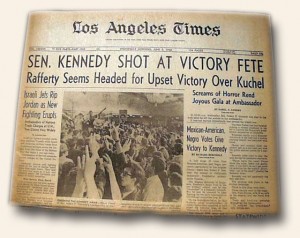 experience utterly lacking in the high school history textbooks I originally studied, or merely looking at images on a computer monitor these days. -Actapublicurist
Yet another, upon discovering the Bobby Kennedy Assassination Report issue shown in the image wrote (in part):
I will never sell this newspaper… I will be 60 in November and lived in Brooklyn when Senator Kennedy was killed. I still shed tears when I think about it all these years later. He left nine children (and a tenth on the way) and a wonderful wife, and we will never know what a difference this magnificent man with a huge heart would have made in the White House. I grieve for him as if he was close friend. I will treasure this newspaper and others in my ample collection of the RFK assassination.
What an incredible hobby!
Whatcha Got? Harry Rinker interviews Tim Hughes…
February 28, 2014 by GuyHeilenman · Leave a Comment
 Many collectors are quite familiar with Harry Rinker’s nationally syndicated radio talk show, “Watcha Got?”. Harry recently interviewed Tim regarding the Rare Newspapers collectible. Please enjoy the interview at (click on the audio mp3 button): Watcha Got?
Note: The interview lasts about 15 minutes and begins at the 28:50 time marker (just slide the bar to this point). Better yet, enjoy Harry’s entire broadcast. 🙂
What about three wrongs making a right?
December 6, 2013 by GuyHeilenman · Leave a Comment
 Finishing out our month-long tribute to the memory of John F. Kennedy, today we look at what may have been the closing chapter of the tragic death-sequence which began on November 22, 1963 with the assassination of JFK, advanced to November 23, 1963 with the shooting and death of Lee Harvey Oswald, and culminated on January 3, 1967 with the passing of death-row inmate, Jack Ruby. Many to this day are convinced that all three deaths are rife with conspiracy. Perhaps time will prove them to be correct.
Finding newspapers on the death of Ruby are quite difficult as the event was not deemed significant by most, and many institutions were no longer saving their newspapers for year-end binding – choosing instead to store them on microfiche to conserve precious storage space. However, every now and then one turns up. Please enjoy (?) the January 3, 1967 report as it appeared in The Parsons Sun (Kansas): The Death of Jack Ruby
Historic newspapers… entering on the ground floor of a collectible…
September 30, 2013 by TimHughes · 2 Comments
 In the world of collectables, early newspapers by no means rank among the most well-known of hobbies. In fact most would be surprised that it even is a hobby. Who knows anyone who collects early newspapers?
That was exactly my thought nearly 40 years ago. Having been a coin collector since I was a kid, I knew that hobby well. I knew it well enough to recognize that no bargains could be had for the truly rare coins. Coin collecting was, and is, a well exploited hobby. The number of serious collectors must run in the hundreds of thousands with a proportionate number of dealers who make a living selling coins. So as a youngster with only grass-cutting money in my pocket, it didn’t take long to become frustrated when trying to find the last few desirable coins to fill out a set. I simply could not afford them. Everyone knew they were rare, and with more people wanting them than inventory allowed, prices were beyond my reach.
I liked collecting and I wanted a hobby that dealt with history. Holding a coin minted during the time when Lincoln was President, or when Indian battles were still raging on the Plains, intrigued me. I felt like I was touching history. But I needed a collectable that was yet to be exploited. One which few people were involved in. More importantly, one where I could hope to amass a reasonably nice collection without breaking the bank.
 So it was by accident that while browsing through a local flea market that I came across a Philadelphia newspaper from 1846. I was intrigued, not only by the price–$3—but by what I would get. Quickly my mind ran through the host of various coins from 1846 which would require more than ten times the price tag, and what do you get but a hunk of medal with a date & an image of a dead President? A coin could be fully examined in seconds. But this 1846 newspaper would take half an hour to absorb. So $3 exchanged hands and the newspaper was mine.
Handling this newspaper was better than touching history. Yes, someone in 1846 held this newspaper in their hands, just like coins of the era, but this collectable actually CONTAINED history. News of the day, including events of the Mexican-American War, were within its four pages. Political reports from the term of James K. Polk were scattered throughout. Even the advertisements were fascinating.
I was hooked. The coin collection went on a shelf and I pursued whatever old newspaper I could find. It didn’t take long to discover a whole new world of collectables. Better yet, because so few people were collecting old newspapers prices seemed such a bargain compared to what coins or stamps or any other collectable with similar rarity would cost. I was convinced I got in on the ground floor.
As the years passed my hobby turned into a business catering to a niche market. At best I would suspect there are less than 2000 serious collectors of rare newspapers. Compare that number to the world of stamps, coins, books, or autographs, which hundreds of thousands consider their hobby.
 A hobby still yet to be discovered by the collecting world, prices remain attractive for the most modest of budgets. Consider that a genuine New York Times in very nice condition from 1863 with front page Civil War reports sells for less than $30. Or consider that a genuine London Gazette from 1680—a 330+ year old newspaper—is available for under $50. Of course content certainly drives interest and price so a newspaper reporting the Battle of Gettysburg can exceed $500, while the same in a Confederate title (much more rare) could be triple the price. But still, genuine issues covering the War of 1812 sell for $25; newspapers with Indian battles are under $35; issues with baseball reports from the 1880‘s can be had for $25; newspapers from during the administration of George Washington for $45. Is there a hobby where genuine items of comparable vintage are at comparable prices? Certainly not.
Rare newspaper collecting is a fascinating world which awaits any historical hobbyist. Whatever event or era in history intrigues, newspapers covered those events. From the Great Plague of London in 1666, to reports of pirates Blackbeard and Capt. Kidd, to the French & Indian War, the Revolutionary War, the Lewis & Clark Expedition, the Texas War for Independence, every presidential election & inauguration (and death), the outlaws of the West—you name it. Newspapers exist which document those occurrences and every other transforming event in American & world history.
Don’t just touch history with your hobby. Read history from the very day it was reported. You, too, will be hooked on a hobby you never knew existed.
Beyond the big, historic headline…
June 6, 2013 by TimHughes · Leave a Comment
Some of the better & more fascinating items found in old newspapers are not the most historic or significant, but rather the casual appearance of seemingly innocuous reports which excite collecting interest beyond the historic headline or dramatic presentation which are the more usual draw.
Much of what intrigues collectors can be lost within the body of reports, yet they tell a story of their own, such as the patriotic fervor of some colonist during the Revolutionary War. I recall an issue of the Edinburgh Evening Courant of June 17, 1776 reporting on American soldiers: “…Their uniform is a dark grey coarse linen frock, which covers the whole body…with the words, ‘Death or Liberty’  marked in large red letters on the right sleeve; and many of them are so enthusiastic as to have them marked with their own blood…“. This report is almost lost on page 3 yet its message is very telling of the spirit which caused the Americans to win the war against a world power despite insurmountable odds.
Some reports are fascinating by their bias. A Richmond newspaper’s (Daily Examiner for July 13, 1863) reporting on the Battle of Gettysburg notes: “…The Confederates did not gain a victory, neither did the enemy. He succeeded in defending himself & we failed in some portions of an attack…We killed more of the enemy than we lost; we took very many more prisoners than lost. The Confederate army did not leave the enemy until it had tried every link of his armour…” Another newspaper notes: “ ..Information, certainly authentic, is in the hands of the Government, which leaves no doubt of the safety & triumph of the noble army. General Lee was victorious in all the combats which have taken place. He has been engaged with the whole force of the United States & has broken its backbone…”, Perhaps the most extraordinary example of optimism appeared in the Richmond Examiner of July 25: “…The result was not a defeat, it was not a loss; it was only not a victory…It was little else than a disappointment of extraordinary expectations…”. What a precious statement as an example of Confederate optimism.
Other little gems were very prophetic in their reporting, particularly when read with an historic perspective. A Scottish newspaper from 1775 (EDINBURGH EVENING COURANT, October 7, 1775) sensed a lasting war with America as it reflected on the Battle of Bunker: “…The mischiefs which have already arisen & the greater calamities which are threatened from the unnatural war excited in America…It is impossible we can see, without the utmost alarm, preparations making for the prosecution of an expensive & ruinous war with our own Colonies…”. Some can be very recent, like the New York Times comment on rookie Mickey Mantle in 1951 (NYT, April 5, 1951): “…Mantle, who gives every promise of developing into an outstanding baseball star, was ordered to report to his draft board next Wednesday…” An editorial comment in the Army & Navy Journal of November 28, 1863, just after the Gettysburg Address opined: “…a dedicatory speech by President Lincoln, which we give in full, as decidedly the best feature of the occasion, as well as one of the most felicitous utterances of its author.” How true.
 Some were prophetic even when the reports were simply wrong, like the Illustrated American article of 1898 reporting on “A New Flying Machine That Flies”–five years before the Wright brothers–when it said: “…It is impossible to imagine without terror the day when these mechanical birds, these flying apparitions, will be able to rain upon armies, hostile towns and escalating parties most deadly and most destructive explosives…”. How true it would become.
There can be much to be found in newspapers beyond the headline. What a thrill it is to discover such hidden gems; reports that have escaped hundreds of years of history only to rediscovered with new-found relevance today. Such are just some of the joys of collecting early newspapers.
Additional kudos for, “Reporting the Revolutionary War”…
February 15, 2013 by GuyHeilenman · 2 Comments
 Additional recognition has been received for “Reporting the Revolutionary War“, by Todd Andrlik:
Reporting the Revolutionary War: Before It Was History, It Was News (ISBN: 9781402269677; November 1, 2012; $39.99 U.S.; History; Hard Cover) by Todd Andrlik is being awarded the annual prize of best American Revolution book by The New York Revolutionary War Round Table.
A New Year’s Retrospective thru Historic Newspapers…
December 31, 2012 by GuyHeilenman · Leave a Comment
 A New Year’s-themed Pinterest pin-board has just been created through Timothy Hughes Rare & Early Newspapers… History’s Newsstand which we think you will enjoy. Happy New Year!
Pinterest: A New Year’s Retrospective thru Historic Newspapers…
Historic newspapers make current headlines… an interview on CNN…
December 14, 2012 by GuyHeilenman · Leave a Comment
A little more than a month ago we introduced Reporting the Revolutionary War: Before It Was History, It Was News, a new book by a collector friend Todd Andrlik. His endeavor, which tells the story of the American Revolution through the eyes of Rare Newspapers, received national recognition through a recent interview on CNN. Please enjoy: History As It Happened