
Search
The Rare & Early Newspapers Hobby

Receive the Newsletter

Buy Historic Newspapers

Harper’s Weekly: a magazine or a newspaper?
December 12, 2016 by TimHughes · 4 Comments  Email This Post
|
Email This Post
|  Print This Post
I’ve always referred to it as a newspaper to distinguish it from their own sister publication “Harper’s New Monthly Magazine” which, being smaller, many more pages, and issued monthly, is 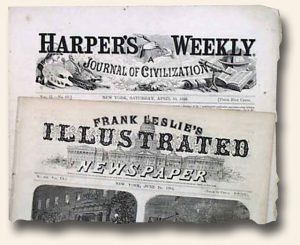 a more definitive magazine. Early in its history the weekly called themselves a “family newspaper”, and modeled themselves against “Frank Leslie’s Illustrated Newspaper” which began about a year earlier. If Leslie’s was a “newspaper” then certainly Harper’s Weekly was a “newspaper” as well.
However, in Mott’s “History of American Magazines” he includes a section for Harper’s Weekly, as well as one for Leslie’s Illustrated Newspaper and other similar weeklies. Then he confuses the issue a bit more in the second volume of his book (pg. 43) by stating: “Half a dozen copiously illustrated weeklies of general appeal must be grouped separately. It would not be inappropriate to classify these periodicals as newspapers, since they all relied much upon the reporting of current events: indeed, one of them called itself a newspaper in its title. But they were all very much more than newspapers, and they placed the emphasis on features of appeal which belonged more characteristically to the magazine than to the newspaper–namely, pictures and belles-lettres…”.
If you liked this post, you may also enjoy...
- Merry Christmas…
- 19th century Harper’s Weekly reviewed…
- From the Vault: Creating Harper’s Weekly engravings: a fascinating process…
- Inspiration Surrounds Us… Illustrated Prints for Framing…
- I’m New Here, Weeks Five & Six…
A December, 2016 stroll back thru time – 50, 100, 150, 200, & 250 years ago…
December 8, 2016 by GuyHeilenman · Leave a Comment Email This Post
| Print This Post
 the daily and weekly newspapers of the period can be quite revealing. This is why we often say, “History is never more fascinating than when it’s read from the day it was first reported.” The following links will take you back in time to show the available newspapers from the Rare & Early newspapers website. There’s no need to buy a thing. Simply enjoy the stroll.
If you liked this post, you may also enjoy...
- A September, 2016 stroll back thru time – 50, 100, 150, 200, & 250 years ago…
- An October, 2016 stroll back thru time – 50, 100, 150, 200, & 250 years ago…
- An August, 2016 stroll back thru time – 50, 100, 150, 200, & 250 years ago…
- A November, 2016 stroll back thru time – 50, 100, 150, 200, & 250 years ago…
- A May, 2016 stroll back thru time – 50, 100, 150, 200, & 250 years ago…
The Traveler… “…I could see no promise in him…”
December 5, 2016 by The Traveler · Leave a Comment Email This Post
| Print This Post
Today I traveled to New York City by the means of Harper’s New Monthly Magazine dated December, 1866. I found the first appearance of Mark Twain in a national magazine with the publishing of “Forty-Three Days in an Open Boat. Compiled From Personal Diaries.”
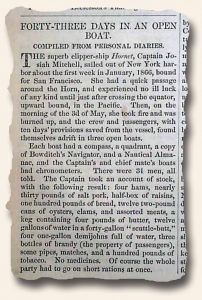 I also found through the Harper’s Monthly website the following information. “Mark Twain’s first article in Harper’s was miss-attributed to Mark Swain. The story, “Forty-three Days in an Open Boat” (December 1866), is an account of the Hornet, a clipper ship that caught fire in the ocean, leaving its crew adrift. Twain referred to it as the “first magazine article I ever published,” though he had published numerous pieces in other periodicals and newspapers under such names as Thomas Jefferson Snodgrass; W. Epaminondas Adrastus Blab; Rambler; Grumbler; and Peter Pencilcase’s Son, John Snooks.
Mark Twain was born thirty-one years earlier, and two months premature, as Samuel Langhorne Clemens, in Florida, Missouri. “When I first saw him I could see no promise in him,” his mother said. The Clemenses moved several miles upstate, to the Missouri River-side Hannibal, when he was four; the town would later inspire the fictional St. Petersburg of his two most famous works, The Adventures of Tom Sawyer (1876) and The Adventures of Huckleberry Finn (1885)…”.
Twain didn’t turn out too bad after-all!
~The Traveler
If you liked this post, you may also enjoy...
- Mark Twain… on the Jews…
- Snapshot 1886… Mark Twain – yet another hidden gem…
- Davy Crockett & Rand Paul – “I Love This Collectible!”
- Collectible Magazines… Rich West… Periodyssey – Part II
- Collectible Magazines… Rich West… Periodyssey…
Announcing: Catalog #253 (for December, 2016) is now available…
December 1, 2016 by GuyHeilenman · 2 Comments Email This Post
| Print This Post
Rare Newspapers’ monthly offering of collectible newspapers, Catalog 253, is now available. This latest collection of authentic newspapers is comprised of more than 350 new items. Some of the noteworthy content includes: Cornwallis surrenders at Yorktown, the Olive Branch Petition, the Battle of Bunker Hill, several nice Nast Santa Claus prints, the Battle of Gettysburg in a Confederate newspaper, a 1775 map of Boston, and more. Key items which include the remaining items from the above may be viewed at: Noteworthy Catalog 253
Whereas the entire catalog is shown at Catalog 253, the following links are intended to aid in quickly finding items from the catalog based on era:
1500-1799 (full view OR quick-scan/compact view)
1800-1899 (full view OR quick-scan/compact” view)
1900-2015 (full view OR quick-scan/compact” view)
To view items from both the current and the previous catalog, go to: Combined Catalogs
If you liked this post, you may also enjoy...
- Announcing: Rare Newspapers’ Catalog #252 is now available…
- Announcing: The 250th Catalog from Rare Newspapers…
- Announcing: Catalog #256 (for March, 2017) is now available…
- Announcing: Catalog #257 – for April, 2017 – is now available…
- Announcing: Catalog #255 (for February, 2017) is now available…
Perhaps one of Gilligan’s ancestors… What does it mean?
November 28, 2016 by TimHughes · Leave a Comment Email This Post
| Print This Post
 An issue of “The Gunnison Advertiser” from Colorado, 1882, notes that it is: “Published Semi-Occasionally…”. Just what does this mean? If “occasionally” means it is not on any set schedule–printed at the whim of the publisher–how much more defining is “semi-occasionally”?
Just curious. Any ideas?
If you liked this post, you may also enjoy...
- The first newspaper in Delaware, and others that followed…
- Mining town of Gunnison, Colorado…
- Numbering an issue….how was it done?
- Colorado’s first newspapers…
- The reason I collected it: an “association piece” attached…
Thanksgiving Proclamation by President Lyndon B. Johnson…
November 24, 2016 by GuyHeilenman · Leave a Comment Email This Post
| Print This Post
The New York Times dated October 19, 1966 was one of the few newspapers we’ve unearthed which printed the full text of LBJ’s eloquent Thanksgiving Proclamation – a message still worthy of consideration a half-century later. If anyone knows of other titles which printed it, we would love to hear about it. In our opinion, it’s that good. Happy Thanksgiving.
If you liked this post, you may also enjoy...
- Thanksgiving – only days away…
- The best of the best from the mouth and/or hand of Abraham Lincoln…
- Lincoln’s “under the radar” proclamation for Thanksgiving…
- The Traveler… Thanksgiving proclamation… schooling that maybe should be revisited…
- Macy’s Thanksgiving Day Parades through time…
The Traveler… tired of pirating… checking out early?…
November 21, 2016 by The Traveler · Leave a Comment Email This Post
| Print This Post
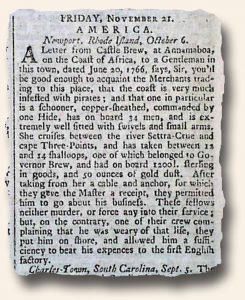 I traveled to London by The London Chronicle of November 22, 1766 where if found that not all Pirates are bad. An article with the dateline “Newport, Rhode Island, October 6” which is from “a letter from Castle Brew, at Annamaboa, on the Coast of Africa…”. It talks about the pirate infested areas along the coastline, but in particular the one ship “commanded by one Hide”. “…These fellows neither murder, or force any into their service; but, on the contrary, one of their crew complaining that he was weary of that life, they put him on shore, and allowed him a sufficiency to bear his expences to the first English factory.”
There is also an interesting article from Paris… “Within a month or six weeks past, several persons in this city, tired of life, have sought the means to deprive themselves of it. Some of them have done it by pistols; but a Baker who in cool blood leaped from the top of Pont-Royal… and was only slightly wounded:… however it was imitated a few days ago by a young man,… threw himself out of a window of the third story into the garden of the royal palace; whereby all his limbs were either broken, or dislocated; and when they raised him up, he only said that it was very unhappy for him that the houses of Paris were so low…”.
~The Traveler
If you liked this post, you may also enjoy...
- The Traveler… senseless tragedy…
- The Traveler… going through withdrawal… setting an example…
- The Traveler… ah, this bloody weather…
- The Traveler… the coronation… out of the mouths of babes…
- The Traveler… 13th Amendment ratified…
Oddball collecting ideas – advice columns through time…
November 17, 2016 by GuyHeilenman · 3 Comments Email This Post
| Print This Post
One of the beauties of the Rare Newspapers hobby is the infinite possibilities old newspapers provide for collecting. Triumphs and tragedies, inventors and inventions, outlaws and gangsters, incredible feats and devastating failures, historic headlines and under-the-radar events – the reasons for collecting are almost endless.
A new idea (to me)…
Recently, as I was searching for historic content related to Thanksgiving, I was struck by the abundance of advice columns and wondered if the questions and corresponding advice had stood the test of time. This motivated me to grab a handful of issues from 50 years ago to randomly select a few to include within this post (see below). If I had more time and energy, the thought of amassing a collection of such columns through time and providing a bit of hind-sight analysis might make for an interesting coffee-table book – or perhaps a blog. Regardless, how’d she do? Does her advice still hold water? Are the questions still pertinent to those living today? I personally give her a 2 1/2 out of 3. Enjoy.


If you liked this post, you may also enjoy...
- Videos regarding the hobby… Private Collections…
- Red (British) tax stamps… They appear to be random…
- My Collecting Story… Robert (Bob) Cassidy…
- Collecting Newspapers – The Basics (Part II) – What to Expect…
- This Day in “News” History (Part II) – January 27th…
America – pulling a nation back together…
November 14, 2016 by GuyHeilenman · Leave a Comment Email This Post
| Print This Post
 My Fellow Americans: Devastating hurricanes, Pearl Harbor, 9-11, the end of WWII, Lindbergh’s 1st flight across the Atlantic – while there is much that divides us, there have been times throughout our history when both triumphs and tragedies have inspired us to lay down our weapons and to unite as one. While these times of mutual good will are typically short-lived, they often act as a reset to help center us on that which binds us together. We need such a time!
It is was with the current atmosphere of angst as a backdrop that I was moved by an under-the-radar prayer found buried on page 11 of an issue reporting the assassination of President JFK. His death, airmailed via television directly into the living room of nearly every home in America, brought together Republicans, Democrats, and Independents alike and unified us around shared grief. May a day come when such unity of spirit flourishes without the inspiration of deep sorrow, tragedy, or war. As another assassinated President once said: “A house divided against itself cannot stand (Abraham Lincoln).” It is time for us to lay down our weapons. Much is at stake.
If you liked this post, you may also enjoy...
- National Day of Prayer… Love our neighbors… Newspapers provide perspective…
- They Put It In Print (1862)… Slavery At The Capital…
- Who’s Who in Newspapers? Citizen Genêt edition…
- They put it in print… Interesting Kennedy obituary…
- History’s Hidden Gems… President Lincoln, July 4th, 1861…
Looking back at past elections…
November 10, 2016 by GuyHeilenman · Leave a Comment Email This Post
| Print This Post
 Now that the 2016 U.S. Presidential election is in the rear view mirror, we thought it might be fun to take a look back at past elections.Which were the most impacting? hotly contested? controversial? The History Channel has an interesting post (Memorable Elections) which explores these questions. It begins, in part:
“With the chance to serve as chief executive of the world’s premier power at stake, the race for the U.S. presidency has delivered its share of hotly-contested elections. George W. Bush became the fourth president to win despite losing the popular vote in 2000, an election that wasn’t decided until the U.S. Supreme Court ruled a Florida recount to be unconstitutional. Harry S. Truman won in 1948 despite the publication of a newspaper that announced otherwise, while Rutherford B. Hayes moved to the White House only after a controversial electoral commission helped him overcome a massive popular-vote deficit in 1877… (read more).”
Please enjoy the currently available authentic historic newspapers containing election content, spanning from George Washington to Barack Obama. The list has been arranged in reverse-chronological order: PRESIDENTIAL ELECTIONS (excuse the stray reports regarding non-U.S. elections).
If you liked this post, you may also enjoy...