
Search
The Rare & Early Newspapers Hobby

Receive the Newsletter

Buy Historic Newspapers

Collecting statehood newspapers…
January 12, 2009 by TimHughes · 3 Comments  Email This Post
|
Email This Post
|  Print This Post
There are many “series” of historical significance which lend themselves nicely to the hobby of collecting newspapers. Reports of presidential elections, presidential inaugurations, major military battles, state-of-the-union addresses, and an issue from every possible decade are but a few ways to create a collection with a common theme.
 Statehood newspapers are a logical theme for collecting as well. With states joining the union from 1787 until the mid-20th century a very wide range of dates and reporting styles are evident. The earliest official statehood events were when each ratified the Constitution and can be challenging finds, although we’ve offered most if not all through the years. Later statehood entries were typically inconspicuous and brief, which adds to the quaintness of reporting styles of the 19th century given their historical significance.
Of recent attention is the 50th anniversary of Alaska statehood which happened on January 3, 1959. Later this summer we will celebrate the 50th anniversary of Hawaii, the last state to Join the Union.
The search can turn up some interesting tidbits and provide some trivia facts which would surprise most. Do you realize that five states joined the Union in the 20th century? (Oklahoma, New Mexico, Arizona, Alaska, Hawaii). What was the last of the 48 contiguous states to join? (Arizona: Feb. 14, 1912). What was the first state beyond the original 13 to join the Union? (Vermont: 1791). What was the only state to join the Union during the Civil War? (West Virginia: 1863). What was the first state to join in the 19th century? (Ohio: 1803).
Search for such issues can be fun and interest will grow with each statehood report found.
What other “series” of events have you found interesting?
If you liked this post, you may also enjoy...
- Alaska’s first newspapers…
- Collecting the Old West…
- My collecting story… J. W. in Stow, MA…
- Lead-up to a Nation… as reported in the newspapers of the day (Intro & August, 1775)…
- Celebrating 150 years since Arizona’s first newspaper…
Ways to collect: beautiful mastheads…
January 8, 2009 by TimHughes · Leave a Comment Email This Post
| Print This Post
 When I started collecting early newspapers many years ago, beyond the intrigue of something printed hundreds of years ago I was struck by the engravings found in the mastheads of many newspapers. I am still intrigued today, and I’ll admit that many of the newspapers found in our private collection are there because of their masthead engravings, not for their historic content. As a dealer one of my frustrations in the early years was publishing a catalog which did not accommodate photos. Later editions had a select few (most still do) but now many of our pricier catalog issues can be viewed online. And of course any newspaper we sell on our website or our eBay Store has multiple photos, allowing us to share the beauty of masthead engravings of centuries past.
 Eagle engravings are a favorite of mine and the variety available from the 18th & 19th century has to number well into the hundreds. The photo shows an issue of the “The Eagle”, the title apparently so obvious that the words never appeared in the masthead (but see the top of the first column). This is a rare title from Castine, Maine which lasted for only two years.
Themes in masthead engravings have been a focus of many of our customers. One man only buys newspapers with engravings of people shaking hands, and surprisingly I was able to find several for him.
What masthead engravings intrigue you? Do you have a favorite?
If you liked this post, you may also enjoy...
- The reason I collected it: Freeman’s Journal & Philadelphia Mercantile Advertiser, Oct. 21, 1812…
- I need more than just the headline…
- The reason I collected it: Newe Gazette van Brugge…
- They put it in print… First appearance of an American flag?
- The Civil War…
A little monkey business… and food for thought…
December 30, 2008 by GuyHeilenman · Leave a Comment Email This Post
| Print This Post
 About a week ago we “unveiled” our office manager, Doreen Mileto, for the world to see. The feedback received was greatly appreciated. In the post we mentioned one of her talents – adviser to Paula Dean (or was it Betty Crocker? or Susie Homemaker?). Today she blessed us with another opportunity for personal growth – Monkey Bread. In an effort to share the wealth, we’ve included a link to the recipe recipe for your personal enjoyment.
Monkey Bread: http://www.momswhothink.com/easy-recipes/monkey-bread-recipe.html
A healthy portion (or two) goes well with a fresh cup of coffee while digesting the hidden nuggets within a 19th century newspaper. The combination will help you reminisce about days gone by (or at least the past year). Perhaps you have a classic recipe to share with the Rare Newspapers community??? Regardless, enjoy the Monkey Bread. Happy New Year from the staff of Timothy Hughes Rare & Early Newspapers. Good wishes for a healthy and blessed 2009.
If you liked this post, you may also enjoy...
- The Traveler… Gen. Lee’s wagon train… Davy Crockett makes a monkey…
- The Traveler… Taft is notified… have we learned yet?
- How things have changed…
- Meet the staff: Doreen Mileto… Office Manager Extraordinaire…
- Two Discoveries, One Powerful Reminder – It Started with the Pony Express…
Collecting spurs research, spurs “neat stuff”…
December 26, 2008 by TimHughes · 1 Comment Email This Post
| Print This Post
As all of you know reading old newspapers can provide an interesting perspective on history, and cause one to question what we remember from history class of long ago. And with the advent of the internet, verifying some “facts” as reported 100+ years ago can lead to even more intriguing footnotes to history which we’d otherwise miss.
One interesting tidbit came to light earlier today and is worth sharing. The NEW YORK TRIBUNE of Feb. 28, 1862 includes on the backpage a printing of the words and music with a heading: “A Song That Is Now Rather Popular”. I recognize the music as the “Battle Hymn of the Republic”, and was aware of the lyrics which began: “John Brown’s body lies a mould’ring in the grave…” and of course the well known chorus (see photos). I was also aware that Julia Ward Howe wrote the words to “Battle Hymn…” but a website provided an interesting backdrop:
 “In 1861, after a visit to a Union Army camp, Julia Ward Howe wrote the poem that came to be called “The Battle Hymn of the Republic.” It was published in February, 1862, in The Atlantic Monthly.
Howe reported in her autobiography that she wrote the verses to meet a challenge by a friend, Rev. James Freeman Clarke. As an unofficial anthem, Union soldiers sang “John Brown’s Body.” Confederate soldiers sang it with their own version of the words. But Clarke thought that there should be more uplifting words to the tune.
Howe met Clarke’s challenge. The poem has become perhaps the best-known Civil War song of the Union Army, and has come to be a well-loved American patriotic anthem.”
Equally as interesting was another site concerning the “John Brown” mention, which I always presumed to be a reference to John Brown of Harper’s Ferry fame. Apparently not so:
“During a visit to Washington in the autumn of 1861, poet Julia Ward Howe attended a public parade and review of Union troops. On her way back to Willard’s Hotel she found her carriage delayed by marching regiments. To spend some time, she and her cohorts in the carriage sang a few of the war songs so popular those days, among them, “John Brown’s Body,” which contained the provocative words, “John Brown’s body lies-a-mouldering in the ground…. His soul is marching on.”
Howe would have assumed that the John Brown of the song was the famous abolitionist. But the song belonged to a young Scotsman in the Massachusetts Volunteer Militia who shared Brown’s name.
The Scotsman was well aware of John Brown the abolitionist. Having the same name made him a prime target for many good-natured jokes. As the soldiers marched, they would hammer out, in folk-song fashion, the tune that Julia Ward Howe would later hear. Lines like “His Soul’s Marching On” were meant to tease the Scotsman. But as the catchy verse traveled to other units, it was known only as a song about the John Brown who was captured at Harpers Ferry. New verses were constantly added:
Old John Brown’s body is a-mouldering in the dust,
Old John Brown’s rifleís red with blood-spots turned to rust,
Old John Brown’s pike has made its last, unflinching thrust,
His soul is marching on!
The morning after hearing the song, Julia Ward Howe wrote her own words to the tune. Soon after, it was published in the “Atlantic Monthly” as “The Battle Hymn of the Republic.”
John Brown the Scotsman would not live to hear this version. He died early in the war, drowned in the Shenandoah River at Front Royal, Virginia.”
Just a few of the interesting tidbits of history one learns by reading old newspapers!
If you liked this post, you may also enjoy...
- John Brown, 1859… What would you be willing to die for?
- The Civil War… 150 years ago today… July 20, 1861
- 13th to 19th Amendments and Beyond…
- Big things (sometimes) come in small packages…
- The Civil War… 150 years ago today… May 11, 1861
From the private collection: “Yes, Virginia, there is a Santa Claus”
December 22, 2008 by TimHughes · 2 Comments Email This Post
| Print This Post
 Sometimes historical content in newspapers takes a back seat to seemingly innocuous items found which, in time, resonate through our culture without the slightest impact on history. Lincoln’s Gettysburg Address could be one example. And such was the case with an innocent letter written to THE SUN newspaper of New York City in 1897.
Eight-year-old Virginia O’Hanlon wrote a letter to the editor and the quick response was printed as an unsigned editorial in their Sept. 21, 1897 edition. The work of veteran newsman Francis Pharcellus Church has since become history’s most reprinted newspaper editorial, appearing in part or whole in dozens of languages in books, movies, and other editorials, and on posters and stamps. It has unquestionably become a part of Christmas culture over 110 years later.
At this special time of year we feel it appropriate to share not only the inquiring words of Virginia O’Hanlon but the timeless response just as it appeared in the newspaper in 1897.
May all of you allow the spirit of the Christmas season as beautifully expressed by Mr. Church find a special place in your heart and home this week.
If you liked this post, you may also enjoy...
- “Yes, Virginia, there is a Santa Claus”…
- Christmas in July…
- Merry Christmas… looking back…
- The editor shows his bias…
- Blockbusters of the Past. . . Movies Bring Nostalgia…
Merry Christmas… and good wishes to all…
December 22, 2008 by GuyHeilenman · 1 Comment Email This Post
| Print This Post
 It is always a bit tricky when acknowledging certain holidays from a business platform. Christmas is certainly one day which fits this bill. Some might be offended if the acknowledgment is too “religious”. Others might have the same reaction if the holiday is spoken of too lightly. This debate has gone mainstream with a vengeance as various retail stores have advised (or mandated) that their employees not mention Christmas in verbal exchanges with customers. To me, this reeks of political correctness gone wild. There was a time when we would focus on the interests of others as opposed to ourselves. Although I might not be Jewish, if I knew someone was, I would certainly wish them a Happy Hanukkah (at the appropriate time)… and they would do the same for me at Christmas. I’ve even had British associates wish me a Happy 4th of July! The focus was on an appreciation for the person being spoken to. Their holiday might not be special to me, but it was to them; therefore, acknowledging what was important to them was in order. Whether we called this behavior public decorum, others focused, or simple civility, it created a harmonious atmosphere we all appreciated. It is with this harmony in mind, and with tongue firmly planted in cheek, I share the following 2007 “Yuletide Greeting” from one of our friends, Vincent Golden:
December 2007 ( a year ago)
Dear [Friends],
Happy holidays, Christmas/Kwanza/Hanukah/Pagan Feast Day/Tuesday (Circle one).
Once again another year has come and almost gone and none of us managed to keep our New Year’s resolutions. By May I was back to submitting fake garage sales ads in the local newspaper for neighbors that annoyed me. In August I was creating new books of the Apocrypha and burying them in caves in the Middle East region. I thought I could make it to the end of the year on my last one, but once again I failed and as a result have to wait a year before I can donate blood.
As usual it has been a busy year. One of my big projects was helping little Jimmy get his Cub Scout merit badges. We spent a lot of time on the whittling badge. He did a marvelous job following my instructions. Unfortunately he didn’t get the badge. I tried to argue that the handbook does not prohibit what can be whittled. I thought the point was it should look realistic. Still thanks to the publicity generated by the controversy (and the bomb squad), Jimmy’s project brought over $1200 on eBay.
Work at the library was not that exciting. The high point was the uncovering of Thomas Jefferson’s personal copy of Slavery for Dummies. His annotations in the margins of chapter 9 strengthen the historical and controversial issue about Sally Hemmings. We also acquired the rare 1752 Boston printing of The Lighter Side of Puritanism. Did you know they were the first to bring a piñata from Mexico? Or the first to leave flaming bags of poo outside wigwams?
Since moving to Massachusetts I’ve explored the many historical sites of New England. At Mystic Seaport I saw the replica of the ship, La Zapata, which introduced psoriasis to the New World. Near Portland, ME a historical society has restored a series of houses from the 1830s designed by architects with severe head injuries. Some have features that have no vocabulary that begins to describe them. The closest I can think of is “wonky.” In the fall I drove up to Vermont. Most people go up there during a two-week period for leaf peeping. I ended up with a group of die hards that go leaf stalking. I think they discovered the secret of fermenting maple syrup to make “wacky pancakes” before they begin the day.
So what is new with the family? My parents continue to keep busy. They are becoming experts at rehabilitating circus elephants and releasing them into the wild. Unfortunately they release them into the wilds of Illinois. They tend not to survive the winters. My older brother is applying new techniques of quantum physics to agriculture. I’m not sure the Heisenberg Uncertainty Principle is the best way to go when harvesting corn. Little sister is still pursuing her dream as an artist. Her attempt at creating counter-intuitive theatre did not get an NEH grant, but the CDC is interested in her performance.
I plan on doing a little re-gifting this year. The politically correct term is environmentally responsible recycling of inert compounds. I use the term inert, but it really means the crap that stays in the garage. I don’t remember who gave what. Please let me know what you gave last year from this list so I’ll make sure you don’t get it back.
1. Singing bass plaque with the voice of Celine Dion.
2. Scented tennis raquet.
3. Hawaiian-print bandages.
4. Hybrid-fuel roller skates.
5. Ultimate fighting lessons.
6. Fruit fly cake.
I’m keeping the cattle prod. The more I have to go to worthless meetings, the more ideas I come up with for it.
As you remember, every year I have a holiday trivia competition. Since I’m sure you saved the letter from last year, here are the answers:
1. Red
2. Blood red
3. Venison
4. Senator Fred Thompson was once burgermeister meisterburger.
5. Gimpy was the third string reindeer.
And now to this year’s holiday trivia questions.
1. What strategies do Santa and WalMart use in common to keep their employees from unionizing?
2. Which battle was started because of a fruitcake and ended by bad egg nog?
3. In the song, “The 12 Days of Christmas”, how many health violations are broken if the recipient lived in Chicago? In New Jersey?
4. What percent of family holiday gatherings end with a psychotic episode? End with pie?
5. When did the tradition end of Queen Elizabeth finishing her annual Christmas broadcast by saying, “keep cool my posse?”
And so as the year draws to a close, please raise a glass to toast the new year. To 2008. May we elect someone who can walk and chew gum this time.
Vincent
As for those looking for a little more traditional cheer, feel free to consider other poems (or newspapers) about the Christmas season:
“A Visit from Saint Nicholas” by Clement Clark Moore (or Henry Livingston)
“Christmas Bells” by Henry Wadsworth Longfellow
“Noël” by Anne Porter
“Christmas” by John Betjeman
“Christmas Trees” by Robert Frost
“The Shivering Beggar” by Robert Graves
“Christ Climbed Down” by Lawrence Ferlinghetti
“The Savior must have been a docile Gentleman” by Emily Dickinson
“Christmas at Sea” by Robert Louis Stevenson
“A Hymn on the Nativity of My Savior” by Ben Jonson
“Old Santeclaus” by Clement Clark Moore
“Prologue of the Earthly Paradise” by William Morris
“Ecce Puer” by James Joyce
“The Thread of Life” by Christina Rossetti
“Dust of Snow” by Robert Frost
“At Christmas” by Edgar Guest
“The Oxen” by Thomas Hardy
“Come, bring with a noise” by Robert Herrick
“On the Morning of Christ’s Nativity” by John Milton
“A Christmas Carol” by Christina Rossetti
“Heigh Ho, The Holly” by William Shakespeare
“The Burning Babe” by Robert Southwell
“Ring Out, Wild Bells” by Lord Alfred Tennyson
“The Mahogany Tree” by William Thackeray
“A Christmas Carol” by George Wither
“Skating in Harlem, Christmas Day” by Cynthia Zarin
Merry Christmas to all! Guy
If you liked this post, you may also enjoy...
- Merry Christmas… looking back…
- ‘Twas the Week Before Christmas – Rare Newspapers Edition…
- I’m New Here: Week Forty-Two, Wishing You A Blessed Christmas!
- Christmas Eve – Looking back…
- With the holiday season upon us… thanks Bing!
The Articles of Confederation formally united the 13 colonies…
December 18, 2008 by TimHughes · 1 Comment Email This Post
| Print This Post
For a collector of historic American documents as printed in period newspapers a printing of the “Articles of Confederation” would be a very significant issue. With much credit to Wikipedia, the creation & importance of this document provides some fascinating reading:
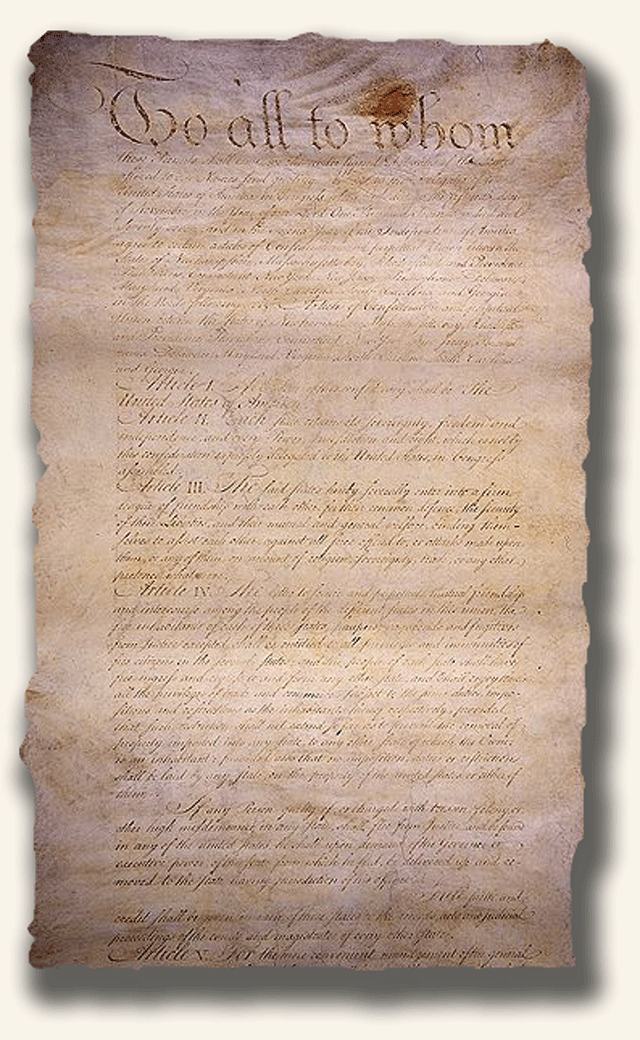 The Articles of Confederation was the governing constitution of the alliance of thirteen independent and sovereign states known as the “United States of America.” The Articles’ ratification, proposed in 1777, was completed in 1781, legally uniting the states by agreement into the “United States of America” as a union with a confederation government. Under the Articles (and the succeeding Constitution) the states retained sovereignty over all governmental functions not specifically deputed to the central government.
The last draft of the Articles was written in the summer of 1777 and adopted by the Second Continental Congress on November 15, 1777 in York, Pennsylvania after a year of debate. The Articles set the rules for operations of the “United States” confederation. The confederation was capable of making war, negotiating diplomatic agreements, and resolving issues regarding the western territories; it could not mint coins (each state had its own currency) nor could it borrow money, whether inside or outside the United States. An important element of the Articles was that Article XIII stipulated that “their provisions shall be inviolably observed by every state” and “the Union shall be perpetual”.
The Articles were created by the chosen representatives of the states in the Second Continental Congress out of a perceived need to have “a plan of confederacy for securing the freedom, sovereignty, and independence of the United States.” Although serving a crucial role in the victory in the American Revolutionary War, a group of “federalists” felt that the Articles lacked provisions for a sufficiently effective government. The key criticism by those who favored a more powerful central state (the federalists) was that the government lacked taxing authority; it had to request funds from the states. Another criticism of the Articles was that they did not strike the right balance between large and small states in the legislative decision making process. Due to its one-state, one-vote structure, the larger states were expected to contribute more but had only one vote. The Articles were replaced by the United States Constitution when created in 1787.
Our issue of the Pennsylvania Ledger dated March 11, 1778 contains the complete printing of the Articles of Confederation. The many photos will allow you to enjoy the significance of the newspaper and to appreciate how those who held this actual edition some 230 years ago might have felt knowing the independent colonies were joining together for a common cause–to not only provide a foundation for a united country which might some day–hopefully–become a world player, but for more immediate purposes, to survive the incursions of the British during the ongoing Revolutionary War. In 1778 no one knew how either effort might turn out.
Enjoy the issue!
If you liked this post, you may also enjoy...
- The Articles of Confederation formally united the 13 colonies (revisited)…
- Announcing: Catalog #267 (for February, 2018) is now available…
- Most historic: 1784 thru 1800…
- “The United States of America”… humble beginnings?
- The red, white and blue… The Traveler…
Meet the staff: Doreen Mileto… Office Manager Extraordinaire…
December 17, 2008 by GuyHeilenman · 4 Comments Email This Post
| Print This Post

Doreen – Office Manager
Doreen is typically the first and front-line person to make personal contact with you, whether it is by phone or by email. Her life at Rare Newspapers is never boring as it is comprised of all types of duties… a true “Girl-Friday” (woman-Friday???). First and foremost, she is the office manager. She also takes and processes customer orders. She answers messages that are received through both the regular email and the eBay message board. Another aspect her job is the writing of item descriptions and photographing issues for the website, as time prevails.
Playing “sleuth” is another role that she undertakes.
“One of my greatest pleasures is in finding hidden family treasures for our clients which have been buried within our archives for decades… just waiting to be found. When time permits, I put on my detective’s hat and head to the stacks. It’s also a disappointment when the need content cannot be located. I hate to disappoint.” Doreen
The most difficult task asked of her is when someone wants her to “select something for them”, i.e, a recommendation. The rare newspaper hobby is so varied, and is grounded so deeply within a person’s personal interests, making such selections is almost impossible.
As for the more personal side of Doreen… She is a wife, a mother of two, a grandmother of three, and a person who simply enjoys life to the fullest. She belongs to a small group of women who love to sing at various church events, and takes great pleasure in reaching out to the local community.

Doreen at work…
One of the greatest drawbacks of having Doreen on staff is her incredible ability to bake some of the most scrumptious cakes, pies, etc., and has a propensity for “celebrating” every possible staff birthday, holiday, anniversary, and more. We’ve all had to double our exercising efforts to burn off the calories, and if you’ve kept an eye on our annual staff photos, you can see some of us have had only minor success.
Doreen is a treat to have as part of the Rare Newspapers’ Team! She is truly my right arm… and perhaps a little of my left.
If you liked this post, you may also enjoy...
- Meet the Staff – Timothy J. Hughes – Founder
- A little monkey business… and food for thought…
- Meet the staff: Guy Heilenman, our President…
- Memorial Day (aka, Decoration Day) and the melting pot of grave markers…
- Thankful for today, but dreaming of a better tomorrow…
Most historic pre-Civil War 19th century event…
December 15, 2008 by TimHughes · 3 Comments Email This Post
| Print This Post
Continuing with our discussion on the “most historic” reports to be found in newspapers, we have been discussing the events of American history by era, the last being the Civil War. This post will discuss the most significant event in American history of the 1801 – 1860 era.
Much in American history happened during these 60 years: from the Louisiana Purchase in 1803, the War of 1812 from 1812-1815, the Texas war for independence of 1836, the Mexican War of 1846-1848, the California Gold rush of 1949+, and the events leading up to the Civil War to name just a few.
But what single event during the period of 1801 – 1860 would rank as the most significant in American history? If you could only have one newspaper from the pre-Civil War era in your collection, what one event would you most desire to best represent the era and–in your opinion–most affected the future of American history?
 Arguments could be made for many events including those noted above, but also perhaps also the Monroe Doctrine of 1823, maybe a single event from the War of 1812, or the battle of the Alamo, or the treaty ending the Mexican War, or the Cherokee Trail of Tears, or perhaps even John Brown’s raid at Harper’s Ferry that would happen just before the outbreak of the Civil War.
In my opinion the Louisiana Purchase was the most significant. This purchase from France would double the land area of the United States and in time 13 states would be carved from it. The explorations of Lewis & Clark and the subsequent Westward migration of so many from the East would transform the nation in so many ways that its significance cannot be ignored. To me it was the most significant event in American history from 1801 to 1860.
What’s your thought? We would all love to hear.
If you liked this post, you may also enjoy...
- Collecting 19th Century… Pre-Civil War… Hidden gems abound…
- Most historic Civil War event…
- Most historic Civil War event (revisited)…
- Thoughts on the most historic 19th century report…
- The Civil War… 150 years ago today… July 20, 1861
Headline was ready: regardless of who won…
December 11, 2008 by TimHughes · Leave a Comment Email This Post
| Print This Post
Among the many curious newspapers we’ve encountered the last 32 years is a pair of the “Publix Opinion” newspapers from New York, both dated September 22, 1927. This was essentially a promotional newspaper 
 done by the Publix Theatres Corporation which owned various movie houses across the country.
The curiosity of this pair is that they both report on the famous Jack Dempsey – Gene Tunney boxing match fought the date of this issue. Obviously they had two editions ready to hit the streets depending on who won: “TUNNEY WINS” with subhead “Champion Retains Crown” was the one newspaper, and: “DEMPSEY WINS” with subhead: “Ex-Champ Regains Crown” read the other newspaper. Somehow both editions were bound into the volume of issues for the year, but I suspect none of the “Dempsey Wins” issues were offered on the street, as Gene Tunney won the fight.
This was the famous “long count” match during which there was some controversy as to whether Tunney, when knocked down, was actually down for 13 seconds versus 9 seconds before standing up and coming back to defeat Dempsey.
The text was written generically enough–or so they thought–to satisfy any reader of the newspaper. Or at least they didn’t care about inaccuracies, as there was no mention of Tunney hitting the canvas, nor the controversial long count. And they report the crowd was 160,000 when in fact it was 104,000.
Ultimately the report was just a lead-in to promote the showing of the film “Underworld” in the Publix Theatres (see last paragraph). An ad for the movie appears on page 3. Not surprisingly the contents of pages 2, 3 and 4 are identical in both issues.
Enjoy a fascinating curiosity!
If you liked this post, you may also enjoy...