

Search
The Rare & Early Newspapers Hobby

Receive the Newsletter

Buy Historic Newspapers

Collection Spotlight: One man’s passion for pulp… From Antique Trader…
April 16, 2009 by GuyHeilenman · Leave a Comment  Email This Post
|
Email This Post
|  Print This Post
Joe Rainone, a member of the Rare & Early Newspapers Community, recently had a featured article in a post at AntiqueTrader.com. His passion is focused primary on pulp magazines, with some cross-over to collectible newspapers. The article begins:
 “My passion for collecting started in the mid 1980s although I did enjoy collecting stamps, coins and reading comics as a child. I started to collect comic books again with my 9-year-old son who loved Spider-Man. This was my introduction to popular fiction.
I became intrigued with pulp magazines. In time, I became more interested, not only in the artwork, but also the history of how and where it all began…”
To read more, go to http://www.antiquetrader.com/article/One_mans_passion_for_pulp. Great job Joe!
The rare newspaper community is pregnant with scores of members with their own collectible passion. One of the beauties of the hobby is the endless varieties of directions one’s collection can go. If you’d like to share about your collectible area of interest, please do.
If you liked this post, you may also enjoy...
- “Collecting Newspapers – The Basics” (Part III) – Newspaper Care…
- My Collecting Story… Brent Lacy…
- My Collecting Story… David Cunningham…
- My Collecting Story… Paul Sarna…
- My Collecting Story… Gregory Christiano…
Collectible Magazines… Rich West… Periodyssey – Part II
April 13, 2009 by GuyHeilenman · 1 Comment Email This Post
| Print This Post
Tammy Kahn Fennell at Collectibles Corner TV recently completed part II of her interview with Rich West of Periodyssey fame. Part II of the interview begins at the 3:32 mark; however, if you have the time, the entire episode is worth watching. Thanks Tammy… and Rich.
Episode #10 – Depression Glass, Colophon, Rich West of Periodyssey part 2, Get Me Video
Note from the previous post re: the interview with Rich:
Although Timothy Hughes Rare & Early Newspapers’ archives contain nearly every issue of Gentleman’s Magazine, Harper’s Weekly (actually an illustrated newspaper), Harper’s Monthly, The Sporting News, and a selection of others (Liberty Magazine, Atlantic Monthly, Scribner’s, etc.), including many of these and others beyond what is posted on the Rare & Early Newspapers website, the Timothy Hughes of magazine collecting is Rich West of Periodyssey. He operates with integrity, has an incredible inventory of magazines to offer, and is the most knowledgeable resource in the field of magazine collectibles.
If you liked this post, you may also enjoy...
- Collectible Magazines… Rich West… Periodyssey…
- An Interview with Timothy Hughes…
- Frederic Remington Prints on Pinterest…
- Collecting Newspapers – The Basics (Part I) – Eras, Topics, and Titles…
- A video look at Rare & Early Newspapers – revisted…
Editorial policy (?) and the potential impact upon an issue’s collectibility…
April 11, 2009 by GuyHeilenman · Leave a Comment Email This Post
| Print This Post
The following are a few thoughts by Morris Brill (guest contributor) concerning slight differences in the printing of the Declaration of Independence within the London Chronicle (dated August 17, 1776) vs. the printing within the Gentleman’s Magazine (dated August, 1776):
Recently on Ebay two different sellers offered a printing of the Declaration of Independence in the Gentleman’s Magazine. I also noted your offering of the Declaration within the London Chronicle.
I (Morris) noted, while reading the text of Gentleman’s Magazine, as photographed on Ebay, a particular sentence in which two words were missing and substituted with a line, i.e. ___________
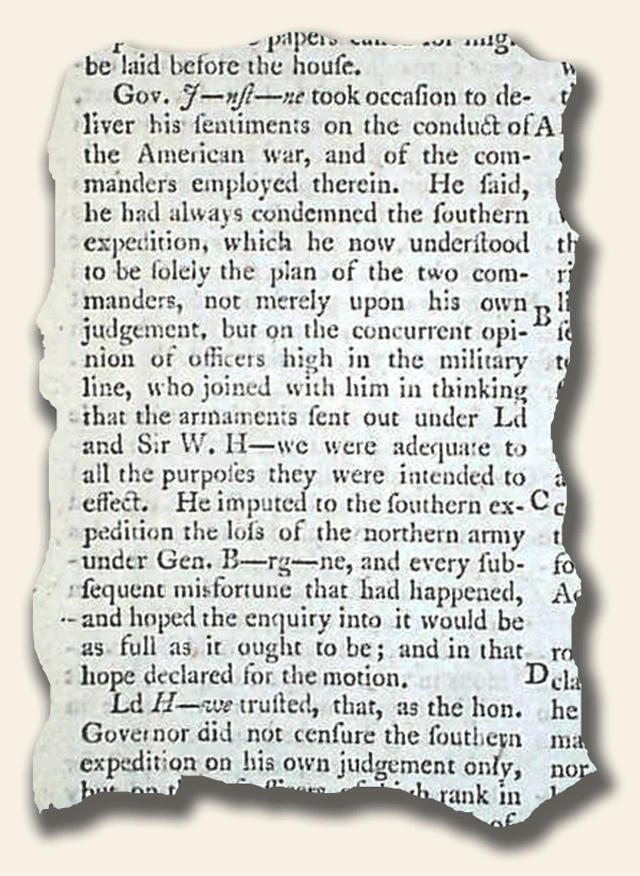 The sentence is as follows:
“A prince, whose character is thus marked by every act which may define a tyrant, is unfit to be the ruler of a free people.”
In the Gentleman’s Magazine the words ” prince” and “tyrant” are deleted.
I find it interesting that although the Gentleman’s Magazine and the the London Chronicle are both British that one paper printed the words prince and tyrant, yet the other did not.
To me, the deletion of the two words certainly diminishes the historic value of the printing as it appeared in the Gentleman’s Magazine, although I would not pass up the opportunity to own this paper. Perhaps it has to do with an opposing editorial policy, or the political persuasion of the two publishers.
Morris
Note: If anyone is aware of the formal policy which led to the deletion of certain words within the Gentleman’s Magazine, please share your insight with the rare newspaper community.
If you liked this post, you may also enjoy...
- When did the “Gentleman’s Magazine” print the Declaration of Independence?
- Most historic: The Declaration of Independence in your collection…
- Stories Surrounding the Declaration of Independence… the Treason of Thomas Hickey…
- Print date for the Gentleman’s Magazine…
- The Traveler… it’s a boy… poetry in cards…
Double-dated newspapers: the Julian and Gregorian calendars…
April 9, 2009 by TimHughes · 1 Comment Email This Post
| Print This Post
 If you have some 1600’s newspapers in your collection you may have a few with dates showing years as “1683/4″ or 1686/7”, or perhaps you have a few issues from a single year where a later date has an issue number lower than an earlier date, and you’ve wondered “how could this be?” Well, it’s due to the calendar, or more specifically which calendar was in use at the time.
Although the differences between the older Julian calendar and our current Gregorian calendar are many and very complicated and can be understood by visiting this site, the short answer is that in the latter part of the 17th century & a portion of the 18th century both calendars were in use in England, and the date of the issue would reflect which calendar was in use.
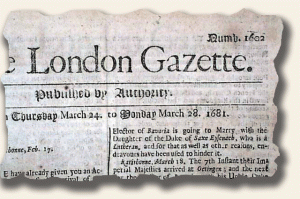 The new year of the older Julian calendar began on March 21, so an issue dated March 17, 1675 would be followed by the next weekly issue dated March 24, 1676. This would also mean that an issue dated December 31, 1675 would be followed by an issue dated January 7,1675. This was how the London Gazette dated it’s issues for much of the 17th and early 18th centuries. At first glance one would think that the issue of Jan. 7, 1675 was older than one dated December 31, 1675, but the opposite was true.
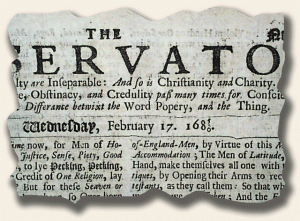 Other titles were a bit more helpful in noting the year of publication by dating issues from January 1 thru March 20 with a double-dated year such as “1684/5” or “1686/7” so the reader would know that it was from the year 1684 under the Julian calendar, or 1685 under the Gregorian calendar.
Some American newspapers of the 18th century have similar double dates, but by the beginning of the 19th century–if not reasonably before–newspapers had converted exclusively to the Gregorian calendar. The same was true with most of the Western world, while other portions of the globe adopted the Gregorian dating system much later.
Hopefully this answers a few questions you have had. Be in touch if we can be more helpful!
If you liked this post, you may also enjoy...
- This Day Through History (as reported in authentic newspapers)…
- Snapshot 1665 – The Oldest Continuously Published Newspaper is Born…
- The first newspapers in Mississippi…
- When did the “Gentleman’s Magazine” print the Declaration of Independence?
- This Day in “News” History (Part II) – January 27th…
Numbering an issue….how was it done?
April 6, 2009 by TimHughes · Leave a Comment Email This Post
| Print This Post
 The numbers noted at the top of the front page of a newspaper, typically at the far left and right of the dateline, may seem a bit confusing so I’ll try to explain what they mean.
Most newspapers had two sets of numbers: 1) the issue & volume numbers, and 2) the whole number.
The issue & volume number often appear such as “Vol. 5 num. 237” which means this is the 237th issue from the fifth year of the newspapers existence. Newspapers would assign a volume number to their publication which would increase by one on the anniversary of its beginning, so if a newspapers published it’s first issue on March 5, 1837, volume two would begin with the first publication after March 5, 1838. The issue number notes the issue from within that volume, meaning that issue “Vol. 5 num. 313” might be followed by issue “Vol. 6 num. 1” if the newspaper published 6 days a week (365 days less 52 Sundays = 313 published issues in the year).
 But to many the more mysterious number is the “whole number”. Essentially it indicates how many issues have been published since the founding of the paper, and can be a very large number if the paper has been in publication for many years.
Using the above example of “vol. 5 num. 313” the “whole number” of this issue would likely be 1565 (313 issues per year x 5 years = 1565). And the very next issue, noted as “vol. 6 num 1” would be whole number 1566.
 The tricky thing is that when some newspapers were sold, reorganized, changed their name, or merged with another they might begin a “new series” and the volume/issue numbers would begin afresh, and the whole number may or may not start over with number 1, depending on the whim of the publisher. So these numbers cannot be depended upon to give an accurate reflection of how old the newspaper is, nor the number of issues that were printed since its inception. Niles’ National Register did this at least twice in its 40 years’ existence.
If you liked this post, you may also enjoy...
- “New Series” of a newspaper…
- The reason I collected it: just intriguing…
- Print date for the Gentleman’s Magazine…
- Newspaper circulation in the 1700’s…
- Newspaper circulation in the 1700’s (revisited)…
Don’t tell the Chamber of Commerce…
April 4, 2009 by TimHughes · Leave a Comment Email This Post
| Print This Post
 A brief piece in the “Niles’ National Register” newspaper of Baltimore, January 14, 1843, obviously came from a disgruntled visitor to the West:
“Capt. Kendall, in describing Santa Fe, says it is a little mud-built city, that stands between civilization and the jumping off place.”
If you’ve visited Sante Fe, New Mexico recently, you can certainly attest to the significant improvements which have been made since 1843.
If you liked this post, you may also enjoy...
- First newspapers in New Mexico…
- The Traveler… time to build…
- The Traveler… Presidential election day 1912… the first in New Mexico…
- The Traveler… showing the way…
- Many Thanks to Give…
Red (British) tax stamps… They appear to be random…
April 2, 2009 by GuyHeilenman · Leave a Comment Email This Post
| Print This Post
 Recently a member inquired as to why the red-ink British tax stamps seemed to appear randomly within an issue – sometimes on the frontpage, sometimes on the backpage, and at other times somewhere within the issue. Although we had our thoughts on the subject, we called upon a collector of red-ink stamp issues, Randall Burt. His thought substantiated our “hunch”:
“These newsprint publishers bought their stock from the
paper makers, and then were required by law to pay the paper tax on it at the gov’t
house where the paper was taxed at current rates. The stamp was applied on
the blank sheets [pre-printing], then taken to their newspaper office where the news was added.
 These tax stamps were not always in a desirable place for the collector. J.H. Chandler & H. Dagnall wrote extensively on this subject in their “Newspaper & Almanac Stamps of
Great Britain,” as did several other noted revenue writers.” Randall Burt
Thanks for your insight Randall.
If you have additional questions you would like to see addressed through the History’s Newsstand Blog, please comment to this post of send your questions to guy@rarenewspapers.com.
If you liked this post, you may also enjoy...
- When crises happen, publishers can be creative… Ben Franklin & the Stamp Act…
- A 49 year search comes to an end… The 1765 “Tombstone” issue…
- The reason I collected it: just intriguing…
- From the private collection: “Yes, Virginia, there is a Santa Claus”
- Printed History: Collecting 3.5M rare newspapers in Central Pa.
Collectible Magazines… Rich West… Periodyssey…
April 1, 2009 by GuyHeilenman · 1 Comment Email This Post
| Print This Post
Although Timothy Hughes Rare & Early Newspapers’ archives contain nearly every issue of Gentleman’s Magazine, Harper’s Weekly (actually an illustrated newspaper), Harper’s Monthly, The Sporting News, and a selection of others (Liberty Magazine, Atlantic Monthly, Scribner’s, etc.), including many of these and others beyond what is posted on the Rare & Early Newspapers website, the Timothy Hughes of magazine collecting is Rich West of Periodyssey. He operates with integrity, has an incredible inventory of magazines to offer, and is the most knowledgeable resource in the field of magazine collectibles. Lou Kahn and his daughter Tammy Kahn Fennell recently interviewed Rich for Collectibles Corner TV. Feel free to enjoy the entire video or advance to the 5 minute mark to catch only the portion of the show containing the interview with Rich. Rumor has it they’ll be doing a follow-up interview with Rich West shortly. Please Enjoy:
Episode #9 – Occupied Japan, Provenance, Antique Quilts, American Periodicals, Rich West of Periodyssey
If you liked this post, you may also enjoy...
- Collectible Magazines… Rich West… Periodyssey – Part II
- An Interview with Timothy Hughes…
- Frederic Remington Prints on Pinterest…
- Davy Crockett & Rand Paul – “I Love This Collectible!”
- A video look at Rare & Early Newspapers – revisted…
Genuine or reprint?
March 26, 2009 by TimHughes · 31 Comments Email This Post
| Print This Post
A great fear of any novice collector is knowing whether an item purchased is genuine or not. It’s a valid concern, as the other collectibles have been infested by reproduction,s reprints, or deceivingly fake material from furniture to coins to baseball collectibles.
The world of rare newspapers is not immune but it is not a serious problem either. With a few helpful hints almost every collector can avoid the pitfalls of having non-genuine newspapers end up in their collection.
Fake material of any collectible seems to become an problem when popularity and values grow. Since rare newspaper collecting remains a relatively unknown hobby with relatively low prices there is little incentive to create fake editions. And the requirements to recreate a 200 year old newspaper to have it look like a genuine edition can be complex and expensive.
With but one exception, I am not aware of any reprinted newspapers which were created to deceive. Virtually all facsimile issues on the market were created as souvenirs of historic events (Honolulu issues on Pearl Harbor can still be purchased at the memorial), on anniversaries of the first issue printed (many volume one, number one issues are reprints), as curious give-aways or “premiums” (major events such as the Boston Massacre, Declaration of Independence, etc. were reprinted), or as teaching tools in an educational environment (Harper’s Weekly issues from the Civil War were reprinted on their 100th anniversary: look for “a reissue of” above the “H” in “Harper’s Weekly” on page 1).
The lone exception is a collection of the “Pennsylvania Gazette” from the 1730’s – 1787 with issues turning up in small auction halls throughout the East some 20 years ago. The issues were aged to look 200 years old and the paper was very close to genuine newsprint from the era. Beware of this title if it contains a “Tontine Coffee House” inked stamp on the front page & if it looks a bit washed out.
The number of reprint newspapers on the market is exceedingly small so collectors have little to worry about. But keep these points in mind:
1) The most common reprint newspapers are on the Library of Congress check-list. Go here to keep the list handy. It also includes helpful tips on how to tell if genuine or a reprint.
2) Be aware of what 200 year old and 100 year old newsprint should look like. Almost all reprints were done on paper which is not reflective of the era.
3) Be suspicious of exceedingly historic newspaper turning up in illogical places. The likelihood of a genuine Declaration of Independence report being in flea market or amongst of group of papers from a non-collecting family is very remote. In other words if the find seems too good to be true, it likely is.
4) Be careful with volume one, number one newspapers. Such first editions were commonly reprinted by the publisher on the 50th or 100th anniversary.
5) Above all, buy from reputable dealers whose expertise, experience and reputation stand behind all they sell.
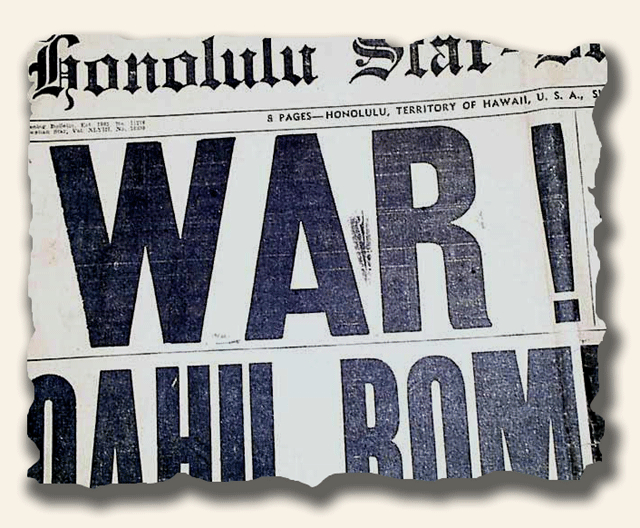 The “Honolulu Star-Bulletin” of Dec. 7, 1941 mentioned above is not on the Library of Congress check-list, however it’s easy to spot a reprint. The genuine issue has an ink smear between the “A” and “R” in the huge word “WAR!” on the front page (see photo). They cleaned it up on the reprint so it won’t be present.
And a news flash–I just learned that the “Dallas Morning News” issue of Nov. 23, 1963 reporting Kennedy’s assassination has been reprinted. Look for the word “Reprint” in the dateline just after the four stars. Do note those we have on our website & have sold for over 20 years are all genuine!
Common sense can be the best guide. The requirements to reprint an 8 page Civil War newspaper with a minor battle report could cost hundreds of dollars while the genuine issue might sell for $20, so chances are good such finds are genuine. For this reason our hobby is a fascinating one not prone to the pitfalls of other collectibles.
Our community of collectors is quite small which has worked in our favor. All of us are in an enviable position of being able to assemble great collections of historic material before the world at large “discovers” our hobby and changes the environment in years to come.
Enjoy!
If you liked this post, you may also enjoy...
- The reprint issues of the “Honolulu Star-Bulletin” Pearl Harbor issue… and the reprint set…
- Your help would be appreciated…
- Extensive list of reprinted newspapers…
- Documenting an early reprint of the Ulster County Gazette…
- Reprinted Newspapers – Identified as of 1931…
Historically significant: one from our inventory…
March 21, 2009 by TimHughes · Leave a Comment Email This Post
| Print This Post
 Although we would like to think we have a large number of interesting and fascinating newspapers within our inventory, there are few which float to the top when it comes to being very historically significant.
Our “American Weekly Mercury” from Philadelphia, 1735 is certainly one. The title and date alone would qualify its rarity, as American newspapers from that time are exceedingly scarce; from when Ben Franklin was just beginning his career. It is a handsome issue as well as the masthead features two wood engravings which make this a very decorative issue.
This was the first newspaper not only in Pennsylvania but also the Middle Colonies, having begun in 1719 by famed newspaper publisher Andrew Bradford, and continued until its demises in 1746. It was also just the third newspaper in all the colonies.
The content is certainly noteworthy, reporting on the very founding of the colony of Georgia. See the photos for the report and the involvement of James Oglethorpe. Its appeal as a purchase might be limited to those with a strong interest in Georgia history, but anyone could appreciate the value of having such an inconspicuous gem of a report on the front page of a newspaper.
Click on the link and enjoy.
If you liked this post, you may also enjoy...