
Search
The Rare & Early Newspapers Hobby

Receive the Newsletter

Buy Historic Newspapers

Collecting 19th Century… Pre-Civil War… Hidden gems abound…
May 17, 2013 by GuyHeilenman · Leave a Comment
An era rich in history… with hidden gems throughout…
Many rare newspaper collectors focus on the more memorable eras of history such as the Revolutionary War, the Civil War, or World War II. Brief date periods –as war events tend to be—can allow for a more concise collection without becoming unduly large if one concentrates on just the major events. Consequently, less notable eras often get over-looked without realizing there is a treasure trove of events which are both fascinating and historically significant found in period newspapers, and well within the range of the average collector.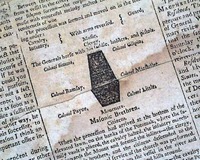
One such era would be the 1800-1860 period which we designate on our website as the “Pre-Civil War Era”. This was a transitional time in American history as the events of the Revolutionary War and the struggles with creating the federal government gave way to a more secure nation and a more independent America as the nation grew in both size and complexity.
This sixty year era offers a great wealth of events which were formative for the American landscape. The century began with continual coverage of the funeral of George Washington who died less than 3 weeks before the new century began. Thomas Jefferson was the first President to be elected in the 19th century and he did not escape the headaches of war, as the “Barbary Wars” fell within his tenure. He also lead the charge for the Louisiana Purchase which more than doubled the size of the nation and would be home, in full or in part, for 15 new states that would eventually join the Union. Newspaper reports on the Lewis & Clark Expedition were few and far between, but finding even brief mentions in a period newspaper can be quite a thrill.
As the country grew a wealth of notable events transpired & were noted in newspapers of the day. Presidential elections and inauguration are always popular, and there were many in this era: Jefferson, Madison, Monroe, John Quincy Adams, Jackson, Van Buren, William Henry Harrison, Tyler, Polk, Taylor, Fillmore, Pierce, Buchanan, and of course Lincoln, who was elected in this era, but would be inaugurated in the “Civil War Era”, a fascinating chapter of American history onto itself. For those who like to have :complete” collections, finding every election and inauguration is a doable quest.
The War of 1812 falls within this era and provides an opportunity for a sizable and notable collection on its own, from the declaration of War to the many naval battles, the attacks on Baltimore & Washington, the significant battle of New Orleans, and the treaty which ended the war. Collectors like that war events typically allow for collection “bookends” (war declaration and treaty of peace), between which they can become as focused as their budget will allow in collecting the major events.
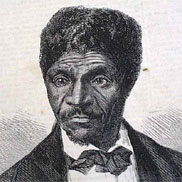 The slavery issue would remain a stain on the American fabric during this era, with events such as the Denmark Vesey and Nat Turner insurrections, and the more notable John Brown raid at Harper’s Ferry, as lead-ins to the Civil War. Abolitionist newspapers would be created, including the Liberator & the Emancipator among others, and names such as Frederick Douglass, Dred Scot, and William Lloyd Garrison would make their marks in American history forever. And it was very much a political issue as well with the Missouri Compromise being just one of several federal decisions which had slavery as a basis. Relations with the Native Americans were troubling also, with the Seminole War, the “Trail of Tears”, and the many broken treaties commonly reported in newspapers of the day.
The Texas Revolution of 1835-1836 has a spice of historical romance similar to the events of the Old West, as both were dramatized in movies. The memorable Battle of the Alamo (starring John Wayne on the big screen) and its fiercely heroic soldiers & citizens, who knowingly faced death to establish the independence of Texas, remains a proud moment in not just Texas but American history. The battles which lead up to that event, and those which followed can be found in newspapers of the day, and mention names we remember from history books including Sam Houston and Davy Crockett.
The Mexican War was another event which resulted in the expansion of the nation with all the major battles reported in newspapers of 1846 to 1848. Just a few years latter attention focused once more on the West with the California Gold Rush and all the romance of a nation heading west to find their fortune. The newspapers reported those thrills, but also reported the struggles & hardships which would befall the many on the trek to the West. Newspapers of the day were more frank than were history books 100 years later.
Westward expansion wasn’t limited to the battle fronts or the quest for gold, as the Missouri River Expedition, The Yellowstone Expedition, the Rocky Mountain exploration, and reports on the Santa Fe Trail were all reported as the adventurous were discovering and creating history—and reported first in newspapers of the day. Such expansion was responsible for states to be created, and reports of statehood for Alabama, Indiana, Michigan, and Illinois among others were detailed in newspapers, as were reports of changes needed in the United States flag to honor such additions.
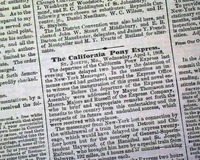
The Erie Canal, creation of the cotton gin and the Pony Express were notable events during this period. Famous names were commonly found as their reports were making history & reported in newspapers as such, including the likes of Daniel Boone, John Jacob Astor, Bolivar, John Jay, Henry Clay, Horace Greeley, and Kit Carson to name but a few. Of special intrigue is finding reports of famous names before they became famous, such as inconspicuous mentions of Abraham Lincoln from 1848 when he was a member of Congress, or Jefferson Davis from 1833, nearly 30 years before becoming President of the Confederacy.
 Judaica interest, reports of pirates, the Black Hawk Indian War, runaway slaves, William Henry Harrison’s one month Presidency, and the earliest reports of the Mormons and the journey across the country provide fascinating reading in newspapers of the pre-Civil War era. The Monroe Doctrine is just one of an endless list of historical documents and landmark Supreme Court decisions which were reported in newspapers of the day. Early newspapers from Hawaii, Florida, and Kentucky among others, more commonly found after the 1870’s are a special treat when found before the Civil War. And more than American history found their way into American newspapers. The Battle of Waterloo and the other Napoleonic Wars with mention of Buonaparte, Wellington and other key European figures put world history into perspective when such reports are found alongside notable events in American history.
If capturing history in the pages of the nation’s newspapers is your hobby, certainly there is much from the 1800 – 1860 period to excite any historical hobbyist. Do not overlook this fascinating era in the growth & development of the United States of America.
The War of 1812… through contemporary newspapers and more…
May 13, 2013 by GuyHeilenman · Leave a Comment
 Rare & original newspapers have always been an excellent resource for capturing the context, contemporary response, and details of historic events. This truth was brought home recently via Todd Andrlik’s, “Reporting the Revolutionary War: Before It Was History, It Was News“. Moving slightly into the future, Vice Admiral, U.S. Navy (retired) George W. Emery does the same in his work, “In Their Own Words – The Navy Fights The War Of 1812“. Yet again we are reminded that “History is never more fascinating than when it’s read from the day it was first reported.” Additional details worth exploring may be found at:
In Their Own Words: A New Look at the Naval War of 1812
Thanks for this latest contribution which brings the past into the present through the eyes of those who experienced the War of 1812 first-hand.
“Rag paper” allowed newspapers to pass the test of time…
May 10, 2013 by GuyHeilenman · Leave a Comment
One of the biggest surprises–and a pleasant one–novice collectors of newspapers discover is that the oldest newspapers they purchase, those from before 1870, are in much better condition than the more recent “old” newspapers of the late 19th or 20th centuries. How could this be?

Printed on "Rag Paper"
It’s all in the paper. and I literally mean in the paper. Prior to the 1870’s, newsprint was primarily made of cotton & linen fibers. It was handmade and very dependent upon the raw ingredients being available, which was not always the case. It was common to find newspaper advertisements seeking “rags” for the printer, to be used to make the paper upon which the newspaper was printed. Equally as common would be a note from the printer that an issue would have fewer pages or be skipped altogether due to the lack of newsprint. “Rag” paper, as it is called, was not an inexpensive or easily made commodity.
Typically, the older the newspaper, the better the quality. It is not uncommon to find newspapers from the 1680’s which are very white, relatively thick, and extremely pliable. They can be bent, folded, creased, wrinkled and no harm will be done. Do the same to a newspaper of the 1890’s or early 20th century and it will crack and crumble. I recall some years ago a novice customer returning an issue of the London newspaper “The Observator“, 1683, because he claimed “it looked to new to possibly be over 300 years old”. I could not convince him otherwise. Newsprint of 300 years ago simply does not yellow. We occasionally receive similar feedback from similar titles: The Spectator, The Post-Boy, and more. Even a select number of 20th century papers were printed on rag linen as well, typically for use in institutions.
Such handmade paper, particularly that used in the 17th and 18th centuries, can be distinguished from paper made later by holding it up to a light and looking for “chain-lines” which are left from the wires in the paper mold. With this method, fewer fibers accumulate directly on the wire, so the paper is slightly thinner and more transparent to light. This pattern is usually very apparent and appears as lines that run about an inch apart, with several horizontal short lines connecting the long wire lines. Some modern paper has artificially-applied chain lines, and is usually referred to as “laid” paper, which is the name given to handmade chain-line paper.
The handmade chain-line paper made of cotton and linen rags which were soaked in liquid until the fibers broke down into very small bits. Paper was formed by hand by dipping a paper mold into the fiber suspension, and then lifting and shaking off the excess water. The paper sheet was then partially dried before being removed from the mold. Modern handmade paper (used in fine printing of small editions by private presses, as well as in artists books) is basically made by the same process.
The high quality of newsprint was an expensive process & caused newspaper subscriptions to be beyond the means of the average citizen. Consequently holdings of newspapers are relatively small. They were never printed in huge quantities because they cost too much to be widely purchased by the populace. And keep in mind that the percentage of literate people in the 18th and early 19th centuries was not what it is today.
The use of “rag paper” for the publishing of early newspapers is one of the great joys of this hobby. Early newspapers–including issues dating back to the Revolutionary War and beyond–need very little care to maintain their state of preservation. We keep such issues on open shelves where they have been for years to no harm. They can be handled & read from beginning to end without risk of damage or harm. Truly, a collector can hold history in his hands, enhancing the tactile experience this hobby enjoys beyond others where “do not touch” is more the norm.
Another benefit of rag paper is that it allows for easy detection of reprint or facsimile newspapers. A common question crossing our desk is “are you sure it is a genuine newspaper?” or “is my newspaper genuine or not?” When I authenticate newspapers one of the easiest determinants is the quality of paper. If the newsprint is browned or yellowed and fragile to the touch, chances are exceedingly good it is not a pre-1870 newspaper (although there are exceptions). Newspapers from the Revolutionary War should not crack when folded or creased.
The vast majority of reprint or facsimile newspapers on the market were never meant to deceive the collector but rather were anniversary issues, done 50, 100 or 200 years after a significant event, or in celebration of the very first edition of that title. They were often give-aways to subscribers. The “New York Herald” of April 15, 1865 is perhaps the most commonly found reprint newspaper, and most fail the rag paper test; they are much to browned or fragile to have been printed in 1865.
It was the industrial revolution of the latter half of the 19th century which resulted in the technology to create newsprint from wood pulp and chemicals. It was a welcomed innovation for publishers as newsprint become much less expensive to make, but it began the downfall for long-term preservation. But then, newspapers were never intended to last more than a day. Another issue would be on the streets for the consumer the next morning, to the delight of publishers across the country.
The Traveler… three cheers…
April 22, 2013 by The Traveler · Leave a Comment
 Today I traveled to Boston, Massachusetts, through the Independent Chronicle dated April 22, 1813. There I found Commodore Bainbridge was addressing the sailors of the Constitution as they had been invited to the Theatre. “Sailors, In the action with the Java you shewed yourselves men. You are this ev’ng invited to partake of the amusements of the Theatre. Conduct yourselves well… Let the correctness of your conduct equal your bravery, and I shall have additional cause to speak of you in terms of approbation.” He then informed them that on Monday morning, “pay to them the prize money in consideration of their good conduct in the actions with the Guerriere and Java. The crew received the information with great satisfaction, and gave the Commodore three cheers.”
The article has a concluding paragraph from a correspondent who had observed the attendance of the sailors and the comments to their appearance and behavior.
Blessed are the feet of those who bring good news – for a change.
Regarding the remainder of the issue, I wonder if James Madison suffered from writing cramps after all his signing???
~The Traveler
The Traveler… USS Constitution defeats HMS Java… River Raisin…
February 18, 2013 by The Traveler · Leave a Comment
 This week I traveled to Philadelphia, Pennsylvania, by way of the Aurora dated February 19, 1813. Here I found the report of “Another Naval Victory!” being reported “… On the 29th of December, off St. Salvadore, the Constitution, capt. Bainbridge, fell in with the British frigate Java, of 38 guns (mounting 49) and 400 men. After an action of one hour and forty-five minutes, the Java struck, with the loss of 60 killed and 170 wounded. The Constitution had 9 killed and 25 wounded… The Java was so much damaged in action, that it was deemed impossible to fetch her in, and by order of captain Bainbridge she was burnt…”.
Also in this issue was the report of the battle at river Raisin, including the killing (scalping) of General Winchester and the further mutilation of his body. It is so hard to imagine what they went through in those battles. So much for nostalgia.
~The Traveler
The Traveler… Captain Hull honored…
January 7, 2013 by The Traveler · Leave a Comment
 Today I traveled to Hartford, Connecticut by way of the American Mercury, January 6, 1813. There I found that Isaac Hull, commander of the United States frigate Constitution, was being honored in New York City. He was being presented the freedom of the city “…for his gallantry in capturing the British frigate Guerriere…”. He was presented with a gold box, richly set with emeralds, representing the action between the two frigates, and the arms of the city. Mr. Clinton delivered the speech, Captain Hull replied to the address and “…on descending the steps from the Hall was greeted with three cheers as a brave and faithful public servant whom all ‘the people delight to honor.'”
Also in this issue are several military recruitment advertisements, one which is illustrated for the Dragoons.
~The Traveler
Thanksgiving Proclamations… a survey through American History…
November 21, 2012 by GuyHeilenman · Leave a Comment
 This Thanksgiving, why not take the family on a historically “Pinteresting”walk through a survey of Thanksgiving Proclamations made at key moments in American History?
http://pinterest.com/rarenewspapers/thanksgiving-proclamations/
Happy Thanksgiving!
The Traveler…Frigate President makes a capture… newspaper proposal…
November 19, 2012 by The Traveler · Leave a Comment
 Today I traveled through Boston, Massachusetts, by way of the Independent Chronicle dated November 19, 1812, where I found an Official report from John Rodgers. The U. S. Frigate President had captured the British Packet Swallow and the rank of the commander of the vessel being the master and commander in the navy. “… She had no cargo in, except eighty-one boxes of gold and silver, amounting to between one hundred and fifty and two hundred thousand dollars…”. I would say that was a pretty nice cargo!
Also within the issue was the proposal of a new newspaper, that being the Baltimore Patriot. In slightly less than two years, this publication would be the first newspaper to publish The Star-Spangled Banner on September 20, 1814 (Note: Just for an FYI, it appeared within a week in a Washington, DC paper as well).
~The Traveler
Beyond the historic headline…
November 1, 2012 by TimHughes · Leave a Comment
 “Newspapers that shaped the world…“
Some of the better & more fascinating items found in old newspapers are not the most historic or significant, but rather the casual appearance of seemingly innocuous reports which excite collecting interest beyond the historic headline or dramatic presentation which are the more usual draw.
Much of what intrigues collectors can be lost within the body of reports, yet they tell a story of their own, such as the patriotic fervor of some colonist during the Revolutionary War. I recall an issue of the Edinburgh Evening Courant of June, 1776 reporting on American soldiers: “…Their uniform is a dark grey coarse linen frock, which covers the whole body…with the words, ‘Death or Liberty’ marked in large red letters on the right sleeve; and many of them are so enthusiastic as to have them marked with their own blood…”. This report is almost lost on page 3 yet its message is very telling of the spirit which caused the Americans to win the war against a world power despite insurmountable odds.
Some reports are fascinating by their bias. A Richmond newspaper of July, 1863 reporting on the Battle of Gettysburg notes: “…The Confederates did not gain a victory, neither did the enemy. He succeeded in defending himself & we failed in some portions of an attack…We killed more of the enemy than we lost; we took very many more prisoners than lost. The Confederate army did not leave the enemy until it had tried every link of his armour…” Another newspaper notes: “ ..Information, certainly authentic, is in the hands of the Government, which leaves no doubt of the safety & triumph of the noble army. General Lee was victorious in all the combats which have taken place. He has been engaged with the whole force of the United States & has broken its backbone…”, Perhaps the most extraordinary example of optimism appeared in the Richmond Examiner of July 25: “…The result was not a defeat, it was not a loss; it was only not a victory…It was little else than a disappointment of extraordinary expectations…”. What a precious statement as an example of Confederate optimism.
Other little gems were very prophetic in their reporting, particularly when read with an historic perspective. A Scottish newspaper from 1775 sensed a lasting war with America as it reflected on the Battle of Bunker: “…The mischiefs which have already arisen & the greater calamities which are threatened from the unnatural war excited in America…It is impossible we can see, without the utmost alarm, preparations making for the prosecution of an expensive & ruinous war with our own Colonies…”. Some can be very recent, like the New York Times comment on rookie Mickey Mantle in 1951: “…Mantle, who gives every promise of developing into an outstanding baseball star, was ordered to report to his draft board next Wednesday…” An editorial comment in the Army & Navy Journal just after the Gettysburg Address opined: “…a dedicatory speech by President Lincoln, which we give in full, as decidedly the best feature of the occasion, as well as one of the most felicitous utterances of its author.” How true.
Some were prophetic even when the reports were simply wrong, like the Illustrated American article of 1898 reporting on “A New Flying Machine That Flies”–five years before the Wright brothers–when it said: “…It is impossible to imagine without terror the day when these mechanical birds, these flying apparitions, will be able to rain upon armies, hostile towns and escalating parties most deadly and most destructive explosives…”. How true it would become.
There can be much to be found in newspapers beyond the headline. What a thrill it is to discover such hidden gems; reports that have escaped hundreds of years of history only to rediscovered with new-found relevance today. Such are just some of the joys of collecting early newspapers.
Please enjoy: “Newspapers that shaped the world…“
Countdown to “Newspapers that changed the world…”
October 24, 2012 by GuyHeilenman · Leave a Comment
Each month Timothy Hughes Rare & Early Newspapers releases a catalog containing a new set of historic and collectible newspapers (1600′s through 20th century). However, on November 1, 2012, at 12:01 AM ET, the special edition, “Newspapers that changed the world…” will be released. Whether you already collect newspapers, or desire to simply view a sampling of what the hobby has to offer, check back for this special occasion:
Prior to November 1, 2012 and after November 30, 2012, the link below will take you to the most recent offerings of Timothy Hughes Rare & Early Newspapers… History’s Newsstand! During the month of November it will take you to the special release catalog, “Newspapers that changed the world”.
View: “Newspapers that changed the world…“