

Search
The Rare & Early Newspapers Hobby

Receive the Newsletter

Buy Historic Newspapers

A gift for your barber…
April 5, 2013 by TimHughes · Leave a Comment
Although the purpose of the ad in the “Rhode Island American & Gazette”, Providence, February 1, 1831 was to give notice of this barber’s change of location, it’s the description of the service he performs which is most interesting–and amusing (see below).
Mormon history in newspapers…
March 15, 2013 by TimHughes · 3 Comments
As is true with any historical event or founding of an institution, collectors of historical newspapers strive for the earliest reports possible. The Declaration of Independence first appeared in a newspaper on July 6, 1776, and that issue commands a six figure price much higher than printings of the document in other newspapers of later dates  (such as the British Gentleman’s Magazine from August, 1776). Battle reports from the Revolutionary War are most coveted when in newspapers dated as close to the battle as possible. With the widespread use of the telegraph just before the Civil War, timeliness became less of an issue, as events would typically be found in the next day’s edition of newspapers regardless of how distance the printing press was from the event.
With institutions, societies & organizations the collector strives for the earliest reports on their creation. Reports from the Continental Congress, the Constitutional Convention, the creation of military academy at West Point, the first baseball game mention, are just a few examples of icons of present-day societies which collectors like to find in newspaper reports dated as early as possible.
Such is true with development of the Church of Jesus Christ of Latter-Day Saints, or the Mormons. Formally organized in upstate New York in 1829 accounts from that year or 1830 would rank among the most desired. Our earliest account was found in the ‘Christian Intelligencer” issue of February 4, 1831. As was typical with reporting of the day, bias, discrimination and prejudice were rampant within the newspaper pages, with the publisher’s mind-set not encumbered by political correctness. This early report notes that: “…the career of some fanatical individuals, who pretend to work miracles and to preach a new gospel. They profess to have discovered somewhere in New York a new revelation, hidden under a stone, which enables them to work miracles…a delusion and phrenzy with which these individual have wrought up the public mind…something like 500 adherents who follow those ignorant and deluded men with the same submission that sheep are led to slaughter…”. This intriguing report was likely the first its subscribers learned of this new religious movement,and with a current membership of over 14 million, this report dates to when just 500 were followers.
 A slightly later report in the popular ‘Niles’ Weekly Register‘ newspaper from Baltimore, July 16, 1831, shows a similar bias & prejudice: “…that certain knaves, pretending to have found some holy writings hidden under a stone…started a new religion! The leaders make bold pretensions and assert a gift to work miracles…now said to amount to 1,000 souls…some of whom…no doubt believe in all things that are told them…” and more.
Newspaper accounts found in the 1831-1835 period were very few and remain among the most desired among collectors.
By the time the leader Joseph Smith and the Mormons moved from Kirtland, Ohio, to Missouri and then Nauvoo, Illinois by 1839, reports in newspapers became more numerous, as their travels were often made dangerous by the suspicious locals who didn’t want them in their vicinity.
An interesting and desired collection of Mormon-related newspapers would include period reports of their movement westward, from New York to Ohio to Missouri to Illinois and ultimately to their own state of “Deseret” in the present-day state of Utah. With their arrival in 1847, Utah was not only not a state, it was not even a territorial possession. It was part of Mexico, but with the Treaty of Guadalupe Hidalgo which ended the Mexican War in 1848, it became a territory of the United States, and the disputes between the Mormons and the federal government would be legendary, the Mountain Meadows Massacre being among the most publicized. In additional to federal battles, disputes within their organization were quick to make the newspapers, and the practice of plural marriage did not set well with the typical Judeo-Christian ethic of the day.
 Typical of religious movements of the 19th century, the Mormons published several of their own periodicals, among the earliest and occasionally available being ‘Times & Seasons’ done during their turbulent stay in Nauvoo, Illinois. Within its pages was the report of the killing of founder and leader Joseph Smith. Other titles which occasionally surface for collectors are ‘The Latter-Day Saints’ ‘Millennial Star‘, the ‘Gospel Reflector’, and some three years after their arrival at Salt Lake City they set up the ‘Deseret News‘ in 1850, which was the first first newspaper to be published in present-day Utah, some 46 years before it would become a state.
The fascinating and troublesome history of the Mormons and their trek across the frontier of America is now part & parcel of American history. Finding reports in newspapers from when they happened makes for an interesting segment of any rare newspaper collection.
Thomas Nast in Harper’s Weekly…
March 1, 2013 by TimHughes · 2 Comments
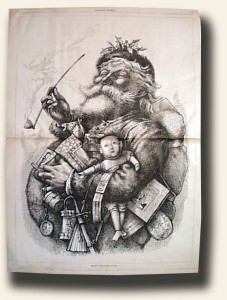 Thomas Nast ranks as one of the most successful, powerful, and prolific artists of the 19th century, and is a name linked closely to one of the most successful, powerful, and prolific newspapers of the 19th century. Through their successes, both Nast and Harper’s Weekly gained sufficient power to influence American politics in the second half of the 19th century and help shape the political climate of America during the industrial revolution.
Thomas Nast was German born, moving to America in 1846. Skilled as an artist, he first went to work for Frank Leslie’s Illustrated Newspaper in 1859, but within 3 years he began working for its competitor, Harper’s Weekly. His work continued to appear in Harper’s thru 1886.
It was a symbiotic relationship for the two. Circulation of Harper’s Weekly grew as Nast drawings were found in more and more of its pages, and Nast‘s notoriety and popularity grew in large part to the increased circulation of Harper’s Weekly. Nast‘s powerful pen in support of the prosecution of the Civil War was honored by President Lincoln when he called Nast “our best recruiting sergeant”.
With original artwork by Thomas Nast commanding prices far beyond the pocketbooks of most collectors, prints found in Harper’s–and only in Harper’s–remain a popular way to assemble a collection of this famed artist’s work at relatively low prices given the current availability of genuine issues.
For today’s collector, interest in Nast falls into three categories:
1) His portrayal of battles & events of the Civil War, which often featured human interest themes & the effect of the war on those back home, remain as some of the best and most heart-felt scenes of the Civil War. Daily newspapers only provided written text; Harper’s Weekly and the prints of Thomas Nast provided a visual representation of the reality of war.
2) Perhaps most noticed as a political cartoonist, his work did much to expose the graft and corruption of William “Boss” Tweed, the powerful Tammany Hall political machine of New York City. In fact it was a Nast cartoon which caused Tweed to be arrested following his escape from jail and flight to Spain. A customs official recognized him from his many appearances in “Harper’s Weekly”. Nast has been credited with doing much to cause elections of all in the hands of those he supported (Grant’s two Presidencies), and cause to fail those he disliked.
 It was Nast who created the caricatures of the Democratic donkey and the Republican elephant to represent those parties, political icons which remain to this day. Desired among collectors are the first donkey to appear in the pages of Harper’s Weekly (January 15, 1870) and the first elephant to appear (November 7, 1874), as well as the first time they appeared together (December 27, 1879). All three command premium prices due to their desirability, but collectors are encouraged by the inexpensive prices for other genuine issues of Harper’s which include Nast illustrations of both.
3) Santa Claus prints. It is Thomas Nast who is credited with creating the modern version of Santa Claus, the jolly, rosy-cheeked, rotund purveyor of gifts in the uniform as we know him today. Nast’s first Santa Claus to appear in Harper’s Weekly was titled “Santa Claus in Camp” from during the Civil War, appearing on the front page of the January 3, 1863 issue. Yet it is the January 1, 1881 issue which has the Santa Claus centerfold which still appears in many Christmas advertisements and is perhaps his most famous rendition. There are many issues of Harper’s Weekly which have Santa Claus prints, all very desired among collectors.
True to any symbiotic relationship, with Nast leaving Harper’s Weekly at the end of 1886, he lost his forum to reach the masses, and in losing Nast, Harper’s Weekly lost its political importance. Nast continued his work in other publications, none being very successful, until his death in 1902 to yellow fever. Harper’s Weekly never regained its success from the Nast years, and it ultimately ceased publication in 1916.
Harper’s Weekly issues with Nast prints are very displayable, particularly those which feature Nast images on the front page, or notable icons such as popular politicians, Santa Claus, Uncle Sam and Abraham Lincoln. A very famous Nast cartoon featuring Lincoln is the “Long Abraham Lincoln A Little Longer” cartoon which is in the November 26, 1864 issue, signifying his successful second Presidential election.
All issues offered by Hughes Rare & Early Newspapers are genuine & complete in 16 pages, save for a few described otherwise. In many cases two or three Nast prints appear in one issue.
Black History Month… looking back…
February 22, 2013 by GuyHeilenman · Leave a Comment
 Slavery. The word itself stirs intense emotions for nearly all who hear it… even for those who have not been directly confronted with the institution. For some it brings feelings of guilt… “How could my forefathers have engaged in such activity?” For others it brings feelings of oppression… anger… and more. While many people groups have been subjected to this burdensome yoke of man through time, for Americans, none is quite as impacting as the enslavement of African Americans. In honor of Black History Month, Timothy Hughes Rare & Early Newspapers has created a Pinterest Board which takes a look back at a time in U.S. history when slavery was alive and (not so) well:
Pinterest… Slave Ads & Related Woodcuts Prints
Additionally, we’ve arranged our available authentic newspapers related to Black Americana in chronological order (recent first) to provide a snapshot into the past for those interest in reviewing how slavery in general, and Black History more specifically, has been depicted in newspapers over the past few centuries. They may be viewed at:
African-American / Black Americana / Slavery…
West Virginia’s first newspapers…
January 28, 2013 by TimHughes · Leave a Comment
 The history of West Virginia newspapers dates some 70 years before West Virginia became a state. Statehood came late to West Virginia, carved from Virginia in the midst of the Civil War, happening officially on June 20, 1863. But its first newspaper began in 1790 when Nathaniel Willis began his “Potowmac Guardian & Berkeley Advertiser” at Shepherd’s-Town, near Harper’s Ferry. Less than two years later Willis moved the newspaper to Martinsburg.
The second newspaper was the “Shepherd’s Town, Charles-Town and County Advertiser” begun by Philip Rootes and Charles Blagrove on June 28, 1797. No copies beyond October 11, 1797 have been located. The third newspaper was the “Berkeley Intelligencer” done at Martinsburg on April 3, 1799 by John Alburtis. Many followed, including what is shown in the image, “The Observer, and Western Advertiser”, Lewisburg, [West] Virgina, 1884.
Wisconsin’s first newspapers…
January 13, 2013 by TimHughes · Leave a Comment
The state of Wisconsin was under several governances before coming onto its own with statehood in 1848. It began as part of the Indiana territory, then part of the Illinois territory, then part of the Michigan territory, then detached as the Wisconsin territory in 1836.
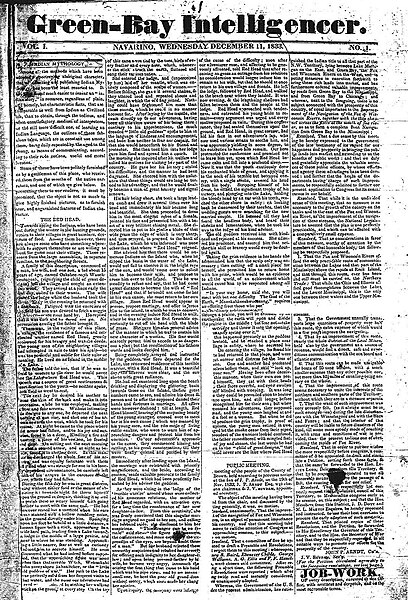 Printing began in the territory in 1827, and it was on December 11, 1833 that Wisconsin had its first newspaper titled the “Green-Bay Intelligencer“, done by Albert Ellis and John Suydam. The city was actually listed as Navarino, which today is a small suburb of Green Bay, population at the 2000 census listed as 442. Ellis was also the very first printer in Wisconsin, printing lottery tickets in 1827 and an almanac in the Chippewa language.
The second newspaper in Wisconsin was actually created as a vehicle to support the candidacy of Morgan Martin for territorial delegate to Congress. He employed William Stevenson and Joseph Dickinson to produced the “Wisconsin Free Press” at Green Bay in August of 1835. But it lasted for less than a year with the printing equipment sold to the “Intelligencer“.
Two more newspapers were created in the 1830’s, they being the “Wisconsin Enquirer” in November of 1838 at Madison, the newly created capital of the territory, and then the “Milwaukee Advertiser” on July 14, 1836. During the 1840’s many newspapers were created as Wisconsin worked towards statehood.
The Traveler… Captain Hull honored…
January 7, 2013 by The Traveler · Leave a Comment
 Today I traveled to Hartford, Connecticut by way of the American Mercury, January 6, 1813. There I found that Isaac Hull, commander of the United States frigate Constitution, was being honored in New York City. He was being presented the freedom of the city “…for his gallantry in capturing the British frigate Guerriere…”. He was presented with a gold box, richly set with emeralds, representing the action between the two frigates, and the arms of the city. Mr. Clinton delivered the speech, Captain Hull replied to the address and “…on descending the steps from the Hall was greeted with three cheers as a brave and faithful public servant whom all ‘the people delight to honor.'”
Also in this issue are several military recruitment advertisements, one which is illustrated for the Dragoons.
~The Traveler
A New Year’s Retrospective thru Historic Newspapers…
December 31, 2012 by GuyHeilenman · Leave a Comment
 A New Year’s-themed Pinterest pin-board has just been created through Timothy Hughes Rare & Early Newspapers… History’s Newsstand which we think you will enjoy. Happy New Year!
Pinterest: A New Year’s Retrospective thru Historic Newspapers…
From a collector of rare newspapers… The Pennsylvania Railroad…
December 7, 2012 by GuyHeilenman · Leave a Comment
From time to time we receive notes from our members which clearly communicate their passion for the collectible. While the issue being discussed did not come from us, we still thought you might enjoy his enthusiasm. We did.
Dear [Timothy Hughes Rare & Early Newspapers],
I received my latest order of folders last Friday…as always, thank you so much. The largest (20×14) folder is for a rather interesting publication – Colliers Weekly – that I thought you’d enjoy seeing…
As with similar magazines, i.e. Harper’s, I never imagined finding a “one-of-a-kind” article on New York’s Pennsylvania Station inside, but – sure enough – I did in this 1903 edition [see below]…
Magazines, such as these, are intriguing…somewhat in a class by themselves. This – and other “competing” titles – bore Saturday cover dates, and were – I imagine – intended to be read on Saturday evenings! I could just “picture” that being some sort of ritual “way back when”. I remember – as a child – seeing my father in our living room on a Saturday evening reading some sort of journal or magazine…he was not a Sunday morning newspaper man!
Hope this note finds you and your staff well. Thanks, again, for your service…
Thanksgiving Proclamations… a survey through American History…
November 21, 2012 by GuyHeilenman · Leave a Comment
 This Thanksgiving, why not take the family on a historically “Pinteresting”walk through a survey of Thanksgiving Proclamations made at key moments in American History?
http://pinterest.com/rarenewspapers/thanksgiving-proclamations/
Happy Thanksgiving!