
Search
The Rare & Early Newspapers Hobby

Receive the Newsletter

Buy Historic Newspapers

The Frederick Douglass’ Paper… Solomon Northup…
February 24, 2014 by GuyHeilenman · Leave a Comment
 I absolutely love this collectible!
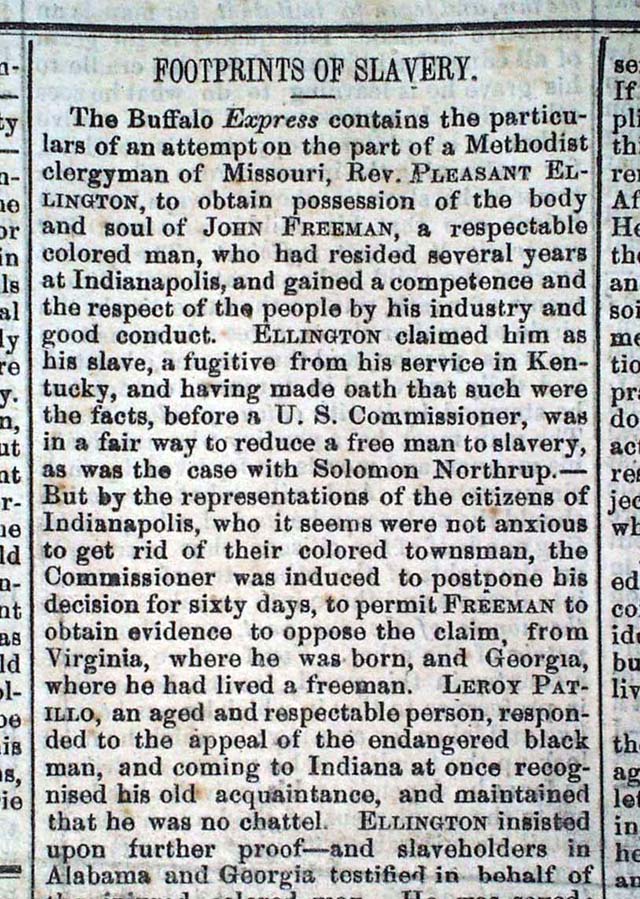
We had in our possession for a number of years an original issue of the Frederick Douglass’ Paper, dated March 17, 1854. It certainly was a grand paper – it being a continuation of Douglass’ North Star. However, while the notoriety of the title was well-established and the angst of slavery oozed throughout, it was a 21st century movie which infused new life into it’s weary 150+ year-old raglinen pages.
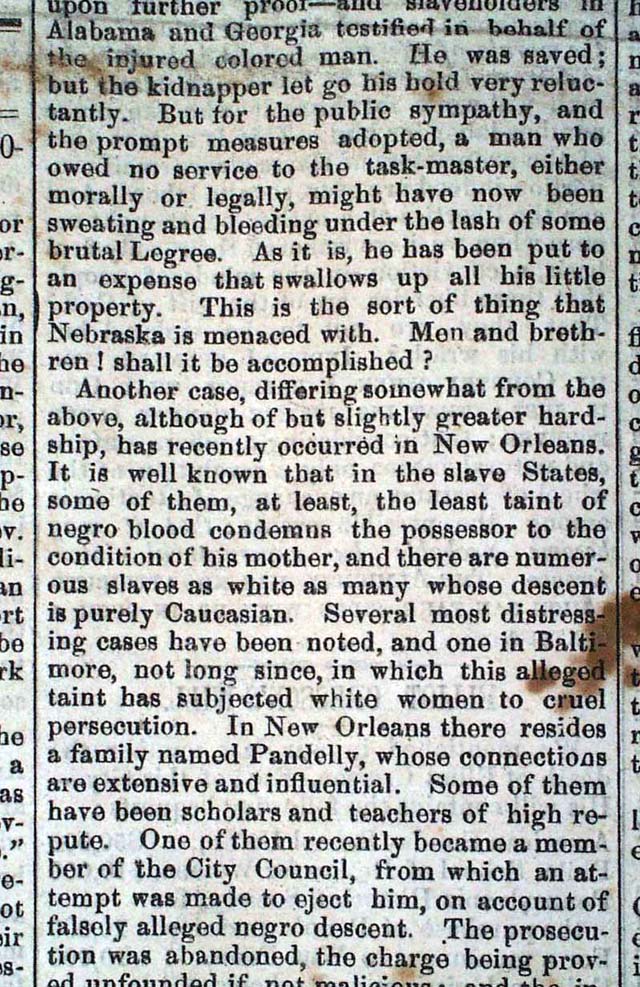
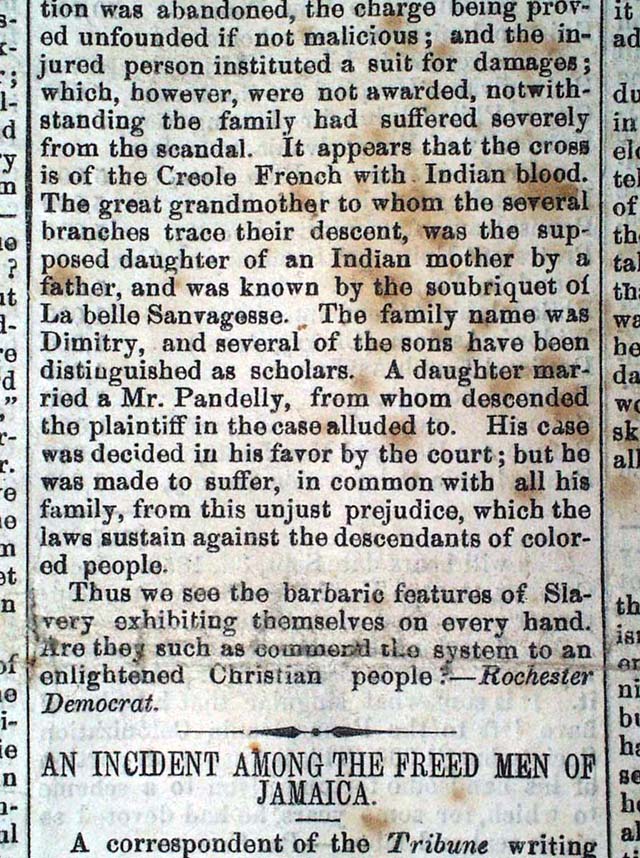
A collector recently went to see the theatrical adaptation of “Twelve Years a Slave – The Memoir of Solomon Northup“, and was moved to visit the Rare & Early Newspapers‘ website to see if we had newspapers with his mention. Searches for his name were unsuccessful – but this collector was not to be deterred. Having previously viewed the Frederick Douglass’ Paper in question, he took the next step and began to go over the corresponding images with a fine-tooth comb. Success. The newspaper was not only noteworthy for its editor and rarity, but it also had an article on the front page with mention of Solomon Northrup (see below). Fantastic.
Like I said, I love this collectible!
Valentine’s Day flowers… chocolates… rare newspapers?
February 13, 2014 by GuyHeilenman · Leave a Comment
 “I love you!” Why is this so hard to say to those whom we love? The old adage goes that when I seasoned relic from the mid-20th century school of cold-knocks was asked why he never tells his wife he loves her, he replied, “I told her I loved her the day we married. If anything changes I’ll let her know.” While a bit humorous, one can’t help but hear the sad sound of little-girl dreams gone unrealized. Valentine’s Day has certainly served its role in helping to remind us to say the things that often go unsaid. Chocolates, flowers, and cards are great tokens of our love, but they pale in comparison to the very words themselves: I love you!
The following historic newspapers, like the February 16, 1861 issue of Harper’s Weekly (shown to the right), provide a chronological look through time at how the holiday has been viewed: Newspapers with Valentine’s Day coverage.
Perhaps a different meaning for “idiot” in 1856…
January 27, 2014 by TimHughes · Leave a Comment
The following appeared in the “New York Clipper” sporting newspaper in its December 6, 1856 issue:
A Three Stooges skit on the House floor…
January 24, 2014 by TimHughes · 1 Comment
“The New York Times” of February 6, 1858 reports a brawl on the floor of the House of Representatives the day before. Although perhaps not as infamous as the Charles Sumner/Preston Brooks attack, this one between Lawrence Keitt and Galusha Grow was more raucous.
The photo below reports some of the exchange of words between the two, but the better report is found in the Wikipedia account of the affair: “A large brawl involving approximately 50 representatives erupted on the House floor, ending only when a missed punch from Rep. Cadwallader Washburn of Wisconsin upended the hairpiece of Rep. William Barksdale of Mississippi. The embarrassed Barksdale accidentally replaced the wig backwards, causing both sides to erupt in spontaneous laughter.” The entire NY Times coverage may be viewed at: “The New York Times” of February 6, 1858
Just for fun… the month of January through time…
January 10, 2014 by GuyHeilenman · Leave a Comment
I thought it might be fun to take a look at historic newspapers from a different perspective – the month of January through time. The issues have been arranged in chronological order, most recent first. It is interesting to see the varied events which have made the news to start the year over the centuries. Please enjoy.
January Newspaper Reporting Through Time
Gentleman’s Magazine: a little gem packed with history…
December 27, 2013 by TimHughes · Leave a Comment

As dealers we have been very true to our focus on rare newspapers, and—for the most part—only newspapers. Yes, we have ventured into the occasional old document, pamphlet, colonial currency and the other items I’ve found intriguing, but otherwise we offer only historic newspapers.
But one big exception has been 18th century magazines. As is likely the case with most collectors of history, the over-riding aim is to find historic news reports dated as early as possible, and the availability of newspapers runs quite thin before 1760 (the London Chronicle dates to 1755 and is the single biggest source of period reports back to this period) if British titles are accepted, and only back to about 1787 if American newspapers are the only option.
It was many years ago that I discovered one of the best titles of the 18th century for period news reporting, and it wasn’t even a newspaper. It is a magazine. More specifically, “The Gentleman’s Magazine” from London. Having begun in 1731, its pages captured news reports concerning America which could never be found in period American newspapers, and rarely found in period British newspapers. From its earliest years “The Gentleman’s Magazine” printed reports on the creation of the colony of Georgia, the founding of the town of Savannah, with many issues mentioning James Olgethorpe. From 1736 are reports of William Penn laying out the city of Philadelphia, and the 1730’s has several reports of pirates operating in the Caribbean and the Atlantic, as well as famous highwayman Dick Turpin. Slave revolts in Jamaica, “Customs of the Jews” and other smaller reports from the American colonies round on the 1730’s.
The 1740’s have several items on the slavery issue which would be a topic of discussion on both sides of the Atlantic well into the 19th century. And relating to slavery are several issues of the 1770’s on famous slave/poet Phillis Wheatley.
There are early reports on the sport of cricket, and much on the Jacobite Rebellion including mention of “Bonnie Prince Charlie”. Other curious reports from the 1740’s include text on Handel and his “Messiah”, Ben Franklin mention with various electricity experiments, the death of astronomer Edmund Halley, the origin of the game of chess, and a curious item on a northwest passage to China through Canada. Military events in periodicals are never-ending, and this decade prints the text of the Treaty of Aix la Chapelle, among many other military events.
The 1750’s are highlighted by much reporting on the French & Indian War between the French & the British, with mention of Quebec, Crown Point, Fort DuQuesne and all the other major battle sites. Keep in mind that the American colonies were British possessions at the time so there was much interest in
“The Gentleman’s Magazine” has nice reporting on Ben Franklin’s lightening rod experiments, and there is also a terrific—although inconspicuous—mention of what would become known to all Americans as the Liberty Bell. Under the heading: “America” and with a “Philadelphia, May 10” dateline from 1753 is a report reading:

“Last week was raised and fixed, in the State-House Steeple, the great bell, weighing 2080 lb. cast here, with this inscription,
‘Proclaim liberty throughout all the land, to the inhabitants thereof.” This is how they reported the installation of what would become known as the Liberty Bell.England in reporting events relative to the colonies. A special feature of Gentleman’s was their very early mention of George Washington, a Major in the Virginia military in 1754 and 1755 when he lead others into battle in Pennsylvania. Such mention of Washington in an American newspaper would result in a price well beyond the budget of most collectors.
The 1760’s in “The Gentleman’s Magazine” are highlighted by the growing tensions between the colonies and England. The full text of the hated Stamp Act is found within its pages, and just a year later is found the formal repeal of the Stamp Act by the British King. Other Acts of Parliament harmful to colonial relations are reported as well.
News from the 1770’s begin with the Boston Massacre (and the trial details of those involved), reported in Gentleman’s in nice detail. All the events of the Revolutionary War received excellent coverage, from the Boston Tea Party to Lexington & Concord, the Battle of Bunker Hill, Saratoga, White Plains, Ticonderoga, Cowpens, Guilford Court House and the other military initiatives of the war with considerable mention of George Washington, Gage, Gates, Burgoyne, Ethan Allen, Howe, Greene, Cornwallis, John Paul Jones, and others. There is even much detail on the infamous Benedict Arnold/Major Andre treason.
Historic documents are found within the pages of “Gentleman’s Magazine” as well, including the Articles of Confederation, the “Causes & Necessity for Taking Up Arms”, the Constitution of the United States (in 1787), and the most desired document of all, the Declaration of Independence. At a time when a period printing of the Declaration in an American newspaper will sell for over a quarter of a million dollars, to be able to purchase a 1776 magazine with a timely printing of the Declaration of Independence for under $4000 is a rare opportunity for any collector.
The 1780’s begin with the closing events of the Revolutionary War, including the surrender of Cornwallis to Washington at Yorktown, Virginia, and shortly thereafter the formal text of the Treaty which ended the Revolutionary War. There are reports on Captain James Cook’s famous voyages of exploration, the obituary of Benjamin Franklin, and with attention focusing more on European reports later in the decade are reports of the fall of the Bastille and the French Revolution, and into the 1790’s with the mutiny on the Bounty, the guillotine execution of Louis XVI and Marie Antoinette, then into the early 19th century with the Battles of Trafalgar and Waterloo. Gentleman’s also printed the text of Washington’s final state-of-the-union address, and then just a few years later, his death.
A very nice bonus found in many of the pages of Gentleman’s is maps & plates. They cannot be found in newspapers of the day. Printed separately from the regular pages of the issue and tipped within, most of the maps fold out to be double the size of the issue, and they includes some of the more desired maps one would want of the 18th century, including Philadelphia, the colonies (from 1755), Pennsylvania, Connecticut, Rhode Island, the Caribbean, St. Augustine, the entire western hemisphere and so much more. Many collectors choose to frame the maps separate from the issue as they are very decorative and are typically dated in an upper corner.
Plates include the Philadelphia State House, later to be known as Independence Hall; St. Philip’s Church in Charleston, the fort at Bunker’s Hill, Ben Franklin’s ‘Square of Squares’, the guillotine which beheaded Louis XVI and his wife, a slavery medal, and even a plate of the Garden of Eden. Plus there is so much more.

The “Gentleman’s Magazine” is a little gem packed with all the history one would want to find from the 18th century. Measuring about 5 by 8 inches and typically having about 40 pages they take up very little room in a collection. But best of all it is an accessible title, and at prices far below what would be found in comparable American & British newspapers of the same period.
There can be little excuse for holding back on buying the best events in American history if one is willing to add this famous & successful title to their collection. And there certainly will be a time when even this title will become very scarce as others discovery it as the little gem just begging to be collected.
Note: Rather than include an endless number of (annoying) links above, if you have interest in any of the topics discussed, simply go to the following link and enter the topic into the search field: www.RareNewspapers.com
Long live the dead… a zombie love affair?
October 31, 2013 by GuyHeilenman · Leave a Comment
The New-York Observer (August 14, 1856) has a report which seems right out of a Hollywood Halloween-Thriller script (or crypt?). Was this a bogus story? Perhaps the blockbuster “Ghost” (1990) wasn’t fiction after all. I’ll save the “being married to a dead-beat” jokes for another post.
The first newspapers in Vermont…
October 4, 2013 by TimHughes · Leave a Comment
Vermont was the first state to join the union outside of the original thirteen colonies, although in a sense they were always a part of the federal union. The territory of present-day Vermont was previously divided among the states of Massachusetts, New Hampshire, and New York.
 The first newspaper in Vermont was the “Vermont Gazette, and Green Mountain Post-Boy” done in Westminster, first published on February 12, 1781. Only one of this issue exists and is in the Vermont Historical Society. Its first newspaper began later than all of the other first newspapers of the original 13 states. The weekly newspaper only lasted until 1783, published by Judah Spooner and Timothy Green, the latter of the famous family of printers from New England.
It is notable that Vermont’s first newspaper was printed on the famous “Daye Press”, brought from England by Stephen Daye in 1638 and set up in Cambridge, Massachusetts. The press came into the possession of Harvard College in 1656, and in 1714 it became the property of Timothy Greene, who took it to New London, Conn., later set up in Norwich, Conn. by Alden Spooner, and in 1781 it was moved to Westminster, Vermont.
The second newspaper in Vermont was founded on August 7, 1783 titled the “Vermont Journal & the Universal Advertiser” printed in Windsor by the partnership of Alden Spooner and George Hough. The newspaper continued publishing into the 20th century.
Other 18th century Vermont titles included “Herald of Vermont“, Rutland, 1792; “Rutland Herald“, 1794; “Fair Haven Gazette“, 1795; “Farmer’s Library“, Fair Haven, 1795; “Burlington Mercury“, 1796; and “Federal Galaxy“, Brattleboro, 1797.
A video look at Rare & Early Newspapers – revisted…
September 23, 2013 by GuyHeilenman · Leave a Comment
 Over the past 10 years we (RareNewspapers.com) have put together a series of videos designed to help educate novices about the hobby of collecting historic newspapers. While some may be a smidge old (compared to today’s high-tech standards), the information within is still pertinent. Pick a topic of interest, turn up the volume, and enjoy our perspective on the collectible.
Collecting 20th Century Authentic Newspapers
Enhance Your Sports Collectible with Historic Ne…
Collecting Scientific American Issues w/ Historic Content
Collecting 19th Century Authentic Newspapers
Original Wild West Era Newspapers – Rare Newspapers
Meet the Staff of Timothy Hughes Rare & Early Newspapers
Harper’s Weekly & The Civil War – Illustrated Collectibles!
The History of Rare & Historic Newspapers & The Hobby!
Collecting 18th Century (and earlier) Authentic Newspapers
The Rare Newspapers’ Private Collection – Collecting Ideas
Rare Newspapers as an Educational Tool
Documenting an early reprint of the Ulster County Gazette…
July 22, 2013 by TimHughes · 3 Comments
If the “infamous” “New York Herald” issue of April 15, 1865 is the most common reprint edition about which we receive phone calls and messages, then the “Ulster County Gazette” of January 4, 1800 has to be next in line.
The front page of a curious little periodical titled “Type of the Times” from Cincinnati, March 15, 1858, provides solid evidence of just how early the “Ulster County Gazette” was reprinted. I had known there were many editions as I’ve seen a multitude of variant issues on different qualities of newsprint–some on rag paper–but this is the first hard evidence of just how early at least one of the reprints was created: