

Search
The Rare & Early Newspapers Hobby

Receive the Newsletter

Buy Historic Newspapers

Announcing: Catalog 365 – Released (early) for April, 2026 – Rare & Early Newspapers…
March 27, 2026 by Phineas Q. Wryte · Leave a Comment
|
|
Announcing: Catalog 364 – Released for March, 2026 – Rare & Early Newspapers…
February 27, 2026 by GuyHeilenman · Leave a Comment
Catalog 364 (for March): This latest offering of authentic newspapers is comprised of over 300 new items, a selection which includes the following noteworthy issues: an issue re: the Olive Branch Petition, Hawaii’s first English language newspaper, “The Crisis” essay #9 by Thomas Paine, a first report of Lincoln’s assassination, a Civil War prison camp newspaper, an early newsbook from 1643, the historic “Funding Act”, and more.
The following links are designed to help you explore all available items from this latest edition of our catalog:
Abridged Catalog (EXCLUDES wholesale lots & titles sold only by year (not by a specific date)
A PDF Version of the Catalog (printable)
Entire Catalog grouped by Era:
1500-1799 (full view OR quick-scan/compact view)
1800-1899 (full view OR quick-scan/compact” view)
1900-Present (full view OR quick-scan/compact” view)
The following links focus on both this month’s and last months catalogs:
- Combined Catalogs (entirety of both)
Become a Premium Member to receive hard copy versions of our catalogs (U.S. residents only).
Announcing: Catalog 363 – Released for February, 2026 – Rare & Early Newspapers…
January 30, 2026 by GuyHeilenman · Leave a Comment
Catalog 363 (for February): This latest offering of authentic newspapers is comprised of over 300 new items, a selection which includes the following noteworthy issues: a Massachusetts Spy with the desired “Join or Die” snake engraving, a Pennsylvania Ledger with the Olive Branch Petition, one of the rarest of early American magazines, The Jew Bill: striving for equal rights for Jews, a handsome colonial New York newspaper from 1745, a fine report on the death of George Washington, and more.
The following links are designed to help you explore all available items from this latest edition of our catalog:
- Abridged Catalog (EXCLUDES wholesale lots & titles sold only by year (not by a specific date)
- A PDF Version of the Catalog (printable)
- Entire Catalog grouped by Era:
1500-1799 (full view OR quick-scan/compact view)
1800-1899 (full view OR quick-scan/compact” view)
1900-Present (full view OR quick-scan/compact” view)
The following links focus on both this month’s and last months catalogs:
- Combined Catalogs (entirety of both)
Become a Premium Member to receive hard copy versions of our catalogs (U.S. residents only).
Two Discoveries, One Powerful Reminder – It Started with the Pony Express…
January 26, 2026 by GuyHeilenman · Leave a Comment
From the very beginning, a recurring theme on the History’s Newsstand blog has been the joy of finding hidden gems—those golden nuggets tucked within historic newspapers. Collectors of rare and early papers know this thrill well: you acquire an issue for one reason, only to uncover something unexpected that proves equally—if not more—captivating.
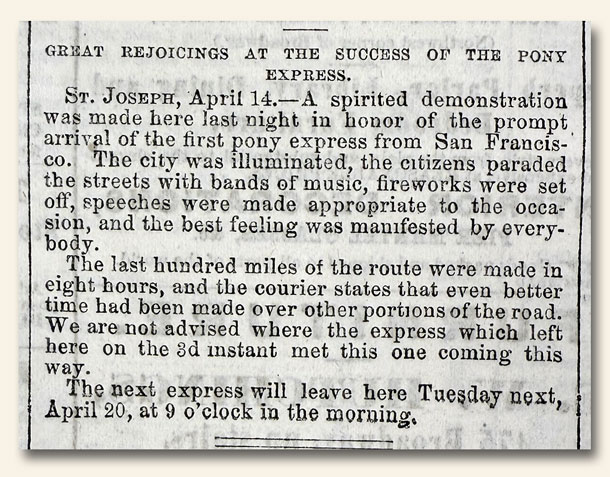
That’s exactly what happened to me recently while examining the April 16, 1860 issue of The Evening Post (New York). My original goal was to locate coverage of the completion of the first run of the Pony Express, and to my delight, I found not one but two front-page reports. Front-page coverage of such events is rare enough—but two related pieces? A true collector’s treat.
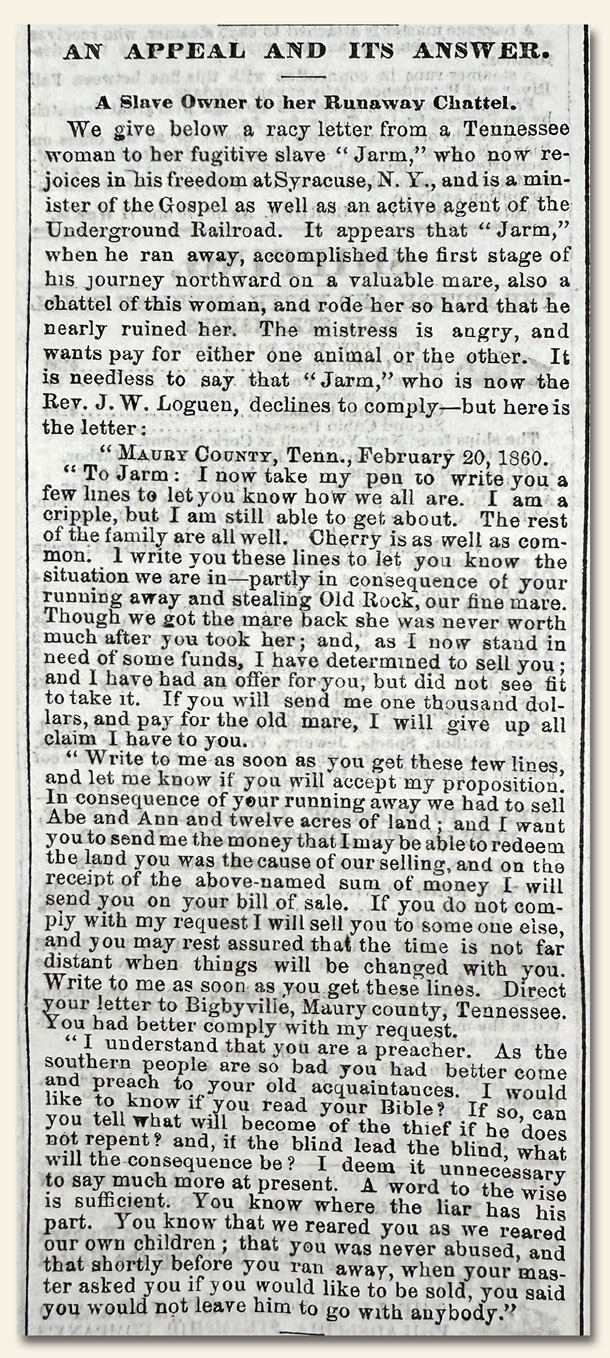
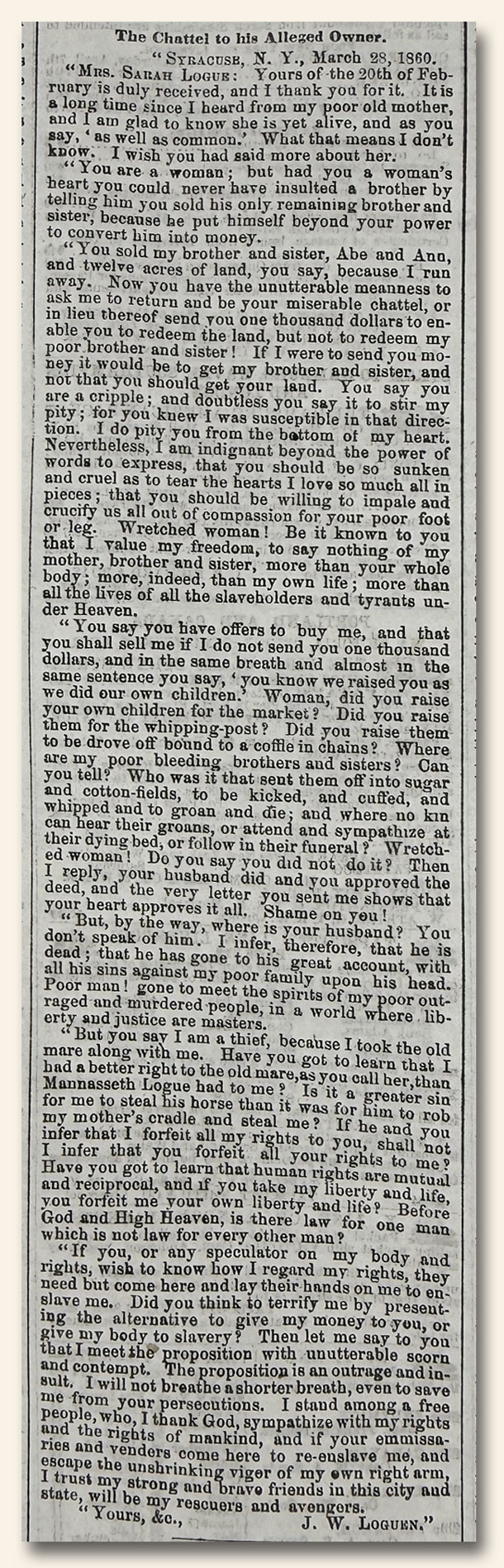
As I continued browsing for additional Pony Express material within the issue, I stumbled upon one of those unforgettable “hidden gems”: a printed exchange between a runaway slave and his former master. While not an account of a major historical event, few subjects evoke as much emotion as slavery, and reading such raw, personal correspondence in a period newspaper was deeply moving.
While the issue’s collectible value is likely anchored by its Pony Express reports, it’s this second discovery that continues to resonate with me. It serves as a poignant reminder—to me, my family, and my friends—of the immeasurable worth of every human being. Each of us, created in God’s image, carries equal and sacred value. Red and yellow, black and white—we are all precious in His sight.
All right, I’ll step down from my soapbox now. The photos below provide context for the discoveries mentioned above. Thanks for reading—and for sharing in the joy of finding history’s hidden treasures.
One of the Two Reports regarding the Pony Express
Correspondence Between the Runaway Slave and his former “Master”
A rare, colonial “2nd forgery” with an intriguing backstory… Cape Fear (part II)…
December 29, 2025 by TimHughes · Leave a Comment
A few weeks ago we featured a post regarding this same issue: “Snapshot 1775 – North Carolina Declares itself Independent!”
Tim Hughes penned the following related post which provides the backstory:
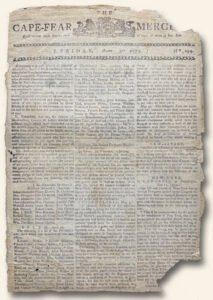
The Cape Fear Mercury, from Wilmington, North Carolina, has a “purported” issue dated June 3, 1775. As the following story informs, this would have to be one of the more interesting colonial newspapers we’ve offered, primarily for being a forgery.
This newspaper began publishing on Oct. 13, 1769, and was suspended for about five months from the fall of 1774 to the spring of 1775. It ceased publication in September, 1775.
As for the intrigue–and this is just a brief explanation–a 1905 article in Collier’s magazine focuses on the existence of a June 3, 1775 issue of the Cape-Fear Mercury which contains on the front page the Mecklensburg Resolves, or a “declaration of independence” from North Carolina some 13 months before what was declared in Independence Hall. This was a hoax, believed to have been perpetrated by surviving document signers many years after the event, in an effort to show North Carolina was first in declaring independence from England. See much more online.
 The following is taken from the well-respected “History & Bibliography of American Newspapers, 1690-1820” by Clarence Brigham. We’ve not seen such text devoted to an avowed forgery as this one in his two-volume reference set, which only speaks to its significance:
“…What purported to be an issue of this paper of June 3, 1775 was exploited in Collier’s of July 1, 1905 by S. Millington Miller, who claimed that he owned the original. The reproduction printed in Collier’s shows only the heading and part of the first and second columns…The paper was immediately believed to be fraudulent & in the ‘American Historical Review’…A. S. Salley and Worthington C. Ford showed the paper to be a forgery with the heading based upon an original issue of Nov. 24, 1769 owned by the American Antiquarian Society. The same defects in type, and even fly-specks in the 1769 issue appear in the spurious 1775 heading.
Miller made up his issue by setting up three columns of new matter, which included the Mecklenburg Resolves…But in giving his issue the date of Friday, June 3, 1775, no. 294, he erred in not knowing that Friday fell on June 2, and that because of a hiatus in publishing, the number of such a paper would be no. 258; also that by June, 1775, the heading [masthead] had been altered and the cut of the royal arms omitted. Later Miller manufactured a better forgery than the one furnished to Collier’s and differing in set-up–for example, the top line of the second column in the first forgery read “ford.—Messirs. Abednego Ramsdell, Dan-“, and in the second forgery: “of Charlestown.—Isaac Gardner, Esq. of.”.
At least 3 copies of this second forgery are now located–in the American Antiquarian Society, the Clements Library at the University of of Michigan, and in the possession of Oliver R. Barreett of Chicago…All of the forgeries were printed on one side of the leaf only, differing from the usual method of printing regular issues of 18th century newspapers.”
This issue we offer is seemingly just the fourth “second forgery” known to exist, unless it is one of the three cited above. The backstory is interesting and attests to what extent some might go to insist upon the greater prominence of North Carolina in early American affairs than what is currently found in history books.
Thomas Jefferson helps to codify George Washington’s footsteps…
December 12, 2025 by GuyHeilenman · Leave a Comment
When it comes to collecting rare and early newspapers, those containing the text of presidential annual messages are quite desirable. While a handful are well known (Lincoln’s 2nd annual address, Washington’s 1st, Kennedy’s 1st, etc.), others fly well under the radar. A recently discovered broadsheet (Republican Argus, Extra, Oct. 16, 1808), containing Thomas Jefferson’s final address in 1808 brought this latter group to mind, yet, upon analysis in light of current events, seems to hold its own historically. The summary below, modified from multiple AI sources, is provided so you can draw your own conclusion. Enjoy.
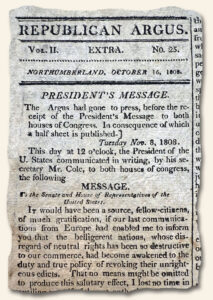
Thomas Jefferson’s Eighth Annual Message to Congress, delivered on November 8, 1808, came at the close of his presidency during a time of international conflict and domestic unrest. He used the address to defend the Embargo Act of 1807, which aimed to protect U.S. neutrality and avoid war with Britain and France by halting foreign trade. Despite its economic toll on American farmers and merchants, Jefferson maintained that economic pressure was preferable to military conflict. The speech also reflected ongoing foreign policy tensions, particularly regarding maritime rights, and the young republic’s efforts to uphold sovereignty amid European aggression.
Jefferson’s speech highlighted the challenges of maintaining neutrality, the importance of strengthening U.S. military defenses, and his vision for internal development, including peace through trade with Native American tribes. It also revealed the political friction of the time, with Jefferson facing criticism from both Federalists and members of his own party over the embargo and proposed federal infrastructure projects. This period of political division underscored deeper questions about the role and limits of federal power in a republic still defining itself.
Most significantly, Jefferson’s 1808 address signaled the end of his presidency and affirmed his decision not to seek a third term. Although he had announced this publicly in 1807, his final annual message served as a symbolic and practical demonstration of his commitment to republican principles. By following George Washington’s example, Jefferson helped establish the precedent that presidents should serve no more than two terms. This voluntary transfer of power reinforced the principle that no individual should hold executive power indefinitely, a safeguard essential to American democracy.
Jefferson’s choice not to pursue a third term, especially during a time of national strain, cemented a critical political norm that influenced every president until Franklin D. Roosevelt. The importance of this precedent lies in its protection against the concentration of power and its promotion of leadership rotation—core values in a constitutional republic. Jefferson’s 1808 address, then, is not just a reflection on policy but a foundational moment in American political tradition, ultimately leading to the formalization of the two-term limit through the 22nd Amendment.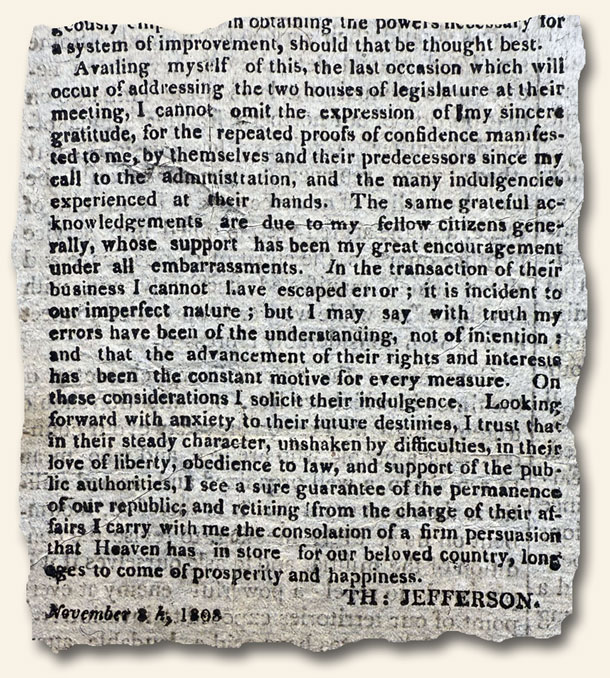
Announcing: Catalog #361 for December, 2025 – Rare & Early Newspapers…
December 1, 2025 by GuyHeilenman · Leave a Comment
|
|
Announcing: Catalog #360 for November, 2025 – Rare & Early Newspapers…
October 31, 2025 by GuyHeilenman · Leave a Comment
|
 Catalog #360 (for November)
|
Who’s Who in Newspapers? Citizen Genêt edition…
October 10, 2025 by GuyHeilenman · 1 Comment
The 10th installment of Who’s Who in Newspapers
Citizen who? While exploring newspapers from the 18th and early 19th centuries over the past few decades, I noticed the name “Citizen Genet” appearing more than once—always tied to some sort of “affair.” As a novice historian at the time (my academic background is actually in mathematics and engineering), and given my aversion to sensationalized “yellow journalism,” I let it pass. With tens of thousands of fascinating topics to explore through our beloved collectible, I never stopped to uncover who he really was or what his “affair” involved.
 Recently, however, I embraced the old adage that “it’s never too late to learn” and finally took the plunge. What I found was a story worth the effort, one that offered both historical insight and a better appreciation for the newspapers that recorded it. A summary of my discovery is as follows:
Edmond-Charles “Citizen” Genet was a French diplomat sent to the United States in 1793 to gain American support for France’s wars with Britain and other European powers. Instead of observing diplomatic protocol, he jumped right into recruiting privateers to attack British ships and encouraging Americans to take up arms against Spain. These moves directly violated President George Washington’s Neutrality Proclamation of 1793. To make matters worse, Genet bypassed Washington altogether and appealed directly to the American public, an act that came across as both disrespectful and threatening to U.S. sovereignty.
The uproar that followed—known as the “Citizen Genet Affair”—quickly became a defining moment in America’s early history. Washington demanded Genet’s recall, reinforcing both the president’s authority in foreign affairs and the new nation’s commitment to neutrality. At home, the controversy deepened political divisions: Federalists supported Washington’s cautious stance, while Democratic-Republicans sympathized with revolutionary France. In the end, Genet was granted asylum in the United States and lived out his life in New York, but his story left behind a lasting lesson in diplomacy and America’s determination to remain independent from foreign influence.
So much for jumping to conclusions regarding his “affair”. I should have known better.
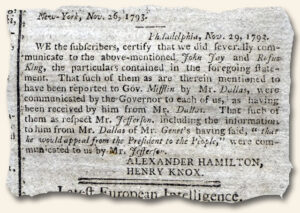
The photos shown are from two articles within the Columbian Centinel, Dec. 11, 1793. – the above in full, and the below of only an excerpt due to the length of the article. If original newspapers on this topic remain available, they would be found at: CITIZEN GENET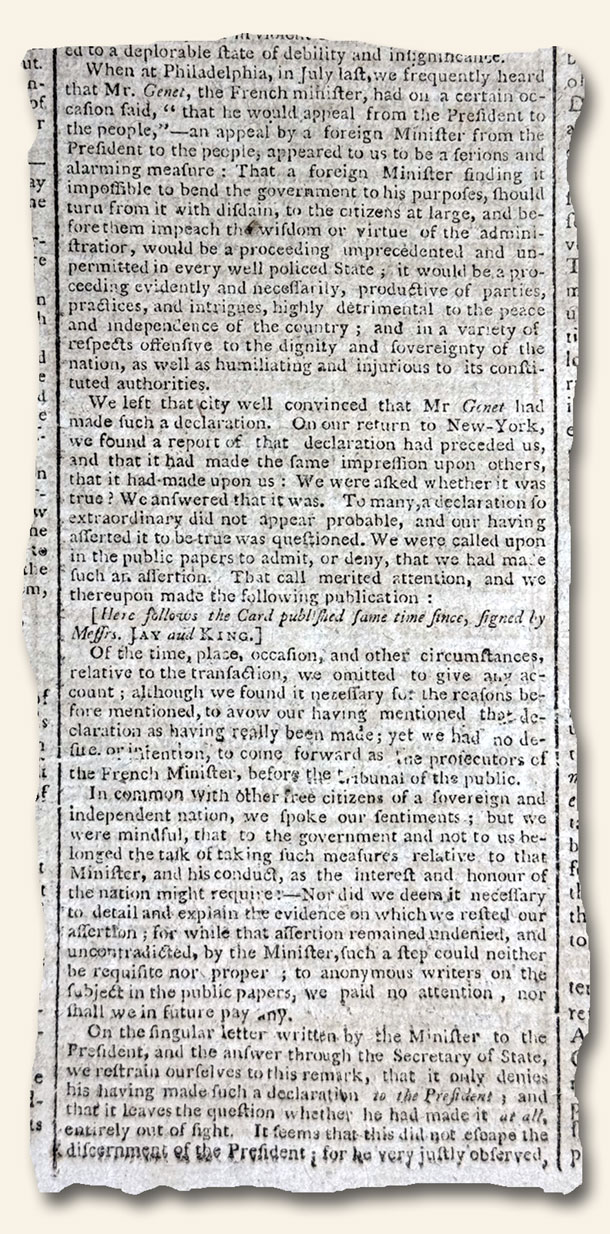
Announcing: Catalog #359 for October, 2025 – Rare & Early Newspapers…
September 30, 2025 by GuyHeilenman · Leave a Comment
|
 October’s catalog (#359)
|