
Search
The Rare & Early Newspapers Hobby

Receive the Newsletter

Buy Historic Newspapers

Announcing: Catalog #301 (for December, 2020) is now available…
November 30, 2020 by GuyHeilenman · Leave a Comment
- Catalog 301 (in its entirety)
- Noteworthy Catalog 301 ($250+)
- Combined Catalogs (current, w/ remnants of previous)
Don’t forget about this month’s DISCOUNTED ISSUES.
The links above will redirect to the latest catalog in approx. 30 days,
upon which time it will update to the most recent catalog.
You know of Molly Pitcher. Do you know of Betsy Doyle?
November 5, 2020 by TimHughes · Leave a Comment
On November 22, 1812 the British, at Fort George, were cannonading the Americans at Fort Niagara. George McFeeley was the American commander and several days later made his official report to Brigadier General Smyth.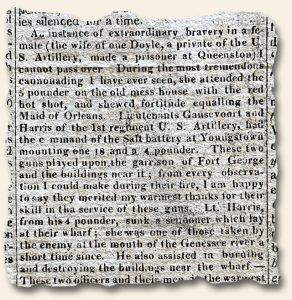 Within the report McFeeley noted: “…An instance of extraordinary bravery in a female (the wife of one Doyle, a private in the United States Artillery, made a prisoner at Queenston,) I cannot pass over. During the most tremendous cannonading I have ever seen, she attended the six-pounder on the mess-house with red hot shot, and showed fortitude equal to the Maid of Orleans…”.
In an act of female heroism during combat, much like the work of Molly Pitcher (although considered folklore by many historians), Betsy Doyle played a notable role. A mother of four whose husband was captured at the Battle of Queenston & held as a prisoner by the British, after some gunners were wounded Betsy stepped in to help. The Americans were loading “red hot shot” into their guns to fire at Fort George. Betsy helped bring the shot from the fireplaces downstairs to the guns.
The December 16, 1812 issue of the “Boston Patriot” is one of few newspapers which reported this event.
Acts of female involvement in combat are rarely reported. Here is a nice one.
Announcing: Catalog #300 (for November, 2020) is now available…
October 30, 2020 by GuyHeilenman · Leave a Comment
- Catalog 300 (in its entirety)
- Noteworthy Catalog 300 ($250+)
- Combined Catalogs (current, w/ remnants of previous)
Don’t forget about this month’s DISCOUNTED ISSUES.
The links above will redirect to the latest catalog in approx. 30 days,
upon which time it will update to the most recent catalog.
They Put It In Print (1918)… “The 19th Amendment fails by 1 vote…”
October 26, 2020 by GuyHeilenman · Leave a Comment
Does one vote matter? Does every vote count?
Since the passage of the 19th Amendment, the impact of women on the political climate, and therefore, on both the course and civil fabric of the United States cannot be understated. Since 1964, more women have voted in presidential elections than men – as measured by both actual quantity and as a percentage of their respective genders. While this “right” was not realized until 1920, few know that the (women’s suffrage) Amendment nearly passed two years earlier, but came up short by a single vote. Sadly, not all Senators were present to vote. How do we know? They put it in print in The Christian Science Monitor (Boston) dated October 2, 1918. 
Snapshot 1807… William Cowper and the Slave Trade…
October 22, 2020 by GuyHeilenman · Leave a Comment
We recently discovered a Gazette Of The United States, For The Country (Philadelphia), dated May 25, 1807 which had a timely reprinting of William Cowper’s poem regarding the abolition of the Slave Trade – just a few weeks after the enactment of the Slave Trade Act of 1807 (United Kingdom). It would still be another quarter-century before slavery within the Britain Empire would be abolished. 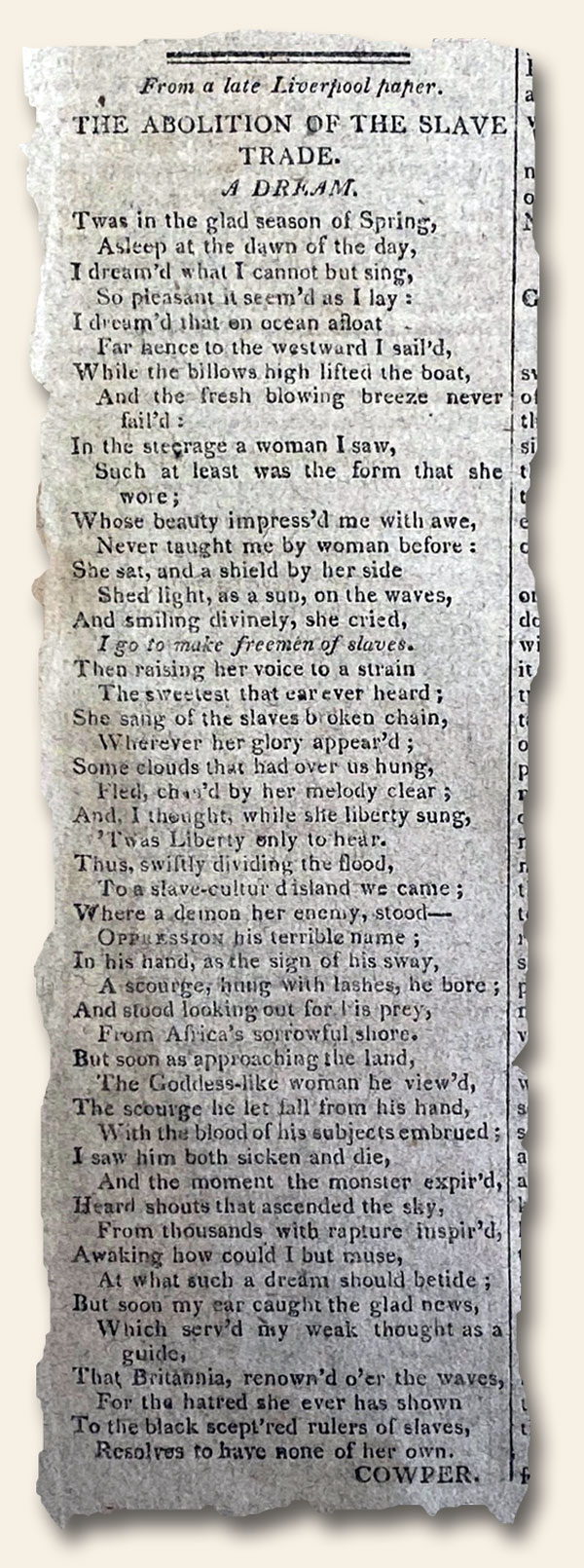
Hidden gems within Niles’ Weekly Registers…
October 16, 2020 by GuyHeilenman · 4 Comments
 Approximately a dozen years ago, shortly after the History’s Newsstand Blog was birthed, we ran a series of posts which focused on the joy of finding hidden gems within Rare & Early Newspapers. The introduction to this series, in part, stated:
“What do gold prospectors, pirates, treasure hunters, archeologists, and rare newspaper collectors have in common? They all share the thrill of the hunt and the reward of discovery. When it comes to rare newspapers, finding the unexpected, in contrast to other collectibles, is often a good thing – and at times can even be quite valuable. Since the inception of the History’s Newsstand Blog, a number of posts have focused on this intrinsic pleasure of the hobby, and several readers have responded with ‘discoveries’ of their own.”
Twelve years later we are revisiting this theme once again – but with a specific focus on one title: The Niles’ Register. If you have ever obtained a Niles’ Register (Weekly Register) and discovered within its pages content which was undisclosed – i.e., a “hidden gem”, you are invited to respond to this post with a comment describing your “find”. Please include the exact date of the issue and the page number(s) were the content is located. Feel free to include additional information either about the content itself, or why you found it compelling. Every now and then we will pull a few responses and post them for others to see.
If you would like to learn more about Niles’ Registers, you can read additional posts about this intriguing title HERE.
Harper’s Monthly & The Self-Made Man – Still Learning…
October 12, 2020 by Stephanie Williams · Leave a Comment
By natural inclination, I spend a fair amount of my spare time delving into the “women’s publications” within the Rare & Early Newspapers collection. Consequently, the title of the Editor’s Table of an 19th century issue of Harper’s New Monthly dragged me in, and in the spirit of fair play I decided to dissect and disseminate the contents, using the writer’s three questions.
Who is the Self-Made Man? In the author’s view, this is not the man who achieved much because of education, as education is an outside influence that detracts credit from the man. However, a self-made man can be educated. The one who is not educated, but rises to success in spite of the lack, is not necessarily self-made, as success does not equal the morality required in a self-made man.
What is the Self-Made Man? Again, this is not the one who commits good deeds, although a self-made man will be characterized by them. “The difference between the two characters is a moral one. It springs from the presence or absence of the humanitarian spirit. It is all the difference between the pure love of truth and the love of opinion.”
What is his true position for good or for evil among the powers of the age? Finally, all the negatives are set aside and the author clearly promotes a man who is driven to find truth — not in new discoveries or insights, but in the wisdom of the ages that has been tested by time, and continues to be trustworthy. Ultimately, the author highly esteems the members of the Protestant Reformation, and the things they accomplished. “It was an age where old truths were brought to light and re-established as old truths. It was a most serious age; it was a modest age; and in all these respects, especially in the latter, it differed widely from our own.”
The final condemnation of the modern era, male and female, is contained in the author’s closing remarks:
All the writings of every kind during that remarkable period, and, we may even say, the century that followed it, would not present so much of this frothy self-laudation, as may be heard in one Hope Chapel meeting of ‘strong-minded women’ and ‘self made’ men.
Announcing: Catalog #299 (for October, 2020) is now available…
October 2, 2020 by GuyHeilenman · Leave a Comment
- Catalog 299 (in its entirety)
- Noteworthy Catalog 299 ($250+)
- Combined Catalogs (current, w/ remnants of previous)
Don’t forget about this month’s DISCOUNTED ISSUES.
The links above will redirect to the latest catalog in approx. 30 days,
upon which time it will update to the most recent catalog.
The Gentleman’s Magazine & Poetry… Still learning…
September 28, 2020 by Stephanie Williams · Leave a Comment
Nestled among the prosaic commodity prices, legal decisions, and historical chronicles that regularly appear in an issue of Gentleman’s Magazine is a section that seems surprising to me — “Select Poetry, ancient and modern.” In some ways, this is a reminder that times certainly have changed, and things are not as they always were. A current publication for the leaders of our era, such as Forbes or Bloomberg or The Wall Street Journal would not contain poetry, unless a noteworthy personage deviated from business acquisition long enough to write, or possibly promote a struggling artist in the name of philanthropy, etc.
But, once upon a time, the well-educated person was learned in literary as well as economic matters. As the  column title hints, the classical emphasis on education set a background that persisted into all arenas of life. With this in mind, I delved into the section and became even further struck by the subject matter of my sampling in meter and rhyme. The closing refrain to each stanza concludes that nothing in life matters without….love.
But weak is our vaunt
While something we want,
More sweet than the pleasure that Prospects can give.
Come, smile, damsels of Cardigan,
Love can alone make it blissful to live.
The author of this particular poem only provided his (presumably) initials to this listing of Prospects, Nectar, Odours, Music, Friendship, Learning, Riches and Honour. All, the poet asserts, are not sufficient to bring bliss to life — only love can do that. The musings that follow include “Ode to a Goldfinch”, “An Astronomical Thought” and “A Translation of the Epitaph”. Put together, they summarize the principle concerns of the time period — the natural and known world, the world yet to be discovered, happiness within all experiences, and the context provided by knowledge of eventual death.
That is, indeed, a selection of ancient and modern — even the modern of today.
They Put It In Print (1848)… “Lincoln that is, political gold, Illinois tea…”
September 25, 2020 by GuyHeilenman · Leave a Comment
A tremendous wag, hilarious, upright, a real gem… We recently uncovered the earliest “feature” article we’ve ever found regarding Abraham Lincoln – buried on the back page of the The Greensborough Patriot (NC) dated September 16, 1848. On the heels of gold having just been discovered in California, another golden-nugget was slowly becoming unearthed on the opposite side of the country – before the very eyes (and ears) of the nation. Although Lincoln was a relatively unknown senator from Illinois, a reporter heard him speak before The House and was impressed enough to take the time to record his observations. It appears this reporter, along with a host of others, would be drawn to the qualities which would set him apart from the pack, and would eventually propel him into the history books. How do we know? Back in 1848, they put it in print:
I can imagine, as articles such as this began to circulate, that the folks back in home in Illinois began to talk in Lincoln’s ear, and…
The first thing you know ol Abe’s politically extraordinaire,
Kinfolk said “Abe move away from there”.
Said “The Capitol” is the place you ought to be”
So they loaded him on a train and he moved to D.C.
The UNITED States would never be the same.