
Search
The Rare & Early Newspapers Hobby

Receive the Newsletter

Buy Historic Newspapers

The Fight Against Slavery… 1822…
June 13, 2022 by GuyHeilenman · Leave a Comment
 If asked to name famous men and women who fought to free slaves and/or to bring an end to this horrible era in American history, most short-lists would likely include Frederick Douglass, Harriet Beecher Stowe, Sojourner Truth, Harriet Tubman, and John Brown, but many others were also sacrificially and emphatically committed to the cause who are relatively (if not completely) unknown. Such is the case of Telemaque, a free former slave who was executed for conspiracy. If you are from Charleston, SC, you likely know his name long with a handful of his accomplishments; however, the remainder of us would do well to learn more about him: Telemaque (Denmark Vessey)
Journalism from Early America to the Digital Age… Election Fraud and more…
June 10, 2022 by GuyHeilenman · Leave a Comment
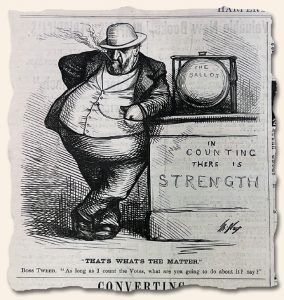 Someone recently brought to my attention an article posted on the website “Brewminate: A Bold Blend of News and Ideas”. While scanning the article I was intrigued by the presence of illustrations of newspapers we have or have previously offered. One in particular which caught my attention was the timely political cartoon by Thomas Nast found in the Oct. 7, 1871 issue of Harper’s Weekly. While a degree of election fraud is (unfortunately) part-and-parcel of the election process, I was inspired to read through the entire article, and in so doing, found it to be quite informative… and wondered if the friends of Rare & Early Newspapers might also find it interesting. Hopefully you will also enjoy reading it:
“Journalism from Early America to the Digital Age”
Announcing: Catalog #319 (for June, 2022) – Rare & Early Newspapers (for purchase)
May 31, 2022 by GuyHeilenman · Leave a Comment
|
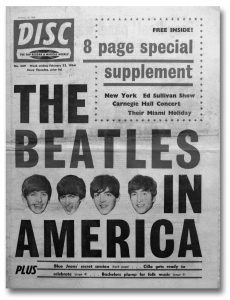 June’s catalog (#319) is now available. Also shown below are links to a video featuring highlights from the catalog, our currently discounted newspapers, and recent posts to the History’s Newsstand Blog. Please enjoy.
|
The links above will redirect to the latest catalog in approx. 30 days,
upon which time it will update to the most recent catalog.
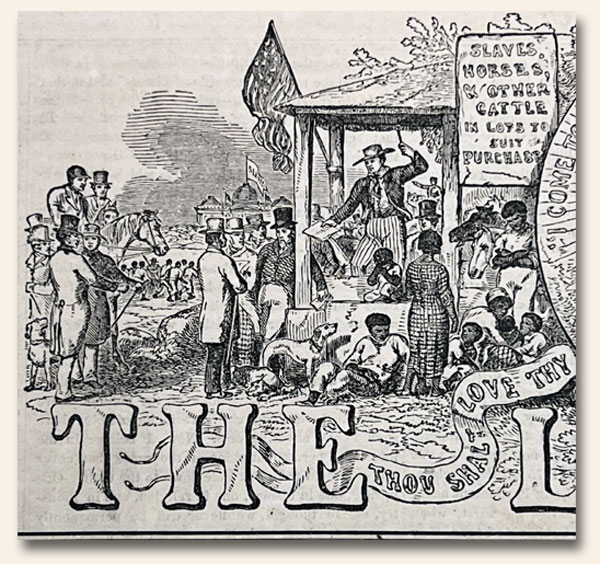
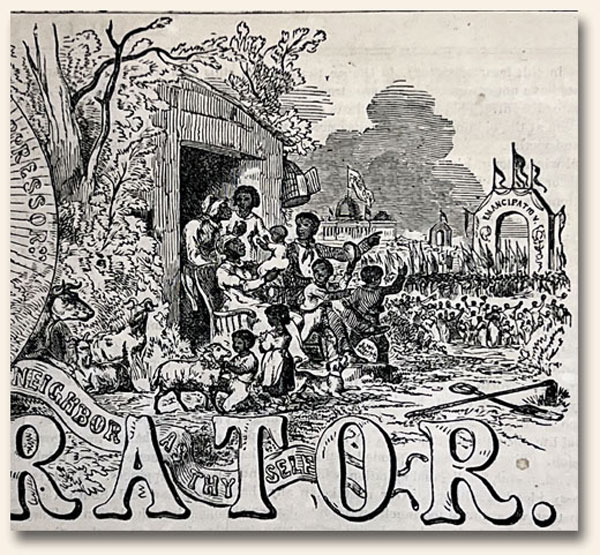
A woodcut masthead is worth a thousand words… Slavery…
May 16, 2022 by GuyHeilenman · Leave a Comment
A few weeks back my favorite person posted: Take a Closer Look … The Delicate Details of Woodcut Prints…
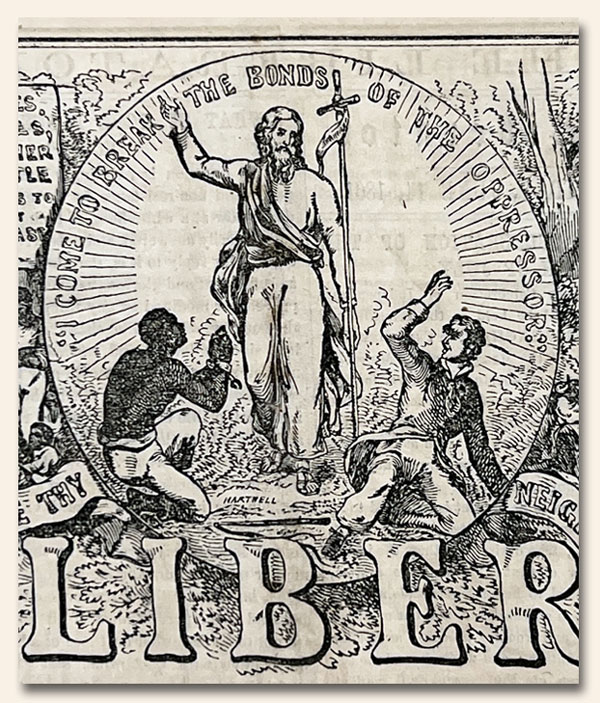
Such prints are truly amazing. However, as is the case with (most?) works of art, to some degree they tell a story. One such story is that of “Slavery – The Cry for Emancipation”, as told through the masthead of The Liberator. While we have many historic newspapers containing articles chronicling the path from the horrors of slavery, through emancipation, then on to suffrage and beyond, few rival what is communicated through this most-amazing, intricate, illustration which was present at the top of nearly every issue. At a distance its beauty speaks to the eyes, but a close-up view shouts to the heart: ENOUGH!
See for yourself:

“The Times They Are A-Changin'”… Martha’s Vineyard… 1867 (updated)
May 13, 2022 by GuyHeilenman · Leave a Comment

Elkman at en.wikipedia
We’ve made a few updates to a prior post…
Most are familiar with the Martha’s Vineyard of today, but few know of its early spiritual roots – at least I wasn’t. However, while scanning issues in search for content which might be of interest to collectors of Rare & Early Newspapers, a front-page article in a Springfield Republican dated August 21, 1867 caught our attention. Under the front page heading: “From Martha’s Vineyard,” appears considerable details regarding Wesleyan Grove (Wesleyan Camp Grove), with the subheading: “The World at a Camp-Meeting – The Sound, Its History and Associations,” followed by considerable detail. One might find it interesting to read the article (through the link above), and then dig a little deeper at Wesleyan Grove. While some elements of the Camp Meeting have undergone dramatic change over time, some things still remain the same. Please enjoy.

Announcing: Catalog #318 (for May, 2022) – Rare & Early Newspapers (for purchase)
April 30, 2022 by GuyHeilenman · Leave a Comment
|
 May’s catalog (#318) is now available. Also shown below are links to a video featuring highlights from the catalog, our currently discounted newspapers, and recent posts to the History’s Newsstand Blog. Please enjoy.
|
The links above will redirect to the latest catalog in approx. 30 days,
upon which time it will update to the most recent catalog.
Edward Gallaway – bibliophile, publisher, circus performer, cardshark – help needed…
April 25, 2022 by GuyHeilenman · Leave a Comment
A collecting friend is doing research on Edward Gallaway (1868-1930). Perhaps the collecting community can help. He sent the following note:
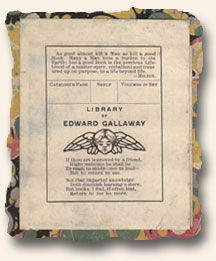
You can help a research project into a largely unknown bibliophile from Chicago, Edward Gallaway, by checking if you have any of the following in your collection:
1) Anything with the bookplate shown in the image.
2) Any issue or clipping from the Payne Weekly People, published in Fort Payne Alabama in October of 1889. This weekly newspaper, published by Edward Gallaway, discontinued roughly a year later end of 1890. This town experienced a boom during those years and many investors hailed from Massachusetts. Thus issues may have been transported back to the New England region.
3) Any issue from the Fort Payne Journal before 1891.
4) Any issue from the Fort Payne Herald.
5) Any issue from the Delphos Kleeblatt before 9th May 1891. The Delphos Kleeblatt was a German newspaper out of Delphos, Ohio, published by Carl A. Jettinger, who was a friend of Edward Gallaway.
Edward Gallaway had a fascinating life. He was born in Delphos, Ohio, in 1868. Already with 14 he became a printer’s devil at the local Delphos Weekly Herald newspaper, where he learned the printer’s art. From 18 years old to 21 he worked as a traveling typesetter. Eventually, he followed his older brother Alexander August Gallaway to Fort Payne, Alabama, where he established the short lived Payne Weekly Newspaper during the coal and iron boom years there. After the boom collapsed, Edward completely changed course and he became a circus performer working from 1892 until about 1895 at small traveling circuses such as the W.D. Ament sideshow. He performed mostly under the stage name Prof. Charles P. Wilson. His act consisted of Punch and Judy as well as magic. He would also work as barker, canvass boss man, as well as sideshow manager.
Edward Gallaway had a secret life as a cardshark. Later in 1902 he would write a manual of sleight-of-hand with cards educating readers on cheating at the card table as well as how to perform magic card tricks. This book, The Expert at the Card Table, was published under the pseudonym S.W. Erdnase, and it is to this day the most important book on sleight-of-hand with cards. It was decades ahead of its time.
Eventually, he found back to his printing profession and he started either alone or with others various job printing business, all of which were short lived. Around 1900 he is employed by the Bentley Murray printing company where he honed his skill on the Monotype typesetting machine which lead him to write the Monotype System books and other educational matter for Lanston Monotype. He started to teach estimating at the United Typothetae which brought him to the attention of Donnelley where he was later employed as estimator. There he rose up through the ranks to reach the position of director of estimating. In other words, he was the chief estimator at the largest privately owned printing company in the US. In 1925 he left and established his own School for Estimating in Chicago, the only school focusing on that particular aspect of printing. He died 1930 in Chicago.
During his life Edward Gallaway accumulated a large library with many precious books which his wife after his death sold through Chicago second-hand book dealers. This was the ‘pension’ she lived on until her death in 1943.
If anyone can be helpful in regards to this research project, please contact me (Guy) at guy@rarenewspapers.com. Thanks.
Snapshot 1844 – Voter Fraud… “death by a thousand cuts…”
April 8, 2022 by GuyHeilenman · Leave a Comment
Political scientist Robert Dahl defines a free and fair election as one in which “coercion” is comparatively uncommon.
Did voter fraud occur in the 2020 U.S. Presidential election? Of course. To think otherwise would be naive. Some degree of fraud has likely occurred in most, if not all elections which involve an imperfect people. This may seem a bit jaded, but I’m actually encouraged by the degree to which most elections in America have been “free and fair”. Still, complaints regarding election fraud have been documented throughout our history. True? In some cases, yes. Enough to impact the final outcome? It’s hard to know.
One such cry came from Louisiana in 1844, and was recorded in the National Intelligencer dated Nov. 30, 1844 (originally printed in the New Orleans Bee). Truth be told, fraud cannot be stopped. However, for the sake of the confidence of the electorate (i.e., to preserve a free and fair election), every intention must be made to keep it to a minimum – while not inhibiting citizens from voting. Balancing both is no small task – but is worth our ongoing effort.
Insight into the mind of Tesla…
April 4, 2022 by LauraH · Leave a Comment
I am always dumfounded by the breadth of brilliance some well-known inventors of the past possessed. Leonardo da Vinci, who is credited with the invention of the parachute, the barreled cannon, the Helical aerial screw, the winged flying machine, diving equipment & the self-propelled cart, also painted the Mona Lisa. How can one not stand in awe? Let’s face it, inventors are often trend setters who give the world around them inspiration as well as practical solutions for common problems.
 On Oct. 14, 1893, SCIENTIFIC AMERICAN featured an article by Nikola Tesla which caught my attention. We think of Tesla as one of the 2-3 most famous “explorers” who contributed to our current-day electrically powered world. However, in this article, he is using his study of the eye to further his insight into electrical currents. Below is a fitting quote from the article by this genius from the late 19th and early 20th centuries:
“The day when we shall know what ‘electricity’ is, will chronicle an event probably greater and more important than any other in the history of the human race.” Much ground has been covered in this regard since he made this statement, but most would agree we have yet to arrive.
Scientific American & The Columbian Exposition… A novice’s discovery…
March 3, 2022 by Stephanie Williams · 2 Comments
As a new staff member and a novice to the hobby, until I started looking closely at an 1893 volume of the Scientific American Supplement, I had no idea that the Chicago World’s Fair was also called The World’s Columbian Exposition in honor of the 400-year anniversary of Columbus’ voyage. I did some digging and found that it ran from May 1st through October 30th, which made the June 3, 1893 issue even more promising in terms of content. The publication does not disappoint.
The front page displays The Exhibit of Windmills & The Palace of Agriculture in grand imagery. Page 3 has: “Notes from the World’s Columbian Exposition” detailing each building and display followed by intricate pen and ink illustrations of new inventions from engines and locomotives to potato planters.
How fitting for an expo honoring the man who jumpstarted America to also honor those who continued to move her along.