
Search
The Rare & Early Newspapers Hobby

Receive the Newsletter

Buy Historic Newspapers

Frederick Douglass – A true American hero…
August 15, 2022 by GuyHeilenman · 2 Comments
 I’m currently reading “The Life and Times of Frederick Douglass”, and I must say, although I have always appreciated his accomplishments and admired him for his perseverance and tenacity as he moved from slavery to freedom, and then on to being a passionate herald for the freedom and equal right of others, over the past few weeks my eyes have been opened to his astounding skills as both a writer and orator. The fact that his cause resonates deep within me makes this revelation even more satisfying.
The quote shown above is from the introduction penned by George L. Ruffin. I couldn’t help but smile upon reading his statement about the value of historic newspapers as primary source material. While I personally prefer the label “contextual-source material”, he certainly seems to grasp the point – and the fact that Douglass himself was a long-time publisher of what we now refer to as rare & early newspapers only adds to the statement’s relevance.
Considering much was also written about (and by) Frederick Douglass in the newspapers of his day, please forgive me if I indulge readers of this blog with related posts over the next few months. At my age, placing the quest to explore more about his life on the backburner would likely be tantamount to tossing it into the recycling bin. Therefore, there is no time like the present. Thanks in advance for your understanding. If anyone would like to contribute a post regarding his life and can tether it to a newspaper (or newspapers) from the past, please be in touch (guy@rarenewspapers.com).
“Take Me Out to the Ball Game” – Historic Baseball Coverage…
August 12, 2022 by GuyHeilenman · Leave a Comment
One of the popular subsets of the Rare & Early Newspapers hobby is the collecting of historic baseball reports (as well as detailed coverage of favorite teams and players from the past). As of the writing of this post, more than 1,000 such issues were available for browsing and/or collecting at:
Baseball Reports and Headlines
One of our staff recently gathered a few issues together and created a one-minute video which we hope you will enjoy:
Snapshot 1822 – Before the last Mohican tugged at our heartstrings…
August 4, 2022 by GuyHeilenman · Leave a Comment
When one thinks of James Fenimore Cooper they no doubt think of his classic novel, “The Last of the Mohicans” – an extraordinarily compelling account (albeit fictional) of the attack on Fort William Henry during the French and Indian War. However, somewhat lost over time is his highly respected work from 5 years prior which brought him national attention and respect as an American novelist: “The Spy” (another work of historical fiction but set during the American Revolution). While still early in his career, the Feb. 2, 1922 Columbian Centinel had a nice report announcing its release and included a mention of “coming attractions”. It also made reference to his deceased father, a former New York State Judge and Senator. Although not mentioned in the article, the reading of it inspired me to do a little digging at which point I discovered his boyhood home was in the village of Cooperstown, New York, which had been named after his family.
Announcing: Catalog #321 (for August, 2022) – Rare & Early Newspapers for collectors…
July 29, 2022 by GuyHeilenman · Leave a Comment
|
 August’s catalog (#321) is now available. Also shown below are links to a video featuring highlights from the catalog, our currently discounted newspapers, and recent posts to the History’s Newsstand Blog. Please enjoy.
|
[The links above will redirect to the latest catalog in approx. 30 days
upon which time it will update to the most recent catalog.]
Mike Drop from 1886… Frederick Douglass Leaves Us All Stunned…
July 25, 2022 by LauraH · Leave a Comment
The phrase “mike drop” is a trendy phrase in 2022, however, none could hold a candle to Frederick Douglass‘ address to Congress in 1886/1887. The Atlantic Monthly from December 1886 & January 1887 carried his plea, and while I would like to have something to add to his words, I believe I’ll let a portion of his address speak for itself:
“The Principle of slavery, which [The Founding Fathers] tolerated under the erroneous impression that [slavery] would soon die out, became at last the dominant principle and power at the South. It early mastered the Constitution, became superior to the Union, and enthroned itself above the law. Freedom of speech and of the press it slowly but successfully banished from the South, dictated its own code of honor and manners to the nation, brandished the bludgeon and the bowie knife over Congressional debate, sapped the foundations of loyalty, dried up the springs of patriotism, blotted out the testimonies of the fathers against oppression, padlocked the pulpit, expelled liberty from its literature, invented nonsensical theories about master-races and slave-races of men, and in due season, produced a Rebellion fierce, foul, and bloody. This evil principle again seeks admission into our body politic. It comes now in shape of a denial of political rights to four million loyal colored people. The South does not now ask for slavery. It only asks for a large degraded caste, which shall have no political rights. This ends the case. Statesmen, beware what you do. The destiny of unborn and unnumbered generations is in your hands. Will you repeat the mistake of your fathers, who sinned ignorantly?”
Some may want to join me in picking our jaws up off of the floor as we stand in awe of a man who, as a former slave, (self) educated himself to such heights, ironically, using The Columbian Orator which was also used as a textbook by other familiar names: Ralph Waldo Emerson (philosopher/poet), Harriet Beecher Stowe (author of Uncle Tom’s Cabin), and Horace Greely (editor/publisher of the New York Tribune) to name a few.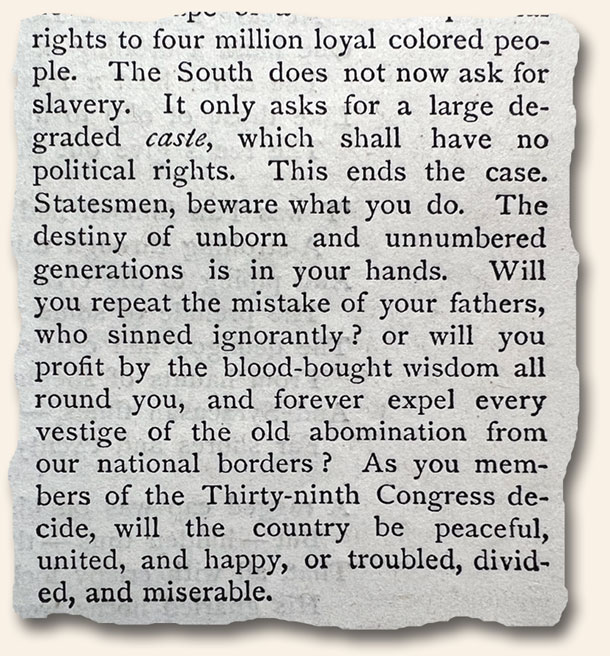
A Fly on the Wall… The Birth of a State….
July 22, 2022 by GuyHeilenman · Leave a Comment
This is the second in the series… “A Fly on the Wall”.
It recently occurred to me that those of us at Rare & Early Newspapers have the unique opportunity to view the passage of time through the abundance of historical reports found within our extensive inventory. One case in point: In 1876 Colorado achieved Statehood, and like all of America’s states, its citizens had done much work, achieved lofty goals, and covered extensive ground before their adoption into the United States of America. The following issue of THE WEEKLY ROCKY MOUNTAIN NEWS, Denver, Colorado, Nov. 15, 1865, is a sneak peek into Colorado Territory years before its big day of adoption. It would have been fun to be a fly on the wall during the proceedings which marked its statehood birth.
While the newspaper shown below is the earliest Colorado newspaper we currently have on hand, each issue covering a territory’s journey to statehood gives a fascinating look into the hearts and minds of those who formed the backbone of this great country.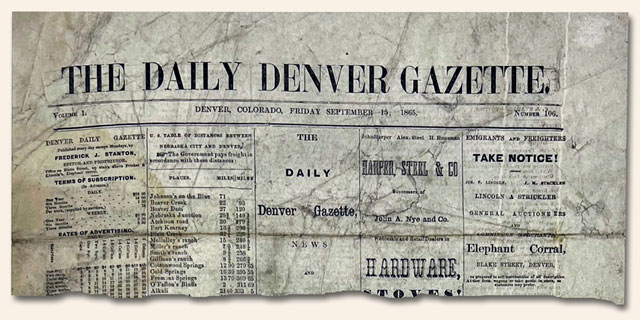
Collateral Damage – Yosemite Valley’s Little Sister…
July 8, 2022 by GuyHeilenman · Leave a Comment
 One of the many joys inspired by collecting (and reading) old/historic newspapers is the knowledge gained by investigating/exploring decades and even centuries old articles about things which were noteworthy in their day but are unbeknownst to the average reader of today. Such is the case with an article I recently found within the November 25, 1882 issue of The Washington World (D.C.).
The worst non-weather-related tragedy in the history of the United States remains the San Fransico Earthquake/Fire of 1906. The devastation was unimaginable – over 3,000 people perished and greater than 80% of San Fransico was destroyed. The direct and collateral impact are still felt to this day. One such case of the latter is the ongoing battle over Yosemite Valley’s little sister.
 Positioned slightly to the north of Yosemite National Park is the Hetch Hetchy Valley. While not as expansive, and with somewhat less than Ansel-Adams-esque views, its beauty was breathtaking – the operating word being “was”. If one were to view the valley today, heartbreaking would be the more accurate description. Instead of the serene beauty that touched the souls of John Muir, Willaim Keith, Albert Bierstadt, and a host of others, today one would see a nearly empty mud-hole resulting from a nearly dry reservoir. Yuck!
But why a reservoir? In response to the 1906 earthquake and resulting fire, the need for a better water-source for the San Fransico Bay region was obvious. After years of battling with the Sierra Club and likeminded naturalists, in 1913 a Congress passed legislation naming the Tuolumne River as “the solution” and authorized a dam to be built in order to create a reservoir for the needed water-supply. In 1923 the O’Shaughnessy Dam was completed and the Hetch Hetchy Reservoir was born. While there continue to be calls to remove the dam, the collateral damage has been done, and reclaiming that which has long-since been washed away by decades of emersion seems highly unlikely if not impossible.
Happy Independence Day – Contrasting Celebrations…
July 4, 2022 by GuyHeilenman · Leave a Comment
The July 11, 1868 issue of Harper’s Weekly contained prints by two notable illustrators – intentionally included to contrast typical 4th of July celebrations in the rural south (Thomas Worth) with those held in northern cities (Winslow Homer). Their diversity reminded me that we can have profound differences while maintaining our bonds of common citizenry. The Revolutionary War was fought for freedom. Today we fight to maintain that freedom. While our diversity in many ways has widened over the past few decades, this new battle is no less noble – and one which calls for unity of purpose. Hopefully we will heed the call. Happy 4th!

Announcing: Catalog #320 (for July, 2022) – Rare & Early Newspapers (for purchase)…
July 1, 2022 by GuyHeilenman · Leave a Comment
|
|
[The links above will redirect to the latest catalog in approx. 30 days
upon which time it will update to the most recent catalog.]
Juneteenth Revisited – “The rest of the story”…
June 27, 2022 by GuyHeilenman · Leave a Comment
 Roughly a week ago we were observing the most recent addition to our list of Federal Holidays: Juneteenth, which commemorates the day when Union troops marched into Galveston, Texas and Major General Gordon Granger informed the people of Texas that all enslaved people were now free. His General Order (No. 3) stated: “The people of Texas are informed that, in accordance with a proclamation from the Executive of the United States, all slaves are free…”. However, what is that at the end? Dot, dot, dot? There’s more?
His full order reads as follows: “The people of Texas are informed that, in accordance with a proclamation from the Executive of the United States, all slaves are free. This involves an absolute equality of personal rights and rights of property between former masters and slaves, and the connection heretofore existing between them becomes that between employer and hired labor. The freedmen are advised to remain quietly at their present homes and work for wages. They are informed that they will not be allowed to collect at military posts and that they will not be supported in idleness either there or elsewhere.” In other words, “You are free, but if you think the government is going to support you if you leave your new ’employer’, think again.” For many, this would be analogous to someone who was bound, kidnapped, and being transported by airplane to some horrible location having their bindings removed and told they were welcome to leave any time they want (albeit, at 10,000 feet without a parachute). While this Order is quite historic, and the day does deserve to be celebrated, there is a whiff of Hotel California in the air: “You can check-out any time you like, but you can never leave!”
Am I exaggerating – misrepresenting the circumstances? One might think so, but an article I recently discovered within a July 16, 1865 issue of The New York Times which printed a follow-up Order by General Granger given approximately one week later begs to differ: 
Even when granted with good intentions, freedom needs to be embraced – and the “doing so” is often fraught with hardship. However, while the struggle continues, taking time to celebrate this momentous occasion (along with the many victories which have occurred since June 19, 1865) is worthy of our unified, citizen-wide efforts – regardless of our racial, social, political, religious or economic differences. The intrinsic hope of “We The People!” must ever be before us.