
Search
The Rare & Early Newspapers Hobby

Receive the Newsletter

Buy Historic Newspapers

The reason I collected it: Dodge’s Literary Museum…
August 21, 2023 by TimHughes · Leave a Comment
Mastheads of newspapers through the centuries offer a very wide assortment of styles, sizes and decorativeness, with many being quite mundane. Only the “special” ones make it to the private collection, and “Dodge’s Literary Museum” is one.
Any newspapering which the masthead consumes one-third of the front page qualifies. This title’s masthead engraving consumes over half of the front page, very unusual as such. The content may be literary items with no “newsy” reports, but the front page is certainly worth of collecting, regardless of what is inside. 21
21
We all need a North Star… Wisdom from Frederick Douglass…
August 14, 2023 by LauraH · 1 Comment
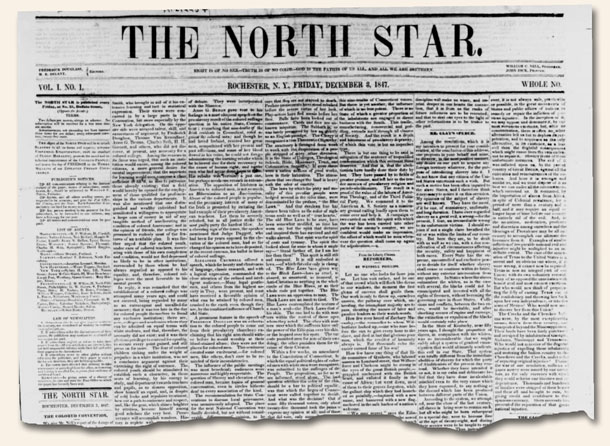
It is difficult to look at the life of Frederick Douglass and not become completely enthralled. Over the years, as I have ventured beyond the surface-deep historical facts by reading his speeches and writing, I have been astounded by his insight into the human condition and his wisdom which inspires the reader to live their best, most sacrificial life. It is no coincidence his first newspaper was titled THE NORTH STAR (later called the FREDERICK DOUGLASS’ PAPER). I would submit we can all use a clear guide to true north. Here’s hoping and praying that every new generation studies his life and writings, thereby helping to ensure “a more perfect Union” and a brighter future for all.
Source: Edited photo from the Library of Congress, Washington, DC
The impact of Newspapers on the abolition of slavery…
August 4, 2023 by GuyHeilenman · Leave a Comment
 The impact print media in general, and newspapers in particular had on attitudes towards slavery cannot be overstated. The abolitionist press was in full-force during the early-to-mid 1800’s with publications such as The Anti-Slavery Bugle, The Emancipator, the National Anti-Slavery Standard, the National Era (which had the honor of being the first to print Harriet Beecher Stowe’s “Uncle Tom’s Cabin”), among those who carried the torch. While some publishers became household names during this critical period in American history (William Lloyd Garrison – publisher of The Liberator), Frederick Douglass – publisher of the North Star [later, the Frederick Douglass’ Paper], and Horace Greeley – publisher of the New York Tribune), a slew of others, while highly influential, have largely been forgotten. One such unheralded publisher was Hezekiah Niles’, the publisher of the Niles’ Register from Baltimore, Maryland. While Niles’ Register would not be placed under the umbrella of The Abolitionist Press, not wearing this label coupled with its heavy focus on political issues may have played to his advantage when Hezekiah wrote and published his “Mitigation of Slavery” in serialized form over a span of 8 issues in 1819. It may not have had an Uncle-Tom’s-Cabin-level impact among the masses, there is little doubt the minds of many in-and-around Washington D.C. were challenged to keep the abolishment of slavery at the forefront of both political and public discourse. The full text of his essay can be read on-line, however, photo-snippets of portions of an original as well as a brief description may be viewed on the Rare Newspapers website: Hezekiah Niles’ “Mitigation of Slavery“. His final thoughts are shown below.
Horrace Greeley, Fred Douglass, Harriet Beecher Stowe… Hezekiah Niles…
Announcing: Catalog #333 for August, 2023 – Rare & Early Newspapers…
July 31, 2023 by GuyHeilenman · Leave a Comment
|
 The August catalog (#333) is now available. Shown below are links to various segments of the catalog, our currently discounted newspapers, and recent posts to the History’s Newsstand Blog. Please enjoy.
|
[The links above will redirect to the latest catalog in approx. 30 days
upon which time it will update to the most recent catalog.]
Christmas in July…
July 28, 2023 by LauraH · Leave a Comment
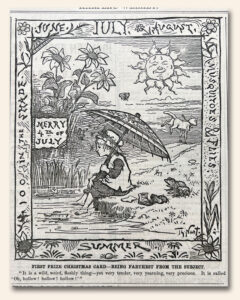 We all have those moments when a memory comes flooding back with all the delight or despair the original moment generated. Such was the case earlier this week as I was organizing a new our new acquisition of Harper’s Weekly Illustrated issues. After working my way through several years, I paused to sort through a stack of Christmas issues. Although it’s the middle of summer and the temperature outside regularly toys with 3-digits, my mind darted back to a midsummer day 20+ years ago when Guy and I were hiking part of the Loyalsock Trail in the Endless Mountains of Pennsylvania. As we were walking along the trail near where we had set up our tents, we thought it odd to hear Christmas music in the distance, however, as we turned off the path and prepared to cross a stream we were amused and entertained by dozens of families and friends celebrating “Christmas in July” right in the middle of the woodland path. Their generator running to power countless strings of Christmas lights, music pumping, and tables crowded with homemade goodies – this family event was in full festive swing.
Jumping back to the present…
With a smile on my face at the thought of this communal celebration, I grabbed my stack of Christmas issues and headed back up to the front office to share them with all of you through this post. Below you will find a few I’ve listed. We may only have only one 1st-rate issue of each of these, there are plenty of similar to choose from on this hot day in July: Christmas-Themed Harper’s Weekly.
Sample Harper’s Weekly w/ a Christmas Theme

Snapshot 1881: Is it a car, a bike, a train or a trike?
July 17, 2023 by GuyHeilenman · Leave a Comment
Is it a car, a bike, a train, or a trike – or something else altogether? Looking back with an effort to place various inventions into current-day buckets is not always easy. However, in this case, there is one thing we know for sure: It is a velocipede: “a human-powered land vehicle with one or more wheels.” This one appeared in the April 16, 1881 issue of Scientific American.

The reason I collected it: The Semi-Weekly Argus from Washington Territory…
July 10, 2023 by TimHughes · Leave a Comment
“The Semi-Weekly Argus” of Port Townsend, Washington Territory, July 7, 1873, might seem like an ordinary issue with typical content of the day. However the most intriguing aspect of the edition is not the data nor its content; it’s the paper upon which it is printed. It is yellow.
On rare occasions, newspaper publishers had to deviate from the traditional newsprint with which we are familiar, when necessity required an alternative. In such situations “necessity paper” was used, the term for whenever an issue was printed on anything non-traditional.
Given Port Townsend’s relative remoteness in the Northwest, I would suspect supply routes were often questionable a best, particularly with this date being 16 years before statehood.
We have encountered newspapers printed on paper with a wide assortment of colors, as well as wrapping paper, cornhusk paper, wallpaper, lined notebook paper. tissue paper, etc. Such editions were typically very short-lived, perhaps a few days at best, until supply chains could be re-established.
Here is a great example of the use of “necessity paper” and a visually prominent addition to any collection.
The question for freedom… the Underground Railroad…
July 7, 2023 by LauraH · Leave a Comment
Down the hill from my house is a backcountry lane called Freedom Road. As my 6 children were growing up, I loved telling them stories of an Underground Railroad stop in the old barn across from our house and how the escaped slaves, after a short respite from their journey, would then travel down the hill to continue along their road to freedom. How fitting a name and how moving a story – especially to children who could gaze across the street and imagine the historical efforts of humble, brave and noble locals being played out in their own neighborhood. Imagine my delight when I found a rare mention of the Underground Railroad in an October 6, 1854, New York Tribune. As Tim Hughes often reminds us, “History is never more fascinating then when it is read from the day it was first reported”… or when it is in your own backyard.
Announcing: Catalog #332 for July, 2023 – Rare & Early Newspapers…
June 30, 2023 by GuyHeilenman · Leave a Comment
|
 The July catalog (#332) is now available. Shown below are links to various segments of the catalog, our currently discounted newspapers, and recent posts to the History’s Newsstand Blog. Please enjoy.
|
[The links above will redirect to the latest catalog in approx. 30 days
upon which time it will update to the most recent catalog.]
The Legacy of Cassius Clay… Could it be in the Name?
June 19, 2023 by LauraH · Leave a Comment
While looking through an October 25, 1862 issue of Harper’s Weekly, a tiny paragraph on the 2nd page caught my eye. Titled “NO HANGING MATTER”, this article began:“Mr. Cassius M. Clay was born in a slave State, and early convinced that slavery was wrong, he has manfully advocated emancipation in Kentucky; and has been universally known as one of the most valiant of the anti02-slavery orators.” Wondering if the mother of Cassius Clay (later known as Muhammad Ali) knew the legacy with whom she was identifying when she named her baby boy, a quick bit of research online answered my question. Not only was she aware of the connection, but she purposefully chose the name because of this 1800’s abolitionist hero. Crossing both racial barriers and nearly 200 years, these 2 men both established lasting legacies.
Sometimes, the most delightful finds in our newspapers are the small, unexpected, little gems that give new insight into people of the past and the present – and in this particular instance, this “text” was discovered hiding in a title known for its illustrations.
