
Search
The Rare & Early Newspapers Hobby

Receive the Newsletter

Buy Historic Newspapers

Collecting the Old West…
March 8, 2013 by TimHughes · Leave a Comment
 Few eras in the broad range of American history have the appeal as that of the “Wild West“, a romanticized period following the end of the Civil War thru the end of the 19th century. It was a time when America was healing from the wounds of war and the adventurous were pushing the American boundary further West. It was the 1849 California Gold Rush which sparked interest. Now with the war over, new adventures were sought by many.
Those of the Baby Boom generation grew up on western movies and cowboy & Indian television shows. Even Disney’s hugely popular Mickey Mouse Club and the newly minted Disneyland had the Wild West as a popular theme. What we remember are battles with Native Americans, saloon brawls, gunfights, and a multitude of other events which seem to define the era. And to the delight of collectors, all are found in newspapers from the Old West.
Geographically our “Old West” definition would be any from west of the Mississippi. Some 25 years ago we were fortunate enough to purchase a sizable collection of Old West newspapers which were deaccessioned from the Bancroft Library, including many titles which existed only there, then only in our inventory. With some regret many have long since sold out, but most remain available.
Ways of collecting this era are many. Some might pursue one of as many different titles as are available. Content is a lesser concern; they just want one of everything. Some might collect one from every state from before the 20th century. Many states would be easily found but others can be challenging, particularly Arizona, New Mexico & perhaps Idaho. Others might be more specific and collect only titles from before statehood, typically known as “territorial newspapers” (note: Arizona & New Mexico joined the Union in 1912 so early 20th century issues are “territorial”). Again, many can be easily found while others are more of a challenge. California became a state in 1850 (interesting how quickly Congress can act when a pile of gold is found in the backyard) and the number of titles which existed in the Golden State before 1850 were very few. For the best of collections, finding an early issue of the first newspaper to publish in each state can be a special challenge. But of course this is the fun of collecting.
Then there is a larger segment of collectors who pursue content, whether it be the iconic events of the Old West such as Custer‘s Massacre, Killing of Jesse James, the gunfight at the O.K. Corral, capture of Sitting Bull, or just mundane reports of iconic events such as skirmishes with Indians, barroom brawls, bank & railroad robberies, and general reports of lawlessness. Yes, they are all found in Western newspapers of the day, and the search can be exciting.
As a subset of an Old West collection is Mormon content, as the story of the Church of Jesus Christ of Latter-Day Saints is part & parcel of the westward expansion. Many titles from Salt Lake City are available and contain a wealth of Mormon content from shortly after their settlement in Utah. Another subset  might be popular Western towns. Yes, 19th century newspapers are available from Tombstone, Sacramento, Deadwood City, Tucson, Albuquerque, San Francisco, Laramie, Reno, Los Angeles, San Diego, Leavenworth, and on and on. Of special intrigue is finding newspapers from ghost towns. Bodie, California is a great example of a once booming mining town which is currently a California State Park and popular ghost town attraction. Many of our titles from Northern California are from towns which are today a fraction of their size in the 19th century.
The world of Old West collecting is endless, and to the surprise of many prices for most newspapers of the era are unexpectedly low. Explore this interesting era of American history and discover a new facet of collecting!
Thomas Nast in Harper’s Weekly…
March 1, 2013 by TimHughes · 2 Comments
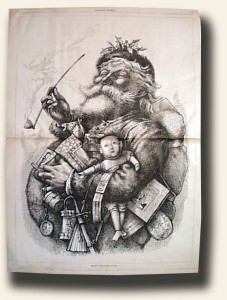 Thomas Nast ranks as one of the most successful, powerful, and prolific artists of the 19th century, and is a name linked closely to one of the most successful, powerful, and prolific newspapers of the 19th century. Through their successes, both Nast and Harper’s Weekly gained sufficient power to influence American politics in the second half of the 19th century and help shape the political climate of America during the industrial revolution.
Thomas Nast was German born, moving to America in 1846. Skilled as an artist, he first went to work for Frank Leslie’s Illustrated Newspaper in 1859, but within 3 years he began working for its competitor, Harper’s Weekly. His work continued to appear in Harper’s thru 1886.
It was a symbiotic relationship for the two. Circulation of Harper’s Weekly grew as Nast drawings were found in more and more of its pages, and Nast‘s notoriety and popularity grew in large part to the increased circulation of Harper’s Weekly. Nast‘s powerful pen in support of the prosecution of the Civil War was honored by President Lincoln when he called Nast “our best recruiting sergeant”.
With original artwork by Thomas Nast commanding prices far beyond the pocketbooks of most collectors, prints found in Harper’s–and only in Harper’s–remain a popular way to assemble a collection of this famed artist’s work at relatively low prices given the current availability of genuine issues.
For today’s collector, interest in Nast falls into three categories:
1) His portrayal of battles & events of the Civil War, which often featured human interest themes & the effect of the war on those back home, remain as some of the best and most heart-felt scenes of the Civil War. Daily newspapers only provided written text; Harper’s Weekly and the prints of Thomas Nast provided a visual representation of the reality of war.
2) Perhaps most noticed as a political cartoonist, his work did much to expose the graft and corruption of William “Boss” Tweed, the powerful Tammany Hall political machine of New York City. In fact it was a Nast cartoon which caused Tweed to be arrested following his escape from jail and flight to Spain. A customs official recognized him from his many appearances in “Harper’s Weekly”. Nast has been credited with doing much to cause elections of all in the hands of those he supported (Grant’s two Presidencies), and cause to fail those he disliked.
 It was Nast who created the caricatures of the Democratic donkey and the Republican elephant to represent those parties, political icons which remain to this day. Desired among collectors are the first donkey to appear in the pages of Harper’s Weekly (January 15, 1870) and the first elephant to appear (November 7, 1874), as well as the first time they appeared together (December 27, 1879). All three command premium prices due to their desirability, but collectors are encouraged by the inexpensive prices for other genuine issues of Harper’s which include Nast illustrations of both.
3) Santa Claus prints. It is Thomas Nast who is credited with creating the modern version of Santa Claus, the jolly, rosy-cheeked, rotund purveyor of gifts in the uniform as we know him today. Nast’s first Santa Claus to appear in Harper’s Weekly was titled “Santa Claus in Camp” from during the Civil War, appearing on the front page of the January 3, 1863 issue. Yet it is the January 1, 1881 issue which has the Santa Claus centerfold which still appears in many Christmas advertisements and is perhaps his most famous rendition. There are many issues of Harper’s Weekly which have Santa Claus prints, all very desired among collectors.
True to any symbiotic relationship, with Nast leaving Harper’s Weekly at the end of 1886, he lost his forum to reach the masses, and in losing Nast, Harper’s Weekly lost its political importance. Nast continued his work in other publications, none being very successful, until his death in 1902 to yellow fever. Harper’s Weekly never regained its success from the Nast years, and it ultimately ceased publication in 1916.
Harper’s Weekly issues with Nast prints are very displayable, particularly those which feature Nast images on the front page, or notable icons such as popular politicians, Santa Claus, Uncle Sam and Abraham Lincoln. A very famous Nast cartoon featuring Lincoln is the “Long Abraham Lincoln A Little Longer” cartoon which is in the November 26, 1864 issue, signifying his successful second Presidential election.
All issues offered by Hughes Rare & Early Newspapers are genuine & complete in 16 pages, save for a few described otherwise. In many cases two or three Nast prints appear in one issue.
Thanksgiving Proclamations… a survey through American History…
November 21, 2012 by GuyHeilenman · Leave a Comment
 This Thanksgiving, why not take the family on a historically “Pinteresting”walk through a survey of Thanksgiving Proclamations made at key moments in American History?
http://pinterest.com/rarenewspapers/thanksgiving-proclamations/
Happy Thanksgiving!
Beyond the historic headline…
November 1, 2012 by TimHughes · Leave a Comment
 “Newspapers that shaped the world…“
Some of the better & more fascinating items found in old newspapers are not the most historic or significant, but rather the casual appearance of seemingly innocuous reports which excite collecting interest beyond the historic headline or dramatic presentation which are the more usual draw.
Much of what intrigues collectors can be lost within the body of reports, yet they tell a story of their own, such as the patriotic fervor of some colonist during the Revolutionary War. I recall an issue of the Edinburgh Evening Courant of June, 1776 reporting on American soldiers: “…Their uniform is a dark grey coarse linen frock, which covers the whole body…with the words, ‘Death or Liberty’ marked in large red letters on the right sleeve; and many of them are so enthusiastic as to have them marked with their own blood…”. This report is almost lost on page 3 yet its message is very telling of the spirit which caused the Americans to win the war against a world power despite insurmountable odds.
Some reports are fascinating by their bias. A Richmond newspaper of July, 1863 reporting on the Battle of Gettysburg notes: “…The Confederates did not gain a victory, neither did the enemy. He succeeded in defending himself & we failed in some portions of an attack…We killed more of the enemy than we lost; we took very many more prisoners than lost. The Confederate army did not leave the enemy until it had tried every link of his armour…” Another newspaper notes: “ ..Information, certainly authentic, is in the hands of the Government, which leaves no doubt of the safety & triumph of the noble army. General Lee was victorious in all the combats which have taken place. He has been engaged with the whole force of the United States & has broken its backbone…”, Perhaps the most extraordinary example of optimism appeared in the Richmond Examiner of July 25: “…The result was not a defeat, it was not a loss; it was only not a victory…It was little else than a disappointment of extraordinary expectations…”. What a precious statement as an example of Confederate optimism.
Other little gems were very prophetic in their reporting, particularly when read with an historic perspective. A Scottish newspaper from 1775 sensed a lasting war with America as it reflected on the Battle of Bunker: “…The mischiefs which have already arisen & the greater calamities which are threatened from the unnatural war excited in America…It is impossible we can see, without the utmost alarm, preparations making for the prosecution of an expensive & ruinous war with our own Colonies…”. Some can be very recent, like the New York Times comment on rookie Mickey Mantle in 1951: “…Mantle, who gives every promise of developing into an outstanding baseball star, was ordered to report to his draft board next Wednesday…” An editorial comment in the Army & Navy Journal just after the Gettysburg Address opined: “…a dedicatory speech by President Lincoln, which we give in full, as decidedly the best feature of the occasion, as well as one of the most felicitous utterances of its author.” How true.
Some were prophetic even when the reports were simply wrong, like the Illustrated American article of 1898 reporting on “A New Flying Machine That Flies”–five years before the Wright brothers–when it said: “…It is impossible to imagine without terror the day when these mechanical birds, these flying apparitions, will be able to rain upon armies, hostile towns and escalating parties most deadly and most destructive explosives…”. How true it would become.
There can be much to be found in newspapers beyond the headline. What a thrill it is to discover such hidden gems; reports that have escaped hundreds of years of history only to rediscovered with new-found relevance today. Such are just some of the joys of collecting early newspapers.
Please enjoy: “Newspapers that shaped the world…“
Countdown to “Newspapers that changed the world…”
October 24, 2012 by GuyHeilenman · Leave a Comment
Each month Timothy Hughes Rare & Early Newspapers releases a catalog containing a new set of historic and collectible newspapers (1600′s through 20th century). However, on November 1, 2012, at 12:01 AM ET, the special edition, “Newspapers that changed the world…” will be released. Whether you already collect newspapers, or desire to simply view a sampling of what the hobby has to offer, check back for this special occasion:
Prior to November 1, 2012 and after November 30, 2012, the link below will take you to the most recent offerings of Timothy Hughes Rare & Early Newspapers… History’s Newsstand! During the month of November it will take you to the special release catalog, “Newspapers that changed the world”.
View: “Newspapers that changed the world…“
Wyoming’s first newspapers…
July 9, 2012 by TimHughes · 1 Comment
Wyoming has the interesting distinction of having once been part of four principal annexations: the Louisiana Purchase, the Oregon Territory, the Mexican Cession and Texas Annexation. It became a territory in July, 1868 and gained statehood on July 10, 1890.
The “Leader” was the first newspaper in Wyoming, begun on September 19, 1867, the same year that the first settlement had been created at Cheyenne. The newspaper was begun by Nathan Baker and J.E. Gates. Baker gained his printing experience in Colorado, working at the “Rocky Mountain Herald” and the the “Rocky Mountain News”. He went one to establish two other newspapers in Wyoming, the Laramie “Sentinel” on May 1, 1869, and the South Pass “News“. See the hyperlink for the interesting history of this town.
 Also begun in Cheyenne in 1867 were the “Daily Argus” in October, and the “Star” in December, but neither one lasted beyond two years. Other early newspapers in Wyoming were the “Sweetwater Miner” at Fort Bridge in February, 1868, a vehicle to promote immigration, and a few months later the “News” at South Pass, noted above.
One of the more interesting newspapers from the West was the “Frontier Index” which began at Fort Sanders and moved along with the Union Pacific railroad going to Benton then to Bryan and then to Bear River City where it was completely destroyed by a mob. And no mention of Wyoming’s newspaper history should fail to mention the “Boomerang” (named for the editor’s mule), founded at Laramie on March 11, 1881 by Bill Nye. Subscribers were found in every state and some foreign countries. When Nye retired from the paper he became one of America’s best known humorists.
Hatfields & McCoys…The media drives interest in historical newspapers…
June 14, 2012 by TimHughes · Leave a Comment
There is no question that media events affect our hobby. Although there was always collector interest in the sinking of the Titanic, it wasn’t until the James Cameron movie was released in 1997 that interest exploded. It was amazing to experience the dramatic increase in calls & requests at our office concerning newspapers reporting the Titanic disaster . The movie release preceded the eBay craze so it was only by individual quotes & listings in our catalog that we could keep up with the demand. Prices did increase dramatically.
The “Amistad” slave ship movie had a similar reaction. Few people even knew of the event before the Stephen Spielberg movie, but upon its release we sold dozens of notable issues of the event & subsequent trial at prices which far exceeded those possible before the movie.
 Other historically-themed events in American or world history, whether they happened on the big screen or television, have had similar effect on the rare newspaper hobby. The most recent “event” is the Hatfield-McCoy feud, spurred on by the recent History Channel mini-series.
Thought by some to be nothing more then legend and not an historical event, the Hatfield McCoy feud was, indeed, very real. We find it interesting the degree to which coverage of the feud appeared in newspapers of the era. We are fortunate to have newspapers from West Virginia (example) in 1889 (the feud happened at the Kentucky-West Virginia border) which have extensive articles on the feud, and our listings on eBay have created a following which far exceeds those listed prior to the mini-series. And many of those following our offerings–and buying them–are new hobbyists who likely never purchased an historical newspaper before.
All this is of benefit to the hobby. Although much criticism has been levied against what is seen on television and in movie theaters today, occasionally quality productions which are based on historical fact have increased interest not only in America history but also appreciation for genuine newspapers which report those events at the time they happened. This can only be good for the hobby.
Period printing… Did you ever notice…?
April 30, 2012 by GuyHeilenman · 1 Comment
A few months ago we received an inquiry from one of our friends wondering why pre-1900 newspapers included a period after the newspaper’s title in the masthead. While I hold hundreds of such issues in my hands each week, I had never taken notice of this. Wondering if this was in fact the case, I quickly began searching through our 19th and 18th century archives, and low and behold, every title ended with a period. Searching through our 20th century inventory I discovered that none of the issues did. I asked Tim Hughes his thoughts on the matter, and his response was as follows:
Regarding the query about periods at the end of 19th century titles, I don’t believere there is a reason beyond it simply being the grammatical style of the  period. In fact the practice goes back to the 17th and 18th centuries as well. It was just the way newspapers (and magazines) were laid out, perhaps following some sort of grammatical “rule” of the day. There was also–compared to today–an excessive use of commas within text, which again was just the style of the day.
Perhaps the more interesting question would be when & why was the period eliminated at some point in the 20th century? I would suspect one paper just made the decision and everyone else eventually followed, as there was much competition and copying among newspapers. Sorry I don’t have a more intriguing answer!
If any of our readers have additional information in regards to this, feel free to respond.
Tombstone was about to fade away…
August 13, 2011 by TimHughes · Leave a Comment
Having offered several Tombstone newspapers from its brief heyday in the late 19th century, I thought you would find this article from the “Prescott Journal-Miner” of Arizona, July 8, 1930, interesting. Having visited Tombstone about 3 years ago I can assure all that it does survive, albeit primarily as a partially reconstructed tourist attraction. It’s a fun town to visit if ever in Southern Arizona:
Warnings of climatic changes…
June 18, 2011 by TimHughes · Leave a Comment
With much attention today given to climatic change and how mankind is affecting weather patterns around the globe, it was interesting to find this article in the “Daily State Journal” newspaper from Austin Texas, May 10, 1871. The article paints a rosier picture in terms of mankind’s affect on climate than most environmentalists do today…