

Search
The Rare & Early Newspapers Hobby

Receive the Newsletter

Buy Historic Newspapers

What could happen to a rumor…
December 9, 2010 by TimHughes · Leave a Comment
“The Daily Journal” newspaper of August 20, 1861 from Wilmington, North Carolina, a Confederate publication, printed an interesting series of dispatches of a fictitious assassination attempt upon President Lincoln (see below). They provide an interesting perspective on how a dramatic event could be much less so once more trustworthy news reports found their way to the press.
The reliability of news reports was a big problem in the 18th & 19th centuries during the pre-telegraph, pre-wire service days when word of mouth was often the source of what made it into the newspaper. This somewhat comical piece illustrates a quandary likely dealt with by most newspaper publishers of the day.
General Butler… “The Beast”…
December 2, 2010 by TimHughes · Leave a Comment
Editorials in Confederate newspapers are always interesting reading–as are many of those from the North–as there is much bias skewed in favor of those reading the newspaper. The Jan. 12, 1865 issue of the “Richmond Examiner” contains a rabidly anti-Butler editorial, even managing to interject his nickname in the South: “The Beast”. This one is worth sharing for all to read:
Minister needed to be clever to say only nice things…
November 6, 2010 by TimHughes · Leave a Comment
This interesting report In the “Richmond Examiner” issue of August 27, 1864 shows some creativity by the preacher:
April 15, 1865 New York Herald reprints… revisited…
November 1, 2010 by GuyHeilenman · 10 Comments
 A previous post by guest contributor Rick Brown detailed how one can identify whether or not their April 15, 1865 New York Herald is authentic. One of the most notable differences between an authentic issue (which is quite rare) and one of the reprints (which are rather common) is that the common reprint has an image of President Lincoln on the front page, whereas, the original does not. We recently came across a photo of the Lincoln image (as shown to the right). If your issue has it… unfortunately, your’s is not an original.
Prices realized… 19th century…
September 20, 2010 by GuyHeilenman · 5 Comments
This post is the 3rd installment of a series dedicated to exploring actual sale prices of historic newspapers from various periods of time. Below please find a few selections from the 19th century.
 Note: If you have an issue of your own you’re trying to price, one trick/strategy is to go to the “advanced” search engine at www.rarenewspapers.com (see top left of window), enter a 2 week range of dates (one week prior to your issue’s date to one week after), and view the results. This will give you comparable issues (if available) to help you in establishing a reasonable price for your issue. Make certain to take into consideration your issues title, city of location, proximity to the location where the event (key content) occurred, condition, displayability, proximity of issue’s date to the date the key event occurred, etc.
19th century selections:
The best Lincoln Assassination issue to be had… THE NEW YORK TIMES, April 15, 1865 ($2,800, 2009)
Wallpaper issue! THE OPELOUSAS COURIER, Louisiana., Apr. 4, 1863 ($2,650, 2006)
The previous posts in this series are:
Prices realized… 16th & 17th centuries…
Prices realized… 18th century…
Non-compassionate approach to advertising…
July 24, 2010 by TimHughes · Leave a Comment
This ad is from the “Daily Delta” of New Orleans, March 29, 1861. The advertiser chose a hard-line approach to selling his product, claiming one is: “…laying the foundation stone for an early grave by your obstinacy and stupidity.”
Your help would be appreciated…
June 14, 2010 by TimHughes · 10 Comments
 Rick Brown, not unknown in our little world of newspaper collecting, is embarking upon a project and seeks your help.
Rick published “Collectible Newspapers” for many years and created the Newspaper Collectors’ Society of America along with producing several projects which remain valuable to our hobby today, including the “List of Common Reprints” found on our website. His current project is producing a list of all known reprint editions of the New York Herald of April 15, 1865, perhaps the most commonly reprinted newspaper on the market. He has identified 35 different versions and is lacking a few including:
* Kitchel’s Liniment for 1890, 1892 through 1899, 1903 and 1904, 1906
through 1908. (The date for each can be found at the
top margin of page 2.)
* Smith’s Buchu Lythia Pills
He also wishes to produce a reprint of the front pages of each of the four
genuine editions of the newspaper for free online use. Should you have a genuine New York Herald, April 15, 1865 in your collection, or one of the reprint edition editions noted above, please be in touch with Rick directly for details on how to assist in his project: Curator@historybuff.com
Poetic analogy from the battlefield…
June 12, 2010 by TimHughes · Leave a Comment
The “Bradford Reporter” newspaper from the small town of Towanda, Pennsylvania, October 22, 1863, contains: “The Story of Two Bullets” which provides a somewhat poetic analogy to a hopeful conclusion to the Civil War.
Value of the internet…
May 13, 2010 by TimHughes · Leave a Comment
 I never fail to be amazed at the incredible wealth of information which is available on the internet, and I never fail to be thankful for such an incredible resource, particularly remembering what it took thirty years ago to research a newspaper.
Back in the 1970’s and ’80’s, when I wrote up an issue for the catalog I had to pull out the encyclopedia if I was unsure of a specific date or consequences of a certain battle. And I also kept close at hand other resources which would document events I was finding in our inventory of newspapers.
But today, more information than I could possibly need flashes on my screen in a matter of seconds. What was the date James Buchanan died? Wikipedia tells me more quickly then it takes me to type “james buchanan”. Many times I’ll read an interesting article about a person which sounds intriguing but is lost to my memory. The web quickly provides a wealth of detail.
What brings this to mind is an entry I worked on this morning. The “Army & Navy Journal” of Dec. 3, 1864 has a touching item about a Mrs. Bixby who received a letter of condolence from Abraham Lincoln for her loss of five sons in the Civil War, the sixth was lying wounded in a hospital. The article includes the letter by Lincoln. Not having heard of this letter, as a whim I decided to Google “mrs. Bixby letter” to see if this was an “event”. To my surprise there is more to the story than the article could give, thanks to the “Collected Works of Abraham Lincoln”.
The touching letter by President Lincoln can be read in the photo. Below is the “rest of the story”:
Credit: “Collected Works of Abraham Lincoln”: In the fall of 1864, Massachusetts Governor John A. Andrew wrote to President Lincoln asking him to express condolences to Mrs. Lydia Bixby, a widow who was believed to have lost five sons during the Civil War. Lincoln’s letter to her was printed by the Boston Evening Transcript. Later it was revealed that only two of Mrs. Bixby’s five sons died in battle (Charles and Oliver). One deserted the army, one was honorably discharged, and another deserted or died a prisoner of war.
The authorship of the letter has been debated by scholars, some of whom believe it was written instead by John Hay, one of Lincoln’s White House secretaries. The original letter was destroyed by Mrs. Bixby, who was a Confederate sympathizer and disliked President Lincoln. Copies of an early forgery have been circulating for many years, causing some people to believe they have the original letter.
The point of this piece is to cite just one example how the internet opens a whole new world to the tidbits of history we find within early newspapers. A 150 year old article might pique the curiosity, but it is the internet which can satisfy. It’s a fascinating combination of very old & very new technology which fit so well in this hobby we love. Give the internet a try with some articles in your collection. You may be pleasantly surprised at what you will find.
Featured websites – The Liberator Files…
April 22, 2010 by GuyHeilenman · Leave a Comment
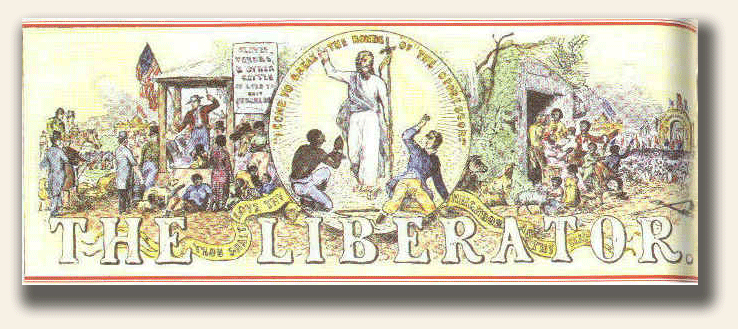 Within the past few months, three members of Timothy Hughes Rare & Early Newspapers each recommended the same website, The Liberator Files, as a great resource for exploring this well-known abolitionist title from the early/mid 1800’s. This Boston paper was published by William Lloyd Garrison, and provides wonderful context for this formative period in U.S. history – from the early 1830’s through the end of the Civil War. The Liberator Files, developed and maintained by Horace Seldon, includes a wealth of abolitionist related commentary in conjunction with a host of scanned Liberator images from William Lloyd Garrison’s own collection, which are currently held at the Boston Public Library. Thanks Horace, for your significant contribution to the world of rare & historic newspapers. Please enjoy!
Feel free to share with the rare newspapers community other historical and/or rare newspaper oriented websites you’ve found to be of use.