
Search
The Rare & Early Newspapers Hobby

Receive the Newsletter

Buy Historic Newspapers

The Traveler… Gen. Lee’s wagon train… Davy Crockett makes a monkey…
May 19, 2014 by The Traveler · 2 Comments
This week I traveled back to New York City by the means of Frank Leslie’s Illustrated Newspaper of May 21, 1864. There I found on the front cover the illustration of “Rebel Attack on Gen. Lee’s Wagon train at Mansfield, LA., April 8”.  “In the late reverses in Louisiana one of the most disgraceful points was the loss of the wagon train of Gen. Lee’s cavalry, which had been sent so far forward that it became impossible for the defeated cavalry to retreat. This led not only to the disgraceful rout of the men but also the capture of the train…”
Also in the issue was the following: “The celebrated David Crockett, on visiting a menagerie, was comparing the countenance of a monkey to that of one of his fellow-members of Congress. Turning, he saw the gentleman had overheard his remarks; so, to make matters pleasant, he said, ‘I do not know which to apologize to, you or the monkey.'”
~The Traveler
Exploring Mother’s Day with Rare Newspapers…
May 2, 2014 by GuyHeilenman · Leave a Comment
With not much more than a week to go: Flowers… a card… taking her out for dinner… going to visit her… While these may be the most common gift ideas for Mother’s Day, another source are the beautiful prints found on the covers of and within historic newspapers. We’ve created a number of Pinterest Boards which feature such decorative prints. Please enjoy:
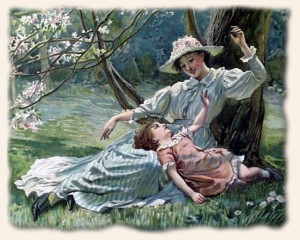 Mother-Themed Prints
#20 – Thoughts on the most historic 19th century report… (*revisited)
March 21, 2014 by GuyHeilenman · Leave a Comment
A few weeks ago we had some interesting comments on what collectors thought was the most historic 20th century newspaper report. Let’s try the same with the 19th century. But given the tremendous diversity of events from 1801 thru 1900 I’m going to break the century into three parts: pre-Civil War; the Civil War; and post-Civil War. Let’s work our way backwards and discuss the post-Civil War era first.
There are many ways to approach “most historic”. My approach will be the most life-altering event with emphasis on “event”. One could argue that the second Industrial Revolution dramatically changed the world but it cannot be pinned down to a single date or event.
 Several items come to mind: the first successful Atlantic cable in 1866 was a major step in causing the world to be much smaller–a trend which continues to this day; the completion of the transcontinental railroad in the United States was a major step in the westward expansion & settlement of the United States which changed the country in many ways; and then there is the Battle of Wounded Knee which was the last battle in the American Indian Wars and the official end of the Old West. Not to be omitted would be the invention of the automobile by gentlemen in Germany in 1889.
I’m going to go with the completion of the transcontinental railroad. In thinking of the multitude of events which played off this event and how it changed the fabric of America (pardon the ethnocentrism) I’ll vote for it as the most historic event of the 19th century post-Civil War era.
What are your thoughts?
—————
*The Fall of 2013 marked the 5th anniversary of the History’s Newsstand Blog by Timothy Hughes Rare & Early Newspapers. We are grateful to have the opportunity to contribute to the newspaper collecting community, and appreciate those who have participated through guest posts, comments, and readership. This year (2014) we are revisiting the top 25 posts (measured by activity), with the number 1 post being re-posted during the first week of 2015. Please enjoy. If you would like to contribute a post for consideration of inclusion on the blog, please contact Guy Heilenman at guy@rarenewspapers.com.
Valentine’s Day flowers… chocolates… rare newspapers?
February 13, 2014 by GuyHeilenman · Leave a Comment
 “I love you!” Why is this so hard to say to those whom we love? The old adage goes that when I seasoned relic from the mid-20th century school of cold-knocks was asked why he never tells his wife he loves her, he replied, “I told her I loved her the day we married. If anything changes I’ll let her know.” While a bit humorous, one can’t help but hear the sad sound of little-girl dreams gone unrealized. Valentine’s Day has certainly served its role in helping to remind us to say the things that often go unsaid. Chocolates, flowers, and cards are great tokens of our love, but they pale in comparison to the very words themselves: I love you!
The following historic newspapers, like the February 16, 1861 issue of Harper’s Weekly (shown to the right), provide a chronological look through time at how the holiday has been viewed: Newspapers with Valentine’s Day coverage.
The Traveler… “spite” hermetically sealed… President Lincoln’s draft order…
February 3, 2014 by The Traveler · Leave a Comment
I traveled today to New York City by way of The New York Times dated February 1, 1864. There I found that President Lincoln had just “Ordered, that a draft for five hundred thousand men, to serve for three years or during the war, be made on the 10th day of March next, for the  military service of the Untied States, crediting and deducting therefrom so many as may have been enlisted or drafted into the service prior to the 1st day of March, and not heretofore credited.” This is signed in type: ABRAHAM LINCOLN.
Also in the issue is an article with the heading “The Death Bandage of Gen. Walker”. “…Lieutenant Drennon… brings with him, hermetically inclosed in glass, the bandage which covered the eye of Gen. William Walker, when he was shot at Truxillo, Honduras…. ‘Remnant of the bandage which encircled the brow of Gen. William Walker, who having honorably capitulated to Norvell Salmon, Commander of H.B.M. steamship of war Icarus, was treacherously surrendered to the Honduras authorities, and by the executed on the 12th September, 1860, in the town of Truxillo. Posterity will do justice to their memories. The victim will be deplored while the traitor will be execrated.’ The bandage is thick with gore, full of bullet holes, and is partially burned — the file of executioners standing so close that the discharges set fire to it…” This was to be presented to General Walker’s father who resided in Nashville, Tennessee. What an item to be presented with to remember your son…
~The Traveler
#24 – Lincoln’s assassination in a Washington, D.C., newspaper… (*revisted)
January 17, 2014 by GuyHeilenman · Leave a Comment
 One of the (positive) frustrations we have always dealt with as a rare newspaper dealer is not being able to share some of the best material which comes our way. Not surprisingly very rare and very historic items have a waiting list of customers waiting for it to come into inventory and such newspapers are typically sold before they have the opportunity to be listed in a catalog. But here is where our blog is of value, allowing us an opportunity to share some nice material even though no longer available for purchase.
Holding true to the belief that newspapers from cities where historic events took place are the best to have, our recent sale of the “Daily Morning Chronicle” of April 15, 1865 from Washington, D.C. fits this description very well. Although purchased by a member with a *“want list” for such material, the issue is too fascinating not to share with others, hence this link to the listing and photos.
Enjoy one of the best newspapers to have on Lincoln’s assassination.
Note: Although we manage a want list for key material, with thousands of such wants, the system is not perfect (i.e., we occasionally miss an item on someone’s want list and it ends up being purchased through a member or public offering). We simply promise to do the best we can. If you have key content of interest, feel free to be in touch.
*The Fall of 2013 marked the 5th anniversary of the History’s Newsstand Blog by Timothy Hughes Rare & Early Newspapers. We are grateful to have the opportunity to contribute to the newspaper collecting community, and appreciate those who have participated through guest posts, comments, and readership. In 2014 we will revisit the top 25 posts (measured by activity), with the number 1 post being revisited during the first week of 2015. Please enjoy. If you would like to contribute a post for consideration of inclusion on the blog, please contact Guy Heilenman at guy@rarenewspapers.com.
Just for fun… the month of January through time…
January 10, 2014 by GuyHeilenman · Leave a Comment
I thought it might be fun to take a look at historic newspapers from a different perspective – the month of January through time. The issues have been arranged in chronological order, most recent first. It is interesting to see the varied events which have made the news to start the year over the centuries. Please enjoy.
January Newspaper Reporting Through Time
A Christmas wish… 2013…
December 23, 2013 by GuyHeilenman · Leave a Comment
While Christmas is certainly a time when many who would not normally do so reflect on the spiritual, historic newspapers reveal a time when the lines between the spiritual and the physical were not nearly so distinct. Religion, while largely stripped from the currently public square, was part and parcel of daily conversation in the not to distant past. An example would be the following report of the importance of religion in the lives of Civil War soldiers found in the Hammond Gazette (Point Lookout, MD) of September 22, 1863. My Christmas wish is that we would regain our previous understanding of the role of true religion in everyday life, minus the driving harsh conditions of the past. Please enjoy.


A good reason to stand & fight…
December 20, 2013 by TimHughes · Leave a Comment
The “Hammond Gazette” hospital newspaper from the Civil War, dated August 25, 1863, has an interesting front page item concerning the “Gray Beard Brigade” (see below) and why they are inclined to stand & fight. And also a likely reason why one of their elderly members joined the army.
A lament of a dying soldier…
December 13, 2013 by TimHughes · Leave a Comment
Occasionally the human side of war comes through in the newspapers of the day, giving hard evidence of the tragedy of lost life and how it affects those back home. The front page of the: “Hammond Gazette” from Point Lookout, Maryland, Jan. 27, 1864, contains a poem titled “Who Will Care for Mother Now?” (see below) It reflects the sorrows & concerns of a dying soldier, and obviously attracted much attention as the internet is full of references to this poem, which at some point was to music as well.