
Search
The Rare & Early Newspapers Hobby

Receive the Newsletter

Buy Historic Newspapers

Historic Newspapers in the classroom…
August 13, 2012 by GuyHeilenman · 2 Comments
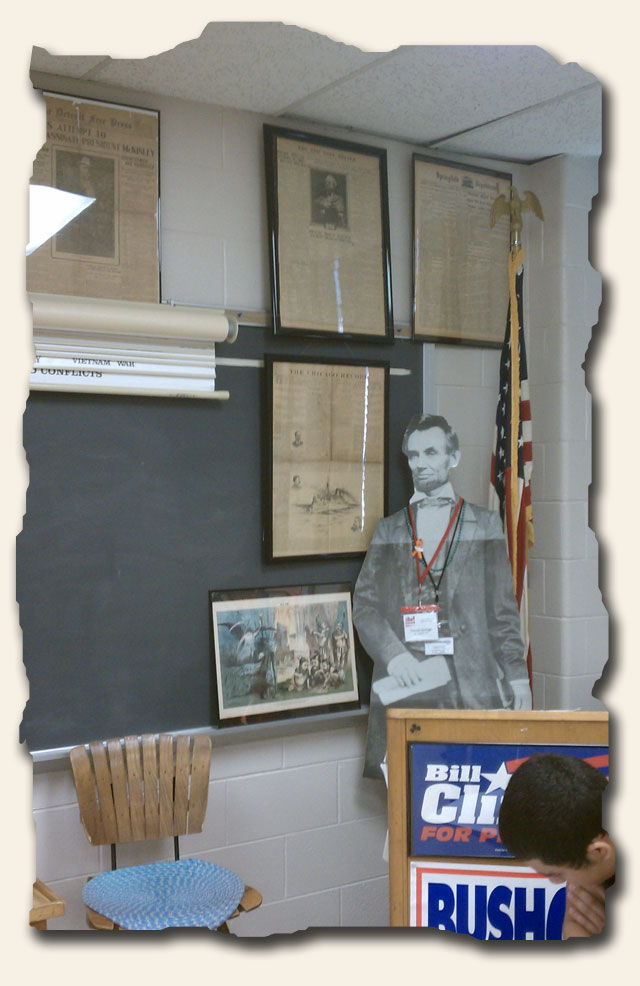 We received the following note from one of our collector friends and thought our readers might enjoy his note:
Dear Tim Hughes and Rare Newspapers:
and rote memorization of facts. Rather, I teach that history is the interpretation of the present as viewed through a prism of past human experiences. I encourage my students to realize that “historical figures” were once living breathing human beings. They may be gone, but the life lessons that they left behind can still empower us to improve our lives and to better understand our world. I believe that “hand’s on learning” provides students with the most ownership of their knowledge. For this reason, my classroom is a museum filled with dozens of historical artifacts and framed newspapers. For example, when studying the Lincoln assassination, I allow students to hold a tear-stained Philadelphia Inquirer from April 1865. My students have even had the opportunity to re-‐enact the 2000 Florida Presidential election on an actual Dade County voting machine. As a practitioner of Problem Based Learning, I believe giving students access to actual historical documents and relics makes the lesson a truly authentic learning experience. I want my students to realize that history is a never-‐ending story of human triumphs and tragedies. It is a story to which they are contributing. That is a powerful lesson.

Rick Brown’s Primer on Collecting Old & Historic Newspapers…
July 30, 2012 by GuyHeilenman · Leave a Comment
 Several year’s ago, a newspaper enthusiast by the name of Rick Brown had a passion to spread the love of collecting “history in your hands… from the day it was first reported”. One of his efforts was to print a newsletter for the hobby. An early entry was a primer on collecting newspapers. While many of the prices are out-of-date, we invite you to enjoy this original contribution to the hobby: Primer on Collecting Old & Historic Newspapers
We will continue to post additional contributions to the collectible experience in future posts.
Only Through the Innocence of Children…
July 6, 2012 by GuyHeilenman · 2 Comments
Our friends at HistoryBuff.com recently posted a newsletter which included an article regarding an early 20th century newsboy. Please enjoy!
Only Through the Innocence of Children
A Memoir of a Newsboy in 1939
The following is a personal memoir of Stanleigh Nettleton written in 1987. Unfortunately, he died a number of years ago – but his memoir lives on!
About 1939 I was working the complaint desk on the Chicago Herald-American one Sunday morning. The complaint desk was simply where people call in that missed their paper and I would call the branch manager and he would send a kid over there with another paper. However, it was also the message center for 7 district managers and 91 branch managers who were supervising 3000 carriers delivering over 100,000 home delivery papers in Chicago.
About 6:30 I got a call from Freddy, the branch manager in 158. He called in and simply said, “The boss is looking for me, tell him I’ll call him when I get back. I just got a call from Austin Avenue Police Station that they are holding a couple of my kids out there, so I am going out there now to see what the beef is.”
Well, about 8:30 Freddy calls and he says, “I’m back and everything is OK.” I asked “What about the kids the cops picked up?” He says, “Well, that’s a long story. I’ll tell you Tuesday when I come in the office.”
Come noon Tuesday Freddy comes over to the desk and says, “Let’s go eat.” As we ate lunch Freddy tells me about the carriers.
Out on Wilcox Avenue in Chicago’s West Side there was this big apartment building that was entirely occupied by Jewish families. In one of these apartments was an old Jewish fellow who managed to flee the Gestapo and came to live with his son in Chicago. One Sunday morning the father goes out into the hall to pick up the paper and as he turns to come back in the apartment, he freezes with fear, for right in the center of the door was a big “X” mark made from white chalk. This was exactly the way the Gestapo would mark the houses in Germany when they took the Jews away to the concentration camps.
He finally stopped shaking enough to go in… (Unfortunately the original link to this story is no longer active. -If anyone can find an online printing of the story, please let us know and we will update the link.)

Cool site of the day: Get a dose of US history…
June 25, 2012 by GuyHeilenman · Leave a Comment
Kim Komando recently wrote an article for Fox News (posted on their website) which focused on the historic value of rare newspapers… and made specific mention of the wealth of information available through the Library of Congress. Please enjoy: Cool Site of the day: Get a dose of history
Atmosphere versus Events – which newspaper-collecting path to tread?
May 28, 2012 by GuyHeilenman · Leave a Comment
 The following is a guest post by blogger Chee Seng:
Newspaper-collecting is something of an oddity in the collectibles and antiques scene. That’s because it’s not the printing house – or the paper/ink – which makes a newspaper valuable to the collector. It is something more ephemeral. It’s the very words that are printed on those yellowing sheets (or not so yellowing for pre-1875 issues), and how they connect to the unfolding story of the times. In other words, it is content, not the vessel, that can elevate one newspaper above all others, in the eye of the collector.
It’s also true to say that, because that collection of news-stories, articles, pictures and adverts are a snapshot of the very essence of an historical epoch – its life-and-times, its mores and outlook – that collectors can be looking at the same newspaper with very different eyes. Some want plenty of local interest, some are fixated on a great news story, some collect certain types of coverage religiously – and some are even looking for specific writers or illustrators.
But while no two-collectors are alike, you can split approaches to newspaper-collecting into two great camps. Those who are chasing after ‘events’, and those who want to steep themselves in the ‘atmosphere’. If you want to understand the sorts of newspapers you should be collecting,
you’d do well to try and understand the different viewpoints of these two camps. It’s not just a philosophical point – chasing ‘atmosphere’ versus ‘event’ can help decide whether a paper is worth one dollar, or a hundred.
It’s fair to say that ‘event’ collectors are hanging their collecting coats, first-and-foremost, from those real big hooks in the historical calendar. Those unforgettable and universal events that are remembered long after they have happened – and often very far from their point of origin. Good examples of these mega-events include the assassination of John F Kennedy or Abraham Lincoln,
the landing on the Moon, or the sinking of the Lusitania.
The reason these big events are so important is that, for many people, who would otherwise not come close to buying a historic newspaper, they resonate a strong chord with them. Having such a bold historical headline, framed and on the wall, is a way of displaying this strong emotional connection. And because so many people are seeking out these original ‘event’ newspapers, the pent-up demand drives up the value.
And of course, much of the interest in collecting newspapers, then, inevitably follows this money. Indeed, many people are drawn into the hobby purely to see if if they can reap big rewards from the ‘events’ held in that stack of newspapers, found stored in the attic. There is nothing wrong with taking such a monetary-influenced path – after all, it sustains many collectible hobbies. But it would
be sad if your newspaper-collecting was restricted to only these mammoth events – which can be counted on fingers and toes for most countries.
This is where the second path of newspaper collecting may be found to be ‘enriching’, on a different level: collecting for ‘atmosphere’. The starting point for the atmosphere collector is usually a personal interest in a particular era. Some people are drawn to the life-or-death drama of the World Wars – where even local news-stories are set against a backdrop of that wider struggle. Others are
find the moral contrasts of Prohibition-era America, for example, with its gangsters and raids and flighty fashions, irresistible.
Following this atmospheric path gives you a lot more scope to learn a little from history’s lessons. However, this is not the history taught in the dry words of the history text books – but in the often vivid and colorful language of the local news-hack. You may also find nuggets of historical interest that other collectors may also find fascinating – and so another route to a higher-than-normal
valuation can open up.
For example, there was a particular buzz, recently, over ‘frontier rags’ – newspapers that rolled out across the frontier, as the West was opened up. Some of these papers had short printing runs, and even shorter lives, as towns boomed and bust. That makes them pretty rare and exotic, and so a lively market grew up around these.
Of course its impossible to predict trends in atmospheric collecting such as these. Far better is to follow your instincts, and build a collection around what interests you. That way a labor of love will provide its own rewards, and any financial boon will come as a pleasant surprise. And that motto makes sense whichever path – event or atmosphere – your choice to take.
Newsies… a tough life…
May 11, 2012 by GuyHeilenman · Leave a Comment
While movies and stage shows such as Newsies show the life of a 19th century newsboy to be a difficult one, we still walk away with a somewhat romanticized view of their daily struggle. In contrast, the following article from The New York Times, September 1, 1868, helps us to better understand the conditions under which many of these young boys (barely) survived. As an integral part of the subculture of nearly every major city of the period, it is interesting to see a contemporary glimpse of the conditions under which they existed. To better grasp the perils under which they lived, click on the link any of the links to view both “The Newsboys Lodging House” and “A Sheep in Wolves Clothing” .
Period printing… Did you ever notice…?
April 30, 2012 by GuyHeilenman · 1 Comment
A few months ago we received an inquiry from one of our friends wondering why pre-1900 newspapers included a period after the newspaper’s title in the masthead. While I hold hundreds of such issues in my hands each week, I had never taken notice of this. Wondering if this was in fact the case, I quickly began searching through our 19th and 18th century archives, and low and behold, every title ended with a period. Searching through our 20th century inventory I discovered that none of the issues did. I asked Tim Hughes his thoughts on the matter, and his response was as follows:
Regarding the query about periods at the end of 19th century titles, I don’t believere there is a reason beyond it simply being the grammatical style of the  period. In fact the practice goes back to the 17th and 18th centuries as well. It was just the way newspapers (and magazines) were laid out, perhaps following some sort of grammatical “rule” of the day. There was also–compared to today–an excessive use of commas within text, which again was just the style of the day.
Perhaps the more interesting question would be when & why was the period eliminated at some point in the 20th century? I would suspect one paper just made the decision and everyone else eventually followed, as there was much competition and copying among newspapers. Sorry I don’t have a more intriguing answer!
If any of our readers have additional information in regards to this, feel free to respond.
Topsy the elephant… Thomas Edision vs. Nikola Tesla…
April 18, 2012 by GuyHeilenman · Leave a Comment
 Each day at Rare Newspapers brings new discoveries. Today we found an item which is quite historic. In 1903, the battle between Thomas Edison and Nikola Tesla (and Westinghouse) as to which form of electrical current (DC or AC) was to become the standard, was largely decided – with Edison’s DC current being the loser. Not willing to give up without a fight, Edison attempted to win public and political support by stressing the greater danger of death by electrocution from contact with AC current. In a highly publicized dramatic event, Edison organized and helped supervise the filming and electrocution by AC current of Topsy, a Coney Island circus elephant which had recently killed three men. While the execution was successful, and was overseen by the Society for Prevention of Cruelty to Animals, Edison was highly criticized for the event which did not accomplish his desired goal. The report was found on the front page of the ALLEGHENY COUNTY REPORTER, Wellsville, New York, January 6, 1903. I wonder if the S.P.C.A. would support such an action today?
Happy Passover… Happy Easter…
April 6, 2012 by GuyHeilenman · Leave a Comment
President George Washington is known for his letters to various Hebrew congregations (Newport, Savannah, etc.) and churches which are filled with spiritual references. Considering the recipients, such language might be expected even if the writer was not a person of faith. However, the following is a speech he gave to the leaders of Philadelphia upon his visit to the city while in transit to New York to take the oath of office. At a time when he could have said anything, what he chose to say and how he chose to say it speaks volumes. Please enjoy his address as it appeared in The Massachusetts Centinel, May 2, 1789: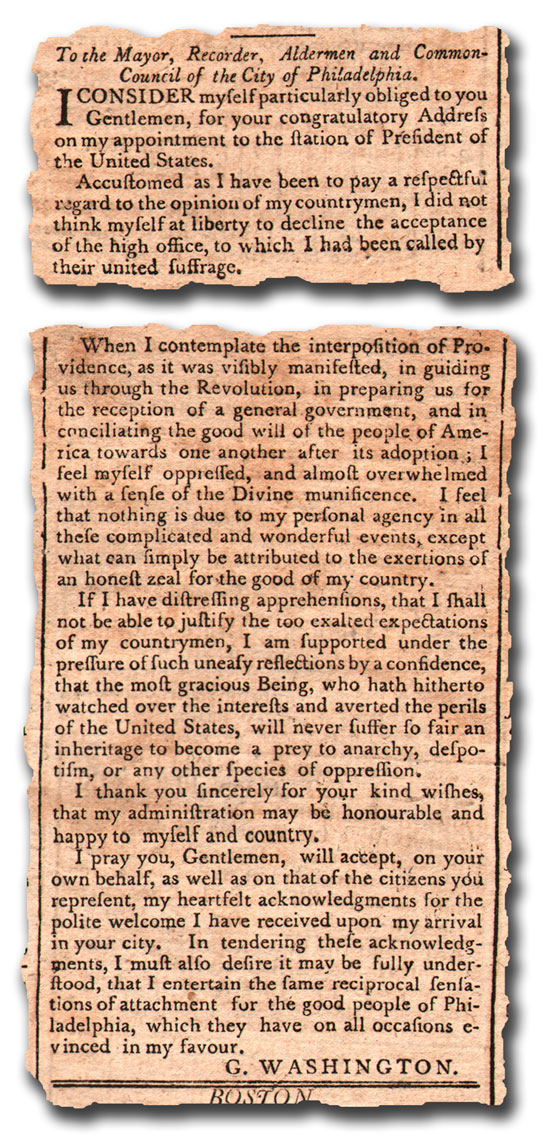
Marriage ceremony etiquette infraction?
March 31, 2012 by GuyHeilenman · Leave a Comment
I thought the groom was not supposed to “see” the bride on her wedding day until she walked down the isle? The groom apparently had other pressing concerns he felt trumped proper wedding etiquette. His behavior is quite revealing as to his true intentions (New York American, December 18, 1827):