

Search
The Rare & Early Newspapers Hobby

Receive the Newsletter

Buy Historic Newspapers

Charles Dickens on newspapers…
June 15, 2009 by TimHughes · 3 Comments
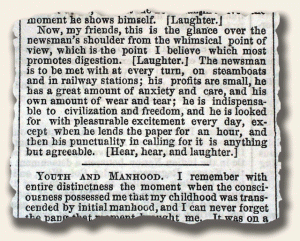 The Boston Evening Transcript of July 21, 1862, has a front page article “Charles Dickens on Newspapers”, a speech he delivered in London at the Newsvenders’ Benevolent Institution. The lengthy speech takes two-thirds of a column and is filled with witty comments, and ends with: “…The newsman is to be meet with at every turn, on steamboats and in railway stations; his profits are small…he is indispensable to civilzation and freedom, and he is looked for with peasurable excitement every day…”.
Male chauvinism has its drawbacks…
June 13, 2009 by TimHughes · 1 Comment
 The newspaper with a curious title of “The Tickler” from Philadelphia, January 22, 1812, contains a comical little item at the bottom of the back page. Little “treats” such as these may be found throughout old newspapers. See the photo.
Reducing old maids and increasing the population…
June 6, 2009 by TimHughes · Leave a Comment
 The Connecticut Courant issue of Hartford dated October 18, 1790 contains a curious piece taken from a Virginia newspaper, noting that:
“…a serious petition is now drawing up…stating arguments in favour of polygamy, from the plain principles of reason: and praying that a man may legally marry two wives. This, it is thought, will be the most effectual means to extirpate the numerous race of old maids, and increase the population of the United States…”
Editors take note: be mindful of photos accompanying headlines…
June 4, 2009 by TimHughes · 1 Comment
 The “Second Extra” of the Atlanta Journal newspaper of November 22, 1963 has a curious–if not macabre–combination of headline and photo. As would be expected of an “Extra” of this date, the large & bold headline proclaims: “KENNEDY KILLED” but immediately beneath it is a photo of a street sweeper pushing his bucket which has a pair of trousers & boots protruding from the top, with the caption: “Sweeper Means What He Says”.
One might excuse the editor, for I’m sure that in rushing this edition to the streets as quickly as possible the planned headline was removed and the Kennedy death report quickly inserted with little thought as to what else was scheduled for top half that day’s edition. But it serves as an important lesson to budding newspaper editors everywhere: be mindful of what what might accompany an article or photo.
Census with a bit of flair…
May 23, 2009 by TimHughes · Leave a Comment
“The Alaska Times” newspaper from Seattle, W.T. (Washington Territory), May 14, 1871, contains a very colorful front page article with a simple heading: “Alaska” which reports a census for Sitka. Enjoy reading how the inhabitants were categorized.

Davy Crockett survived the Alamo?
May 16, 2009 by TimHughes · 1 Comment
 The report shown appeared in the “Staunton Spectator” newspaper of Virginia, May 5, 1836. Accuracy in reporting the news certainly wasn’t any better back in 1836. Have you ever found similar inaccurate reporting?
Baseball fans… can you help?
May 11, 2009 by TimHughes · Leave a Comment
 A customer was requesting a newspaper with a report of Nap LaJoie, one of the more notable names in baseball in the early 20th century, ending the 1901 season with a .422 batting average. He was one of only a few to do so in the 20th century (there’s been a 67 year dry spell since Ted Williams was the last to do so, in 1941).
Finding reports of batting averages in 1901 is very difficult, but I did find a report at the end of the season which notes: “Lajoie…took part in 131 games. He was at bat 554 times, made 226 singles, 48 doubles 12 triples and 13 home runs…”.
Never mind that the numbers are slightly off from the official record book, which notes 543 games, 229 singles, 48 doubles (only one correct), 13 triples and 14 homers, as such errors might be understandable. But even given the accurate numbers, in calculating his average one comes up with a sum of 304 successful at bats, divided by the number of games (543) giving an average of .560. But curiously, if you just took his 229 singles divided by 543 the result is exactly his recorded batting average: .4217, rounded out to .422.
Should I surmise that the term “singles” actually means “hits” by today’s terminology ? Was this the common practice back then, to call any type of “hit” a “single”? If so, when did they make the switch?
Thanks for your help !
Tim
No smoking in the court of King James…
May 9, 2009 by TimHughes · Leave a Comment
 The Gazette of the United States from Philadelphia, Nov. 24, 1790, includes an interesting item on a treatise of King James I, who was way ahead of his time in opposing smoking.
He considered it a: “…heinous sin…” and those who used it were: “…guilty of great vanitie & uncleannesse–of sinful and shameful lust…”. He considered it: “…harmfull to the brain–dangerous to the lungs–and in the black stinking fume thereof, nearest resembling the horrible stygian smoake of the pit that is bottomlesse.”
See the photo for the full text.
Marriage & death in the same news report…
May 2, 2009 by TimHughes · 1 Comment
 Typically marriage and death reports are found in separate columns in the newspapers, but one news item in the Salem Mercury of July 6, 1831 could combine both into one:
“Marriage and Death — In Bath, Steuben Co. N.Y. 11th ult. Mr. Moses Alexander, 88, to Miss Frances Tompkins, 105. They wre taken out of bed dead on the following morning.”
Responding to the patriotic call…
April 25, 2009 by TimHughes · Leave a Comment
 The Columbian Centinel newspaper from Boston, April 28, 1792 contains a very inconspicuous notice at the bottom of the front page which calls for recruits for the military. It’s the wording which is a delight, as the call was put forth:
“To the sons of ambition—Those noble fellows whose courage and superiority of soul dictate to them to enter the list of Fame…Her field is now open and filled with every inducement for a Soldier; every necessary of life and every chance for fortune. It will be your fault if she does not stamp on your names HERO to be caught by every ear…” with more.
See the photo for the full text of this delightful little gem from the 18th century.