

Search
The Rare & Early Newspapers Hobby

Receive the Newsletter

Buy Historic Newspapers

The Traveler… Gen. Lee’s wagon train… Davy Crockett makes a monkey…
May 19, 2014 by The Traveler · 2 Comments
This week I traveled back to New York City by the means of Frank Leslie’s Illustrated Newspaper of May 21, 1864. There I found on the front cover the illustration of “Rebel Attack on Gen. Lee’s Wagon train at Mansfield, LA., April 8”.  “In the late reverses in Louisiana one of the most disgraceful points was the loss of the wagon train of Gen. Lee’s cavalry, which had been sent so far forward that it became impossible for the defeated cavalry to retreat. This led not only to the disgraceful rout of the men but also the capture of the train…”
Also in the issue was the following: “The celebrated David Crockett, on visiting a menagerie, was comparing the countenance of a monkey to that of one of his fellow-members of Congress. Turning, he saw the gentleman had overheard his remarks; so, to make matters pleasant, he said, ‘I do not know which to apologize to, you or the monkey.'”
~The Traveler
The Traveler… Mexican irony… dirty dancing prohibited!
May 5, 2014 by The Traveler · Leave a Comment
Today I traveled back to Boston by the means of The Boston Traveler and Evening Herald dated May 5, 1914. There I found a banner headline (see below) “Looting of Mexico City Planned”, with subheadlines, “New Plot to Down Huerta” and “Mexican Refugees at Vera Cruz Say Gen. Castro Is Stirring Army to Revolt.” How ironic to have this headline on the day of Cinco de Mayo — typically a special day of celebration in Mexico!
Also… The Boston school systems were being faced with a new dilemma… the dance craze, the tango! Due to this dance and other such “modern dances”, the headmasters were not going to take any chances with having these dances performed and were putting their foot down and cancelling all of the dances. And 3/4 of a century later, “Dirty Dancing” makes millions upon millions!
Additionally… The Leo Frank murder trial continues, with testimony that includes the accusation that he paid someone to lie for him.
~The Traveler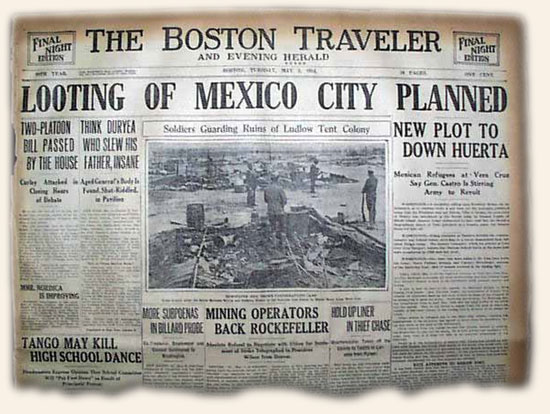
The Traveler… premature death… Tecumseh… substituting…
April 21, 2014 by The Traveler · Leave a Comment
 Today I traveled to Boston, Massachusetts by the way of The Yankee dated April 22, 1814. There I found an article on an embargo of vessels in the American harbors. This also included “…[Here the Editor gives a report of the capture of the President by the Majestic; and, says the article, Commodore Rodgers was killed.]…” Considering he died on August 1, 1838, I would say that this was a premature reporting of his death!
The last page of this issue contains a great “Biographical – Character of Tecumseh.” “The celebrated aboriginal warrior, Tecumseh was in the 44th year of his age, when he fell at the battle of the Thames. He was of the Shawanoe tribe, five feet ten inches, high, well formed for activity and the endurance of fatigue, which he was capable of sustaining in a very extraordinary degree…”
A great story from Georgia. A “youthful citizen” had volunteered his services to the military. Approaching battle, he was afraid that he may not survive so he found himself a substitute and returned home to his “heart’s delight.” She had already heard of what he had done and was not pleased of his patriotic indignation. When he had informed her of his intentions of their engagement, she replied “I must refuse to fulfill my engagement, until you employ a substitute.”
~The Traveler
An unusual two issue set… a disaster and a massacre…
April 11, 2014 by GuyHeilenman · Leave a Comment
 The Set: FRANK LESLIE’S ILLUSTRATED NEWSPAPERS, New York, both dated May 3, 1873.
The Intrigue: A two issue set of the same title with the exact same date? Yes. In regards to standard daily newspapers, especially those printed for major city distribution, it was not uncommon for there to be multiple editions of the newspaper printed on the same day – perhaps a morning and evening edition. However, we have yet to discover a weekly illustrated newspaper who printed more than one version of an issue on the same day. It is this lack of discovery to-date which makes this two-issue set rather interesting. Frank Leslie’s Illustrated apparently printed two nearly identical but different issues for May 3, 1873… each having a different cover. One might think they accidentally reprinted a cover from a previous week for some of the issues, but we have had the other issues surrounding this date, and none of them have either cover in question. Additionally, while the inner pages are almost all the same, there is also another page (pg 125) which is different. Everything else is identical.
If anyone is aware of the background concerning this set, please share.
Note: Additional (and quite interesting) information concerning both front pages may be found at Colfax Massacre and Richmond Switch Disaster (Rhode Island).
The Traveler… Leo Frank… “Watchful, Waiting”…
April 7, 2014 by The Traveler · Leave a Comment
 Today I traveled through Atlanta, Georgia by the way of The Atlanta Constitution dated April 7, 1914. There I found the defense attorneys for Leo Frank had come into possession of a large number of new affidavits which would be made public shortly. Also coverage of the war in Mexico between Carranza and Pancho Villa. This also has the reporting of the Fall of Torreon with the reporting of the expulsions of the Spaniards.
“Watchful, Waiting” policy is how Lloyd Brown was dealing with his 14-year marriage as he was bringing a divorce suit to court. He said shortly into the marriage his wife “began to take a violent dislike to him… She had not only left the house, but had taken all the covers off the bed before so doing. I borrowed some more from a neighbor and, when my wife came back in the morning,…I explained to her that to her that things couldn’t go along that way much longer… I just sat there and said nothing. Well, that made her madder and madder, I just sat still and kept quiet. Finally she hit me over the head with a fire shovel.” She left that night and never returned. Divorce granted.
~The Traveler
The Traveler… the verdict… the change… yeah, yeah, yeah…
March 17, 2014 by The Traveler · Leave a Comment
 Today I traveled back in time through The Detroit Free Press of March 15, 1964. The issue featured a banner headline “How Dallas Jury Reached Verdict of Death for Ruby” in which “…the four women and eight men jurors reached the decision — one of four possible verdicts open to them — after just two hours and 20 minutes of deliberation…”. Ruby was on trial for shooting to death Lee Harvey Oswald, who killed President John F. Kennedy. Ruby did appeal the case but died from a pulmonary embolism as the date for his new trial was being set.
Just a few weeks prior, Cassius Clay had defeated Sonny Liston in the world heavy weight boxing match. “‘Cassius X’ Says He’s a ‘Prophet'” said “…his Muslim name is ‘Muhammad Ali and I’m a true follower of Elijah Muhammad. I face east five times a day…”. This is when he started using Muhammad Ali as his known name.
And just for fun, “Happiness is a 40-ft. Beatle”… yeah, yeah, yeah!!!
-The Traveler
The Battle of Los Angeles…
March 14, 2014 by TimHughes · 2 Comments
 The “Los Angeles Times–Extra” of February 24, 1942 has one of the more dramatic, screaming headlines to be found in any newspaper: “L.A. AREA RAIDED ! ” with a smaller head noting: “Jap Planes Peril Santa Monica, Seal Beach, El Segundo, Redondo, Long Beach, Hermosa, Signal Hill”. The report begins: “Roaring out of a brilliant moonlit western sky, foreign aircraft flying both in large formation and single, few over Southern California early today and drew heavy barrages of anti-aircraft fire–the first ever to sound over United States continental soil against an enemy invader…” (see).
The Battle of Los Angeles, also known as The Great Los Angeles Air Raid, is the name given to this rumored enemy attack and subsequent anti-aircraft artillery barrage which took place from late February 24 to early February 25, 1942 over Los Angeles. The incident occurred less than three months after the United States entered World War II as a result of the Japanese Imperial Navy’s attack on Pearl Harbor.
Initially, the target of the aerial barrage was thought to be an attacking force from Japan, but speaking at a press conference shortly afterward, Secretary of the Navy Frank Knox called the incident a “false alarm.” Newspapers of the time published a number of reports and speculations of a cover-up. Some modern-day UFOlogists have suggested the targets were extraterrestrial spacecraft. When documenting the incident in 1983, the U.S. Office of Air Force History attributed the event to a case of “war nerves” likely triggered by a lost weather balloon and exacerbated by stray flares and shell bursts from adjoining batteries.
Air raid sirens sounded throughout Los Angeles County on the night of February 24-25, 1942. A total blackout was ordered and thousands of air raid wardens were summoned to their positions. At 3:16 am the 37th Coast Artillery Brigade began firing .50 caliber machine guns and 12.8-pound anti-aircraft shells into the air at reported aircraft; over 1,400 shells would eventually be fired. Pilots of the 4th Interceptor Command were alerted but their aircraft remained grounded. The artillery fire continued sporadically until 4:14 am. The “all clear” was sounded and the blackout order lifted at 7:21 am.
Several buildings and vehicles damaged by shell fragments, and five civilians died as an indirect result of the anti-aircraft fire, three of them killed in car accidents in the ensuing chaos and two of heart attacks attributed to the stress of the hour-long action. The incident was front-page news along the U.S. Pacific coast, and earned some mass media coverage throughout the nation.(credit to Wikipedia)
The Traveler… victory over Indians… horrible finding…
March 3, 2014 by The Traveler · Leave a Comment
 Today I traveled through Boston, Massachusetts, by the way of The Yankee (March 4, 1814). There I found a lengthy report on the Indian battle taking place, known as the Battles of Emuckfaw and Enotachopo Creek. The battles were under the leadership of Maj. Gen. Andrew Jackson, General Coffee and Captain Hamilton. This battle included “friendly Indians” fighting against the Creek Indians. This report was submitted by Andrew Jackson.
“A Tale of Horror” report from Rutland, Vermont, was of a merchant, Joseph Green, who suddenly went missing. The town people thought he may have gone out of town, but when he did re-appear, they investigated his business and found his mangled remains behind a large woodpile under the stairs. “A person by the name of James Anthony, a hatter by trade, was strongly suspected of being accessory to his secretion, if not murder, in consequence of marks of violence which appeared on his face, and the manner in which he accounted for the same.” He was found guilty and commitment to prison until the sitting of the supreme court in the town the following Monday.
~The Traveler
The Frederick Douglass’ Paper… Solomon Northup…
February 24, 2014 by GuyHeilenman · Leave a Comment
 I absolutely love this collectible!
We had in our possession for a number of years an original issue of the Frederick Douglass’ Paper, dated March 17, 1854. It certainly was a grand paper – it being a continuation of Douglass’ North Star. However, while the notoriety of the title was well-established and the angst of slavery oozed throughout, it was a 21st century movie which infused new life into it’s weary 150+ year-old raglinen pages.
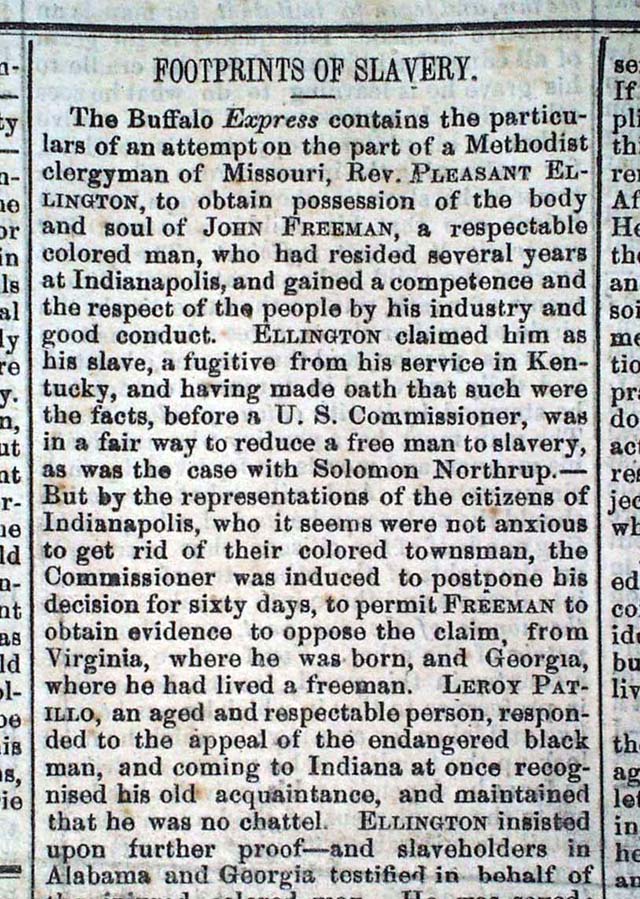
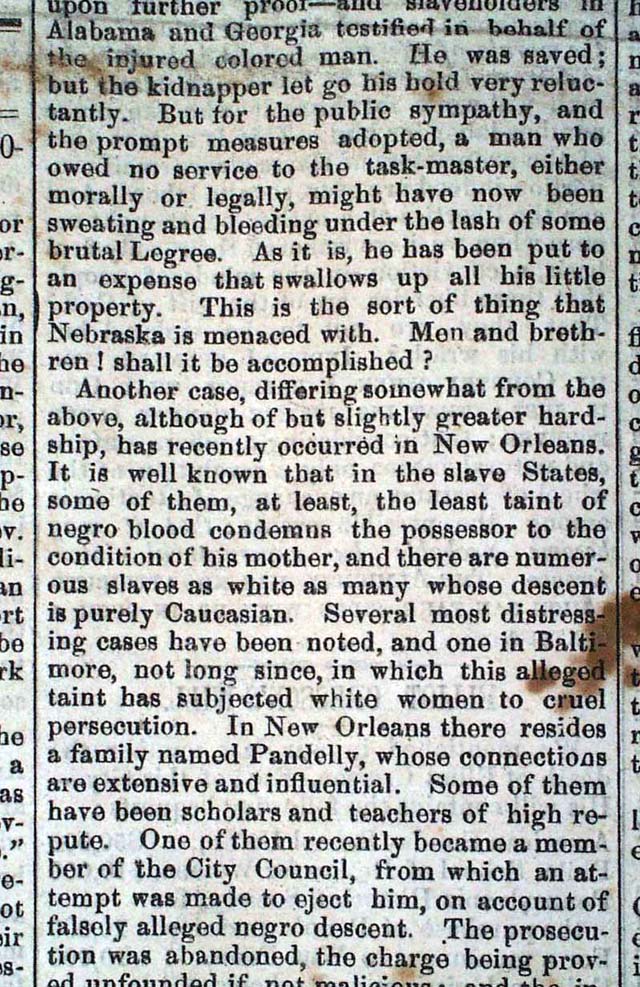
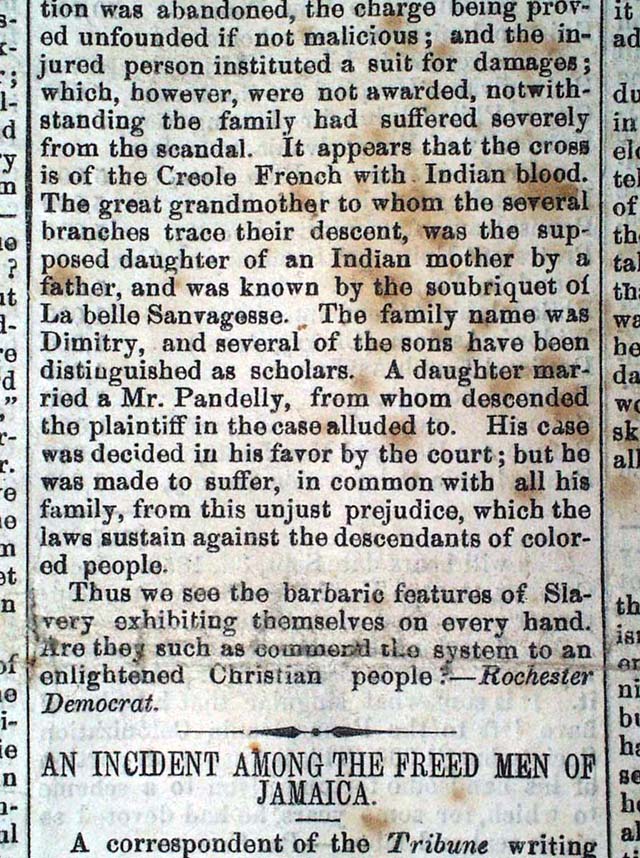
A collector recently went to see the theatrical adaptation of “Twelve Years a Slave – The Memoir of Solomon Northup“, and was moved to visit the Rare & Early Newspapers‘ website to see if we had newspapers with his mention. Searches for his name were unsuccessful – but this collector was not to be deterred. Having previously viewed the Frederick Douglass’ Paper in question, he took the next step and began to go over the corresponding images with a fine-tooth comb. Success. The newspaper was not only noteworthy for its editor and rarity, but it also had an article on the front page with mention of Solomon Northrup (see below). Fantastic.
Like I said, I love this collectible!
The Traveler… to catch a bear… He’s what?… No whites allowed?
February 17, 2014 by The Traveler · Leave a Comment
Today I traveled back to London, England, by the way of The London Chronicle: or, Universal Evening Post dated February 18, 1764. There I found an interesting article on “The manner of catching Bears at Kamtschatka” (see photo below) which is a peninsula in Russia Far East. Although that article itself is quite interesting in the manner of how to catch these animals, the introduction is even more fascinating. “Bears and wolves are so numerous, that they fill the woods and fields like cattle; the bears in summer, and the wolves in winter. The bears of Kamtschatka are neither large nor fierce, and never fall upon people, unless they find them asleep; and then they seldom kill any outright, but most commonly tear the scalp from the back part of the head; and, when fiercer than ordinary, tear off some of the fleshy parts, but never eat them… It is remarked here that the bears never hurt women; but, in the summer, go about with them like tame animals, especially when they gather berries. Sometimes, indeed, the bears eat up the berries which the women have gathered, and this is the only injury they do them…”
Another article is of a death of a “…woman that went by the name of John Chivy. She dressed always in man’s apparel, and passed for a man; and notwithstanding she had been married upwards of 20 years, her sex never discovered till her death…”.
The following article caught my attention. “Among the sundry fashionable routs or clubs, that are held in town, that of the Blacks or Negro servants is not the least. On Wednesday night last, no less than fifty-seven of them, men and women, supped, drank, and entertained themselves… till four in the morning. No Whites were allowed to be present, for all the performers were Blacks.” The closing sentence made me ponder as to its meaning. I welcome your thoughts and explanations as well.
~ The Traveler