

Search
The Rare & Early Newspapers Hobby

Receive the Newsletter

Buy Historic Newspapers

19th century newspapers… revisited…
December 26, 2009 by GuyHeilenman · 1 Comment
Over the past three weeks Timothy Hughes has explored his thoughts concerning what he believes to be the top ten newspapers from each of the pre-18th, 18th, and 19 centuries (see below), the most recent being the latter. Some of his thoughts concerning the 1800’s historic newspapers were captured in the following video:
Collecting authentic rare and historic newspapers from the 1800’s can be exciting, rewarding and surprisingly affordable. Daily newspaper reports of America’s tumultuous 19th Century included first hand accounts of historic turning-points like….. the Louisiana Purchase…the Civil War…and Spanish-American conflict. As cries of “manifest destiny” signaled America’s unbridled expansion west, newspapers became a crucial link for a people suddenly united in a common quest that would set their young nation on a course of unprecedented and historic prosperity.
There are many sought after “holy grails” from the 19th century, including: o President Abraham Lincoln’s Assassination o Battle of Gettysburg and the Gettysburg Address o Battle of the Alamo o Deaths of Jessie James and Billy the Kid o Issue from Tombstone Arizona (Tombstone Epitaph) o Winslow Homer’s “Snap the Whip”
Of course, select accounts of the most historic & desired events of 19th century America are available for premium prices.
However, a wealth of fascinating original newspapers from the vast inventory of Timothy Hughes Rare & Early Newspapers are available for much less…often as little as $30 – $50. These include first-hand news from the War of 1812, Yankee & Confederate Civil War battle reports, slave ads from the South, the California Gold Rush with outlaw & Indian battle accounts, the Mormon migration to Utah and fascinating reports of when baseball was in its infancy.
The “Old West” and America’s westward expansion are represented in genuine newspapers from California, Utah, Nevada, Montana, and Arizona. You’ll also find affordable issues from the illustrated press which graphically documented every aspect of 19th century America in the pages of Harper’s Weekly, Frank Leslie’s Illustrated, Gleason’s, Ballou’s, and The London Illustrated News.
Whether your interest is in the War of 1812, westward expansion and the gold rush, the Civil War, and/or the Wild West, original newspapers provide an excellent view of history in context. History is never more fascinating than when when it’s read from the day it was first reported. If you love history… you deserve to have it in your hands. Rare newspapers make this possible. Please enjoy the hobby.
Top ten newspapers: 16th and 17th centuries…
Top ten newspapers: 18th century…
Top ten newspapers: 19th century…
18th century & pre-18th century newspapers… revisited…
December 17, 2009 by GuyHeilenman · Leave a Comment
Over the past two weeks Timothy Hughes has explored his thoughts on what he believes to be the top ten pre-18th century and the top ten 18th century newspapers (see below). Some of these thoughts were captured in the following video:
Collecting authentic rare and historic newspapers from the 1500’s – 1700’s can be exciting, rewarding and surprisingly affordable. British titles such as the London Gazette, London Chronicle, Gentleman’s Magazine and more, are all available for much less than you would expect, as are their American counterparts, the Columbian Centinel, Dunlap’s Daily American Advertiser, Concord Herald, and more.
Whether your interest is in the Colonial Era or the Revolutionary War Era, or extends to the 1500’s and/or 1600’s, original newspapers provide an excellent view of history in context. History is never more fascinating than when when it’s read from the day it was first reported. If you love history… you deserve to have it in your hands. Rare and early historic newspapers make this possible. Please enjoy the hobby!
Top ten newspapers: 16th and 17th centuries…
Top ten newspapers: 18th century…
The “top ten”: 18th century…
December 14, 2009 by TimHughes · 9 Comments
Continuing with our “top ten events to be found in newspapers” for various periods of time, today we consider the 18th century.
What an event-filled one hundred years it was. As you can tell by the list my focal point is on the American Revolution, but there are other events or specific newspapers which made it into my top ten.
Again I offer apologies to our non-American friends as this list has a decidedly American bias, primarily because the vast majority of those who purchase from us are American.
Here we go, starting with number ten:
 10) Death of George Washington, 1799 (Front page, preferably in a Virginia Gazette)
9) Hanging of Captain Kidd, 1701 (Just can’t resist a great pirate hanging, he being perhaps the most famous of all time)
8.) Any newspaper with the first installment of Paine’s “The Crisis” (“These are the times that try men’s souls…” has to be one of the more famous beginnings of all time)
7) Full text of the Stamp Act (Certainly a trigger event that would lead to the Revolution)
6) Boston Tea Party (In a Boston newspaper. An event every school kid knows about)
5) The Pennsylvania Journal, Nov. 1, 1765 “skull & crossbones” engraving (Replaced its normal masthead on this date: seen in most history books)
 4) Battle of Lexington & Concord with mention of Paul Revere’s ride (The beginning of the Revolutionary War. I had one once with mention of Revere–exceedingly rare–great to have in a Boston area newspaper)
3) The Boston News-Letter, 1704 (Great to have issue #1 of America’s first successful newspaper, but any issue from 1704 would do)
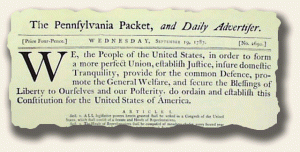
2) The Pennsylvania Packet, Sept. 19, 1787 (First newspaper to print the Constitution, & done in broadside format. Need I say more?)
1) The Declaration of Independence, 1776 (Ideally the Pennsylvania Evening Post, July 6, 1776, but the Packet of July 8 would work too as it contains the Declaration entirely on the front page: better for display).
Top 10 lists…
December 3, 2009 by GuyHeilenman · Leave a Comment
Top 10 lists are always fun to consider. Their strength is in their ability to generate thought, reflection, and opinion. We all acknowledge that no two top ten lists are the same, and whereas going to experts in the field may add a certain level of credibility to a list, even an amateur/novice can bring food for thought to the discussion. Everyone has an opinion, and each and every opinion has some some value. In the end, the greatest benefit may well be in the journey traveled as we formulate and consider both our own views as well as the views of others.
It is with this in mind we plan to offer 4 top ten lists over the course of the next four Mondays. The focus will be on giving thought to the top ten most historic newspapers from each of the following eras: 17th century and earlier (12/7/2009), 18th century (12/14/2009), 19th century (12/21/2009), and 20th century & beyond (12/28/2009). In some cases we may choose a specific newspaper title (any date), realizing that having any issue of the title is of note. In other instances we may focus on a specific title and date of a newspaper – these being the “holy grails” of the hobby. Yet in other cases we’ll include a more general top ten entry, focusing on the event itself, acknowledging that finding any newspaper coverage of the event is noteworthy.
As we proceed through the month, we invite both reactions to our lists and the submission of your own “top tens”.
 In an effort to help kick-start your walk into the past, we invite you to enjoy a recent post which appeared on OnLineSchool.net titled, “100 Great Moments in American History You Can Catch on YouTube”, by Amber Johnson: (http://onlineschool.net/2009/11/18/100-great-moments-in-american-history-you-can-catch-on-youtube/).
Old news is good news for collectors…
November 19, 2009 by GuyHeilenman · Leave a Comment
 David Chesanow recently interviewed Timothy Hughes for a post at Americollector.com titled, “Old news is good news for collectors”. Some of the questions asked were:
- What newspapers do you yourself collect: ones from a specific region or era or pertaining to a certain subject? Or are newspapers in general your collecting “area” and you just like the rarest, most historic items?
- What are the collecting areas within the hobby?
- What are some of the interesting collecting areas of some of your customers?
- How extensive is the hobby of collecting rare newspapers? Are there any other dealers at all who specialize in this?
- What are the “Holy Grails” of newspaper collecting?
- Are newspapers ever forged? For example, aren’t there a lot of professionally done reprints in England?
- What have newspapers been made of over the years, and how perishable are they? Are the high-acid papers necessarily hard to preserve?
- When was the transition from rag content to high-acid paper in the U.S. and abroad?
- AND… many more!
The entire post is available for viewing at: Americollector.com. Thank you David for your contribution to the collectible.
A look back at the past’s look into the future…
November 14, 2009 by GuyHeilenman · Leave a Comment
 One of the many pleasures of the Rare Newspaper collecting hobby is often quoted within our material:
“History is never more fascinating than when it’s read from the day it was first reported”. In fact, this look back is the impetus for the name of this blog, “History’s Newsstand”. However, occasionally these excursions can also provide us with a glimpse of just how far we’ve come in comparison to the expectations of those who lived in the past. It is such a look into the future, from exactly 100 years prior to today’s posting, that is available to us through an old newspaper section we found within our archives pulled from the Cleveland Leader, November 14, 1909. Please enjoy this look back at the past’s look into the future: The Cleveland Leader, 11/14/1909. The link will take you to a brief description of the article in question, with images of the entire article. Did we surpass their expectations? We’d love to know your thoughts.
Celebrating 150 years since Arizona’s first newspaper…
November 2, 2009 by TimHughes · 2 Comments
The history of Arizona, an Indian word meaning “place of small springs”, goes back some 10,000 years B.C. with the arrival of the first Native Americans, while its history as recorded by Europeans dates to 1539 when the first white an, Marcus de Niza, a Franciscan friar arrived. It was organized as a territory in 1863 and admitted as a state in 1912, the last of the 49 contiguous states to join the Union.
Arizona’s first newspaper was the “Arizonian”, started at Tubac in March, 1859. Tubac lies about midway between Tucson and the Mexican border. For the following we credit Megan Thomas and the Chronkite News Service:
“For visitors at Tubac Presidio State Historic Park, (volunteer James) Pagels rolls ink and presses paper to metal to demonstrate a Washington Hand Press that was used to print the state’s first newspaper, “The Weekly Arizonian”. It still provides visitors with replicas of the paper.
“It’s living history,” Pagels said.
Arizona State Parks is preparing to celebrate the 150th anniversary of the arrival of the press in Arizona. Brought by ox cart from the Mexican port of Guaymas for William Wrightson of the Santa Rita Mining Co., the press turned out the first copy of the Arizonian on March 3, 1859, promoting the mining company and its agenda.
The “Arizonian” published out of Tubac for several months before moving to Tucson. According to an account by the late Douglas C. McMurtrie, a historian of printing in the U.S., the newspaper apparently ceased publication in the summer of 1860, resumed briefly in 1861 and resumed once again in 1867 – both times under different ownership – before finally folding for good in 1871. The press wound up in Tombstone, printing the Nugget newspaper for a time, and, according to McMurtrie, passed to the Arizona Historical Society in 1913.
Back home in Tubac and on permanent loan to Arizona State Parks, the press is a point of pride, said Joe Martinez, manager of the park.
“I think it’s amazing that the press came here in 1859 can still function today and we can show it to people and give them copies of the first edition,” Martinez said.
That edition describes attacks by Native Americans and crimes including horse thefts. It notes that stagecoaches were charging 40 cents to $1 per pound for extra baggage on runs between El Paso and San Diego. A section is devoted to the obituary of James Gadsden, who brokered the purchase from Mexico of nearly 30,000 square miles that are now part of southern Arizona and New Mexico.”
Collectible themes… additional thoughts…
September 28, 2009 by GuyHeilenman · Leave a Comment
There is an endless variety of ways to collect early newspapers.
- The vast array of newspaper dates, titles, sizes and content would seem almost formidable should one decide to collect newspapers without a theme or focus. Even a small percentage of every newspaper title published would not only be a formidable task to assemble but would be too cumbersome to organize and store.

- But collecting by theme offers a fascinating challenge to cut through the forest of available titles to add only those issues to a collection which fit the scope of a special interest. And the areas of interest can be endless.
- Whatever one’s interest might be a newspaper collection can be assembled as an interesting complement. You like old radios? Collect newspapers reporting the development of the radio and its antecedents from the telegraph to satellite radio. Or collect newspapers with advertisements of the radios in your collection. You like military history? Collect newspapers reporting major battles of each of America’s conflicts from the French & Indian War to the Gulf War. Politics? Collect issues covering the elections, or inaugurations of each president from George Washington to the present. Or collect at least one of each of the annual state-of-the-union addresses beginning with Washington (yes, he started the tradition which continues today). Or perhaps presidential deaths, or significant policy pronouncements.
- The Wild West, 20th century gangsters, sports heroes, the weird & bizarre, major tragedies, scientific developments are just a few themes. More specific topics can result in a very focused collection themed on just the Civil War or World War II or Western exploration or 19th century baseball to name a few.
- Less event-focused collections can also result in an intriguing variety of issues, such as one newspaper from every decade from the 1650’s to the present showing the progression & evolution of newspaper publishing from its infancy to the internet. Huge headlines of any event can provide for a very dramatic & displayable collection, or erroneous reports (Dewy Defeats Truman” is the most famous, but there are many more), printing errors (wrong dates, upside-down type, misspelled headlines, etc.) can result in an interesting collection.
- Given the tens of thousands of titles and the 400 year span of newspaper publishing the themes of collecting are virtually endless. Explore and widen your interest by adding newspapers to your collection. A fascinating world of collectibles awaits you.
Note: If you are still having trouble deciding on a theme upon which to begin centering your collection, consider the History’s Newsstand Store’s or the Rare & Early Newspapers’ list of categories as potential starting points. Many collectors began their collections by amassing a low-end (low priced) issue from each decade from the mid-1700’s through the mid-20th century. A basic issue from each U.S. President’s term of office is also a popular theme.
The list of collecting strategies is endless. Feel free to contribute ideas of your own.
Alaska’s first newspapers…
September 24, 2009 by TimHughes · 2 Comments
The very first newspapers published in a state or territory–particularly those west of the Allegheny Mountains, have always been of interest to me and I suspect others as well. To share the wealth of information found John C. Oswald’s “Printing In The Americas” I will, from time to time, reflect upon the first newspaper or newspapers in many of the United States. Alaska’s interesting history will be first.
 The first periodical issued for distribution in Alaska was in handwritten form. It was a monthly “published” for the information of a force of men laying a telegraph line connecting Alaska with Siberia. Its name was the “Esquimeaux” (we now spell ‘Eskimo’), begun Oct. 14, 1866 and continued for twelve numbers, ten done at Libbysville, Port Clarence, Russian America, and two at Camp Libby, Plover Bay, Eastern Siberia. The completion of the Atlantic cable having put an end to the telegraph project, the manuscript of the “Esquimeaux” was taken to San Francisco & issued in printed form beginning Oct. 31, 1867.
The first formal newspaper which circulated in Alaska was actually printed in San Francisco beginning March 1, 1868, shortly after the purchase of Alaska by the United States, titled the “Alaska Herald“. It was semi-monthly & printed in both Russian & English.
The “Alaska Times” started at Sitka on May 1, 1869 and continued there until 1870 when it was moved to Seattle where–according to Oswald–just two numbers were published. But our inventory shows at least 20 numbers having been published in Seattle.
“News Rooms”: a curiosity of the past…
September 21, 2009 by TimHughes · Leave a Comment
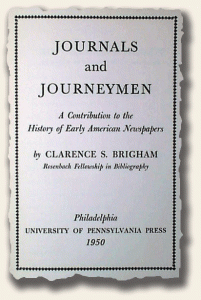
One last excerpt from Clarence Brigham’s book “Journals & Journeymen” is worthy of sharing with follow collectors as it explores a part of newspaper history of which most are unaware. The chapter is titled “News Rooms”:
 An interesting custom in newspaper history was the establishment in the early 1800’s of news rooms at nearly all of the larger towns. Somewhat akin to this idea was a project carried out at a much earlier day at Bridgeton, New Jersey. Here in December 1775, & continuing for two months, a weekly paper called “The Plain Dealer”, consisting of essays but with topics relating to the problems of the colonies, was written out in manuscript and posted up in Matthew Potter’s tavern. It enabled readers to gather at a central meeting place and peruse a weekly publication, which they would not trouble, or perhaps could not afford, to purchase.
Soon after 1800 reading rooms sprang up in several towns. In Boston the Anthology Reading Room was established in 1806, with 160 subscribers, and making available all the leading newspapers of the country. In 1808 Samuel Gilbert established at Boston what may have been the first commercial news room in the country. It was located in the Exchange Coffee House, erected in 1808, with its “Reading Room and Marine Diary” on the entrance floor where newspaper files could be consulted.
In New York, John H. Payne in 1811 opened a reading room where could be found the most important newspapers and magazines of the day. Charleston had a newsroom in 1813 where the terms were ten dollars for subscribers and strangers one dollar a month. In fact, almost every city and larger town before 1820 had its news room where leading newspapers were regularly filed. To enumerate them would require a lengthy chapter and necessitate an exacting study of early newspaper advertisements. Unfortunately there is no record of a new room proprietor preserving his files for posterity.