

Search
The Rare & Early Newspapers Hobby

Receive the Newsletter

Buy Historic Newspapers

Announcing: Catalog #316 (for March, 2022) – Rare & Early Newspapers (for purchase)
February 25, 2022 by GuyHeilenman · Leave a Comment
|
|
The links above will redirect to the latest catalog in approx. 30 days,
upon which time it will update to the most recent catalog.
Scientific American & the Harlem River… 1890…
February 11, 2022 by Stephanie Williams · Leave a Comment
Growing up less than 50 miles from NYC, it was a regular occurrence for “us kids” to reach as far forward in the car as we could to be the first of the family to pass the paint mark on the Lincoln Tunnel walls delineating the New York/New Jersey boundary. Along with the iconic skyline and the Statue of Liberty, tunnels and bridges defined the vista of any excursion to Manhattan.
 Today’s jaunt into the Scientific American reminded me of those childhood outings and had me scouring old maps to discern the changes wrought in the waterway systems for the development of metropolitan New York. This publication, filled with inventions and botanical discoveries, also chronicles the many arenas of civil engineering foresight and ingenuity. Those examples of “aging infrastructure” so hotly debated in the political arena of today, were the marvels of yesterday. Without computer models, before construction vehicles, absent the communication methods of today, great changes were made to the natural landscape in order to accommodate the iconic center of commerce.
An article in the March 22, 1890, Supplement to Scientific American describes “The Harlem River Improvement and Ship Canal” — a project that lasted thirteen years and cost over $200,000. Many political, geological, and legal difficulties are described, along with evaluation of decisions made, as well as alternate proposed solutions. The detail is fascinating, even to someone who has no understanding of the impact rivers and railroads have on commerce and industry. In fact, it never occurred to me that rivers are moved, straightened or even deepened in order to make them more useful. And I wonder what today’s civil engineers think of the building strictures from over one hundred years ago.
The laws of May 20, 1879, provides that all bridges hereafter to be constructed over this channel shall be at right angles to its courses, and that the bridges at the draws shall not be less than 24 feet above high water of spring tide, and that no tunnel shall be constructed under it which will not permit the excavation of a 20-foot channel.
Announcing: Catalog #314 (for January, 2022) is now available…
December 31, 2021 by GuyHeilenman · Leave a Comment
-
Catalog 314 (in its entirety)
-
Noteworthy Catalog 314 ($250+)
-
Combined Catalogs (current, w/ remnants of previous)
Don’t forget about this month’s DISCOUNTED ISSUES.
The links above will redirect to the latest catalog in approx. 30 days,
upon which time it will update to the most recent catalog.
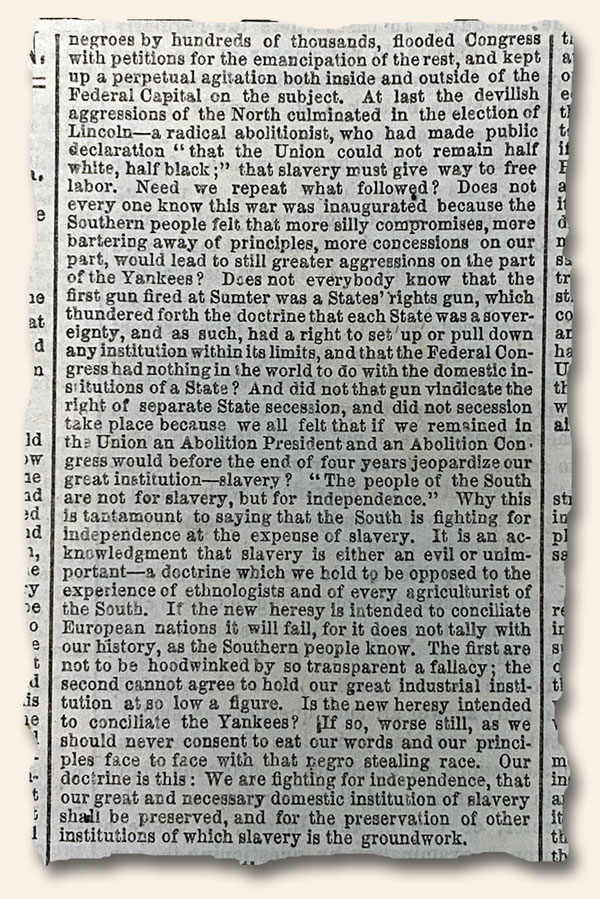
Snapshot 1864… Confederacy’s fight – for independence or slavery?
December 20, 2021 by GuyHeilenman · Leave a Comment
In grade school back in the 1960’s/1970’s I was taught that the Civil War was fought between the Northern (Yankee) States who wanted to free the slaves and the Southern States (Confederates) who wanted to keep the slaves in bondage. Bad Southerners! Perhaps if I had been born in The South my education would have been bent in a different direction, but through my teenage years I assumed this was the accepted “truth”. When I moved on to college… and then graduate school, my assumption of such a simplistic view was challenged by my enlightened (now I think they would be called “woke”) professors who informed me of the true reason: The Southern States merely wanted to exercise their right to self-government (i.e., “State’s Rights”)… to not be controlled by a federal government whose reigns were largely in the hands of the Northern States and their own interests… the right to separate (succeed)., while the Northern States wanted nothing more than to preserve The Union (largely for selfish reasons). Bad Northerners!
Of course I now know the reasons were varied and complex, but by far the most important result was in fact the Emancipation of enslaved blacks. After all, how could “We The People” possibly stand the test of time without embracing (to the core) the self-evident truth that “all [people] are created equal, that they are endowed, by their Creator, with certain unalienable Rights, that among these are Life, Liberty, and the pursuit of Happiness”?
However, I digress. Circling back to the divergent views I was taught…
As I was perusing a Sacramento Daily Union (Nov. 3, 1864), the heading of a front-page article caught my attention: “The New Agitation in the South – Slavery as Well as Separation the Ultimate Object of the Rebellion”. It turns out that while revising history to meet a specific narrative may be the order of the day, the historical perspective regarding this particle issue may not be a victim of these Orwellian efforts. The article (in full) is as follows:
Announcing: Catalog #313 (for December, 2021) is now available…
December 3, 2021 by GuyHeilenman · Leave a Comment
-
Catalog 313 (in its entirety)
-
Noteworthy Catalog 313 ($250+)
-
Combined Catalogs (current, w/ remnants of previous)
Don’t forget about this month’s DISCOUNTED ISSUES.
The links above will redirect to the latest catalog in approx. 30 days,
upon which time it will update to the most recent catalog.
Snapshot 1801… The importance of newspapers…
November 4, 2021 by GuyHeilenman · Leave a Comment
In 1803 the well-respected Columbian Centinel and Massachusetts Federalist dated August 19, 1801 printed an article affirming a new publication, the Country Gazette of the United States (Philadelphia), and made a powerful statement regarding the importance of newspapers which we have shown below. This declaration is reflective of new president Thomas Jefferson’s comments regarding newspapers from back in the late 1780’s:
“The people are the only censors of their governors: and even their errors will tend to keep these to the true principles of their institution. To punish these errors too severely would be to suppress the only safeguard of the public liberty. The way to prevent these irregular interpositions of the people is to give them full information of their affairs thro’ the channel of the public papers, & to contrive that those papers should penetrate the whole mass of the people. The basis of our governments being the opinion of the people, the very first object should be to keep that right; and were it left to me to decide whether we should have a government without newspapers or newspapers without a government, I should not hesitate a moment to prefer the latter. But I should mean that every man should receive those papers & be capable of reading them.”
If either the publisher of the Columbian Centinel or Thomas Jefferson were alive today, do you think they’d feel the same? Please share your thoughts.
WW2 Era Newspapers Found In The Attic… Are They Worth Anything?
October 25, 2021 by GuyHeilenman · Leave a Comment
Perhaps the most common inquiry we receive concerns newspapers from World War II found in parents’ attics. As generations pass it is incumbent upon their children to sort out what is of value and what is not.
The list which follows is a guide for determining what to keep and what to dispose.
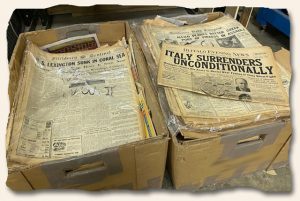 In general, there are only about 15 events which are sufficiently notable to excite most collectors. Those event not included on the list are considered “generic” or “atmosphere” issues which, although reporting much on the war, are generally not significant enough to draw the attention of the serious collector.
It’s worth noting that graphic appeal tends to trump title. Example: the New York Times remains one of the more notable newspapers of the 20th century, but their headlines were typically conservative, lacking any drama, flash, or graphic appeal. Small town newspapers with dramatic graphic appeal will be more desired.
Issues which fit the events and criteria noted below could well have collector value. Feel free to send the exact title and date of each along with photos of the entire front pages (showing margins) to: info@rarenewspapers.com
Note: Perhaps the mostly commonly reprinted issue of the war is the Honolulu Star-Bulletin of Dec. 7, 1941. Most of the issues on the market are the common reprint, still sold at the souvenir stand at the U.S.S. Arizona Memorial in Honolulu. See this blog post on how to tell a reprint from the genuine issue.
Top 15 events of World War II:
1) Germany invades Poland, 9/1/1939
* This event marked what many regard as the start of the war. Although not an American
event, most collectors want this report among their holdings.
2) Attack on Pearl Harbor, 12/7/1941
* Japan’s naval air force attacks military bases on Oahu, Hawaii, thus thrusting the United States into the war. The more dramatic and shocking the wording in a banner headline the better.
3) U.S. Declares war against Japan, 12/8/1941
* Just one day after the attack on Pearl Harbor the United States officially declares war against Japan, formalizing America’s entry in the war in the Pacific.
4) U.S. declares war against Germany & Italy, 12/11/1941
* The United States enters the war in Europe as well, just 3 days after declaring war against Japan.
5) Battle of Midway, 6/4-7/1942
* Just six months after Pearl Harbor the United States scores a major naval victory in the Pacific against Japan. Being a multi-day event, collectors would pursue the best headline near the end of the battle reporting the American victory.
6) D-Day, 6/6/1944
* With Axis forces controlling much of Western Europe, this day marks the offensive of the Allied forces in re-taking conquered countries. The word “Invasion” is desired somewhere within the headlines.
7) Battle of the Bulge, 12/16/1944
* This was the last major German offensive on the Western Front taking place from December 16, 1944 to January 25, 1945. Issues near the end of the battle which reported an Allied victory would be more desired.
8) Photo of the flag raising on Mt. Suribachi, Iwo Jima, 2/23/1945
* If there was a single, iconic photo of American successes in the Pacific it would be this Pulitzer Prize-winning photo. Many newspapers included it in their editions of a day or two later, many did not. Better if the photo is on the front page, as many newspapers—when using it—did so on an inside page.
9) Death of FDR, 4/12/1945
* Although arguably not a true war event, the death of the President who was Commander-In- Chief of the military through almost the entirety of the war cannot be missed as a notable event.
10) Death of Hitler, 4/30/1945
* Hitler’s suicide deep inside a Berlin bunker essentially ended the war in Europe as just days later terms of surrender were agreed to by Nazi officials. Most newspapers reported his death on May 2, and a few published the Nazi propaganda report that the Fuehrer: “…has fallen in battle at the head of the heroic defenders of the Reich capital…”. The blunt words: “Hitler Dead” are more dramatic than “Death of Hitler”.
11) V-E Day, 5/7/1945
* The official end of the War in Europe. This was one event where newspapers often used patriotic embellishments to celebrate the victory, some multi-colored, some incorporating war photos within letters, etc.
12) Atomic bomb drop on Hiroshima, 8/6/1945
* With the war in the Pacific still raging, the first atomic bomb ever deployed was dropped over the city of Hiroshima. Some newspaper down-played the horrific affects of the bomb. More desired are headlines which more accurately reported the incredible devastation.
13) Atomic bomb drop on Nagasaki, 8/9/1945
* Just 3 days after Hiroshima, the second atomic bomb was dropped, which prompted the Japanese to pursue surrender terms. Again, bluntly accurate reporting in the headline is desired over a more subdued report.
14) V-J Day, 8/15/1945
* Terms for surrender were agreed upon, and the world announced the end of World War II. Much like V-E Day, newspapers typically became very creative in patriotically celebrating the end of the war. The more creative the front page the better.
15) Formal surrender of Japan, ending WWII, 9/2/1945
* Signing of the surrender terms happened on board the U.S.S. Missouri in Tokyo Bay. Although most collectors would consider V-J Day as the end of the war, and in many respects it was, collectors often pursue this event as well.
There are also 2nd-tier items which could be collectible, but the extent of coverage and graphic appeal are paramount, and in some cases the title/publisher is essential. The list below contains such items, and will be updated from time-to-time.
Pre-War
Nuremberg Laws enacted, 9/15/1935
Jews no longer permitted to own property (various)
Opening of Concentration Camps (various)
Kristallnacht, 11/9-10/1938
During The War
Fake Report of attack on Los Angeles, “Battle of Los Angeles” (2/25/1942)
Bismarck Sunk, 5/27/2941
Star of David Badge, 9/7/1941
Doolittle Raid , 4/18-20/1942
USS Lexington Lost, 6/12/1942
Bataan Death March, 1/28/1944
JFK PT Boat, 6/11/1944
MacArthur returns to the Philippines, 10/20/1944
Post-War
USS Missouri – Peace Treaty Signed, 9/2/1945
Louis Zamperini Found, 9/9/1945
Patton’s Death, 12/21/1945
The October (2021) Newsletter from Rare & Early Newspapers…
October 15, 2021 by GuyHeilenman · Leave a Comment
Monthly Newsletter ~ Rare & Early Newspapers
|
|
|


Announcing: Catalog #311 (for October, 2021) is now available…
October 1, 2021 by GuyHeilenman · Leave a Comment
- Catalog 311 (in its entirety)
- Noteworthy Catalog 311 ($250+)
- Combined Catalogs (current, w/ remnants of previous)
Don’t forget about this month’s DISCOUNTED ISSUES.
The links above will redirect to the latest catalog in approx. 30 days,
upon which time it will update to the most recent catalog.
The September (2021) Newsletter from Rare & Early Newspapers…
September 17, 2021 by GuyHeilenman · Leave a Comment
Monthly Newsletter ~ Rare & Early Newspapers
|
|