
Search
The Rare & Early Newspapers Hobby

Receive the Newsletter

Buy Historic Newspapers

Where did it end up? Boston
October 20, 2016 by GuyHeilenman · Leave a Comment
 As both collectors and sellers of historic newspapers, we (Rare Newspapers) often wonder what happens with many of the issues which pass through our hands. We know some have been given to Presidents, well-known authors, and various public figures throughout the world. Equally rewarding are those which end up in the hands of those whom either love history or have a personal connection with the issue’s content. Many are found in museums for all to see, yet others a likely stored away in boxes for protection and many never again see the light of day. Regardless of their final resting place, we derive a certain degree of satisfaction in knowing we play a part in preserving history in written form. With these thoughts as a backdrop…
We recently became aware of how one issue has been put to use (see image). Feel free to explore:
BOSTON SEMI-WEEKLY ADVERTISER, Sept. 20, 1856
Announcing: The 250th Catalog from Rare Newspapers…
September 8, 2016 by GuyHeilenman · Leave a Comment
Catalog 250 is now available. This latest offering of authentic newspapers is comprised of nearly 350 new items. Some of the noteworthy content includes: a printing of the Constitution of the United States, an issue of The Royal Gazette from Charleston (1782), a 1659 newsbook we’ve never offered before, Winslow Homer’s famous “Snap The Ship”, an issue with the British response to the Declaration of Independence, coverage of Cornwallis surrenders at Yorktown, and more. Key items which include the remaining items from the above may be viewed at: Noteworthy Catalog 250
Whereas the entire catalog is shown at Catalog 250, the following links are intended to aid in quickly finding items from the catalog based on era:
• 1500-1799 (full view OR quick-scan “compact” view)
• 1800-1899 (full view OR quick-scan “compact” view)
• 1900-2015 (full view OR quick-scan “compact” view)
To view items from both the current and the previous catalog, go to: Combined Catalogs
Anyone know anything about this newspaper?
August 22, 2016 by TimHughes · Leave a Comment
If any of our collectors are looking for an interesting puzzle to solve, here is one. We’ve come across a single sheet newspaper from Dublin, Ireland, “THE FLYING NEWS-LETTER“, with “Monday October 11” in the dateline. This would seems to be an exceedingly rare title as an internet search resulted in nothing with this title from Dublin.
 There is no issue number noted in the masthead as would be typical. There is also no year printed in the dateline, but a search notes that the only Mondays which fell on October 11 from the mid-18th century (my estimate based on paper, format, layout) in which the printer, Edward Exshaw, was working as a printer were 1736 and 1742 as he died in 1748. The years 1725, 1731 also had a Monday, October 11, but a website notes he was “active in Dublin from 1733-1748”. And 1756 and 1762 also had a Monday, October 11, but being after his death his name would not had been in the imprint at the bottom of the back page.
I would be curious to know which of these two years it was printed (no year is noted in any of the articles), and a bit more about how long the newspaper published. Is this issue unique?
Thanks for any help!
Chuckle for the day…
June 9, 2016 by TimHughes · Leave a Comment
The “Pennsylvania Packet“, Philadelphia, issue of September 24, 1788 contains on page 3: “Dean Swift’s idea of an attorney…”. You can read it for yourself (see below).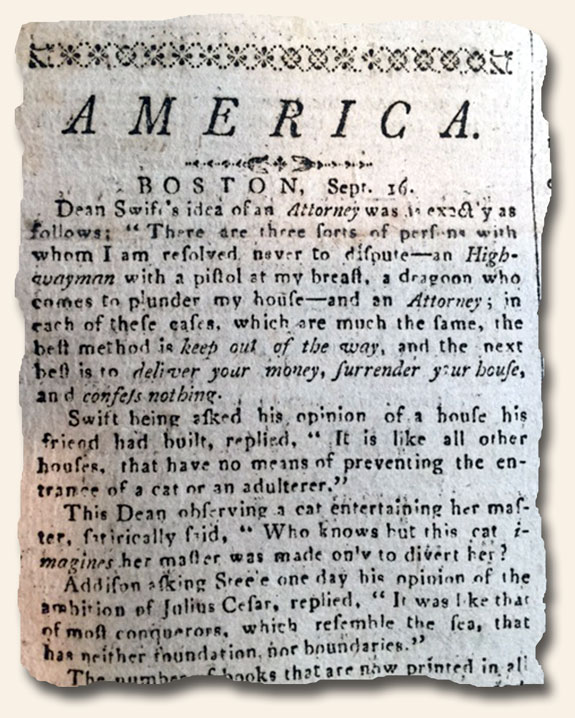
Obtaining the Value of a Newspaper or Collection…
May 12, 2016 by GuyHeilenman · Leave a Comment
We do not monitor requests concerning the value of newspapers through this venue – but we would be glad to assist. If you have a newspaper or a collection for which you are seeking an appraisal, please contact us directly at info@rarenewspapers.com. Please include as many details as possible. Thanks.
Newspaper Museums abound… Looking for input…
January 28, 2016 by GuyHeilenman · Leave a Comment
 Newspapers have been one of the main means of community communication for several centuries. While many newspaper publishers have closed their doors as on-line access has increased, one would still be hard-pressed to find a city without its own printed newspaper. However, as the number of newspaper publishers gradually decrease, the number of newspaper museums appear to be on the rise. Current news may be best viewed within a moment of its occurrence via the internet, news of the past (history) seems to be best viewed first-hand – either by reading a historic newspaper first-hand, or by visiting one of the hundreds of newspaper and print-shop museums. Collecting rare newspapers satisfies the first, but what about the second? The Newseum and the American Antiquarian Society (think Isaiah Thomas) are great place to start, but what about museums with a more local or historical bent? A favorite for some is the relatively new Edes & Gill Print Shop attached to The Old North Church in Boston, but what about others? If you have visited a newspaper museum and/or historic print shop which you found interesting, please share by commenting with the name, location, and a brief mention of what you enjoyed.
Lincoln’s “under the radar” proclamation for Thanksgiving…
November 25, 2015 by GuyHeilenman · Leave a Comment
Many are quite familiar with President Abraham Lincoln’s Thanksgiving Proclamation of October, 1863. However, few have read or heard of his similar proclamation from a few month’s prior which helped build the foundation for his famous October proclamation. The Star of the West, July 25, 1863 contains the text (see images below) of this earlier declaration calling for a day of thanksgiving and prayer – words which are apropos as we prepare (in the U.S.) to celebrate Thanksgiving. Note: We’ve included the text of this famous proclamation below.
October 3, 1863
By the President of the United States of America.
A Proclamation.
The year that is drawing towards its close, has been filled with the blessings of fruitful fields and healthful skies. To these bounties, which are so constantly enjoyed that we are prone to forget the source from which they come, others have been added, which are of so extraordinary a nature, that they cannot fail to penetrate and soften even the heart which is habitually insensible to the ever watchful providence of Almighty God. In the midst of a civil war of unequaled magnitude and severity, which has sometimes seemed to foreign States to invite and to provoke their aggression, peace has been preserved with all nations, order has been maintained, the laws have been respected and obeyed, and harmony has prevailed everywhere except in the theatre of military conflict; while that theatre has been greatly contracted by the advancing armies and navies of the Union. Needful diversions of wealth and of strength from the fields of peaceful industry to the national defense, have not arrested the plough, the shuttle or the ship; the axe has enlarged the borders of our settlements, and the mines, as well of iron and coal as of the precious metals, have yielded even more abundantly than heretofore. Population has steadily increased, notwithstanding the waste that has been made in the camp, the siege and the battle-field; and the country, rejoicing in the consciousness of augmented strength and vigor, is permitted to expect continuance of years with large increase of freedom. No human counsel hath devised nor hath any mortal hand worked out these great things. They are the gracious gifts of the Most High God, who, while dealing with us in anger for our sins, hath nevertheless remembered mercy. It has seemed to me fit and proper that they should be solemnly, reverently and gratefully acknowledged as with one heart and one voice by the whole American People. I do therefore invite my fellow citizens in every part of the United States, and also those who are at sea and those who are sojourning in foreign lands, to set apart and observe the last Thursday of November next, as a day of Thanksgiving and Praise to our beneficent Father who dwelleth in the Heavens. And I recommend to them that while offering up the ascriptions justly due to Him for such singular deliverances and blessings, they do also, with humble penitence for our national perverseness and disobedience, commend to His tender care all those who have become widows, orphans, mourners or sufferers in the lamentable civil strife in which we are unavoidably engaged, and fervently implore the interposition of the Almighty Hand to heal the wounds of the nation and to restore it as soon as may be consistent with the Divine purposes to the full enjoyment of peace, harmony, tranquility and Union.
In testimony whereof, I have hereunto set my hand and caused the Seal of the United States to be affixed.
Done at the City of Washington, this Third day of October, in the year of our Lord one thousand eight hundred and sixty-three, and of the Independence of the Unites States the Eighty-eighth.
By the President: Abraham Lincoln
William H. Seward,
Secretary of State
Golden Nuggets… the “hits” just keep on coming…
June 29, 2015 by GuyHeilenman · Leave a Comment
At Rare & Early Newspapers we always enjoy hearing about the various “finds” that permeate the collectible. While most significant content is know before one purchases an issue to add to their collection, due to the nature of the hobby, golden nuggets cannot help but be buried, yet  undiscovered, deep within the pages of a newspaper. In some instances, the discoveries are quite significant – that is, significant to all having a general knowledge of history. In other cases, the find might be a little more subtle – yet still worthy of bringing to light.
The following account was sent to us not too long ago. Feel free to send along your own stories as well (send to guy@rarenewspapers.com).
Hi, I just wanted to let you know the papers arrived in great shape as usual but what was really great was once I went through them were the other stories I found.
In the May 8, 1930 New York Times on page 11 there was a story about how a newspaper in Havana, Cuba was fearing Al Capone was about to move there they feared he would turn it into “a second Chicago.”
In the inner pages of the Dec. 27, 1941 L.A. Times there was a story about five Iowa brothers joining the Navy and will serve together. This is an article about the Sullivan brothers who were later killed inaction in the Pacific and the Hollywood movie The Fighting Sullivans was made about them.
This is why I love collecting newspapers it’s not only about the main story you might have kept the paper for but the inner page stories you might have not paid attention to at first.
Thanks C.H. for sharing your story with the Rare & Early Newspapers’ Family.
Post-Boys from London… A collector asks…
June 12, 2015 by GuyHeilenman · Leave a Comment
The following is a guest post from a collecting friend. Feel free to weigh-in on any of his questions or comments:
“While I have been buying newspapers for 10 years [from Rare Newspapers], I have yet to see numbers of estimates printed for the popular London Post-Boy (most of my collection is the Post-Boy). Over the years, I have not found any numbers on the web until just this week! I was again urged on my watching Art and Coin TV, in which the 1899 Morgan Silver Dollar for sale, was mentioned to be very rare, with only 300,000 minted! Ha!
In the publication ‘Publishing Business in Eighteenth-Century England’, by James Raven, he states surviving records list the thrice-weekly printing in 1704 was 9000 a week, so 3000 per date! Quite a bit less then Morgan dollar for sure. But what of the total numbers that survive today?
My best guess would be at most, 1-2 percent of any one date, under 100 copies held in intuitions and private hands? Any one here found any estimates published on surviving copies? As an off-set pressman by trade, I enjoy showing off the Post-Boy at work, to the delight of all.”
Lawrence Garrett
Follow-up from Lawrence:
“I know a phrase from a London Gazette I have been trying to fully understand, without success. {It is found within] a September 24, 1666 issue you have. It states a ship ‘struck on the sands of the riff-raffes’. This sounds like a Sandbar, but I have seen sandbars called just that in these old newspapers. Despite much research, I cannot find any slang term for sandbars from any time period, let alone 1666. It would be nice to find published information confirming these Riff-Raffes are indeed sandbars. Is it possible these sea/lake/river bottom features were called Riff-Raffes BEFORE land use for rough trouble making people? Any other readers found this in other newspapers?”
A National calamity… What is one to do?
April 3, 2015 by GuyHeilenman · Leave a Comment
What does one do when abruptly ushered into one, if not the, most powerful positions on earth by the untimely death of the President of the United States? Today, in honor of the Easter Holiday Weekend, we reach back to 1841 to see how newly elevated President John Tyler responded when placed in this situation. The following proclamation, which begins in part, “When a Christian people feel themselves to be overtaken by a great public calamity, it becomes them to humble themselves under the dispensation of Divine Providence, to recognize His righteous government over the children of men, to acknowledge His goodness in time past, as well as their own unworthiness, and to supplicate His merciful protection for the future…”, was printed in The Globe, Washington, D.C., April 15, 1841:
Happy Easter from the Rare & Early Newspapers Team