

Search
The Rare & Early Newspapers Hobby

Receive the Newsletter

Buy Historic Newspapers

Snapshot 1862… Civil War inner-family strife takes its aim at Lincoln…
June 11, 2019 by GuyHeilenman · Leave a Comment
The following snapshot comes from The Crisis, Columbus, Ohio, dated May 7, 1862, which printed the death report of Abraham Lincoln’s brother-in-law, and includes considerable Lincoln-directed angst.
I’m New Here: Week Seventeen…
June 7, 2019 by Stephanie Williams · Leave a Comment
Despite the obvious gender bias inherent in the title, I like “The Gentleman’s Magazine“, as I suspect many non-gentlemen of the time did as well. This week I pulled an issue from April of 1775 – mainly because I enjoy the tone of superiority that saturates those months before what we now know of as the Revolutionary War (or whichever various title you prefer). “Colonial upstarts” were causing commotion and consternation to the rest of the world, but mainly to the ruling class in London. The heading of the very front page of the one perched on my desk amidst the new catalog excitement is entitled, “Continuation in the House of Lords on the Address to his Majesty respecting the Situation of Affairs in America”. What follows is a labyrinthine balance between appeasing the vanity of the monarch, and an attempt to elucidate the different aspects of potential vulnerability to defeat. In particular, the French and Spanish ships continuing to trade with the colonists brought great consternation. “Does the noble Earl pretend to interpret this explanation [England would be “…at liberty to seize any of their ships trading with American subjects”] generally, so as to authorize our taking their vessels at sea? If he does not, what can such a vague deluding promise avail? If he does, then I will venture to assure his Lordship, that he is miserably deceived; and that the first attempt to prevent French or Spanish ships from navigating the American seas will furnish them with an opportunity of asserting their maritime freedom, of making reprisals, and of justifying their conduct to the other great states of Europe, who are known to be long jealous of what they are pleased to call our despotic claim to the sovereignty of the ocean.”
When I read this, I start to understand a little bit this American spirit, this classification under which our country has been perceived by the world, from the very earliest days. This mindset changed the world. And that is an immense, and not embarrassing, thought.
But, lest you think the GM’s are all politics, I would like to recommend any meteorology enthusiasts plug in the data compiled monthly and displayed on the inside cover page. The average prices of corn, wheat, rye, barley, oats and beans are delineated by county. Genealogists will enjoy the Births, Marriages, and Deaths alongside the list of Promotions and Bankrupts. There are book reviews and parish reports and a comprehensive section entitled “Historical Chronicle“, which gives an overview of multiple aspects of the state of the world.
Anyway, to delve into these accounts of the earliest days of this country is to see the tenacity that fueled an eventual nation – and perhaps nurture an admiration for what was once made, an inspiration for all that could be made again.
You can read more about Gentleman’s Magazines via previous posts at: Gentleman’s Magazines
Announcing: Catalog #283 (for June, 2019) is now available…
June 4, 2019 by GuyHeilenman · Leave a Comment
- Catalog 283 (in its entirety)
- Noteworthy Catalog 283 ($250+)
- Combined Catalogs (current, w/ remnants of previous)
Don’t forget about this month’s DISCOUNTED ISSUES.
(The links above will redirect to the latest catalog in approx. 30 days, upon which time it will update to the most recent catalog.)
I’m New Here: Week Sixteen…
May 31, 2019 by Stephanie Williams · Leave a Comment
Here in “our neck of the woods” Spring frequently brings tornado warnings. Yesterday, radios, smartphones, and computer displays all sounded the alarm. One of the part-time people working on the labels for Catalog 283 asked what I would choose for my last meal before the tornado hit. I parried with “what would you take into your safe space from the annals?” And my contribution, quickly and easily, was “The American Museum” issues — as many as I could grab from the shelf.
I have one collector who looks for these and he contacts me by email with a list of five or six dates. Every time I search, thinking “there is no way we have any from that month.” Each time I locate one or two, and he happily buys them. During that brief interaction studying dates and verifying the appropriate appendices I have come to find this publication ridiculously beautiful. If I were trapped in a tornado shelter, 18th Century American Magazines would suffice for amusement and instruction. In a single issue there are lexicons for four different Native American languages, methods for preparing dye, a treatise on the Biblical perspective of capital punishment, and political news from around the world. Stock prices are listed alongside poetry. In fact, the complete title enthralls me: “The American Museum: or Repository of Ancient and Modern Fugitive Pieces, &c. Prose and Poetical”.
Subscriber names, by state, are listed alphabetically over the first ten pages. The issue I randomly pulled has a touching inscription: “Henry Wayman Woods presented by his dear mother August 6, 1832. Wisdom is the principle thing, Henry.” The content feature is Lexington and Concord, but buried within one of the random sections is an article about the first reported African-American doctor and details of the “Virginia Calculator”, a slave from New Orleans who was described as a savant by Dr. Benjamin Rush (one of the signers of the Declaration of Independence).
There is so much to learn, packed within these octavo-sized (8” x 5”) papers. Knowledge was culled from every imaginable subject, in order to educate and enlighten. A well-informed public, it seems, was deemed critical for the development of the young country. In my opinion, that’s a lofty goal that would translate well to any civilization at any point in history.
Wisdom is, quite possibly, the principle thing.
They Put It In Print (1938)… Martin Niemöller…
May 28, 2019 by GuyHeilenman · 1 Comment
“First they came for the socialists, and I did not speak out—because I was not a socialist. Then they came for the trade unionists, and I did not speak out— because I was not a trade unionist. Then they came for the Jews, and I did not speak out—because I was not a Jew. Then they came for me—and there was no one left to speak for me.” (Martin Niemöller)
The Christian Science Monitor for March 4, 1938 reports Reverend Martin Niemöller has been sent off to a Nazi concentration camp.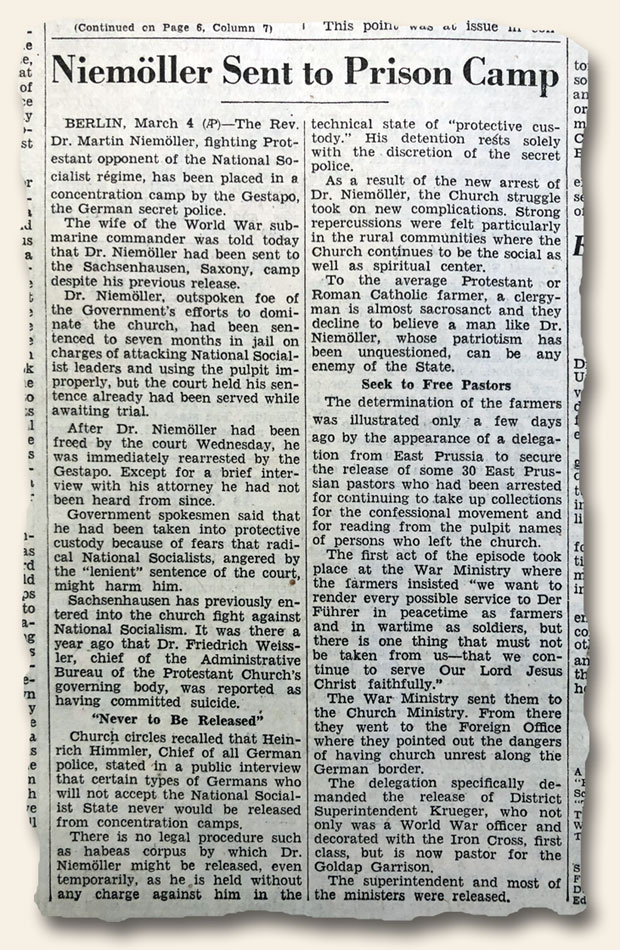
I’m New Here: Weeks Fourteen & Fifteen…
May 24, 2019 by Stephanie Williams · Leave a Comment
Last week I didn’t post because I was involved in a local amateur production of Disney’s Beauty and the Beast. Consequently, I returned to work with many dramatic musical numbers dictating the soundtrack of my mind. Perhaps that influenced my interest in an assigned hunt for a title that reported on the death of the “Leather Man” in 1839.
I found it, and duly replied back to the collector. But I also took a little bit of a break to search out the meager story of this individual who was a vagabond for 32 years of his life. The inscription on his tombstone describes a man, “who regularly walked a 365-mile route through 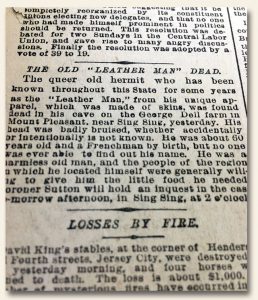 Westchester and Connecticut from the Connecticut River to the Hudson living in caves in the years 1858–1889.” Like clockwork, apparently, he completed his circuit every year and was greeted and given hospitality by many along the way who would normally reject any other vagrant. The internet provides an intriguing image of this leather patchworked fellow in his exile from the rhythms of normal life.
And, with the tortured song of the male lead sounding in my head, I wondered at the days preceding his arrival; what made him the man who came to be known this way?
Was he tormented and driven to trudge through the days, or was this a happy occupation for a human being – leaving behind the established cares of civilized life, content to cover so much ground in so many hours for the prescribed revolutions of the sun? Either way, or something in-between, he made it to the second page of The New York Times. For all the documentation housed here, how many millions of unread or even untold stories must there be?
Anyway, I am back at work, tracking down first, second and third day accounts of the original murder that inspired Capote’s “In Cold Blood” and pulling the obituary for a man who had no known name or history of origin. Next week I am determined to look at these territory papers that are so desirable, and maybe delve into the popular Gentleman’s Magazines with their coveted battle maps.
All of which remind me of one theory concerning the Leather Man: that he was an ex-French soldier. Perhaps that’s true, and all the years of marching over fields and sleeping rough became a way of life he ultimately could not break. Whatever compelled him, day after day, I’m fairly certain a tragic musical score is appropriate.
The May (2019) Newsletter from Rare & Early Newspapers…
May 21, 2019 by GuyHeilenman · Leave a Comment
Each month the staff of Timothy Hughes Rare & Early Newspapers sends out a newsletter to our members which includes special offers, discounts, alerts to new inventory, and information related to the rare newspaper collectible.
The May, 2019 newsletter:
|
 Welcome to the May 2019 edition of our monthly newsletter. Featured this month is an early look at one of the best issues from the Virginia Gazette collection, a free illustrated newspaper from 150 years ago (along with a snapshot of life from the period), three of my favorite posts from the past month (one full of discovery, one politically encouraging, and another providing food for thought), newly discounted items, and more. Please enjoy.
|
They Put It In Print… The Communist’s Oath from 1848…
May 14, 2019 by GuyHeilenman · 1 Comment
As we were searching through our issues from 1848 looking for early Gold Rush content, we discovered an interesting item in a August 8, 1848 Boston Evening Transcript with content related to Communism. With contemporary material related to early Communism hard to come by, it is nice the B.E.T. decided to put this in print: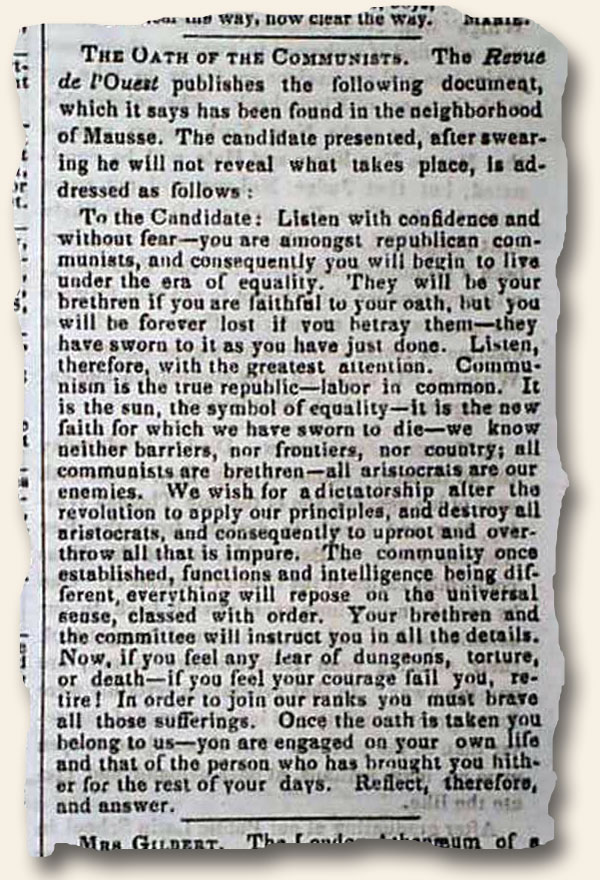
I’m New Here: Week Thirteen…
May 10, 2019 by Stephanie Williams · Leave a Comment
 All of my grandparents immigrated to the United States as young adults, and three of them came through Ellis Island. My maternal grandmother spoke six languages since she was from a portion of Europe that had a high degree of ethnic overlap. However, she never taught anything but English to her seven children because my grandfather was adamant that he, his wife, and all their offspring would read and write English fluently and speak it without a trace of an accent. He didn’t count the heavy Jersey City vowels they acquired along the way.
As proud as they were to be Americans, the history of these states was far less important than the political and economic makeup of the land of opportunity.
This week I encountered four different collectors who are tracing their ancestry via newspapers. And, through their eyes, I see different aspects to catastrophes like the Dust Bowl and the Johnstown Flood — the human stories. Each American tale is so varied, so unique, so distinct within the melting pot of “huddled masses yearning to be free” welcomed by the Statue of Liberty.
Whether family was part of the westward expansion, established in the old blood of Philadelphia, divided along the Mason Dixon Line, or descendant from early coastal fisherman that braved mortality rates to literally eke out a living – pieces of the stories are buried within these old newspapers. One fellow found a pot from the Tennessee foundry in which his great-great-grandfather worked, and then he managed to track down a paper with an article on the workmen facing a strike. “There were only twelve employees,” he told me. “So one of those mentioned was my ancestor.”
I’m a wee bit envious of those of you who can find your folks through the New York Tribune or the New Orleans Picayune, or even D.C’s National Intelligencer . Still, the next best thing might be pulling a title that contributes a piece to someone else’s puzzle. Thank you for enlisting our help; please keep the requests coming.
And, in honor of “Jack”, Faustina, Stephen and Charlotte, I am including in this post a photograph from an issue of Scientific American. If there is only one piece of American history in your lineage, I think Ellis Island is a pretty hefty one.
Cheers!
Post Script: The number of staff here is too limited to do more research than pulling titles and dates that have been requested by collectors. There are many great databases for searching content. Once you know the paper you are looking for, we are happy to see if we have it!
Equal rights – a long and arduous path…
May 6, 2019 by GuyHeilenman · Leave a Comment
“Equal Rights” – Within the United States, it is easy to think the struggle for equality based on race, gender and/or socioeconomic status was, and in certain areas continues to be, one placed on the shoulders of only Blacks and Women. However, it doesn’t take too much digging to see this was not the case. I was reminded of this reality when I recently came across a December 19, 1818 issue of the Niles’ Weekly Register. Therein I found a heading titled “Maryland legislature,” which included in part, “…A committee was appointed to bring in a bill to extend the same civil privileges to persons professing the Jewish religion as are enjoyed by those of any other religious sect…”.
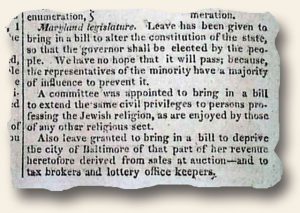 As a bit of history, In 1776 Maryland’s constitution safely protected “…all persons professing the Christian religion…” yet said nothing at all for those of other beliefs. It was a fact not widely known among other Americans that in the State of Maryland, and in Maryland alone, a citizen professing the Jewish religion could not hold any office, civil or military. In 1797 Solomon Etting, Baltimore leader and representative Jewish figure, along with other prominent Jews petitioned the Maryland Assembly to address this prejudicial issue and secure equal rights for Jews. The petition was well received but ultimately rejected. Year after year as it was presented and turned down new advocates were enlisted including influential Gentiles. In 1818 Judge H. M. Brackenridge and others began a vigorous battle to right this wrong. The legislation ultimately to be known as “The Jew Bill” was enfranchised in 1825 and confirmed the following year. This change, along with a series of others, helped motivate many Jewish citizens to participate, from a position of privilege, in the early suffrage movement.
Regarding State and National Constitutions… Our fore(parents) may not have gotten everything right, but thankfully, in most cases, they had the foresight to created peaceful paths for change. Peaceful progress, using the proper channels the framers built within these founding documents, may take entirely too long, but staying within the given bounds has served us well over time. There is, and will likely always be much to be done, but we live in a marvelous land of progress. Let’s never let the need for pruning and continued growth ever cause us to hack away at the roots.