

Search
The Rare & Early Newspapers Hobby

Receive the Newsletter

Buy Historic Newspapers

Headlines drive interest in World War II…
March 11, 2013 by TimHughes · 2 Comments
For likely a multitude of reasons, interest in World War II newspapers ranks far higher than in the Korean War, World War I, or the Spanish-American War. It may be a generational thing, as most collectors today are children of World War II veterans and likely heard stories of the war first-hand, or found 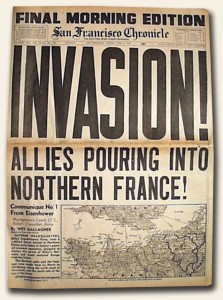 newspapers in their parents attics which sparked an interest. One could debate a number of other possible reasons why other wars lack the intrigue found in that fought by the “greatest generation”.
Headline collecting has always been a focus for this hobby, and as any collector knows, bold, banner headlines did not become commonplace until late in the 19th century. With the increasing competitiveness of daily newspapers across the country–Hearst, Pulitzer & others rising to prominence–flashier front pages were needed to draw attention at the corner news stand. It’s a shame there is not more interest in the Spanish-American War and World War I as both events resulted in some huge, dramatic, & very displayable headlines.
Because there are a plethora of newspapers from the WWII era available, collectors have become very discriminating in what they collect. Only the “best of the best” will do, meaning just the major events and only those with huge and displayable headlines. If there is a “top 6” list of sought-after events, our experience is they would be: 1) attack on Pearl Harbor; 2) the D-Day invasion; 3) death of Hitler; 4) end of the war in Europe; 5) dropping of the atomic bomb; 6) end of the war in the Pacific. One could add any number of other battle reports such as Midway, battle of the Bulge, fall of Italy, Iwo Jima, battle for Berlin, and so much more. And we could step back before American involvement in the war and add Hitler’s invasion of Poland and the battle of Britain.
The bigger the headline the better. With some newspapers the entire front page was taken up with a headline and a related graphic. The U.S. flag was a common patriotic device. Tabloid-size newspapers commonly had the front page entirely taken up with a singular headline and tend to be better for display given their smaller size.
 And not just American newspapers draw interest. German newspapers hold a special intrigue, but the language barrier is a problem for many. But the British Channel Islands, located in the English Channel between England & France, were occupied by the Nazi during the war so their reports were very pro-Nazi while printed in the English language (ex., Guernsey Island). And the military newspaper “Stars and Stripes“, while certainly being American, was published at various locations in Europe and the Pacific. Collectors have a special interest in finding World War II events in the official newspapers of the American military forces. Plus there were a multitude of “camp” newspapers, amateur-looking newspapers printed on a mimeograph machine for consumption limited to a military base, and typically printed is very small quantities. Their rarity is not truly appreciated by many.
For obvious reasons, there is also a high degree of collectible interest from those wishing to make sure certain aspects of history are not forgotten. The Holocaust, and the Nazi propaganda used to provide a rationale for eliminating the Jewish people, is well documented in newspapers from the era. In addition to the Holocaust and its atrocities, issues providing context through reporting other pre-war events such as the Great Depression, fascism, and increased militarism, are also desirable.
True to any collectable field, newspaper collectors are always on the lookout for an issue better than what they have, and collection upgrades are constant. Finding that special, rare, unusual or fascinating headline is what makes the hobby fun. Will interest in the Korean War and the Vietnam War gain more interest in future years? Perhaps so. With interest currently low and availability and prices very attractive, it might be a good time to explore.
Collecting the Old West…
March 8, 2013 by TimHughes · Leave a Comment
 Few eras in the broad range of American history have the appeal as that of the “Wild West“, a romanticized period following the end of the Civil War thru the end of the 19th century. It was a time when America was healing from the wounds of war and the adventurous were pushing the American boundary further West. It was the 1849 California Gold Rush which sparked interest. Now with the war over, new adventures were sought by many.
Those of the Baby Boom generation grew up on western movies and cowboy & Indian television shows. Even Disney’s hugely popular Mickey Mouse Club and the newly minted Disneyland had the Wild West as a popular theme. What we remember are battles with Native Americans, saloon brawls, gunfights, and a multitude of other events which seem to define the era. And to the delight of collectors, all are found in newspapers from the Old West.
Geographically our “Old West” definition would be any from west of the Mississippi. Some 25 years ago we were fortunate enough to purchase a sizable collection of Old West newspapers which were deaccessioned from the Bancroft Library, including many titles which existed only there, then only in our inventory. With some regret many have long since sold out, but most remain available.
Ways of collecting this era are many. Some might pursue one of as many different titles as are available. Content is a lesser concern; they just want one of everything. Some might collect one from every state from before the 20th century. Many states would be easily found but others can be challenging, particularly Arizona, New Mexico & perhaps Idaho. Others might be more specific and collect only titles from before statehood, typically known as “territorial newspapers” (note: Arizona & New Mexico joined the Union in 1912 so early 20th century issues are “territorial”). Again, many can be easily found while others are more of a challenge. California became a state in 1850 (interesting how quickly Congress can act when a pile of gold is found in the backyard) and the number of titles which existed in the Golden State before 1850 were very few. For the best of collections, finding an early issue of the first newspaper to publish in each state can be a special challenge. But of course this is the fun of collecting.
Then there is a larger segment of collectors who pursue content, whether it be the iconic events of the Old West such as Custer‘s Massacre, Killing of Jesse James, the gunfight at the O.K. Corral, capture of Sitting Bull, or just mundane reports of iconic events such as skirmishes with Indians, barroom brawls, bank & railroad robberies, and general reports of lawlessness. Yes, they are all found in Western newspapers of the day, and the search can be exciting.
As a subset of an Old West collection is Mormon content, as the story of the Church of Jesus Christ of Latter-Day Saints is part & parcel of the westward expansion. Many titles from Salt Lake City are available and contain a wealth of Mormon content from shortly after their settlement in Utah. Another subset  might be popular Western towns. Yes, 19th century newspapers are available from Tombstone, Sacramento, Deadwood City, Tucson, Albuquerque, San Francisco, Laramie, Reno, Los Angeles, San Diego, Leavenworth, and on and on. Of special intrigue is finding newspapers from ghost towns. Bodie, California is a great example of a once booming mining town which is currently a California State Park and popular ghost town attraction. Many of our titles from Northern California are from towns which are today a fraction of their size in the 19th century.
The world of Old West collecting is endless, and to the surprise of many prices for most newspapers of the era are unexpectedly low. Explore this interesting era of American history and discover a new facet of collecting!
Thomas Nast in Harper’s Weekly…
March 1, 2013 by TimHughes · 2 Comments
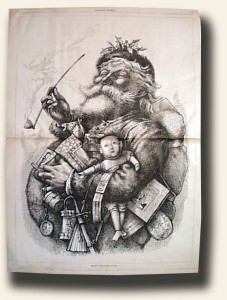 Thomas Nast ranks as one of the most successful, powerful, and prolific artists of the 19th century, and is a name linked closely to one of the most successful, powerful, and prolific newspapers of the 19th century. Through their successes, both Nast and Harper’s Weekly gained sufficient power to influence American politics in the second half of the 19th century and help shape the political climate of America during the industrial revolution.
Thomas Nast was German born, moving to America in 1846. Skilled as an artist, he first went to work for Frank Leslie’s Illustrated Newspaper in 1859, but within 3 years he began working for its competitor, Harper’s Weekly. His work continued to appear in Harper’s thru 1886.
It was a symbiotic relationship for the two. Circulation of Harper’s Weekly grew as Nast drawings were found in more and more of its pages, and Nast‘s notoriety and popularity grew in large part to the increased circulation of Harper’s Weekly. Nast‘s powerful pen in support of the prosecution of the Civil War was honored by President Lincoln when he called Nast “our best recruiting sergeant”.
With original artwork by Thomas Nast commanding prices far beyond the pocketbooks of most collectors, prints found in Harper’s–and only in Harper’s–remain a popular way to assemble a collection of this famed artist’s work at relatively low prices given the current availability of genuine issues.
For today’s collector, interest in Nast falls into three categories:
1) His portrayal of battles & events of the Civil War, which often featured human interest themes & the effect of the war on those back home, remain as some of the best and most heart-felt scenes of the Civil War. Daily newspapers only provided written text; Harper’s Weekly and the prints of Thomas Nast provided a visual representation of the reality of war.
2) Perhaps most noticed as a political cartoonist, his work did much to expose the graft and corruption of William “Boss” Tweed, the powerful Tammany Hall political machine of New York City. In fact it was a Nast cartoon which caused Tweed to be arrested following his escape from jail and flight to Spain. A customs official recognized him from his many appearances in “Harper’s Weekly”. Nast has been credited with doing much to cause elections of all in the hands of those he supported (Grant’s two Presidencies), and cause to fail those he disliked.
 It was Nast who created the caricatures of the Democratic donkey and the Republican elephant to represent those parties, political icons which remain to this day. Desired among collectors are the first donkey to appear in the pages of Harper’s Weekly (January 15, 1870) and the first elephant to appear (November 7, 1874), as well as the first time they appeared together (December 27, 1879). All three command premium prices due to their desirability, but collectors are encouraged by the inexpensive prices for other genuine issues of Harper’s which include Nast illustrations of both.
3) Santa Claus prints. It is Thomas Nast who is credited with creating the modern version of Santa Claus, the jolly, rosy-cheeked, rotund purveyor of gifts in the uniform as we know him today. Nast’s first Santa Claus to appear in Harper’s Weekly was titled “Santa Claus in Camp” from during the Civil War, appearing on the front page of the January 3, 1863 issue. Yet it is the January 1, 1881 issue which has the Santa Claus centerfold which still appears in many Christmas advertisements and is perhaps his most famous rendition. There are many issues of Harper’s Weekly which have Santa Claus prints, all very desired among collectors.
True to any symbiotic relationship, with Nast leaving Harper’s Weekly at the end of 1886, he lost his forum to reach the masses, and in losing Nast, Harper’s Weekly lost its political importance. Nast continued his work in other publications, none being very successful, until his death in 1902 to yellow fever. Harper’s Weekly never regained its success from the Nast years, and it ultimately ceased publication in 1916.
Harper’s Weekly issues with Nast prints are very displayable, particularly those which feature Nast images on the front page, or notable icons such as popular politicians, Santa Claus, Uncle Sam and Abraham Lincoln. A very famous Nast cartoon featuring Lincoln is the “Long Abraham Lincoln A Little Longer” cartoon which is in the November 26, 1864 issue, signifying his successful second Presidential election.
All issues offered by Hughes Rare & Early Newspapers are genuine & complete in 16 pages, save for a few described otherwise. In many cases two or three Nast prints appear in one issue.
Black History Month… looking back…
February 22, 2013 by GuyHeilenman · Leave a Comment
 Slavery. The word itself stirs intense emotions for nearly all who hear it… even for those who have not been directly confronted with the institution. For some it brings feelings of guilt… “How could my forefathers have engaged in such activity?” For others it brings feelings of oppression… anger… and more. While many people groups have been subjected to this burdensome yoke of man through time, for Americans, none is quite as impacting as the enslavement of African Americans. In honor of Black History Month, Timothy Hughes Rare & Early Newspapers has created a Pinterest Board which takes a look back at a time in U.S. history when slavery was alive and (not so) well:
Pinterest… Slave Ads & Related Woodcuts Prints
Additionally, we’ve arranged our available authentic newspapers related to Black Americana in chronological order (recent first) to provide a snapshot into the past for those interest in reviewing how slavery in general, and Black History more specifically, has been depicted in newspapers over the past few centuries. They may be viewed at:
African-American / Black Americana / Slavery…
Additional kudos for, “Reporting the Revolutionary War”…
February 15, 2013 by GuyHeilenman · 2 Comments
 Additional recognition has been received for “Reporting the Revolutionary War“, by Todd Andrlik:
Reporting the Revolutionary War: Before It Was History, It Was News (ISBN: 9781402269677; November 1, 2012; $39.99 U.S.; History; Hard Cover) by Todd Andrlik is being awarded the annual prize of best American Revolution book by The New York Revolutionary War Round Table.
News worthy of the headline… Which would you choose?
February 8, 2013 by GuyHeilenman · 1 Comment
 Selecting the news for a newspaper’s headline must be quite challenging at times, especially when there are multiple significant events clamoring for top billing. We recently came across a Leominster Daily Enterprise, MA, April 16, 1947, which had 5 noteworthy events to choose from:
* Execution of Rudolf Hoess, Nazi commandant of Auschwitz… oversaw massacre of 2,000,000 Jews
* Milton Reynolds breaks Howard Hughes around-the-world aviation record in his “Bombshell”
* Jackie Robinson breaks racial barrier… 1st regular season MLB game played by an African American
* Texas City disaster (350 killed)
* Princess Elizabeth and Philip Mountbatten (from Greece) become engaged, with photo
Which do you think grabbed the headline back in 1947?To find out if you made the right choice, go to:
1947 Headline
(see the 4th image)
What if the same events occurred today? Would the editors make the same choice for tomorrow’s headline? We’d love to know your thoughts… and reasons.
West Virginia’s first newspapers…
January 28, 2013 by TimHughes · Leave a Comment
 The history of West Virginia newspapers dates some 70 years before West Virginia became a state. Statehood came late to West Virginia, carved from Virginia in the midst of the Civil War, happening officially on June 20, 1863. But its first newspaper began in 1790 when Nathaniel Willis began his “Potowmac Guardian & Berkeley Advertiser” at Shepherd’s-Town, near Harper’s Ferry. Less than two years later Willis moved the newspaper to Martinsburg.
The second newspaper was the “Shepherd’s Town, Charles-Town and County Advertiser” begun by Philip Rootes and Charles Blagrove on June 28, 1797. No copies beyond October 11, 1797 have been located. The third newspaper was the “Berkeley Intelligencer” done at Martinsburg on April 3, 1799 by John Alburtis. Many followed, including what is shown in the image, “The Observer, and Western Advertiser”, Lewisburg, [West] Virgina, 1884.
The Assassination of Abraham Lincoln… one the the very best…
January 18, 2013 by GuyHeilenman · Leave a Comment
The April 22, 1865 issue of the National Police Gazette, New York, printed what many consider to be the best illustrated newspaper related to the assassination of President Abraham Lincoln. Judge for yourself. Regardless of your final analysis, please enjoy the images from this incredible authentic newspaper compliments of Timothy Hughes Rare & Early Newspapers… History’s Newsstand… via Pinterest:
A gem in the American Antiquarian Society… Charleston Mercury Extra…
January 14, 2013 by TimHughes · Leave a Comment
In celebration of its 20oth anniversary the American Antiquarian Society published a beautiful exhibition catalog titled “In Pursuit Of A Vision – Two Centuries of Collecting at the American Antiquarian Society”. Featured are a fascinating array of books, documents, maps & other paper ephemera, as well as several very rare & unusual newspapers we felt worthy of sharing with our Rare & Early Newspapers’ collectors (with permission from the A.A.S.).
 “Charleston Mercury Extra“, December 20, 1860
The divisive political events of the 1850s had pitted North against South on numerous issues, including the expansion of slavery into the western territories, tariffs on goods such as cotton, and broader concepts of states’ rights vs. federal law. Political compromises made throughout the decade in an attempt to keep the nation together effectively collapsed with the election of Abraham Lincoln in November 1860. South Carolina, heir to the legacy of states’ rights lion John C. Calhoun, was the first to address the possibility of leaving the Union. On November 10, 1860, four days after the presidential election, South Carolina brought the issue to a head by calling a secession convention for the following month.
Considered by virtue of timing to be the first Confederate imprint, this broadside announced to the public the convention’s declaration, on December 20, 1860, that South Carolina would secede from the United States. This sheet was removed from a wall in Charleston by the Boston-born author Caroline Howard Gilman (1794-1888), who had moved permanently to Charleston following her marriage to the Rev. Samuel Gilman. Gilman mailed the broadside to her daughter Eliza in Salem, Massachusetts. Eliza in turn presented the document to AAS member Nathaniel Paine who, heeding the Society’s call to preserve all printed material relating to the unsettling national events, passed the broadside along to AAS.
A high-resolution image of this issue is viewable at: American Antiquarian Society, #47
Wisconsin’s first newspapers…
January 13, 2013 by TimHughes · Leave a Comment
The state of Wisconsin was under several governances before coming onto its own with statehood in 1848. It began as part of the Indiana territory, then part of the Illinois territory, then part of the Michigan territory, then detached as the Wisconsin territory in 1836.
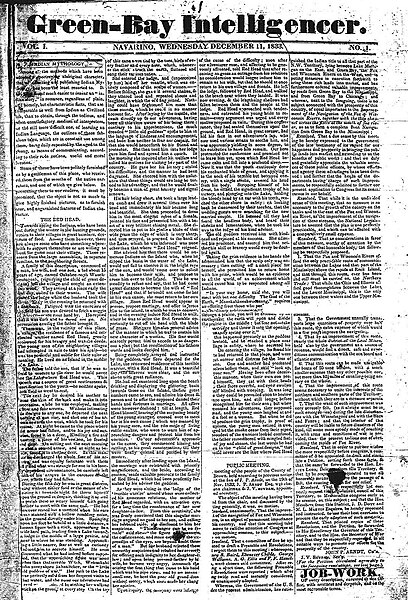 Printing began in the territory in 1827, and it was on December 11, 1833 that Wisconsin had its first newspaper titled the “Green-Bay Intelligencer“, done by Albert Ellis and John Suydam. The city was actually listed as Navarino, which today is a small suburb of Green Bay, population at the 2000 census listed as 442. Ellis was also the very first printer in Wisconsin, printing lottery tickets in 1827 and an almanac in the Chippewa language.
The second newspaper in Wisconsin was actually created as a vehicle to support the candidacy of Morgan Martin for territorial delegate to Congress. He employed William Stevenson and Joseph Dickinson to produced the “Wisconsin Free Press” at Green Bay in August of 1835. But it lasted for less than a year with the printing equipment sold to the “Intelligencer“.
Two more newspapers were created in the 1830’s, they being the “Wisconsin Enquirer” in November of 1838 at Madison, the newly created capital of the territory, and then the “Milwaukee Advertiser” on July 14, 1836. During the 1840’s many newspapers were created as Wisconsin worked towards statehood.