
Search
The Rare & Early Newspapers Hobby

Receive the Newsletter

Buy Historic Newspapers

Thanksgiving Proclamations… a survey through American History…
November 21, 2012 by GuyHeilenman · Leave a Comment
 This Thanksgiving, why not take the family on a historically “Pinteresting”walk through a survey of Thanksgiving Proclamations made at key moments in American History?
http://pinterest.com/rarenewspapers/thanksgiving-proclamations/
Happy Thanksgiving!
A visit to Jim Thorpe (Mauch Chunk), PA…
November 16, 2012 by GuyHeilenman · Leave a Comment
 A few weeks ago my wife and I had the pleasure of visiting a relatively unknown town steeped in history. Upon our return to the Rare & Early Newspapers office/archives, I spent some time exploring one aspect of the town’s history (The Molly Maguires) through the eyes of contemporary newspapers. A sampling of what was discovered both on the excursion and upon our return has been posted through images on Pinterest. Please enjoy:
Jim Thorpe & The Molly Maguires
Additional posts regarding Jim Thorpe himself, the town’s name since shortly after his death in 1953, may be viewed at: Jim Thorpe… “the greatest athlete that ever lived.”
Communication… My how far we’ve come…
November 12, 2012 by GuyHeilenman · Leave a Comment
 When it comes to collecting historic newspapers related to progress in the area of communication, collectors (rightfully so) typically focus on the telegraph, Morse code, the Pony Express, the typewriter, and the telephone. However, we recently came across a newspaper from New York which may rival some of the most collectible issues in the area of communication development – the report of the first successful use of a cell phone. At the time this historic event was only deemed worthy of a page 57 report, and most newspapers never reported it. As a result, this may end up being one of the most difficult reports to find… and collect. Once again we are reminded of one of the greatest joys of the hobby – uncovering hidden gems… instantly transforming what was once an average newspaper into a noteworthy collectible. Please enjoy the report on our website at New York Times, April 4, 1973 or on eBay at Historic Cell Phone Call – Motorola DynaTAC:
Why I Still Read Newspapers… part 3 of 3… perhaps with more forthcoming???
November 9, 2012 by GuyHeilenman · Leave a Comment
A staff member at Timothy Hughes Rare & Early Newspapers recently received a set of newspaper headlines which are worth pondering. We’ve decided to split them up over a few posts… this being the final of the initial set – with perhaps more to come??? If you know of others – appropriateness is a must 🙂 – please send them on (e-mail to guy@rarenewspapers.com) and we will consider adding them to a future post. If you would like to receive credit, please include your name. Please enjoy:
Why I Still Read Newspapers… part 2 (of 3)
November 3, 2012 by GuyHeilenman · Leave a Comment
A staff member at Timothy Hughes Rare & Early Newspapers recently received a set of newspaper headlines which are worth pondering. We’ve decided to split them up over a few posts… this being the 2nd of three. If you know of others – appropriateness is a must 🙂 – please send them on (e-mail to guy@rarenewspapers.com) and we will consider adding them to a future post. If you would like to receive credit, please include your name. Please enjoy:
Beyond the historic headline…
November 1, 2012 by TimHughes · Leave a Comment
 “Newspapers that shaped the world…“
Some of the better & more fascinating items found in old newspapers are not the most historic or significant, but rather the casual appearance of seemingly innocuous reports which excite collecting interest beyond the historic headline or dramatic presentation which are the more usual draw.
Much of what intrigues collectors can be lost within the body of reports, yet they tell a story of their own, such as the patriotic fervor of some colonist during the Revolutionary War. I recall an issue of the Edinburgh Evening Courant of June, 1776 reporting on American soldiers: “…Their uniform is a dark grey coarse linen frock, which covers the whole body…with the words, ‘Death or Liberty’ marked in large red letters on the right sleeve; and many of them are so enthusiastic as to have them marked with their own blood…”. This report is almost lost on page 3 yet its message is very telling of the spirit which caused the Americans to win the war against a world power despite insurmountable odds.
Some reports are fascinating by their bias. A Richmond newspaper of July, 1863 reporting on the Battle of Gettysburg notes: “…The Confederates did not gain a victory, neither did the enemy. He succeeded in defending himself & we failed in some portions of an attack…We killed more of the enemy than we lost; we took very many more prisoners than lost. The Confederate army did not leave the enemy until it had tried every link of his armour…” Another newspaper notes: “ ..Information, certainly authentic, is in the hands of the Government, which leaves no doubt of the safety & triumph of the noble army. General Lee was victorious in all the combats which have taken place. He has been engaged with the whole force of the United States & has broken its backbone…”, Perhaps the most extraordinary example of optimism appeared in the Richmond Examiner of July 25: “…The result was not a defeat, it was not a loss; it was only not a victory…It was little else than a disappointment of extraordinary expectations…”. What a precious statement as an example of Confederate optimism.
Other little gems were very prophetic in their reporting, particularly when read with an historic perspective. A Scottish newspaper from 1775 sensed a lasting war with America as it reflected on the Battle of Bunker: “…The mischiefs which have already arisen & the greater calamities which are threatened from the unnatural war excited in America…It is impossible we can see, without the utmost alarm, preparations making for the prosecution of an expensive & ruinous war with our own Colonies…”. Some can be very recent, like the New York Times comment on rookie Mickey Mantle in 1951: “…Mantle, who gives every promise of developing into an outstanding baseball star, was ordered to report to his draft board next Wednesday…” An editorial comment in the Army & Navy Journal just after the Gettysburg Address opined: “…a dedicatory speech by President Lincoln, which we give in full, as decidedly the best feature of the occasion, as well as one of the most felicitous utterances of its author.” How true.
Some were prophetic even when the reports were simply wrong, like the Illustrated American article of 1898 reporting on “A New Flying Machine That Flies”–five years before the Wright brothers–when it said: “…It is impossible to imagine without terror the day when these mechanical birds, these flying apparitions, will be able to rain upon armies, hostile towns and escalating parties most deadly and most destructive explosives…”. How true it would become.
There can be much to be found in newspapers beyond the headline. What a thrill it is to discover such hidden gems; reports that have escaped hundreds of years of history only to rediscovered with new-found relevance today. Such are just some of the joys of collecting early newspapers.
Please enjoy: “Newspapers that shaped the world…“
Announcing…
October 29, 2012 by GuyHeilenman · 1 Comment
Two special events related to the Rare & Early Newspapers collectible are scheduled for this week:
 1) A long time collector of historic newspapers, Todd Andrlik, has written a book which is sure to quickly become a classic within the hobby, “Reporting The Revolutionary War: Before It Was History, It Was News”, which tells the story of the Revolutionary War through the eyes of the newspapers of the period. Todd used authentic newspapers from the period… putting into practice what has been stated many times at History’s Newsstand: “History is never more fascinating than when it’s read from the day it was 1st reported.” The link below will take you to Amazon’s “Look Inside” and will give you the opportunity to pre-order a copy through Wednesday, and direct order starting Thursday. Thanks Todd.
“Reporting The Revolutionary War: Before It Was History, It Was News”
2) “Newspapers that shaped the world…“, a special edition catalog from Timothy Hughes Rare & Early Newspapers, is also scheduled to be released on Thursday, at 12:01 AM ET, on November 1, 2012. While the following link shows items from our previous catalog, as of 12:01, it will take you to the release of what may be our most notable catalog to-date.
“Newspapers that shaped the world…“
Why I Still Read Newspapers… part 1 (of 3)
October 26, 2012 by GuyHeilenman · Leave a Comment
A staff member at Timothy Hughes Rare & Early Newspapers recently received a set of newspaper headlines which are worth pondering. We’ve decided to split them up over a few posts. If you know of others – appropriateness is a must 🙂 – please send them on (e-mail to guy@rarenewspapers.com) and we will consider adding them to a future post. If you would like to receive credit, please include your name. Please enjoy:
The first newspapers in Texas…
October 25, 2012 by TimHughes · Leave a Comment
Texas had a fascinating history, with flags of six nations having flown over some portion of the present state: Spain, France, Mexico, Republic of Texas, United States of America, & Confederates States of America.
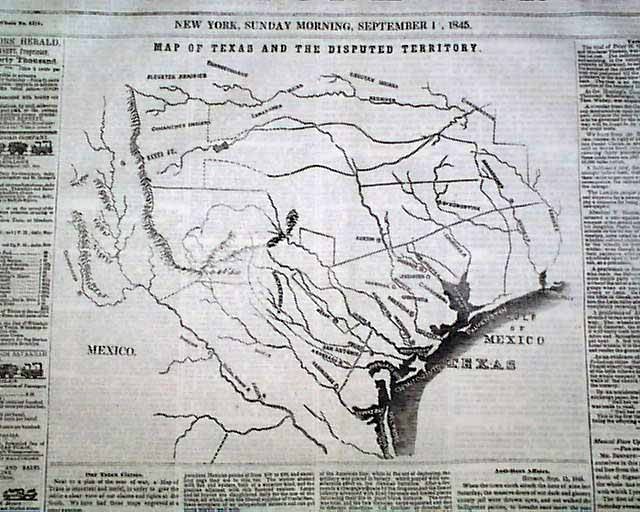 It was during the time when the Mexico flag flew over its land that a periodical titled “El Mejicano” was reportedly printed in Nacogdoches in May , 1813, as noted in Oswald’s “History of Printing In The Americas”. One report, from the “Southwestern Historical Quarterly” notes that a newspaper was printed from the same press at about the same time, titled “Gaceta de Texas” with a date of May 25, 1813. Some years later Horatio Bigelow and Eli Harris put out the first issue of the “Texas Republican” on Aug. 14, 1819. When Nacogdoches was captured by the Mexicans two months later the printing office was destroyed.
Milton Slocum, a printer from Massachusetts, established the “Mexican Advocate“, a newspaper in both English and Spanish, in Nacogdoches in September, 1829. Unfortunately no copies have survived. Outside of Nacogdoches a weekly paper titled the “Texas Gazette” was begun on Sept. 25, 1829 in San Felipe de Austin. This paper then moved to Brazoria in July 1832 and ultimately was sold to the publisher of an existing newspaper titled the “Texas Gazette & Brazoria Commercial” which had begun just two years earlier. The combined enterprise became the “Constitutional Advocate and Brazoria Advertiser“.
Beginning in the 1830’s a multitude of newspapers sprang up in present-day Texas, continuing in the 1840’s and beyond.
Countdown to “Newspapers that changed the world…”
October 24, 2012 by GuyHeilenman · Leave a Comment
Each month Timothy Hughes Rare & Early Newspapers releases a catalog containing a new set of historic and collectible newspapers (1600′s through 20th century). However, on November 1, 2012, at 12:01 AM ET, the special edition, “Newspapers that changed the world…” will be released. Whether you already collect newspapers, or desire to simply view a sampling of what the hobby has to offer, check back for this special occasion:
Prior to November 1, 2012 and after November 30, 2012, the link below will take you to the most recent offerings of Timothy Hughes Rare & Early Newspapers… History’s Newsstand! During the month of November it will take you to the special release catalog, “Newspapers that changed the world”.
View: “Newspapers that changed the world…“