

Search
The Rare & Early Newspapers Hobby

Receive the Newsletter

Buy Historic Newspapers

Great Headlines Speak For Themselves… Graf Zeppelin’s flight…
December 19, 2014 by The Traveler · 1 Comment
The best headlines need no commentary. Such is the case with The New York Times, October 16, 1928: “ ZEPPELIN SAFE AT LAKEHURST AFTER 111-HOUR FLIGHT; SOARS OVER THE WHITE HOUSE AND THEN OVER NEW YORK; MOORED TO MAST TILL WIND DROPS AT 2 A.M.; NOW IN HANGAR”…
Great Headlines Speak For Themselves… death of Rudolph Valentino…
December 5, 2014 by The Traveler · Leave a Comment
The best headlines need no commentary. Such is the case with the Los Angeles Record – Second Extra, August 23, 1926: “VALENTINO DEAD“, with subhead, “Hollywood Mourns Film ‘Sheik’s’ Death“…
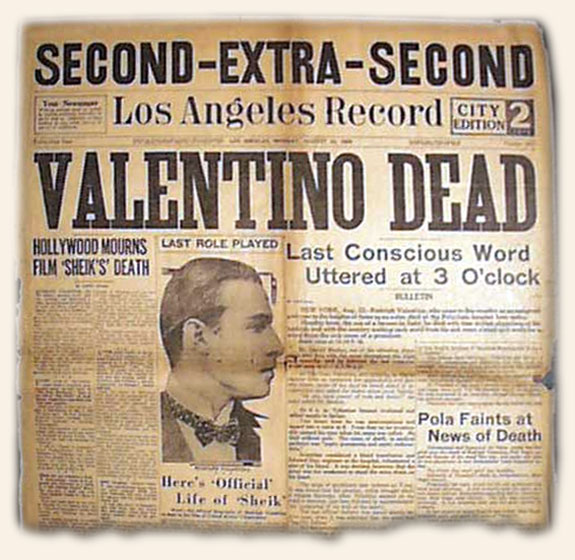
Rudolph Valentino
I’m thankful for… Abraham Lincoln…
November 26, 2014 by GuyHeilenman · Leave a Comment
As Thanksgiving rapidly approaches, one is compelled by the overwhelming blessings so many of us experience on a daily basis to consider things for which we are thankful, but often overlook. One such gratitude-producing individual for me is Abraham Lincoln. Was he a perfect man? No. Have many of his flaws been white-washed from history? Yes (I’m counting on the same treatment). However, this does not negate the truth that in my eyes, he was a man for “such a time” as his was. I’ve always appreciated his writing (whether it be from his own pen or another’s makes no difference to me). One of my favorites is:
“I do the very best I know how – the very best I can; and I mean to keep doing so until the end. If the end brings me out all right, then what is said against me won’t matter. If the end brings me out wrong, then ten Angles swearing I was right would make no difference at all.” Abraham Lincoln
We should all have such strength of conviction in regards to our actions under fire.
A short time ago I came across a letter from him which was printed in a National Intelligencer dated January 27, 1865 that may rival the above. It is his response to a letter received from him from Eliza Gurney, the wife of a recently departed friend. The full text is viewable via the image shown below, with the transcribed text to follow.
Executive Mansion,
Washington, September 4, 1864.
Eliza P. Gurney.
My esteemed friend.
I have not forgotten–probably never shall forget–the very impressive occasion when yourself and friends visited me on a Sabbath forenoon two years ago. Nor has your kind letter, written nearly a year later, ever been forgotten. In all, it has been your purpose to strengthen my reliance on God. I am much indebted to the good Christian people of the country for their constant prayers and consolations; and to no one of them, more than to yourself. The purposes of the Almighty are perfect, and must prevail, though we erring mortals may fail to accurately perceive them in advance. We hoped for a happy termination of this terrible war long before this; but God knows best, and has ruled otherwise. We shall yet acknowledge His wisdom and our own error therein. Meanwhile we must work earnestly in the best light He gives us, trusting that so working still conduces to the great ends He ordains. Surely He intends some great good to follow this mighty convulsion, which no mortal could make, and no mortal could stay.
Your people–the Friends–have had, and are having, a very great trial. On principle, and faith, opposed to both war and oppression, they can only practically oppose oppression by war. In this hard dilemma, some have chosen one horn, and some the other. For those appealing to me on conscientious grounds, I have done, and shall do, the best I could and can, in my own conscience, under my oath to the law. That you believe this I doubt not; and believing it, I shall still receive, for our country and myself, your earnest prayers to our Father in heaven.
Your sincere friend,
A. Lincoln.
So, what are you thankful for?
Thanksgiving – only days away…
November 24, 2014 by GuyHeilenman · Leave a Comment
As Thanksgiving (U.S.) rapidly approaches, we thought we’d bring everyone’s attention to various Thanksgiving-themed posts from the past. Please enjoy:
Civil War era reflections on Thanksgiving…
Reflecting on a Day of Thanksgiving & Prayer from 1776…
Thanksgiving Proclamations… a survey through American History…
The Traveler… Thanksgiving proclamation… schooling that maybe should be revisited…
Lincoln establishes a national Thanksgiving Day…
Thanksgiving… I time for expressing gratitude…
Great Headlines Speak For Themselves… Gary Cooper dies…
November 21, 2014 by The Traveler · 1 Comment
The best headlines need no commentary. Such is the case with the HERALD EXPRESS–EXTRA, Los Angeles, May 13, 1961: “GARY COOPER DIES“…
Exploring newspapers, 1900-1949… Any Discoveries?
November 14, 2014 by GuyHeilenman · 3 Comments
 A unique pleasure one often experiences from the collecting of Rare & Early Newspapers is the hidden nuggets found within nearly every issue. Whereas collectible newspapers are often purchased due to their historic headlines or perhaps their rarity, the undisclosed content – whether articles or ads – often provides intrigue and a historical perspective that go far beyond the original reason for seeking the issue.
With this in mind, let’s have some fun!
This post will serve as a home for collectors to brag about the non-headliner discoveries they’ve found within newspapers dated from 1900-1949. Share your finds. All we ask is for everyone to refrain from using this post as a means for offering collectible newspapers for sale. It’s intended to purely be a “no-agenda” platform for sharing one of the simple joys of collecting.
If you are new to the hobby (or already are a collector) and would like to join in the hunt, to help you get started we are offering a highly discounted set of 5 issues, one per decade, covering the 1st half of the 20th century. This offering may be viewed at: Five-Issue Set (1900-1949)
Great Headlines Speak For Themselves… “Bugsy” Siegel assassinated…
November 7, 2014 by The Traveler · Leave a Comment
The best headlines need no commentary. Such is the case with the HERALD EXPRESS–EXTRA, Los Angeles, June 21, 1947: “‘BUGSY’ SIEGEL MURDERED“…
Great Headlines Speak For Themselves… death of Carole Lombard…
October 24, 2014 by The Traveler · Leave a Comment
The best headlines need no commentary. Such is the case with the LOS ANGELES EXAMINER, California, January 18, 1942: “CAROLE LOMBARD AND 21 OTHERS IN AIRLINER WRECK”
Great Headlines Speak For Themselves… Dodgers are champions!
October 10, 2014 by The Traveler · Leave a Comment
The best headlines need no commentary. Such is the case with the LOS ANGELES TIMES–EXTRA, September 30, 1959: “L.A. DODGERS CHAMPIONS ! “
13th to 19th Amendments and Beyond…
September 29, 2014 by GuyHeilenman · 1 Comment
 The National Park Service recently posted a page on one of their park sites titled: “Brown vs. Board of Education – The 13th to 19th Amendments and Beyond”. The post certainly is informative and their use of historic newspapers and magazines (Harper’s Weekly, Frank Leslie’s Illustrated, The Crisis, Taunton Daily Gazette) to provide visual and historic depth to the topic will be of particular interest to rare & early newspaper collectors. Please enjoy: Brown vs. Board of Education