
Search
The Rare & Early Newspapers Hobby

Receive the Newsletter

Buy Historic Newspapers

Reducing old maids and increasing the population…
June 6, 2009 by TimHughes · Leave a Comment
 The Connecticut Courant issue of Hartford dated October 18, 1790 contains a curious piece taken from a Virginia newspaper, noting that:
“…a serious petition is now drawing up…stating arguments in favour of polygamy, from the plain principles of reason: and praying that a man may legally marry two wives. This, it is thought, will be the most effectual means to extirpate the numerous race of old maids, and increase the population of the United States…”
Editors take note: be mindful of photos accompanying headlines…
June 4, 2009 by TimHughes · 1 Comment
 The “Second Extra” of the Atlanta Journal newspaper of November 22, 1963 has a curious–if not macabre–combination of headline and photo. As would be expected of an “Extra” of this date, the large & bold headline proclaims: “KENNEDY KILLED” but immediately beneath it is a photo of a street sweeper pushing his bucket which has a pair of trousers & boots protruding from the top, with the caption: “Sweeper Means What He Says”.
One might excuse the editor, for I’m sure that in rushing this edition to the streets as quickly as possible the planned headline was removed and the Kennedy death report quickly inserted with little thought as to what else was scheduled for top half that day’s edition. But it serves as an important lesson to budding newspaper editors everywhere: be mindful of what what might accompany an article or photo.
Extensive list of reprinted newspapers…
June 2, 2009 by TimHughes · Leave a Comment
 The Library of Congress, as we previously discussed, maintains a web listing of the eighteen mostly commonly found reprinted newspapers. Most reprints which turn up today will be found in this list, however many others do exist.
Rick Brown, who maintains the “historybuff.com” website and who edited the journal “Collectible Newspapers” for many years, created a master list of some 567 reprinted newspapers. Should you encounter a newspapers and you are suspicious of its genuineness, check the list of titles and dates on “American Newspapers Known to Have Been Reprinted” which can also be accessed from the home page of our website. If the title & date appear on this list your suspicions many be justified.
If you care to take an additional step towards determining genuineness, Rick offers a more detailed “Annotated Index of Newspapers Editions Known To Have Been Reprinted…” for a modest charge, which offers additional details for each entry.
Although reprinted editions are exeedingly rare in the hobby of early newspapers—and most common reprints are easy for even a novice to spot—having access to such a list is of much value to the hobby and can provide some comfort when pursuing historic newspapers for one’s private collection.
Census with a bit of flair…
May 23, 2009 by TimHughes · Leave a Comment
“The Alaska Times” newspaper from Seattle, W.T. (Washington Territory), May 14, 1871, contains a very colorful front page article with a simple heading: “Alaska” which reports a census for Sitka. Enjoy reading how the inhabitants were categorized.

So what’s the earliest “London Gazette”?
May 21, 2009 by TimHughes · Leave a Comment
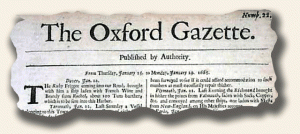 The world’s oldest continually published newspaper was begun in 1665 and still prints today, a staggering 345 year history which likely will never be broken by any other single title. Indeed, the newspaper still publishes today so it sets a more unbeatable record as each year passes.
The newspaper is titled “The London Gazette“, but collectors have occasionally seen issues of “The Oxford Gazette” and wondered about the connection.
First, the most convincing derivation of the term “gazette” is from “gaza”, the Greek word for a treasury or store. That newspapers are a “treasury or store” of information would allow for a plausible adoption of the term “gazette”.
In 1665 the Royal Court had been removed from London due to the Plague which had been ravaging the city. The smaller towns in the country seemed less susceptable to the contagion. So with a newspaper serving as a mouthpiece of the Royal Court it was logical that it would set up shop in Oxford, calling itself “The Oxford Gazette“.
But when the affects of the Plague seemed to have abated sufficiently for the Court to return to London, so did the newspaper. Twenty-three issues were published in Oxford, and with issue number 24 was the first with the title “The London Gazette“, a title which has remained unchanged for over three centuries.
So there might be a bit of a debate as to what the earliest issue is of “The London Gazette“. The earliest with this title would be issue #24, dated February 5, 1665 (1666 by today’s calendar), but argument certainly could be made that the first issue of “The Oxford Gazette” would qualify, it dated November 16, 1665.
Given its short life under the earlier title of “The Oxford Gazette”, such issues are extremely elusive. We have sold many over the past 33 years but rarely find them today.
Davy Crockett survived the Alamo?
May 16, 2009 by TimHughes · 1 Comment
 The report shown appeared in the “Staunton Spectator” newspaper of Virginia, May 5, 1836. Accuracy in reporting the news certainly wasn’t any better back in 1836. Have you ever found similar inaccurate reporting?
Baseball fans… can you help?
May 11, 2009 by TimHughes · Leave a Comment
 A customer was requesting a newspaper with a report of Nap LaJoie, one of the more notable names in baseball in the early 20th century, ending the 1901 season with a .422 batting average. He was one of only a few to do so in the 20th century (there’s been a 67 year dry spell since Ted Williams was the last to do so, in 1941).
Finding reports of batting averages in 1901 is very difficult, but I did find a report at the end of the season which notes: “Lajoie…took part in 131 games. He was at bat 554 times, made 226 singles, 48 doubles 12 triples and 13 home runs…”.
Never mind that the numbers are slightly off from the official record book, which notes 543 games, 229 singles, 48 doubles (only one correct), 13 triples and 14 homers, as such errors might be understandable. But even given the accurate numbers, in calculating his average one comes up with a sum of 304 successful at bats, divided by the number of games (543) giving an average of .560. But curiously, if you just took his 229 singles divided by 543 the result is exactly his recorded batting average: .4217, rounded out to .422.
Should I surmise that the term “singles” actually means “hits” by today’s terminology ? Was this the common practice back then, to call any type of “hit” a “single”? If so, when did they make the switch?
Thanks for your help !
Tim
No smoking in the court of King James…
May 9, 2009 by TimHughes · Leave a Comment
 The Gazette of the United States from Philadelphia, Nov. 24, 1790, includes an interesting item on a treatise of King James I, who was way ahead of his time in opposing smoking.
He considered it a: “…heinous sin…” and those who used it were: “…guilty of great vanitie & uncleannesse–of sinful and shameful lust…”. He considered it: “…harmfull to the brain–dangerous to the lungs–and in the black stinking fume thereof, nearest resembling the horrible stygian smoake of the pit that is bottomlesse.”
See the photo for the full text.
Sharing My Story… How I got started…
May 7, 2009 by TimHughes · 1 Comment

Tim Hughes, founder
Invariably there is the quizzical stare I get from anyone who asks “what do you do?” and I answer by saying, “I sell old newspapers.” The typical response is, “…what??” Any follow-up to the inquiry usually leads to, “How did you get started?”
We all have our own stories of what lead us to early newspapers, and mine may not but much different from yours.
I have always collecting something. I guess I was always intrigued by what was old, and coin collecting captured my interest when I was in 3rd or 4th grade, a hobby which still gets my attention but on a dramatically smaller scale. Collecting coins lead to old books, which lead to old bottles, which lead to old radios; and perhaps a few other items which struck my interest through the years.
I eventually found coin collecting a bit frustrating, as the rarities I needed to fill some holes in my collection were way beyond my budget. Coin collecting has always been a well exploited hobby so rare items were almost impossible to find at reasonable prices as the “heavy hitters” kept the prices quite high. I always dreamed of finding a collectible which few people knew about, where truly rare & historic items could be found at reasonable prices.
One day while browsing a local flea market I cam across an 1846 Philadelphia newspaper for $3. I was intrigued. I knew an 1846 coin in nice condition would be ten times that amount. I bought it, took it home and read all four pages and was fascinated by the content. I had found my new collectible and was hoping my dream had come true.
I expended much effort over the next several years looking for more newspapers and found several sources for 18th & 19th century issues at what I thought were amazingly low prices given my coin collecting experience.
Then one day I asked a source from whom I had been buying issues for $3 each if I could get a better price if I bought more than one. His response was fateful and set the course for the rest of my life: he said, “If you take 100 issues you can have them for $1 each”.
Although $100 was likely half of my net worth at the time, I sent the check, received my 100 issues, and starting advertising the issues for sale at $3 each (plus 25 cents for postage; which actually covered the cost).
As I sold the issues I bought more, and found more sources for different titles and different time periods. I eventually found several auction halls which regularly listed newspapers, and established contacts in England for early British material. In time I would travel not only throughout the Middle Atlantic & New England states but went to London each year to to search the back roads for antique & book shops which had material I could use.
Those were very exciting days, as material was plentiful and I bought voraciously. Buying today is more of a challenge so I take great comfort in knowing my appetite some 30 years ago was justified as much of our inventory of over 2 million newspapers was purchased long ago.
Good material still comes our way. Having our name in the marketplace for over 30 years and maintaining considerable Internet presence has allowed much great material to end up at our doorstep, a trend which–hopefully–will continue as we allow my dream to be realized by our customers: rare, historic material at reasonable prices.
In the coming months we will be posting the stories of other collectors as well. Details are forthcoming.
Marriage & death in the same news report…
May 2, 2009 by TimHughes · 1 Comment
 Typically marriage and death reports are found in separate columns in the newspapers, but one news item in the Salem Mercury of July 6, 1831 could combine both into one:
“Marriage and Death — In Bath, Steuben Co. N.Y. 11th ult. Mr. Moses Alexander, 88, to Miss Frances Tompkins, 105. They wre taken out of bed dead on the following morning.”